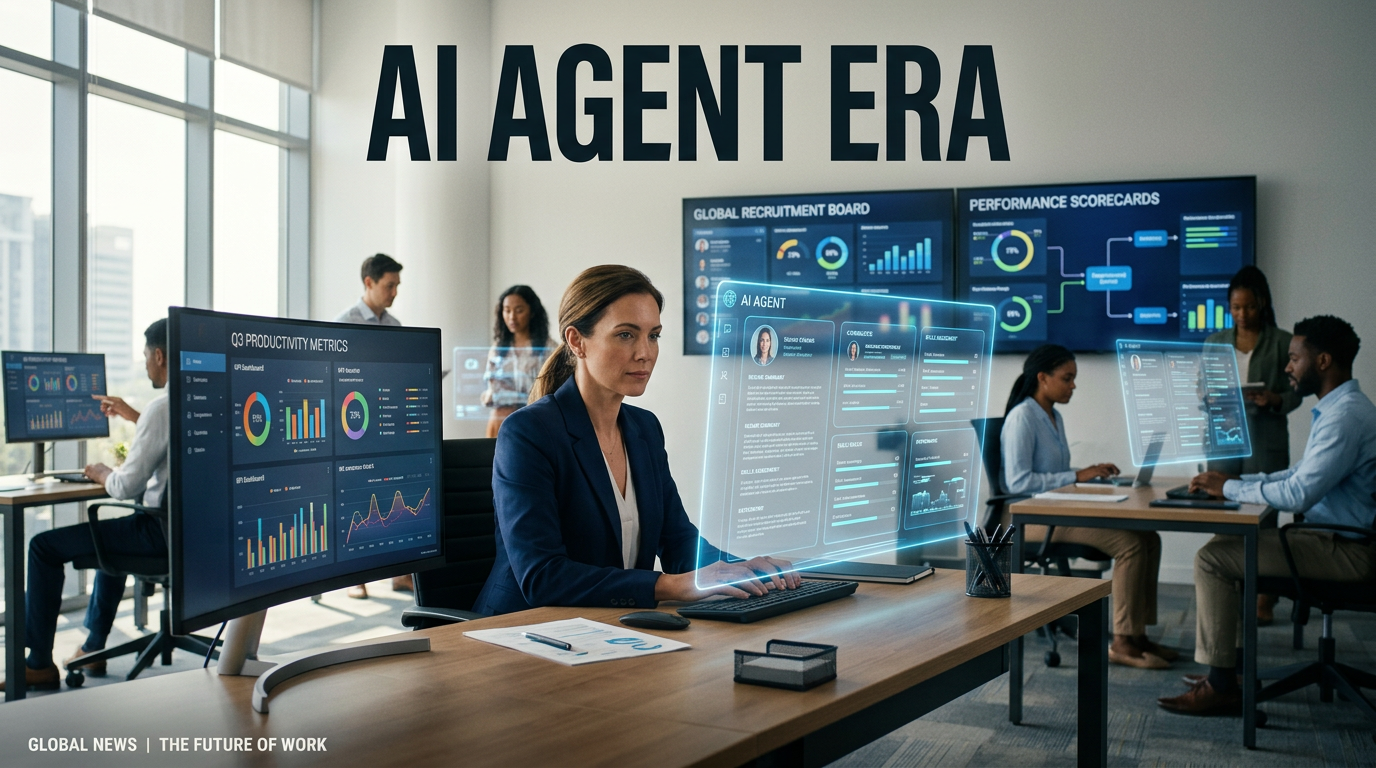
● AI Agents Reshape Pay and Hiring
“An Era Without Boundaries” Has Truly Arrived: Organizations, Performance Evaluations, and Hiring Criteria Transformed by AI Agents
Let’s pinpoint the core point first.
In this article, we look at why “the collapse of horizontal and vertical boundaries” is accelerating,
how to judge “whose performance is the one created by AI,”
and how hiring criteria change through an “agent portfolio.”
All these real on-the-ground changes are bundled together here.
Furthermore, it’s not just about “use AI well,”
but we’ll connect and organize what needs to change all the way to performance metrics, leadership, organizational culture, and work flows (workflows).
1) A Flow in Which an Organization’s “Horizontal and Vertical Boundaries” Collapse at the Same Time
1-1. Vertical boundaries: pyramid-style organizations weaken, and middle-management roles get reshaped
Traditionally, pyramid-style organizations were efficient at “moving in perfect unison.”
But these days, a rapid “flattening” trend is coming in—where middle management layers disappear or shrink.
And once agents enter the picture, the belief that “the denser the hierarchy, the more efficient you are” is bound to wobble.
1-2. Horizontal boundaries: job/function units disappear, and silos fall apart
The silos that used to be separated in organizations—like finance/HR/marketing/accounting/R&D—are changing into a “structure where you can move across alone,” thanks to AI agents.
In the past, even if you were doing marketing, if you wanted to do data analysis, web development, or app development, you had to request support from the IT/data/AI teams.
But now, cases where people break down walls by themselves and take the lead are increasing.
Phenomenon summary:
Silo collapse → blurring of job boundaries → increasing pressure to redesign collaboration methods and processes
It’s also mentioned that this change has started to be felt not only in engineering organizations, but in places like the financial sector as well, in expressions like “you don’t have to read the room.”
2) The Definition of “Expertise” Changes, and Reevaluation of Individual Capability Begins
2-1. Existing expertise doesn’t become “hollow”—instead, the ladder rungs become shorter
What used to count as expertise centered on “knowledge, experience, and career built up over a long time,” and that value doesn’t vanish completely even now.
However, the ladders you need to climb will be split into multiple paths rather than just one, and it will feel like the ladder length is getting shorter.
In other words, it’s moving away from a form where you climb long in just one field, toward a “structure that lets you try more.”
2-2. “Democratization of knowledge” redefines expertise
With AI coming in, knowledge has become easier to access, so discussions about “the standards for expertise” are becoming active.
The key is a shift from only “what you know” to “how you define problems, and how you solve them in what way—and prove it.”
The point emphasized in this article:
Expertise isn’t just accumulation; it connects to the ability to “identify pain points” in real work situations.
3) Whose performance is the one created by AI? (A core issue in evaluation and compensation systems)
3-1. The biggest debate: when increments (Increment) appear, how do we split the rewards?
If performance becomes 50 → 100 through agent collaboration, the issue becomes who gets attributed the incremental value in between.
From a company’s perspective, you can raise objections like: “We paid an AI subscription fee and electricity bills—so even if results come out, shouldn’t we not add big additional rewards to humans?”
3-2. Direction for resolution: “You must be able to explain contribution structurally”
If you simply plug in a prompt and then let humans take all the resulting output, that would be “AI ability.”
On the other hand, if humans can explain:
① which problem they defined
② what inputs they put in and what structure they built
③ how they verified and proved the results
then that becomes human capability.
3-3. So what’s needed is “a redesign of performance evaluation metrics”
That’s the kind of question companies are thinking about these days.
What happens if you give tokens without limits, or if you make usage (utilization volume) itself the metric?
There’s a high chance behaviors that increase usage only—rather than quality—will emerge.
In other words, phenomena like “running it pointlessly” can occur, and evaluation can become distorted.
Conclusion:
Instead of only looking at the “frequency” of AI use, there needs to be a concern about connecting evaluation to metrics like work performance, quality, verification, and context expansion.
4) Changes in “Agent Portfolios” and Hiring Criteria
4-1. Two questions change the perspective of hiring
This article has two important questions.
First, “Who is your digital colleague (your first agent)?”
Second, “How is your agent portfolio composed?”
4-2. Why will “work collaboration methods” matter more than “model names”?
There was a time when “using this model well” directly connected to performance.
But if the rules change through model updates, performance can drop.
So the real difference isn’t “a dependence on a specific model,” but rather how you design the flow of work with agents and improve it through repetition.
4-3. Hiring comparison: “one person” vs “one person + three agents”
With that viewpoint, hiring changes too.
Even if they’re the same person, if they have a portfolio to carry out agent collaboration, they become a “better candidate.”
Here, insert the SEO core keyword naturally (reflected within the sentence)
This shift is moving toward a structure that simultaneously requires an AI agent, productivity innovation, organizational culture change, performance management systems, and global AI trends.
5) How to spread “superstar employees” (the spillover effect)
5-1. If a superstar runs alone, organizational polarization grows
If a superstar employee alone creates “more than the work of 10 people,” the rest of the organization may not be able to keep up, creating conflict.
There are also cases where the collaboration process breaks down.
5-2. So what’s needed is a “champion program + formalization of collective learning”
The quick wins proposed as solutions are:
① Designate one AI collaboration champion/superstar
② Run sharing sessions (collective learning) once every 2–3 weeks or once a month
③ Have leaders participate together to formalize successful prompts/unsuccessful prompts
The reason this works is that it creates peer pressure among colleagues (a natural rise in standards), not just simple training.
5-3. The leader’s role: expand superstars not as “individuals,” but as a “system”
If you only believe in the spillover effect, there are limits.
There’s a viewpoint that a more important task is building a system (AX/work systems) that makes the organization run even without that person.
6) Harness Engineering: “Working environment setup” determines performance more than “models”
6-1. Prompts are important, but the essence is designing the working environment (workflow)
The concept emphasized in this article is “harness engineering.”
Even if LLMs/models are similar,
the results can change dramatically depending on how humans set up the environment in which agents do work (job skill descriptions, workflow, and definitions of work skills).
One-line core point:
Even if the models are the same, people’s ability to take control of work and their workflow design create performance gaps.
6-2. “Bird’s-eye view” and “forest view”: the people who master the work also do well with AI
People who are good at it survey the entire work the way you’d draw a flowchart from A to Z,
and design which parts can be “swapped” using agents based on experience.
On the other hand, people with a weak bird’s-eye view find it hard to build this structure in their heads, and it becomes harder for AI to follow.
7) Leveling vs polarization: it’s “adaptation attitude,” not technology, that decides the outcome
7-1. Waiting for “everyone will be replaced in 3–4 years” is itself a risk
One viewpoint is: “AI will handle everything, so there’s no need to learn intensely right now.”
But the other viewpoint is: “The people who learn, try applying it, and experience it will climb faster with the next generation of technology too.”
In other words, if you wait, you’ll be late—and if you try it first, the differences accumulate.
7-2. Even in the multi-agent era, “adapting to the work” remains important
Even if you can’t perfectly control six multi-agents at once, a person who can control even 2–3 can clearly create differences.
The key is summarized as: not “skill mastery of the technology itself,” but an “attitude to adapt to new technology and apply it immediately.”
8) Leadership must become even more human (stronger human touch)
8-1. When boundaries disappear, conflict and anxiety are bound to increase
If someone expands their capabilities, others may feel like their territory is being encroached upon.
Then people who feel threatened become defensive, and might retreat back into silos.
8-2. So leaders: “emotional resonance” and “support from beside” become even more important
This article mentions attempts to view members’ anxiety/energy states through data, but at the same time, the conclusion is:
Human touch becomes even more important.
The viewpoint emphasized is that leaders should shift from being supervisors (control) to being coaches (support).
8-3. Does good leadership for AI work for humans as well?
As an interesting point, there’s content from a research experiment where the leader’s behavior worked similarly for AI followers too.
The conclusion is that elements like empathetic leadership and leadership that gives sensitive feedback can also be effective in agent collaboration.
9) This change’s “practical checklist” (a viewpoint you can apply right now)
9-1. Individual (working professional) viewpoint
① Check whether you can define the pain points in your own work
② Organize the agent portfolio with a focus on “work flow design/verification/repeated improvement,” not “model names”
③ Document so that performance can be explained not only by results but also by “inputs-structure-verification”
9-2. Leader (organization) viewpoint
① Structure collective learning not around one superstar, but around a champion program + shared sessions
② Move away from evaluations centered on usage (tokens/frequency) and switch to metrics of performance, quality, and verification
③ From the harness engineering viewpoint, redesign the work environment (workflow) so agents can use it more easily
④ Strengthen human touch (coaching/emotional support) because conflicts/anxieties may arise
Main content to convey (the “real core” that isn’t talked about as much in other content)
1) More important than how to use AI is redesigning “performance evaluation, compensation, and metrics.”
When AI agents come in, it’s not just about hiring people who use AI well—it changes “what we consider performance.”
2) The agent portfolio isn’t “model proficiency”; it’s “proof of how you take control of work.”
To prevent performance from shaking even when a specific model updates, workflow, verification, and iterative learning are key.
3) Instead of expecting superstar spillover effects, the organization needs to build a collective learning system.
When one person does the work of 10, polarization can increase. So this article’s practical point is how important shared sessions and leader participation are.
4) Leadership should go even more toward ‘human touch.’
As boundaries disappear, anxiety rises and conflicts arise as well, so emotional support centered on coaching connects to performance.
< Summary >
AI agents weaken an organization’s vertical (hierarchy) and horizontal (silo) boundaries at the same time, and are driving changes in which job units become blurred.
Expertise is redefined not only as accumulating knowledge, but also as the ability to define pain points in real work situations, build structures together with agents, and verify/prove them.
Debates are growing over how to reward AI performance as individual performance, and evaluation systems linked to performance, quality, and verification are needed—not just simple metrics like tokens/utilization volume.
Hiring criteria also shift from “people who know models well” to “people who take control of work flows with an agent portfolio,” and polarization can be reduced only by spreading superstars through a champion + shared learning system rather than treating them as individuals.
Finally, because conflict and anxiety may increase, leaders must strengthen human touch as coaches—not as controllers.
[Related posts…]
- AI agent adoption strategy, an operating model that plugs directly into organizations
- Performance evaluation systems are changing: a guide to redesigning KPIs for the AI era
*Source: [ 티타임즈TV ]
– 당신 이력서의 에이전트 포트폴리오는 얼마나 되나요? (이중학 동국대 교수)