● Musk Shock, Tesla Relief
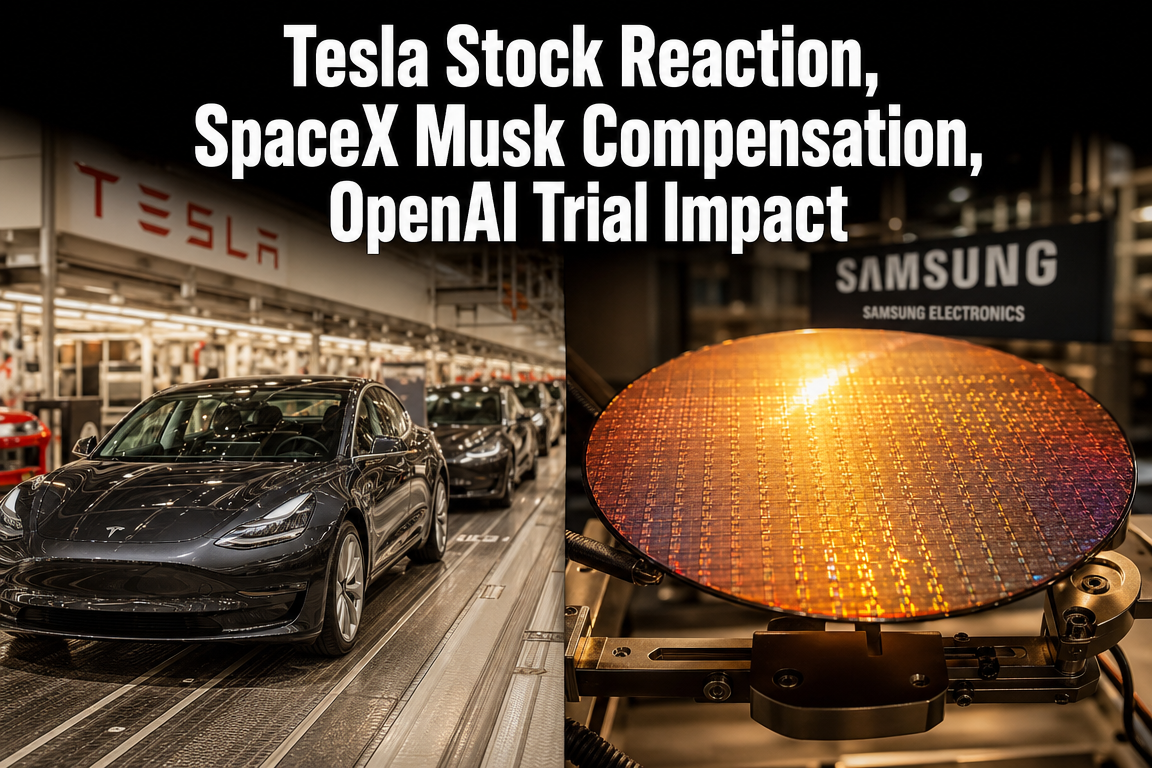
Why Tesla Shareholders Found Reassurance at $376 on the Day SpaceX Promised Musk a KRW 7.5 Trillion Package
Two same-day events help explain why the recent Tesla stock move was more than routine volatility.
First, Elon Musk testified in the OpenAI trial.
Second, SEC filings revealed that SpaceX approved an outsized compensation package for Musk tied, in practical terms, to a “Mars settlement” milestone.
On the surface, the SpaceX headline appears more consequential and could be read as negative for Tesla.
Market interpretation was more nuanced.
A notable cohort of investors viewed the SpaceX package as making Tesla’s incentive framework look comparatively more executable, contributing to a psychological support zone around $376.
This report covers:
- How the OpenAI trial may affect Musk’s credibility and broader AI industry governance narratives
- Why SpaceX’s Mars-linked compensation structure is an unprecedented corporate governance issue
- Signals that Tesla and SpaceX are effectively competing for Musk’s time and attention
- Why the news can be interpreted as a medium-term re-rating consideration in the context of the U.S. equity market, rather than a purely short-term negative
- The under-discussed reason Tesla appeared to receive relative reassurance
1. Market context: Tesla weakness was not solely idiosyncratic
Tesla closed at $376, down on the day.
Interpreting the move as purely Tesla-specific can be misleading.
The broader market was in a risk-reduction and wait-and-see posture ahead of major technology earnings.
Microsoft, Meta, Alphabet, and Amazon results were imminent, while Middle East geopolitical risk further weakened risk appetite.
Accordingly, the Tesla decline appeared driven more by macro factors and sentiment than by a clear deterioration in company fundamentals.
This distinction matters because rate-cut expectations and mega-cap earnings season remain key determinants of global asset pricing.
In this environment, market framing often matters more than any single headline.
2. The OpenAI trial: a governance dispute with implications for AI legitimacy
2-1. Core case framing
The dispute is not merely personal conflict between Musk and Sam Altman.
The central issue is the extent to which an organization founded as a nonprofit can alter its mission to pursue commercial outcomes.
Musk’s side argues that OpenAI materially diverged from its public-interest founding purpose.
A key contention is that following Microsoft’s large investment, OpenAI effectively transitioned toward a for-profit orientation.
OpenAI’s position is that Musk is attacking a successful organization after losing influence and departing earlier in its development.
2-2. Why the court sought to limit social-media commentary
Musk’s public statements on social media became a procedural concern prior to trial.
The judge warned Musk to avoid social-media conduct that could inflame the situation outside the courtroom.
This is not a formality.
In a jury setting, public commentary can affect perceived motivation and credibility.
Musk claims the lawsuit is about principles; however, repeated derisive language toward the opposing party can dilute that message for jurors.
The case therefore involves both legal arguments and narrative credibility.
2-3. Why investors should view this as an early signal for AI governance and regulation
The implications extend beyond OpenAI.
The proceedings may influence how AI companies operationalize “public interest,” “safety,” nonprofit missions, and commercialization.
Over time, this can affect AI-sector valuation frameworks, regulatory risk premia, and partnership structures.
3. SpaceX’s “Mars compensation plan”: the structure matters more than the headline number
3-1. Key terms
Reuters reported that the SpaceX board approved a new, exceptionally large compensation package for Musk.
The triggers are not conventional metrics such as revenue growth or share-price performance.
Reported conditions include a substantial increase in company valuation and achieving a milestone consistent with establishing a human research settlement on Mars.
Additional operational targets were reported, including space-based data-center development.
This is closer to a mission-based performance contract than a traditional CEO pay plan.
3-2. Why it is historically atypical
CEO compensation is typically linked to quantitative metrics such as revenue, operating profit, stock price, or total shareholder return.
The SpaceX structure extends beyond financial metrics by embedding civilization-scale objectives as KPI-like triggers.
This represents an extreme expression of mission-aligned capitalism within executive compensation.
3-3. The critical variable: Musk’s time allocation rights
The market focus is not cash; it is time.
Investors are assessing where Musk will allocate attention across Tesla, SpaceX, xAI, X, and Neuralink.
For a multi-entity executive, the binding constraint is managerial bandwidth.
The SpaceX package can be interpreted as an attempt to secure priority over Musk’s future time.
4. Why Tesla was viewed as relatively reassured
4-1. SpaceX milestones appear so long-dated that Tesla’s appear comparatively executable
This is the key interpretive point.
Because SpaceX targets are exceptionally ambitious, Tesla’s milestones can appear more near- to medium-term and operationally tractable by comparison.
A Mars settlement is a multi-decade technical, regulatory, and logistical challenge, with uncertain attainability within a typical executive horizon.
Tesla, by contrast, has more observable milestones: robotaxi deployment, FSD progress, energy storage scale-up, Optimus development, manufacturing expansion, and stepwise market-capitalization targets.
While still challenging, these are within a range investors can associate with execution and measurable progress.
As a result, some investors could infer:
“To realize compensation in a practical timeframe, Tesla may remain the more immediate platform for results.”
4-2. Why $376 held as a psychological level
Price action remained comparatively contained.
Had the market decisively concluded that Musk was prioritizing SpaceX over Tesla, a sharper drawdown would have been plausible.
Instead, the market response suggested uncertainty rather than a definitive reallocation narrative.
Within a “future expectations reset” regime, relative executability can support downside sentiment.
5. Key positives and risks for Tesla shareholders
5-1. Potential positives
- The magnitude of SpaceX compensation could reduce the relative intensity of prior debate over the scale of Tesla’s legacy pay package.
- If Tesla’s milestones are perceived as more executable than SpaceX’s, expectations for managerial focus may tilt in Tesla’s favor.
- Tesla’s growth narratives (autonomy, robotaxi, Optimus, and energy) remain active strategic pillars.
- The semiconductor market and AI infrastructure buildout can indirectly support Tesla’s compute capability and autonomy-related data processing competitiveness.
5-2. Key risks
- Time-allocation risk across Musk’s portfolio remains unresolved.
- As SpaceX, xAI, X, and litigation visibility increases, debate over CEO dedication to Tesla may re-emerge.
- Shareholders may raise fiduciary-duty concerns, implying potential litigation and governance risk.
- Tesla’s equity story remains materially keyed to Musk-specific execution, a governance-related discount factor.
6. Broader macro and strategic implications
6-1. Executive compensation increasingly reflects “national-scale” strategic missions
Historically, strong quarterly execution defined a successful CEO.
In strategic sectors such as AI, space, semiconductors, robotics, and energy, leadership increasingly aligns with industrial-policy-scale objectives.
Musk’s incentive structure is an extreme example of this shift.
It signals growing reliance on private-sector entities to pursue long-horizon strategic agendas.
6-2. AI and space may converge into a single infrastructure stack
References to space-based data centers should not be dismissed.
In the AI era, compute, communications, energy, and physical infrastructure are increasingly interdependent.
Satellite connectivity, space-derived data, autonomy, robotics, and cloud compute operate as a connected value chain.
Accordingly, what appears to be a Tesla-specific event can also be interpreted within the broader AI infrastructure reconfiguration.
6-3. Relevance increases during mega-cap earnings season
The current market regime resembles a technology-leadership cycle more than a single-stock environment.
Mega-cap earnings, the AI capex cycle, data-center investment, geopolitical risk, and monetary policy are intertwined.
In this context, Tesla and SpaceX should not be analyzed solely as an automaker or a launch provider.
They function as vehicles for growth-premium and future-infrastructure expectations.
7. The most under-covered point
7-1. The core issue is not the headline compensation number, but relative executability
Coverage tends to focus on “KRW 7.5 trillion.”
For investment decision-making, attainability often matters more than absolute size.
The more long-dated and ambitious the SpaceX triggers appear, the more Tesla’s incentive-linked milestones can look like the practical alternative.
7-2. Tesla’s reassurance was not based on Musk choosing SpaceX, but on where near-term results are more feasible
This is the central interpretation.
Musk’s long-term priority may remain Mars.
Markets typically prioritize execution sequence over aspirational endpoints.
From an execution-sequencing perspective, Tesla remains the more immediate venue for valuation-impacting deliverables.
This reduced the probability, in investor perception, of a near-term “abandonment” scenario, supporting sentiment around $376.
7-3. Longer-term, structural reconfiguration scenarios may be discussed more frequently
When multiple large enterprises remain tightly linked to a single leader, markets often seek structural solutions.
This can include governance changes, asset reshuffling, divisional separation, or expanded strategic partnerships.
No immediate outcome is implied; however, investors increasingly analyze the “Musk system” rather than Musk alone.
8. Investor checklist
- How Musk’s credibility and argumentation are assessed in the OpenAI proceedings
- Any indication of a SpaceX IPO process and changes to timeline expectations
- Tesla disclosures and measurable progress on robotaxi, FSD, and Optimus
- Board and shareholder communications regarding Musk’s time allocation
- Spillover effects from mega-cap earnings and AI capex on Tesla valuation
9. One-sentence takeaway
SpaceX’s outsized compensation plan initially looked like competitive downside for Tesla, but it also highlighted that Tesla offers more near-term, measurable execution pathways than Mars-scale targets, helping support psychological downside around $376.
< Summary >
On the same day, Elon Musk faced two major focal points: testimony in the OpenAI trial and disclosure of a SpaceX mega-compensation package.
The OpenAI case functions as a high-visibility test of the tension between public-interest missions and commercialization in AI.
The SpaceX package is structurally unprecedented due to Mars-linked triggers; the practical issue is not cash but Musk’s time allocation.
Contrary to a purely negative readthrough for Tesla, the perceived long-dated nature of SpaceX milestones made Tesla’s milestones appear comparatively executable, contributing to investor reassurance near $376.
The key variable for investors is less the size of compensation and more where Musk can deliver tangible results first.
[Related Articles…]
- Why the market is revisiting Tesla Robotaxi and FSD now
- AI industry power shifts: checkpoints more important than mega-cap earnings
*Source: [ 오늘의 테슬라 뉴스 ]
– SpaceX가 머스크에게 7.5조를 약속한 날, 오히려 $376 테슬라가 안심한 이유는?
● Samsung Unrest, Korea Chip Shock, HBM AI Battle, Hike, Strike Risk
Why Samsung Electronics’ Union Dispute Has Become a Real Stress Test for Korea’s Semiconductor Industry: HBM, AI Semiconductors, Rates, and Strike Risk in One View
Korea’s semiconductor industry is no longer a simple “earnings up, stock up” narrative.
The issue is broader in scope.
This report reviews why the Samsung Electronics labor dispute can evolve from a compensation negotiation into a macro-level risk for Korea, why SK hynix and Samsung Electronics cannot be assessed under an identical compensation framework, and how geopolitics, high interest rates, data-center investment, private credit markets, HBM4, foundry leadership, and the AI semiconductor race connect within a single risk chain.
Most coverage focuses on headline numbers (bonus size, strike probability, “Samsung crisis”). The more material point is that the domestic discourse remains centered on distribution, not on sustaining competitiveness.
The core question is whether Korea can maintain leadership in memory and AI-related semiconductors over the next 2–3 years.
1. One-line framing: The priority is sustaining competitiveness, not allocating near-term gains
Superficially, the Samsung Electronics union issue concerns bonuses and wage structures. In substance, it exposes multiple structural challenges facing Korea’s semiconductor sector.
The current upcycle is supported by AI, data-center buildouts, and expanding HBM demand, but that trajectory is not guaranteed to persist. Over the next one to two years, outcomes may shift due to changes in big-tech investment strategies, increased supply-chain control by TSMC and NVIDIA, or geopolitical shocks that disrupt inflation and rate paths.
In this environment, the priority topics are:
- Retaining and attracting critical talent
- Securing funding capacity for forward-looking R&D and capex
- Extending advantage beyond HBM into the next product cycle
- Aligning labor, shareholders, and management around shared targets and governance mechanisms
Accordingly, the dispute is not only a labor-management event; it intersects with industrial policy, corporate governance, export competitiveness, and Korea’s growth model.
2. Market focus: five key issues
2-1. Middle East risk and inflation: concerns that rate cuts may be delayed
A primary variable is prolonged conflict in the Middle East. The central market concern is not the conflict itself but potential disruption to energy transport routes (e.g., the Strait of Hormuz) that could drive oil prices higher.
Higher oil prices can re-accelerate inflation, complicating the Federal Reserve’s ability to cut policy rates. Tighter liquidity conditions would raise the cost of capital and could slow AI infrastructure spending that requires large-scale financing.
Data centers are highly sensitive to funding conditions due to reliance on project finance, private credit, and real-asset style capital structures.
2-2. AI infrastructure capex may remain resilient despite high rates
A counterview is that AI competition has strategic characteristics at the platform and national level. For the United States, sustained AI investment by major technology firms supports longer-term competitive positioning versus China.
Large-cap technology firms (Microsoft, Amazon, Google, Meta) have strong cash-generation capacity and may be less rate-sensitive at the top tier.
The more rate-sensitive segment is downstream: neo-cloud providers, second-tier data-center operators, and smaller participants with greater dependence on external financing. As a result, aggregate demand growth could be affected in breadth and speed even if top-tier capex remains intact.
2-3. Samsung Electronics union dispute: a conflict amplified by improving expectations
Labor disputes typically intensify during downturns or restructuring cycles. In this case, improving semiconductor conditions and expectations of higher profits have increased pressure for compensation adjustments.
Following SK hynix’s stronger signal on incentives and payouts, comparable expectations have emerged within Samsung Electronics.
However, Samsung Electronics and SK hynix differ structurally:
- SK hynix is primarily a memory-focused company.
- Samsung Electronics operates a multi-segment portfolio (memory, non-memory, foundry, smartphones, consumer electronics).
- Samsung has a higher structural need to recycle memory-cycle cash flows into non-memory and foundry investments.
Therefore, parity-based comparisons are not operationally straightforward.
2-4. Why a strike could become a macro risk for Korea
Semiconductors are central to Korea’s exports and are embedded across major manufacturing categories, including autos, smartphones, consumer electronics, displays, defense, shipbuilding, and IT hardware.
Production disruption would not be limited to a single company’s earnings; it could affect export momentum, industrial output, the trade balance, and capital-market sentiment.
In a tight AI semiconductor supply environment, disruption at a major producer could also raise questions about Korea’s reliability within global supply chains.
2-5. Why the incentive debate is structurally complex: labor, shareholders, and management each have defensible positions
This issue is difficult because no party’s position can be dismissed as categorically invalid.
Labor-side arguments:
- Compensation must reflect performance to retain key talent.
- Weaker incentives can accelerate attrition to competitors, including domestic peers and Chinese firms.
- In semiconductors, talent and technology are core; compensation competitiveness is a component of industry competitiveness.
Shareholder-side arguments:
- Corporate performance reflects both labor and capital contributions.
- Excessive cash distribution can reduce dividend capacity and limit value-enhancement initiatives.
- Funding capacity for AI and foundry competition could be impaired.
Management considerations:
- Even with improving memory profits, non-memory and foundry require sustained, large-scale investment.
- Uniform incentives can create internal inequities across business units with divergent profitability.
- A long-term balance is required across R&D, capex, talent retention, and shareholder returns.
The practical challenge is incentive-system design, not sentiment or rhetoric.
3. Why Samsung Electronics and SK hynix should not be evaluated under the same framework
3-1. Different business models
SK hynix is concentrated in memory; when memory (HBM, DRAM, NAND) improves, operating leverage can be significant.
Samsung Electronics has a diversified portfolio, making internal capital allocation and incentive design more complex even when memory profits rise.
3-2. Samsung’s future-investment burden is larger
Samsung Electronics faces the strategic requirement of strengthening foundry and broader non-memory competitiveness.
Closing the gap with TSMC requires sustained investment across leading-edge process technology, capacity, customer acquisition, design enablement, and advanced packaging. This constrains the share of cycle-driven cash flows that can be distributed immediately.
3-3. Internal HR system friction
If semiconductor divisions receive disproportionately high payouts, other divisions may experience heightened internal equity concerns.
Conversely, strategically important but loss-making non-memory units may struggle to retain critical talent if incentives are insufficient.
The issue extends to company-wide HR architecture, not only bonus levels.
4. Korea’s larger challenge: risk of losing position in the post-HBM phase
4-1. HBM is the beginning, not the endpoint
HBM is a critical product in the AI era. The more material issue is structural change beyond the current HBM cycle.
From HBM4 onward, the roles of the base die and logic components may rise in importance. Competitiveness will increasingly depend on design capability, foundry collaboration, advanced packaging, and bargaining power with customers, not only memory process execution.
4-2. If NVIDIA and TSMC control the base-die layer, value capture may shift
If a greater portion of HBM-related value accrues to designers or foundries, the margin share captured by memory suppliers could narrow.
Even if near-term HBM benefits are substantial, the distribution of value across the stack can be redefined as product architectures evolve.
This underpins the capital-allocation question: how current cash flows are deployed to secure next-cycle advantage.
4-3. Memory leadership does not ensure system-level leadership
Korea’s historical semiconductor strength has been concentrated in memory. AI-era competition is likely to be determined by broader system integration.
Key determinants include software, design assets, foundry capability, packaging, data-center architecture, power efficiency, and ecosystem coordination.
This is a period of strong positioning, but it also requires heightened discipline in strategic execution.
5. Why software dynamics and private credit matter to the semiconductor upcycle
5-1. Software innovation can reshape hardware demand
AI markets evolve rapidly; a major model or efficiency breakthrough can alter system design and near-term demand assumptions.
If model efficiency improves materially or new software architectures change compute utilization, the demand mix for GPUs, memory, and networking equipment can shift.
5-2. Data centers are financially leveraged infrastructure
Data centers require substantial capital for construction, equipment, power, land, cooling, and working capital.
If private credit or non-bank funding channels tighten, pressure may emerge first among lower-tier operators, potentially slowing buildout rates even if top-tier demand remains robust.
6. Korea macro perspective: key points
6-1. Semiconductors function as the core of Korea’s export structure
Semiconductors affect FX dynamics, the trade balance, corporate earnings, employment, equity-market sentiment, and capex.
Accordingly, the Samsung Electronics labor risk should be assessed as a potential systemic sensitivity, not a single-company headline.
6-2. Potential spillover into social distribution tensions
High-profile incentive disputes in the semiconductor sector can amplify perceived inequality across industries and income cohorts, given the small share of workers employed by top-tier firms.
6-3. The solution is not “distribution,” but “system design”
Long-term stability is unlikely to be achieved by suppressing labor demands, prioritizing shareholder demands alone, or relying solely on management discretion.
The core requirement is a transparent, rules-based framework that specifies how profits are allocated among incentives, reinvestment, and shareholder returns, and which metrics constitute shared targets.
7. Two practical policy directions
7-1. Target-sharing: align labor, management, and shareholders on common metrics
A feasible approach is to define shared targets so that labor, management, and shareholders evaluate performance using the same numbers.
- Set targets based on operating profit or EVA
- Incorporate metrics such as HBM share, yield, customer wins, and roadmap execution
- Predefine allocation ratios for incentives, dividends, and R&D reserves for outperformance versus targets
This can shift negotiations from distribution to value creation.
7-2. Convert part of cash incentives into equity-based compensation
Partial substitution of cash bonuses with equity awards can align incentives with long-term value creation.
- Employees gain direct exposure to long-term performance.
- Shareholders face reduced near-term cash outflow pressure.
- The company may improve retention via vesting structures.
- Short-term disputes can be reframed around durable enterprise value.
Equity compensation is widely used among global technology and semiconductor firms and is a relevant option for globally competing manufacturers.
8. Under-discussed but material points
8-1. The largest risk may be internal: an overemphasis on distribution can delay structural adaptation
External risks (geopolitics, rates, competition) matter, but if domestic focus remains narrowly on distribution, timing for investment and restructuring may be missed.
8-2. Memory upcycles are not permanent
Recent downturns demonstrated the magnitude of cyclicality. Current strength does not guarantee durability two years forward.
8-3. HBM is an entry point to system integration competition
Future advantage may depend on integrating logic, design, foundry, packaging, and software optimization, not on memory products alone.
8-4. This is not only a Samsung Electronics issue
The dispute may influence compensation design, talent strategies, and capital-market-facing governance practices across Korea’s large corporates.
8-5. The core question is preparedness for the next cycle
Whether the AI cycle proves transitory or durable, converting current cash flows into future technological advantage is central to maintaining market position.
9. Investor and industry checklist
- Whether Samsung Electronics labor negotiations conclude as a one-off event or lead to structural policy reform
- Whether compensation divergence between SK hynix and Samsung accelerates talent migration
- Where base-die and foundry leadership consolidates in the HBM4 era
- Whether US big-tech AI infrastructure capex remains sustained
- Data-center financing conditions, particularly private credit and project finance stress
- Whether Korea’s semiconductor competitiveness expands from memory into system-integration capabilities
10. Conclusion: the effective stress test begins in the upcycle
Current tailwinds include expanding HBM demand, rising AI infrastructure investment, improving memory conditions, and increased big-tech capex.
However, upcycles often surface allocation conflicts and strategic misalignment. If long-term competitiveness is not institutionalized during favorable conditions, the next cycle can impose larger costs.
The Samsung Electronics union dispute is therefore a forward-looking signal: it reflects a choice between short-term distribution and a redesigned structure centered on long-term competitiveness.
The decisive factor is not the near-term payout level but how cash flows from the current cycle are preserved and deployed for future advantage.
< Summary >
The Samsung Electronics union dispute is not merely a bonus controversy; it is a structural test for Korea’s semiconductor sector and the broader economy.
Middle East risk, inflation, and high rates may slow marginal data-center investment, but strategic AI investment by major platforms may remain comparatively resilient.
Samsung Electronics and SK hynix have fundamentally different business structures, making uniform compensation formulas impractical. If labor disruption materializes, spillovers could extend beyond semiconductors into Korea’s broader manufacturing competitiveness.
The central issue is next-cycle competitiveness spanning HBM4, foundry, design, software, and sustained R&D investment, not the absolute size of incentives.
Potential solutions include target-sharing frameworks and equity-based compensation structures to align labor, shareholders, and management with long-term value creation.
[Related Posts…]
Korea’s Semiconductor Supercycle: Identifying Beneficiaries Beyond the HBM Phase
AI Semiconductor Investment Strategy: Big-Tech CAPEX and Data-Center Expansion Trends
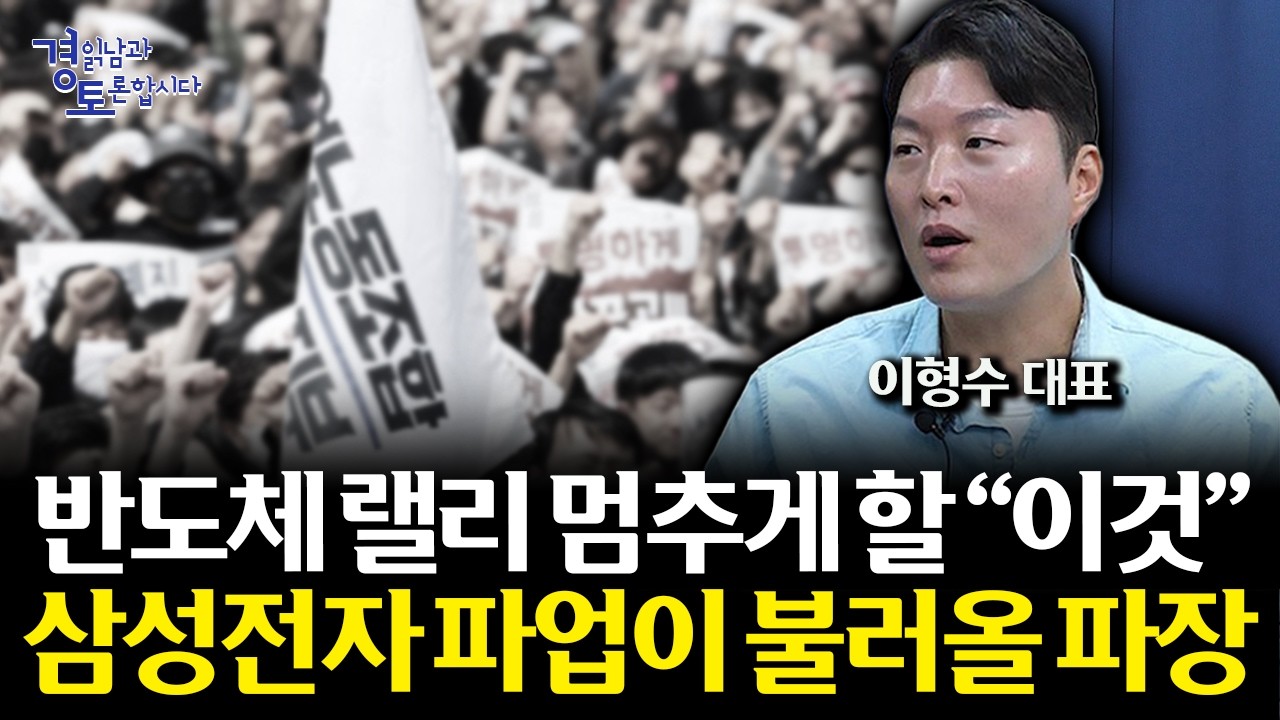
*Source: [ 경제 읽어주는 남자(김광석TV) ]
– 삼성전자 노조 이슈, 한국 반도체의 진짜 시험대가 왔다 | 경읽남과 토론합시다 | 이형수 대표 [3편]