● OpenAI Shock, Nasdaq Slide, Oil Risk
Is the OpenAI “KRW 900 Trillion Bet” Controversy a Real Crisis? A Unified View of the Nasdaq Decline, Oil, Middle East Risk, and OPEC Fractures
This is not solely an OpenAI-specific negative headline. To understand current market price action, it is necessary to link (i) why the Nasdaq weakened, (ii) why AI infrastructure names such as Nvidia, AMD, and Oracle sold off together, and (iii) why crude oil, Middle East geopolitical risk, and potential OPEC cohesion issues matter at the same time.
This report consolidates:
- The core of the controversy around OpenAI missing internal targets
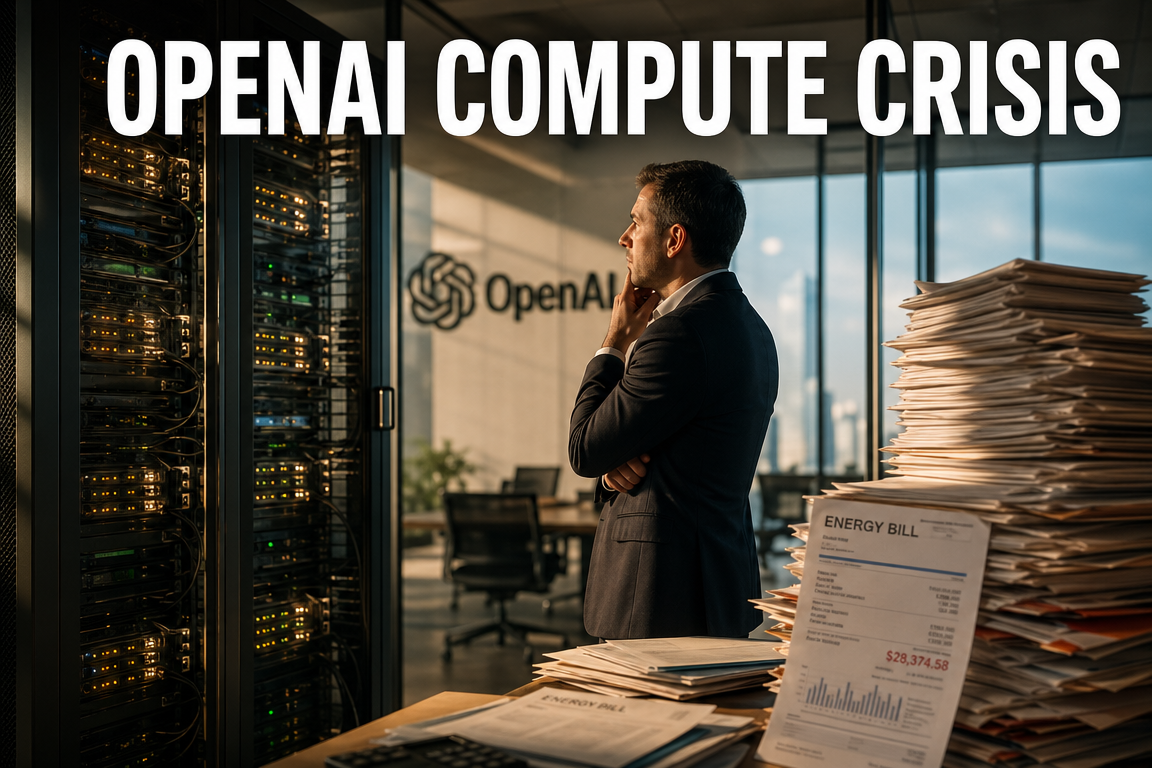
- Whether the approximately USD 660 billion (roughly KRW 900 trillion) computing commitment constitutes a material risk
- Potential spillovers to the AI ecosystem and U.S. equities
- The Iran–U.S. negotiation backdrop and implications for the oil market
- The under-discussed point that pre-emptive supply capture can function as a defensible moat
The market is currently focused on whether the balance between “growth pace” and “upfront investment scale” is at risk of breaking. However, it is premature to conclude that the balance has already failed. This episode is better framed as transitional stress as AI becomes more capital-intensive, rather than a definitive signal of an AI bubble collapse.
1. What happened in today’s market
U.S. equities weakened, led by technology.
- The Nasdaq fell by approximately 1.3%.
- The S&P 500 and Dow also declined.
AI-related equities drove much of the drawdown. Semiconductors (Nvidia, Broadcom, Micron, AMD) and network/infrastructure names (e.g., Arista Networks) traded lower.
This reflected not just company-specific issues but a broader reassessment of the durability of the AI infrastructure investment cycle.
The key question:
- “Can OpenAI sustain this level of spending, and can revenue scale quickly enough to match it?”
As this concern propagated across the AI ecosystem, correlated names came under pressure.
2. Origin of the OpenAI “crisis” narrative: key points from the WSJ report
The immediate catalyst was a Wall Street Journal report, broadly centered on:
- OpenAI’s CFO reportedly expressing internal concern about revenue growth momentum
- A risk that growth may not be fast enough to absorb large, previously committed computing costs
- Tension between management and the board during this process
In practical terms: large forward spending commitments were made, while monetization and cash generation may lag.
Markets are particularly sensitive to scenarios where:
- “The company scaled commitments too quickly and too aggressively to pre-empt the future, while monetization does not accelerate at the same pace.”
3. Three issues cited as OpenAI’s key pressure points
3-1. Risk of missing user growth targets
A widely discussed point is user metrics.
- OpenAI reportedly set a major goal of reaching 1 billion weekly active users.
- No official announcement confirming achievement has been made.
Markets often assume strong metrics are disclosed quickly; the absence of disclosure contributed to the interpretation that the target may not have been met. The key impact was sentiment: growth may be below market expectations.
3-2. Concerns about annual revenue targets and monthly revenue shortfalls
A second issue is revenue:
- The company may miss annual revenue targets.
- Monthly revenue may have fallen short of internal goals in certain periods.
Competitive pressure was cited:
- Consumer: competition with Google Gemini
- Coding and enterprise: competition with Anthropic
The broader takeaway is that the market is not structurally monopolistic; leadership in perception does not guarantee dominance in enterprise monetization.
3-3. Subscription churn and margin pressure
A third issue is potential subscriber churn.
In generative AI, user growth does not automatically translate into better economics:
- Compute costs are high
- A surge in users can worsen margins if paid conversion and retention are insufficient
If infrastructure costs rise faster than paid revenue, unit economics can deteriorate.
4. The central issue: why markets reacted to the USD 660 billion (KRW ~900 trillion) computing commitment
The headline figure was:
- Approximately USD 660 billion in committed/contracted computing spend (roughly KRW 900 trillion)
This can be viewed as a large-scale capacity reservation strategy spanning:
- Data centers, GPUs, cloud services, power, and networking
Markets focused on scale relative to funding:
- Recent fundraising was reported at approximately USD 122 billion
- The commitment size is substantially larger than that figure
This raised a straightforward question:
- “Is this financially sustainable?”
The underlying structural issue is the gap between:
- Massive capex/opex requirements for AI infrastructure, and
- The still-evolving pace of cash flow realization
5. Why the commitment may be a “moat,” not only a risk
Coverage has emphasized overspending risk; the more structural question is resource scarcity.
Potentially scarce resource in the AI era:
- Not the model itself, but compute supply (GPUs, data center capacity, power, network capacity)
From this perspective, a large forward commitment can function as:
- A hedge against rising compute prices and persistent supply constraints
- A strategic lock-in of capacity and service reliability
In enterprise markets, customers prioritize:
- Throughput, uptime, and predictable performance
A leading model without sufficient capacity cannot reliably serve demand. Therefore, “model quality + supply assurance” may determine enterprise winners.
This makes the claim that the commitment is a moat plausible, even if it carries financial risk.
6. OpenAI’s rebuttal: what matters
OpenAI’s response emphasized:
- No leadership split between CFO and CEO
- Recent fundraising was intended to expand compute investment
- Business performance remains solid
It cited three operational supports:
6-1. Advertising monetization is stronger than expected
Advertising can diversify monetization beyond subscriptions, enabling revenue extraction from free users and potentially expanding into:
- Search-like advertising
- Recommendation/placement advertising
- Commercial suggestions embedded in productivity workflows
6-2. Easing constraints in enterprise contracting
Historically, OpenAI was viewed as constrained by its relationship with Microsoft in terms of contracting flexibility with other enterprises and cloud providers.
If constraints are easing, potential benefits include:
- Direct enterprise agreements
- Broader partnerships
- Multi-cloud expansion
This can improve revenue quality, given enterprise customers typically exhibit:
- Higher ARPU
- Longer contract durations
- Lower churn
6-3. Traction in coding AI
Coding AI is among the fastest-monetizing segments in generative AI because:
- Productivity gains are measurable
- ROI is easier to justify for enterprise buyers
Strong product positioning here would support revenue and margin resilience.
7. Assessment: the “crisis” framing may be overstated
There are legitimate concerns:
- Potential target misses
- Slowing revenue growth relative to expectations
- Intensifying competition
- Large investment and cash flow burden
However, interpreting this as structural collapse is premature. Expectations have been elevated. Even growth from roughly 400 million to 900 million weekly active users over a year would be exceptional for most businesses, yet markets are pricing in simultaneous:
- Clear dominance
- Consistent target beats
- Rapid profitability validation
This appears more consistent with the challenges of operating under extreme expectations than with business failure.
8. Not only OpenAI: structural realities across the AI industry
8-1. AI is more capital-intensive than widely assumed
AI is increasingly driven by:
- Semiconductors, power, data centers, and networks
This is not a light-capex SaaS scaling model; it resembles capital-intensive industrial buildout.
8-2. Winners will not be determined by model performance alone
Competitive outcomes likely depend on a combination of:
- Model quality
- Pricing
- Enterprise distribution
- Compute supply
- Regulatory execution
- Brand trust
A multi-polar landscape may deepen, with different players leading different segments.
8-3. AI investment cycles are structurally volatile
In the current phase, AI equities are often more sensitive to:
- Narrative and positioning, and
- Capital flows,
than near-term earnings.
Single headlines can drive outsized moves, even as longer-term drivers remain intact:
- AI infrastructure buildout
- Generative AI adoption
- Cloud modernization
- Enterprise automation
9. Why the shock propagated across AI equities
OpenAI is private, but its spending links directly to public-market beneficiaries:
- GPU suppliers
- Data center builders and operators
- Cloud providers and contractors
- Power and grid beneficiaries
Markets immediately discount the second-order effect:
- “If OpenAI reduces spend, whose revenue is at risk?”
Conversely, if spend plans remain intact or expand, these names can regain momentum.
10. Why the Middle East must be incorporated: Iran–U.S. tensions and crude oil
Equity weakness is not fully explained by AI headlines alone. Middle East risk also weighed on risk sentiment, including:
- Iran–U.S. tensions
- Hormuz Strait disruption risk
- Constraints related to Iran’s crude storage capacity
A parallel interpretation is that economic pressure may increase Iran’s incentive to negotiate, as constrained storage and exports can force production reductions.
Markets tend to focus less on headlines and more on:
- The probability of negotiation
- The persistence of supply disruption risk
11. OPEC fractures: implications of a UAE exit
A potential UAE exit from OPEC would not be merely diplomatic; it could increase oil-market volatility.
OPEC’s core function has been supply management to reduce price shocks:
- Increase production when prices rise excessively
- Cut production when prices fall sharply
If cohesion weakens, price stabilization capacity may decline. Given the UAE’s material production capacity, sustained divergence from Saudi-led coordination could reduce OPEC’s pricing influence.
Higher oil volatility transmits quickly into:
- Inflation prints
- Rate expectations
- Global equity volatility
- Industrial input costs and logistics
12. Under-emphasized points
12-1. The core issue is cash-flow timing, not only growth deceleration
The dominant issue is the mismatch between:
- The pace of cash outflows for compute and infrastructure, and
- The pace of cash inflows from monetization
Industry winners may be those that can finance and survive this timing gap.
12-2. Compute pre-emption can be “power,” not merely cost
If compute remains constrained and pricing rises, long-term capacity commitments can become a strategic asset that reinforces market power and service reliability.
12-3. AI is converging with energy and infrastructure
AI analysis increasingly requires tracking:
- Power grids
- Data center construction
- Semiconductor supply chains
- Cooling technology
- Investments across nuclear, gas, and renewables
This is the linkage between AI and macroeconomic/industrial cycles.
12-4. OPEC dynamics and AI infrastructure are connected
AI data centers are power-intensive. Energy-price volatility impacts:
- Power costs
- Infrastructure buildout economics
- Cloud operating expenses
Energy stability is becoming a recurring variable in AI sector valuation.
13. Near-term watchlist
13-1. Official confirmation of OpenAI user and revenue metrics
Key items:
- Active users
- Paid conversion
- Enterprise revenue trajectory
If disclosed metrics are better than implied by market concerns, the narrative may normalize quickly.
13-2. Execution pace and flexibility of the compute commitment
More important than the headline number:
- Timing of drawdowns
- Contract terms
- Embedded flexibility (e.g., options, scaling clauses)
Long-dated structures can reduce near-term burden; optionality can mitigate risk.
13-3. Competitive positioning and segment-level share
Track segment outcomes across:
- Google Gemini
- Anthropic
- Microsoft ecosystem
- Open-source alternatives
Separate monitoring is required for:
- Coding
- Enterprise productivity
- Search
- Agentic workflows
13-4. Middle East negotiations and the direction of crude prices
Monitor:
- Iran’s negotiation trajectory
- Hormuz Strait risk premium
- Whether OPEC cohesion weakens further via additional exits
These factors transmit into inflation, central bank policy expectations, and cross-asset volatility.
14. Bottom line
The OpenAI controversy has pressured sentiment, but current evidence is insufficient to characterize it as an AI sector breakdown. It is more consistent with a repricing of the AI industry’s capital intensity and the financing gap inherent in scaling compute.
A large pre-commitment can be interpreted as overreach or as a supply-secured moat, depending on contract structure, execution pace, and monetization progress.
The market is oscillating between:
- “Excessive spending risk,” and
- “Strategic dominance through capacity control.”
Decision-relevant monitoring should prioritize cash-flow structure, compute supply security, enterprise monetization, and the energy-cost variable.
< Summary >
The core of the OpenAI narrative is not primarily a user-target miss, but concern over a mismatch between massive compute investment commitments and the pace of revenue growth.
The approximately KRW 900 trillion-scale infrastructure commitment can be viewed either as financial risk or as a moat through pre-emptive control of scarce compute supply.
The Nasdaq and AI-linked equities weakened on reassessment of capital intensity and investment-cycle sustainability, not necessarily on evidence of a sector collapse.
Iran–U.S. dynamics, Hormuz risk, and potential OPEC cohesion issues add oil and inflation uncertainty, with implications for rates and broader equity risk appetite.
Overall, the relevant framework is to integrate AI infrastructure, global macro conditions, oil prices, enterprise revenue scaling, and cash-flow timing.
[Related Posts…]
- https://NextGenInsight.net?s=OpenAI
- https://NextGenInsight.net?s=OPEC
*Source: [ 내일은 투자왕 – 김단테 ]
– 900조원 베팅의 종말? OpenAI의 역대급 위기?
● AI Shock, Coca-Cola Surge, BOJ Hold
Coca-Cola Earnings Beat, Oracle–Bloom Energy Power Strategy, Bank of Japan Holds Rates: Key Market Takeaways
Today’s market action looked straightforward on the surface:the Nasdaq weakened, consumer staples outperformed, and AI-infrastructure names were volatile.However, the underlying signals were more consequential.
This report consolidates:why Coca-Cola is drawing renewed attention at this point in the cycle,why Oracle selected fuel cells over gas turbines,why the AI semiconductor and infrastructure investment narrative came under pressure,why the Bank of Japan’s rate hold still increased market sensitivity,and how these inputs inform positioning across US equities and the global outlook.
Rather than focusing on simple price moves, the discussion emphasizes capital flows, profitability verification, power-infrastructure bottlenecks, and shifts in monetary-policy signaling.
1. US Equity Market Snapshot
US equities opened weaker on April 28, 2026, led by technology.
- Nasdaq: opened down ~1%, later trimmed losses
- S&P 500: down ~0.4% to 0.5%
- Dow Jones: relatively defensive performance
- Russell 2000: modest decline
Core message:
“AI growth expectations remain intact, but the market is increasingly prioritizing the timing and durability of monetization over the magnitude of growth.”
The adjustment in technology is consistent with a transition from expansion-led positioning to a phase focused on profitability and cash-flow validation.
2. AI Semiconductors and AI Infrastructure Weakness: The Question Raised by OpenAI Concerns
2-1. Why Nvidia and Semiconductors Sold Off
Major semiconductor names (Nvidia, Broadcom, AMD, Qualcomm, Intel, Micron) traded broadly lower.
The immediate catalyst was renewed concern around OpenAI:investors questioned whether user growth is meeting expectations and whether revenue growth and cash generation are sufficient relative to the scale of infrastructure spending.
This matters because valuations across AI semiconductors and AI infrastructure have been anchored to the assumption that large AI platforms will sustain aggressive outlays for servers, GPUs, memory, and power capacity.
If a flagship AI buyer moderates spending or re-evaluates the pace of long-term capacity contracts, the market’s key question becomes:
“Is the current pace of AI infrastructure investment structurally sustainable?”
2-2. The Market’s Framework Is Shifting: From Growth to ROI
The focus is increasingly on ROI (return on investment), not model performance or headline user metrics.
- How many GPUs were purchased
- How many data centers were built
- How much power capacity was secured
These are being superseded by:
- Whether investment is converting into revenue
- Whether revenue is converting into profit
- Whether cash flow can support leverage and capex
AI infrastructure expansion is not necessarily ending; the differentiation is shifting toward which participants can build durable monetization and capital-efficient economics.
2-3. Bubble Collapse or Normalization
Current price action is more consistent with normalization than a definitive bubble unwind.
The sector’s trajectory may remain positive, but dispersion is rising as markets differentiate by earnings power, customer concentration risk, capital efficiency, and cash-flow quality.
3. Implications of Changes in the Microsoft–OpenAI Relationship
A key point is Microsoft’s evolving stance.
Investors are interpreting Microsoft’s partial step-back from an exclusive distribution structure as risk management, not merely a partnership adjustment.
This is relevant because the prior narrative assumed large-cap technology would continuously absorb AI build-out costs. The market is now pricing in greater internal discipline: prioritization, risk diversification, and monetization sequencing.
In practical terms, Microsoft appears positioned to retain strategic control while limiting exposure to counterparties’ balance-sheet and funding risks.
4. The Rise of Anthropic and Where AI Competition Is Concentrating
4-1. Why Anthropic Is Being Re-rated
Relative to OpenAI-related concerns, companies like Anthropic are being viewed more favorably due to emphasis on enterprise demand and near-term monetization, including coding and workflow automation.
Markets are prioritizing “explainable revenue”: contract-based enterprise ARR-like structures and measurable productivity outcomes.
4-2. The Center of Gravity in AI Is Shifting
AI is increasingly segmented into two tracks:
- Infrastructure: semiconductors, servers, networking, power, data centers
- Applications: AI software, agents, enterprise productivity solutions
The earlier premium skewed heavily toward infrastructure. The next phase may place greater weight on applications with provable revenue and cash conversion.
Portfolio construction benefits from separating “capex beneficiaries” from “monetization-driven AI services.”
5. Oracle and Bloom Energy: Why Fuel Cells Became Strategically Relevant
5-1. Oracle’s Decision Is Not Primarily an ESG Headline
For a large-scale AI data center project in New Mexico, Oracle indicated a preference for Bloom Energy fuel cells as a primary power source rather than gas turbines or diesel generators.
The strategic drivers are speed and independence.
In AI data-center competition, the binding constraint is increasingly power availability, not only chips.
5-2. Why Fuel Cells Can Be Advantageous
Three principal reasons:
- Faster deployment
- Reduced reliance on grid interconnection timelines
- Potentially lower water use and emissions burden
Grid interconnection can face permitting and queue delays. On-site generation can accelerate commissioning.
In large-scale AI build-outs, delays translate into material opportunity cost.
As a result, power procurement and on-site generation capability are increasingly treated as competitive advantages on par with semiconductor supply.
5-3. What Bloom Energy’s Strength May Signal
Bloom Energy’s move may reflect more than a short-term thematic reaction.
As AI data centers scale, power equipment, fuel cells, microgrids, and power-management software may see rising strategic demand.
AI exposure should be evaluated beyond semiconductors to include cooling, power infrastructure, storage, and industrial electrical equipment.
6. Coca-Cola Earnings Strength: Why Consumer Staples Are Reasserting Leadership
6-1. The Key Takeaway Beyond the Headline Beat
Coca-Cola exceeded expectations on revenue and earnings and raised full-year guidance; the stock responded positively.
A critical detail: volume increased despite price increases, indicating sustained pricing power.
Improving zero-sugar mix signals effective alignment with health-driven demand shifts.
6-2. What Coca-Cola Implies Amid Growth Uncertainty
As a consumer-staples bellwether, outperformance can indicate:
- Rising preference for defensive cash flows amid uncertainty
- Confirmation that consumption has not collapsed, though patterns are changing
US consumption appears uneven:
- Higher-income cohorts sustaining premium spend
- Middle-income cohorts reducing discretionary purchases selectively
- Lower-income cohorts concentrating on essentials
- Retail channels experiencing down-trading
Strong performance in staples suggests resilience in aggregate demand alongside increasingly conservative and efficiency-oriented spending behavior.
6-3. Why Coca-Cola Tends to Hold Up in Higher-Rate, Sticky-Inflation Regimes
When inflation persistence and rate uncertainty extend, markets typically favor stable cash flows and strong pricing power.
- High brand loyalty
- Global distribution scale
- Pricing power
- Dividend profile
- Defensive characteristics
The result is less about a single company outperforming and more about which business models remain durable under tighter financial conditions.
7. Bank of Japan Holds Rates, Yet Markets Read It as Conditional Tightening
7-1. The Signal Was in Forward Guidance, Not the Hold
The Bank of Japan held the policy rate, but investor focus centered on the implied path.
The communication left room for further normalization contingent on inflation and wage dynamics.
In effect: “pause now, possible hike later.”
7-2. Why Japan’s Rate Path Matters for Global Markets
Japan’s ultra-low rates have long supported yen-funded carry trades.
If Japanese rates continue to rise:
- Yen funding costs increase
- Risk-asset appetite may soften
- Potential repatriation of Japanese capital
- Higher volatility risk for US Treasuries and global equities
A gradual shift in BOJ policy can therefore re-shape global liquidity conditions.
7-3. Considerations for Investors
BOJ normalization can transmit through FX, cross-border flows, and relative valuation pressure on growth assets, including semiconductors and US growth equities.
Renewed rate and FX volatility can shift the relative performance of growth versus defensive exposures.
8. Why Apple Was Relatively Resilient
Apple showed comparatively better defensiveness while AI infrastructure names weakened.
This suggests the market is treating Apple primarily as a hardware-and-ecosystem monetization story rather than an AI capex proxy.
AI-related equities are increasingly being segmented by exposure type: capex sensitivity, consumer electronics, platforms, and earnings defensives.
Dispersion across large-cap technology is likely to remain elevated.
9. Oil and Middle East Risk: Inflation and the Rate Path Remain the Dominant Transmission Channel
WTI and Brent faced upward pressure amid geopolitical risk and supply concerns.
Markets have not treated the move as systemically destabilizing, but upside oil risk can revive inflation concerns.
Further oil increases could pressure the expected policy path, long-duration yields, and growth-equity valuation multiples.
Commodity inflation can also affect consumer purchasing power, manufacturing margins, freight costs, and food prices, warranting ongoing monitoring.
10. The Three Core Themes Driving Today’s Market
- AI is still expanding, but the market has entered a profitability-validation phase
- Data-center competitiveness is increasingly determined by power access and deployment speed, not only chips
- Defensives and cash-flow durability are re-gaining relative appeal
11. Underappreciated Points
11-1. The AI Bottleneck Is Shifting from Semiconductors to Power
Investor attention remains concentrated on GPUs, while operational constraints are increasingly power, cooling, transmission, and on-site generation.
AI exposure may require parallel attention to energy and electrical infrastructure.
11-2. The Market Is Moving from “Best Technology” to “Best Monetization”
Valuation frameworks may increasingly prioritize:contract structure, retention, enterprise revenue mix, operating cash flow, and capex payback periods.
11-3. Consumer Staples Strength Signals Consumption Polarization
Defensive leadership is not necessarily a recession signal; it can reflect reallocation toward essentials and select premium categories.
11-4. Incremental BOJ Normalization Can Be More Market-Relevant Than a One-Off Move
A slow but persistent normalization path can gradually reallocate global liquidity and weigh on risk assets over a longer horizon.
12. Strategy Considerations
12-1. Segment AI Exposure into Three Layers
- Layer 1: core semiconductors (GPU, memory)
- Layer 2: power, cooling, and data-center infrastructure
- Layer 3: AI software and agents with direct revenue generation
12-2. Consumer Staples and Cash-Flow Quality Remain Relevant
In an environment of persistent inflation risk and rate uncertainty, stable cash flows and pricing power may continue to command a premium.
12-3. Rates and FX Are Re-emerging as Primary Drivers
With the Federal Reserve, the Bank of Japan, and oil risk interacting, rates and FX are again central variables.
Growth-heavy portfolios should monitor long-end yields, the USD trend, and JPY moves.
13. Conclusion: Not the End of AI Optimism, but the Start of Differentiation
Current conditions do not require a uniformly bearish interpretation.
The market is moving toward a more disciplined phase: broad beta exposure to “AI” may underperform more selective exposure where earnings power, power access, customer structure, cash flow, and monetization models are verifiable.
Leadership may rotate among defensive cash-flow names (e.g., staples), power-infrastructure beneficiaries, and assets sensitive to BOJ-driven rates and FX.
< Summary >
Coca-Cola raised full-year guidance following a revenue and earnings beat; volume growth despite price increases underscored pricing power and consumer-staples defensiveness.
Oracle’s selection of Bloom Energy fuel cells for AI data-center power highlights a shift in the AI bottleneck from semiconductors toward power infrastructure.
Weakness in Nvidia and AI semiconductors tied to OpenAI profitability concerns appears consistent with a profitability-validation phase rather than a definitive AI-cycle breakdown.
The Bank of Japan held rates but left open the possibility of further normalization, introducing an incremental but material variable for global liquidity, FX, and US equity duration risk.
Current positioning requires an integrated view across AI growth, power infrastructure, consumer staples, rates and inflation, and the global macro outlook.
[Related Links…]
- AI Semiconductor and Data Center Investment Strategy: Why It Warrants Reassessment
- Comprehensive Guide to US Equity Positioning Amid Shifts in Rates and FX
*Source: [ Maeil Business Newspaper ]
– 코카콜라, 호실적&가이던스 상향 주가 상승ㅣ오라클 ‘연료전지’만 사용, 블룸에너지 상승ㅣ일본은행 기준금리 동결, 향후 ‘인상’ 시사ㅣ홍키자의 매일뉴욕