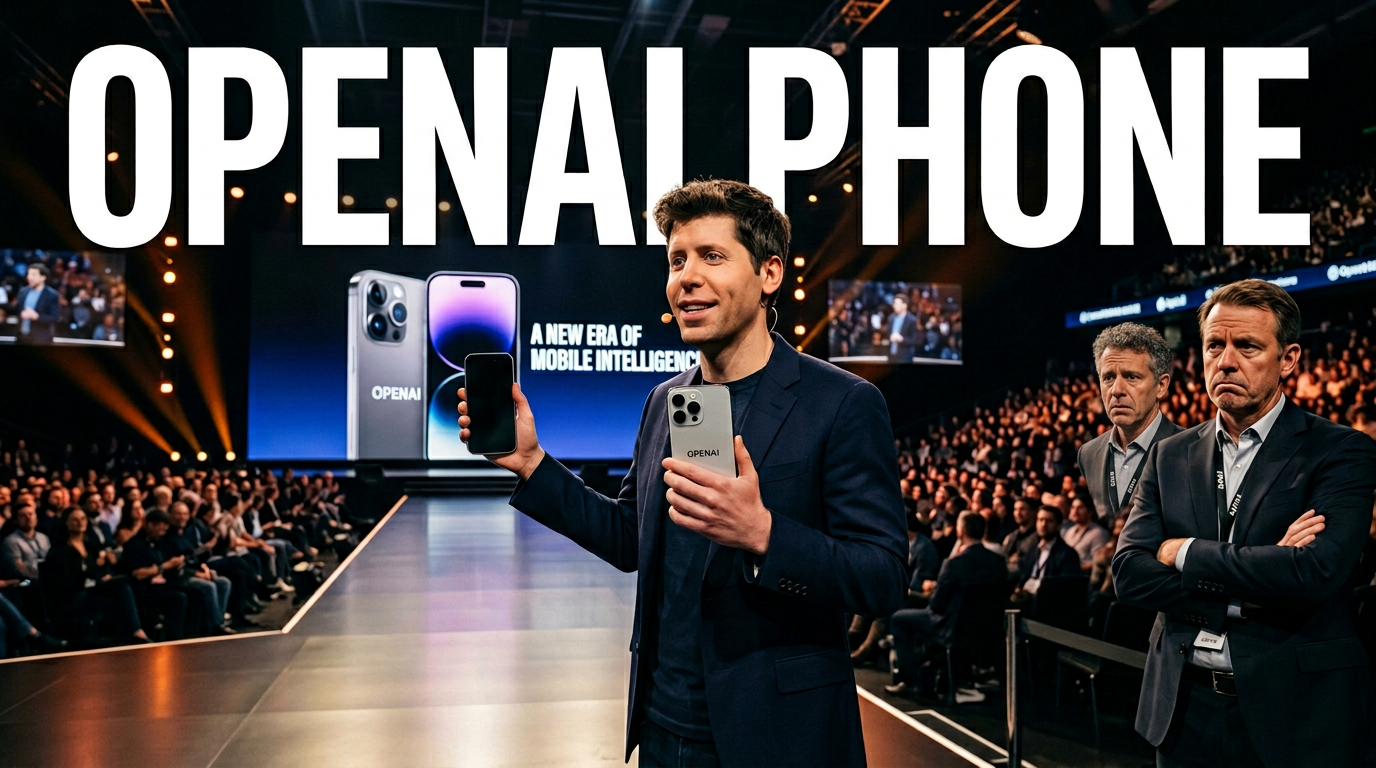
● OpenAI Phone War
The article you are about to read from now on is not your typical news covering simple new product launch rumors.
It is a story about the decisive flare signaling the complete collapse of the mobile ecosystem dominated by Apple’s iPhone for the past 15 years, and the beginning of a new paradigm.
By reading this article to the end, you will be able to most quickly and accurately grasp why OpenAI suddenly changed its stance and intends to make a smartphone directly, and how this decision will overturn the landscape of the IT market for the next 10 years.
When others simply chatter, ‘OpenAI is making a phone!’, you will gain the insight to see right through the true intentions of global IT giants.
[In-Depth Analysis] OpenAI Foreshadows Launch of Its Own Smartphone in 2028… Declaring All-Out War Against Apple
1. [Supply Chain Fact Check] OpenAI Smartphone, Where Is It Currently At?
A surprising fact has been revealed through a recent report by Ming-Chi Kuo, the most highly trusted Apple and IT device supply chain analyst.
It turns out that OpenAI, which had previously drawn the line by saying, “We have no plans to make a smartphone at all,” is actually accelerating the development of its own smartphone behind the scenes with the goal of launching in 2028.
Looking at the faces of the currently identified core point partners, you can tell how seriously this project is proceeding.
First, ‘MediaTek’ and ‘Qualcomm’, the two major pillars of mobile APs, have been selected as the chipset partners that will act as the brain.
The specific chip specifications and the outline of additional parts suppliers are scheduled to be finalized between the end of 2026 and the first quarter of 2027.
And for the most important device manufacturing (assembly), ‘Luxshare Precision’, one of Apple’s major partners, will exclusively take charge, planning to enter full-scale mass production starting in 2028.
Building such a meticulous global supply chain shows OpenAI’s strong will to be reborn as a powerful hardware manufacturer beyond a simple software company.
2. [Change in Strategy] Collaboration with Jony Ive, and the Pivot to Smartphones
Originally, OpenAI was partnering with Apple’s legendary designer Jony Ive to conceptualize a ‘completely new form of AI device’ rather than a smartphone.
Smart speakers, smart glasses, smart lamps, and wireless earphones were mentioned as the candidate group.
OpenAI’s Chief Global Officer (CGO) Chris Lehane also previously stated that the first hardware product would be announced in the second half of 2026 and released in early 2027.
However, a meaningful comment recently left by CEO Sam Altman on his X (formerly Twitter) stating, “It seems like a good time to seriously rethink the way operating systems (OS) and user interfaces are designed,” hinted at a significant revision of the strategy.
They realized the limitation that a form factor in the shape of a peripheral device alone makes it difficult to perfectly implement a true AI revolution in daily life.
In the end, going beyond smart glasses or earphones, they chose a frontal attack strategy of directly jumping into the smartphone market, the most familiar and essential device for humanity.
3. [🔥Exclusive Insight] OpenAI’s True Intentions Not Told by Other News
While other places only talk about what the chipset is and when it will be released, if you are a working investor or an IT trend follower, you must look at the disruptive innovation of the business model hidden behind this event.
The real reason OpenAI goes out of its way to make a smartphone is precisely the monopoly of context data and the domination of the ecosystem.
The current ChatGPT is a passive form that only gives answers when we input questions via text or voice.
However, a smartphone is the only device on Earth that can capture a user’s current location, movement path, activity status, ambient noise, and even the context of communication with others in real-time, 24 hours a day.
When this massive real-time data enters as the core point input value of an AI agent, a continuous and context-aware interface is completed, recognizing my situation and proactively proposing a solution even before I ask.
The more terrifying point is that OpenAI will come to control the hardware and its own OS at the same time.
This is a declaration of war that they will directly build their own massive platform ecosystem, breaking away from the app store commission system dominated by Apple and Google.
Their true master plan is to supply hardware cheaply but provide a powerful integrated AI agent service for a monthly flat rate, thereby completing a massive subscription economy revenue model.
Ultimately, this fight will not be simply about how many devices are sold, but an all-out war with Apple, risking life and death, that will determine who takes the market share of the user interface in the future AI era.
< Summary >
- Launch Goal: OpenAI is developing its own smartphone with the goal of mass production in 2028.
- Core Point Partners: The chipset is from MediaTek and Qualcomm, and manufacturing is exclusively by Luxshare Precision.
- Why a Smartphone: Because it is the only device that can grasp the user’s real-time context (location, activity, etc.) 24 hours a day to implement a perfect AI agent.
- Sam Altman’s Hint: Expressing the will to build their own ecosystem by stating they will fundamentally rethink the OS and UI design methods.
- Market Ripple Effect: Ending the smartphone era centered on simple app execution, foreshadowing direct competition with Apple’s iPhone as a new platform combined with an AI subscription model.
[Related Articles…]
- OpenAI, GPT-5.5 Launch and Anthropic Comparison Showdown
- K-AI Chip Ecosystem Development and Entry into System Demonstration Stage
*Source: https://zdnet.co.kr/view/?no=20260428083334