● Musk Control Shock, SpaceX IPO Signal, Tesla Stakes
The Reuters Exclusive’s Core Signal: A SpaceX IPO Clause, Musk’s Control Imperative, and What Tesla Shareholders Should Monitor
This development cannot be reduced to Tesla closing around $372.
More relevant is that three items converged simultaneously:
First, a single clause in a SpaceX confidential IPO filing obtained by Reuters.
Second, Elon Musk’s statement in OpenAI-related litigation: “I was a fool.”
Third, the implication that both issues connect to corporate governance, control rights, and the longer-term trajectory of AI investment and U.S. equity markets.
While the headline appears to be about SpaceX, it is more accurately a structural signal relevant to Tesla shareholders and growth investors.
This report summarizes the news flow and highlights key points that may not yet be fully reflected in market pricing.
1. Brief market context
Tesla closed around $372.8, with limited day-to-day volatility.
However, broader market sensitivity remained elevated.
The Federal Reserve maintained the policy rate in the 3.5%–3.75% range for a third consecutive meeting, while mega-cap earnings season continued.
Meta declined more than 5% in after-hours trading following earnings, reflecting investor concern about expanding capital expenditures.
Market focus is increasingly on forward capex requirements rather than near-term earnings alone.
2. Key point from the Reuters exclusive: “Only Musk can remove Musk”
2-1. Why a single clause is material
Reuters reported that SpaceX’s confidential IPO filing includes a governance provision with the following effect:
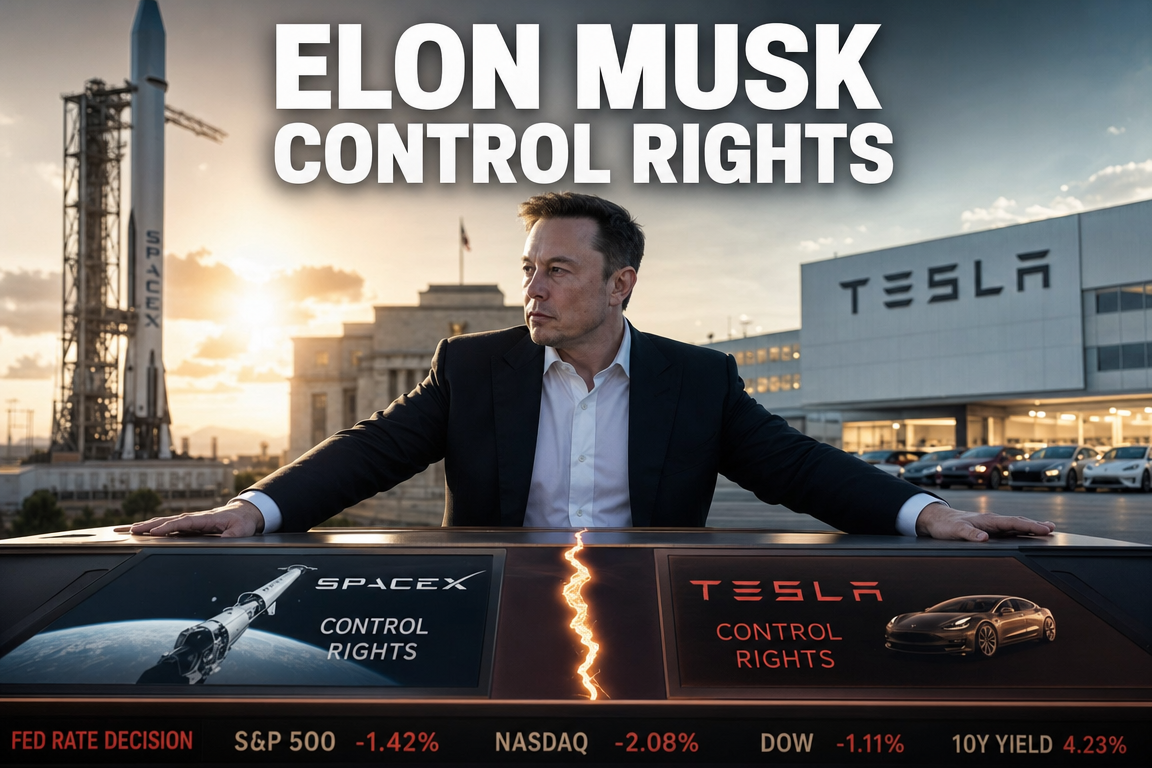
Musk can be removed as board chair, CEO, or president only through the voting power of the Class B super-voting shares he controls.
In practice, the structure makes executive removal difficult without Musk’s own voting consent.
2-2. Dual-class structures are common; this appears more restrictive
Dual-class share structures are common in U.S. technology companies.
Typically, Class A shares carry one vote per share, while founder-held Class B shares may carry multiple votes per share.
Meta, Google, and Figma have used similar frameworks.
However, CEO removal is generally a formal board prerogative, even if founders influence board composition via voting control.
The reported SpaceX provision effectively bypasses the board as an independent check by directly conditioning removal on Musk-controlled voting rights.
2-3. Why this can be implemented
Jurisdictional choice matters.
SpaceX is organized in Texas, and Texas corporate law is often viewed as more accommodating to founder protections and dual-class governance than Delaware.
As a private company, SpaceX also had the ability to pre-design governance terms ahead of any public listing.
2-4. Investor implications
Strong founder control can support long-horizon execution, but it weakens minority shareholder oversight mechanisms.
For public investors, the structure may function as a de facto acceptance of long-term founder entrenchment.
If SpaceX proceeds with an IPO, the investment case would extend beyond industry growth to the valuation trade-off between control stability and governance risk.
3. Why this matters for Tesla by comparison
3-1. Tesla’s governance structure differs
Tesla largely operates with a single-class structure in which Musk’s shares carry the same voting rights as other shareholders’ shares.
This distinction was relevant in Delaware litigation.
The court invalidated the 2018 compensation plan, citing issues related to board independence and shareholder approval process.
From Musk’s perspective, the episode reinforced that Tesla can be subject to governance and legal constraints that can materially affect control and compensation outcomes.
3-2. Musk’s focus on Tesla voting control fits the same pattern
Debate over Musk’s effective control at Tesla continues.
Market estimates often reference roughly 12%–13% beneficial ownership, with higher figures discussed when incorporating potential option exercises and the possibility of reinstating compensation-related equity.
Musk has publicly suggested that approximately 25% voting influence would be required to pursue long-duration AI and robotics strategy within Tesla.
The central issue is control rights rather than cash compensation alone.
4. Why the OpenAI litigation statement should be assessed alongside the IPO clause
4-1. Interpreting “I was a fool”
In OpenAI-related litigation, Musk argued that early contributions ultimately supported the creation of substantial for-profit enterprise value while he lacked control rights.
The statement signals a governance lesson: participation without enforceable control can result in limited ability to influence outcomes as value accrues.
4-2. The consistent takeaway
Without equity, voting power, or legal defenses, strategic direction can be lost.
Across prior removal experiences, adverse court outcomes, and disputes over governance arrangements, Musk has repeatedly encountered the same constraint.
The SpaceX provision is therefore better interpreted as an intentional governance design informed by past experience, not a routine legal formality.
5. Implications for Tesla shareholders: potential positives and negatives
5-1. Constructive interpretation
Supporters may view stronger control structures across Musk-led entities as a commitment to long-term execution and accountability.
For Tesla, this could reduce CEO-transition uncertainty and insulate multi-year AI, robotics, and autonomous driving programs from short-term market pressure.
Long-duration growth investors may assign value to strategic continuity.
5-2. Key risks
Material concerns remain:
First, strengthening a SpaceX-centered control structure could shift strategic priority away from Tesla.
Second, if future transactions involve mergers or equity-linked arrangements, Tesla’s single-class shareholders could face relative disadvantages in voting outcomes.
Third, Musk’s time and capital allocation may remain fragmented across SpaceX, xAI, Tesla, robotics, and data center build-outs.
6. Why merger scenarios are being discussed
6-1. The market’s framing: AI infrastructure integration
Recurring discussion of Tesla–SpaceX integration reflects more than headline speculation.
Investors increasingly evaluate not only AI model capability but also control over the physical stack: power, chips, data centers, and network infrastructure.
6-2. Signal from Meta’s capex expansion
Meta’s higher 2026 capex outlook reinforced that AI bottlenecks are shifting from software to physical infrastructure constraints.
This dynamic points to industrial reconfiguration rather than a purely “tech” cycle.
6-3. Musk’s apparent three-axis strategy
Based on current reporting and public signals, Musk’s strategy can be interpreted along three axes:
First, long-horizon, space-enabled data infrastructure concepts.
Second, manufacturing capacity for large-scale semiconductor and AI compute supply chains.
Third, Tesla’s robotics, autonomy, energy, and supercomputing capabilities.
Integrating these axes typically requires concentrated control to execute sustained capital deployment and organizational coordination.
7. Consolidated news summary
7-1. Today’s key developments
Reuters reported that SpaceX’s confidential IPO filing includes a provision that effectively ties Musk’s removal to Musk-controlled voting rights.
This appears to exceed standard dual-class founder protection in restrictiveness.
Musk’s litigation testimony regarding OpenAI highlighted dissatisfaction with value creation occurring without corresponding control rights.
This aligns with his increasing emphasis on equity and voting power across his companies.
For Tesla shareholders, potential benefits (leadership continuity and long-term execution) coexist with potential costs (relative governance disadvantages and resource prioritization risk).
At the market level, the more consequential theme is the shift of AI competition toward infrastructure: power, chips, data centers, and networks.
8. Under-discussed core point
8-1. Not only about Musk; it signals governance evolution in the AI era
Commentary often focuses on Musk’s personal pursuit of power.
A broader interpretation is that large-scale AI infrastructure programs may be increasingly difficult to execute under conventional public-company checks and short-term performance pressures.
This episode may be an early indicator of renewed adoption of founder-dominant governance structures in AI-linked industries.
8-2. Tesla’s critical variable may be control structure, not only unit sales
Tesla investors have historically emphasized deliveries, margins, FSD, robotaxi timelines, and battery cost curves.
Going forward, Musk’s ability to secure additional control rights could become a more influential valuation driver.
As Tesla is increasingly positioned as an AI/robotics/energy platform rather than solely an automaker, founder-dependence may carry greater weight.
8-3. A SpaceX IPO could initiate broader capital reallocation
A SpaceX IPO would not be an endpoint.
Public-market credibility, capital-raising capacity, equity as transaction currency, and partnership optionality could enable subsequent strategic moves.
This could become an enabling step toward tighter linkages among Tesla, xAI, semiconductors, data centers, and energy initiatives.
9. Emphasis: focus on the blueprint, not the headline
As a standalone news item, the story reads as another instance of founder control.
At a structural level, it suggests systematic governance engineering to prevent recurrence of past losses of control, adverse legal outcomes, and misalignment between contribution and decision authority.
For investors, the key is whether this governance design catalyzes future capital flows and corporate combinations.
Tesla shareholders should monitor Musk’s ownership and voting trajectory, compensation-plan developments, post-IPO SpaceX actions, and the evolving relationship with xAI.
10. Key monitoring items
10-1. SpaceX IPO timing and offering structure
Monitor when the confidential filing becomes public, the Class A vs. Class B terms, and any minority-protection mechanisms.
10-2. Potential efforts to increase Musk’s Tesla control
Progress toward the voting influence Musk has indicated (approximately 25%) may be material to Tesla’s medium- to long-term investment case.
10-3. Resource-sharing structure among xAI, Tesla, and SpaceX
Watch for clearer frameworks governing talent, chips, data centers, cash flows, and compute allocation across entities.
10-4. Broadening AI infrastructure capex cycle
If Meta, Microsoft, Amazon, and Google continue expanding capex, integrated infrastructure strategies may gain further institutional support.
10-5. Minority shareholder rights at Tesla
Any structural changes should be evaluated for impacts on voting rights and economic rights of non-controlling shareholders.
11. Conclusion
The Reuters exclusive is a governance signal rather than a standalone headline.
The SpaceX IPO clause indicates how Musk intends to secure control and coordinate AI, space, energy, and robotics initiatives.
When assessed alongside the OpenAI litigation statement, the message is consistent: enforceable control is being treated as a prerequisite for participation and execution.
This posture is likely to affect Tesla.
The relevant focus is the control architecture being constructed, not the day’s closing price.
< Summary >
Reuters reported that SpaceX’s IPO filing includes a provision that effectively ties Musk’s removal to Musk-controlled voting power.
This appears to be a stronger founder-control model than standard dual-class governance.
Musk’s OpenAI litigation statement reinforces a shift toward avoiding contributions without corresponding control rights.
For Tesla shareholders, leadership continuity benefits coexist with governance and prioritization risks tied to a stronger SpaceX-centered control structure.
At the macro level, the episode aligns with an AI-cycle shift toward infrastructure competition and potential governance restructuring.
[Related Articles…]
- Tesla stock and shifts in autonomous driving strategy: key points to reassess now
- AI infrastructure investment expansion and U.S. market reconfiguration: what mega-cap capex signals
*Source: [ 오늘의 테슬라 뉴스 ]
– 로이터 단독! “머스크만 머스크 해고 가능” — SpaceX IPO 신청서가 노출한 한 줄, $372 테슬라 주주는?
● Fed Shock, Oil Risk, AI Boom
Powell’s Final FOMC: The Real Signal Was Not the Hold—Fed Fractures, Middle East Risk, and the Link to Big Tech AI Earnings
This issue should not be reduced to a single headline stating that US policy rates were held.
This report focuses on three points:
1) The specific statement language changes in Powell’s final FOMC and why those edits matter for interpreting inflation risks and the policy path.
2) The less-discussed internal fractures within the Fed, upcoming leadership transition dynamics, and why Fed independence concerns could raise volatility across the global economy and equity markets.
3) Microsoft, Amazon, Meta, and Alphabet earnings framed not as “beats/misses,” but through the lens of AI infrastructure competition, data center capex escalation, and how AI investment links to profitability and valuation.
The core takeaway is that the meeting was not about “rates unchanged,” but about: inflation risk remains central; internal disagreements are widening; external political pressure is rising; and Big Tech is monetizing AI while simultaneously expanding a cost base that increases execution risk.
1. FOMC at a Glance
The Fed kept the policy rate unchanged.
Headline-wise this appears uneventful, but statement edits, the vote, and Powell’s press conference tone indicated a more hawkish bias than markets may have assumed.
- Policy rate held
- Stronger language on inflation
- Middle East risk explicitly reflected in the statement
- Internal disagreements became visible
- Powell signaled continued influence rather than a full exit
In this meeting, language, posture, and institutional dynamics mattered more than the rate decision itself.
2. Why the Statement Language Changes Matter
2-1. From “Inflation is somewhat elevated” to “Inflation is elevated”
Earlier language included a softening qualifier. That qualifier was removed.
This suggests the Fed is less comfortable with the inflation backdrop. The shift is notable amid rising global energy prices and the risk of renewed inflation pressure.
Operationally: the Fed is formalizing concern that disinflation may stall or reverse.
2-2. Middle East risk became more explicit
Previous statements leaned on general uncertainty. This time, Middle East developments were directly cited as increasing uncertainty around the US outlook.
This indicates the Fed is assessing not only oil prices but broader spillovers into financial conditions and the real economy.
Energy price spikes can constrain consumption, re-accelerate inflation, and delay rate-cut expectations. Geopolitics is now a core input into the policy reaction function.
3. The Vote Revealed Internal Division
A key signal was the absence of unanimity.
Some participants argued for near-term easing, while others opposed even modestly dovish messaging.
This implies a clearer two-track internal debate:
- Early-cut camp: focused on growth deceleration and labor market softening
- Cautious/hawkish-hold camp: focused on energy, tariffs, and renewed inflation risk
With this structure, market volatility around each FOMC meeting is likely to remain elevated as interpretations of the same data diverge.
4. Powell’s Press Conference: Key Messages
4-1. “Rate-cut expectations are premature”
Powell emphasized that inflation is not yet sufficiently contained and that energy-driven shocks may persist.
He signaled that tariff effects could be transitory, but oil-price pressures may prove more durable—reducing the probability of a rapid pivot.
4-2. “Fed independence must be preserved”
Powell’s strongest tone was reserved for institutional independence.
He indicated that political pressure or attempts to remove regional Fed leadership could undermine the system’s foundation.
For markets, diminished central-bank independence can weaken confidence in the policy regime, raising risk premia across Treasuries, the USD, and risk assets.
4-3. Powell’s intent to remain as a Governor
Powell stated an intention to remain on the Board after his chair term.
Market interpretations typically fall into two categories:
- A stabilizing backstop against political interference
- A potential complication for the incoming Chair during the transition
The intended message appeared institutional: protecting independence rather than exerting informal control. However, perception risk can amplify early-transition volatility.
5. Why the Next Chair Framework Matters
Markets are focused not only on policy direction but also communication changes.
Key items to monitor:
- Whether the dot plot framework remains intact
- Whether press-conference cadence or format changes
- Potential reduction in forward guidance
Less explicit communication would increase uncertainty around the rate path, expanding daily ranges in rates and equities. “How it is communicated” may be as market-moving as “what is decided.”
6. Macro Implications
6-1. The US economy remains resilient
Powell characterized growth as still solid. Consumption and business investment have been more resilient than expected, and recession risk has not yet crystallized.
6-2. Labor markets are gradually cooling
Job growth has moderated. Both supply-side dynamics and demand-side cooling are becoming more visible, which could evolve into a clearer slowdown signal in coming months.
6-3. The risk of inflation re-acceleration has increased
Energy prices, tariffs, and supply-chain pressures could impede disinflation.
The Fed remains more likely to prioritize inflation risk over growth risk, implying that aggressive rate-cut scenarios may continue to be pushed out.
7. Big Tech Earnings: Strong Numbers, Mixed Market Reactions
The central theme of this earnings season:
Big Tech is monetizing AI, but AI is also driving substantial cost growth.
As a result, positive earnings surprises have not reliably translated into equity upside.
7-1. Microsoft: AI has become a cash-generation engine
Revenue and EPS exceeded expectations. AI-related momentum was strong, supported by Copilot monetization, backlog expansion, and cloud competitiveness.
Primary risk: scale and speed of AI infrastructure spending, with tight supply in server components (chips and memory) potentially pressuring broader hardware markets.
Microsoft is increasingly viewed as both an AI monetizer and a contributor to supply-chain tightness via elevated capex.
7-2. Amazon: AWS strengthened; the OpenAI/Anthropic strategy gained traction
Amazon delivered strong results. AWS growth re-accelerated, and AI customer acquisition improved.
Demand tied to OpenAI ecosystems and expanded investment in Anthropic supports a re-rating toward “AI platform” rather than “cloud utility.”
Key concern remains spending intensity: markets are increasingly focused on incremental margins and the translation of AI-driven demand into durable profit growth.
7-3. Meta: Earnings beat, but user growth and costs constrained sentiment
Results exceeded expectations, but investors highlighted:
- Daily active user trends below expectations
- A sharp increase in AI-related spending
Meta remains highly profitable in advertising, but the combination of growth ceilings and an expanding cost base weighed on valuation.
7-4. Alphabet: The most positively received result set
Alphabet benefited from improved perceptions of Cloud and Gemini progress.
Enterprise AI expansion, accelerating cloud bookings, and a strengthened TPU strategy were viewed as constructive—particularly in reducing reliance on Nvidia and reinforcing a proprietary ecosystem.
8. Why FOMC and Big Tech Must Be Analyzed Together
These are no longer separable narratives. Macro policy and AI capex cycles are directly linked.
8-1. Higher-for-longer rates raise AI capex burden
AI data centers, servers, semiconductors, and power infrastructure require large capital outlays. Higher rates increase financing costs and lift discount rates applied to long-duration cash flows, tightening valuation constraints.
8-2. Higher energy prices pressure the AI cost structure
AI is power-intensive. Energy inflation increases data center operating costs and power-infrastructure buildout expenses.
Middle East risk therefore affects both the Fed’s inflation calculus and Big Tech’s cost trajectory.
8-3. Markets are shifting from “growth” to “investment efficiency”
Investor focus is moving from top-line acceleration to the speed and credibility of converting capex into profits.
This explains divergent stock reactions despite broadly strong earnings results.
9. Underemphasized but Material Takeaways
9-1. The key risk is institutional, not the policy-rate level
Central-bank independence is not a visible metric, but once questioned it can reprice term premia, FX dynamics, and risk-asset valuations. This meeting functioned as a credibility test.
9-2. Oil is not only an inflation variable; it is an AI-cycle cost variable
AI growth is tied to power, cooling, servers, chips, logistics, and facilities. Energy prices directly pressure the economics of scaling AI infrastructure.
9-3. AI competition has shifted into a capex arms race
The competitive frontier is less about model announcements and more about:
- Data center capacity
- Chip procurement
- Power availability and stability
- Enterprise customer retention and platform lock-in
This shift connects semiconductors, grid infrastructure, cooling technology, cloud platforms, cybersecurity, and enterprise productivity software into a single investment complex.
10. Monitoring Checklist for Investors
10-1. Fed stance shifts
Track CPI, PCE, labor data, and oil dynamics for signs of renewed hawkishness.
10-2. Duration of Middle East geopolitical risk
Assess persistence through oil, shipping/logistics costs, and inflation expectations rather than headline intensity.
10-3. Big Tech monetization pace versus AI capex
Evaluate “AI revenue added” alongside “capital spent to generate it.”
10-4. Communication regime under the next Fed leadership
Communication changes may move markets as much as policy decisions.
10-5. Supply-chain bottlenecks across semiconductors and power equipment
Memory, GPUs, servers, and power equipment availability remain binding variables across the AI value chain.
11. One-Line Assessment
This FOMC appeared quiet on the surface but was institutionally and directionally louder underneath: stronger inflation vigilance, visible internal division, leadership-transition uncertainty, and heightened independence sensitivity—while Big Tech’s AI-driven earnings strength is increasingly offset by an escalating infrastructure cost cycle.
< Summary >
The meeting’s primary signals were the statement language shift, explicit Middle East risk inclusion, visible internal disagreement, and Powell’s emphasis on protecting Fed independence.
Inflation concerns strengthened, and rate-cut expectations may be delayed.
Big Tech results were supported by AI, but market reactions diverged due to capex intensity.
Going forward, investors should jointly monitor rates, oil, AI infrastructure investment efficiency, and leadership/communication changes at the Fed.
[Related Articles…]
https://NextGenInsight.net?s=FOMC
https://NextGenInsight.net?s=AI
*Source: [ Jun’s economy lab ]
– 파월의 마지막 FOMC, 숨겨놓은 의미를 알려드립니다(ft.박지원)