● Samsung, SK Hynix, AI Boom, HBM Surge, 2026 Shock
From Samsung Electronics Labor Issues to the 2026 Semiconductor Outlook: What Investors Should Focus on Now
This is not simply a question of whether Samsung Electronics and SK Hynix delivered strong results or whether their share prices will rise.
The semiconductor market currently requires an integrated view of AI semiconductors, HBM, data-center capex, US-China strategic competition, high-rate risk, labor issues, and whether the semiconductor supercycle remains sustainable beyond 2026.
This report focuses on:
- Why share prices can remain volatile despite strong earnings
- Why this cycle is structurally different from prior cycles
- When an HBM-led price cycle may shift toward a volume-driven cycle
- Why Samsung Electronics’ labor issues matter beyond company-level industrial relations
- What becomes the key investment test after 2026
1. Current Positioning: Where the Semiconductor Market Is in the Cycle
The market appears to have moved beyond the early phase and into a more established supercycle uptrend.
Recent results from Samsung Electronics and SK Hynix are not merely “good”; they reflect unusually high profitability for manufacturing businesses.
SK Hynix has been discussed in the context of operating margins exceeding 70%, signaling a demand surge centered on memory, particularly HBM.
The core point is not “semiconductors are doing well,” but that AI infrastructure competition has repositioned memory as a central strategic component of the industry.
2. Key Drivers Behind the Earnings Strength at Samsung Electronics and SK Hynix
2-1. Earnings Surprise Driven by Mix, Not Volume
The primary driver was not shipment growth.
The key was a shift in product mix: higher HBM exposure versus commodity DRAM and NAND, creating a structure where operating profit grows faster than revenue.
In practical terms, the industry is selling a higher-priced, higher-value product set.
2-2. This Cycle Is More Price-Led (P) Than Volume-Led (Q)
Historically, semiconductor upcycles were often volume-led: demand increased, supply expanded rapidly, and the cycle ultimately turned due to oversupply.
This cycle is more price-led (P).
AI server HBM is difficult to scale quickly, and it is often tied to long-term customer arrangements, supporting pricing power alongside supply constraints.
2-3. FX Tailwinds Supported Results
For semiconductor exporters, earnings sensitivity includes FX.
A weaker KRW increases reported KRW profits on USD-denominated revenue.
Samsung Electronics, SK Hynix, and TSMC benefited from a supportive environment; SK Hynix’s relative strength reflects heavier concentration in AI memory.
3. Why Share Prices May Not Track Improving Earnings
This is central for investors.
Industry fundamentals and equity-market reactions differ.
Earnings may improve sequentially through Q2 and Q3, but equity markets tend to react more to the rate of change than to absolute levels.
Example: if price gains were 96% in Q1, a 60% increase in Q2 can still be exceptionally strong, yet be interpreted as deceleration.
This gap explains why strong earnings and weak share-price performance can occur simultaneously, particularly when expectations are elevated.
4. 2025–2026 Outlook: Supercycle Continuation vs. Structural Transition
4-1. Near-Term Earnings Momentum Likely Remains Supportive
If current conditions persist, Samsung Electronics and SK Hynix could represent an unusually large share of aggregate earnings within the Korean equity market, reinforcing index-level sensitivity to semiconductors.
4-2. The Investment Narrative May Shift From Late 2025 Into 2026
A key transition risk is a shift from a price-driven phase to a supply expansion and shipment-driven phase (Q).
In that environment, operating margins are unlikely to remain at current extreme levels, and equity volatility may rise even if industry conditions remain constructive.
4-3. Why This Cycle May Be More Durable Than Past Cycles
Prior demand centers were consumer-facing (PCs, smartphones).
Now the center of gravity is business infrastructure: AI data centers, cloud, hyperscalers, and enterprise compute.
This demand is less likely to collapse during moderate macro slowdown, as it is tied to strategic competitiveness rather than discretionary consumption.
Large US technology firms face constraints in cutting AI capex materially due to competitive positioning.
5. The Structural Driver: AI Plus Strategic Competition
Market commentary often stops at HBM demand, Nvidia, and server capex. A deeper driver is strategic rivalry.
This is not only AI product competition; it resembles competition over control of a foundational layer of future economic infrastructure.
Compared with prior internet and mobile transitions, AI has stronger “infrastructure-of-infrastructure” characteristics, and policy actors are more directly involved.
6. Data-Center Expansion Indicates Demand Is Not Exhausted
AI demand should be analyzed through the full stack: applications, models, and the underlying infrastructure.
The infrastructure layer depends on semiconductors, power, networks, and data centers.
As model capability expands, compute requirements rise nonlinearly, implying broader demand beyond GPUs: HBM, DRAM, advanced packaging, power equipment, and cooling systems.
7. AI Bubble Risk: How to Frame It
A single answer is insufficient.
7-1. Industry View: Infrastructure Build-Out May Still Be Early
Despite rising usage, many sectors remain in early-stage adoption relative to the scale required to reshape operating models.
7-2. Asset-Market View: Some Overpricing Risk Exists
Equity markets have priced aggressive expectations into select names, with some share prices moving ahead of near-term fundamentals.
The more relevant question is not whether excess exists, but whether conditions are present for an imminent unwind. Current liquidity, policy settings, and industrial momentum do not clearly indicate an immediate contraction.
8. Geopolitical Risk and High Rates: Material but Not Uniform
Middle East conflict, oil-price volatility, inflation re-acceleration, and delayed rate cuts are negative for risk assets.
Data-center construction relies on project finance and private credit structures; higher rates can pressure weaker participants first.
However, not all operators face equal stress. Large, cash-generative hyperscalers and top-tier developers have higher capacity to sustain investment.
Strategic competition also reduces the likelihood of a broad-based capex reversal.
9. Samsung Electronics Labor Issues: Beyond a Company-Level Event
This should not be treated as a minor headline.
It intersects with:
- Profit-sharing and distribution mechanisms within the semiconductor value chain
- Alignment between shareholders and labor
- Funding capacity for future R&D
- Retention risk for critical talent
- Broader inequality dynamics within Korea
9-1. Context for Labor Demands
When profits rise sharply, compensation demands typically increase, particularly in tight talent markets.
9-2. Company Constraints Are Nontrivial
Samsung Electronics operates a diversified portfolio beyond memory, including non-memory, foundry, devices, mobile, and display.
Loss-making segments and investment-heavy growth areas make immediate, full pass-through of memory-cycle gains into compensation structurally challenging.
9-3. Potential Macro Spillovers
Semiconductors are a core export engine and an input to multiple downstream industries.
If labor actions cause meaningful production disruption, effects could propagate across autos, IT, defense, home appliances, and displays, creating supply-chain risk beyond the firm.
10. Core Issue: Protecting Future Competitiveness vs. Near-Term Distribution
Public debate can become concentrated on how much to allocate to bonuses or shareholder returns.
A more material question is whether the industry is securing the next leadership position across:
- Post-HBM competitive advantage
- HBM4-era base-die and logic integration leadership
- System semiconductor competitiveness
- Foundry and advanced packaging capability
- R&D systems capable of matching software-driven iteration speeds
The critical investment question is whether firms are building a structure that sustains earnings power over the next 3 years, not only distributing current-cycle gains.
11. Underemphasized Points in Common Coverage
- This cycle is not a standard memory rebound; it is part of AI infrastructure competition under strategic rivalry.
- Earnings and share prices can diverge; deceleration in growth rates can drive volatility despite strong levels.
- The inflection from a price-led phase to a volume-led phase is a central timing risk.
- Samsung Electronics labor issues affect investment capacity and talent strategy, not only wage negotiation.
- Post-2026 differentiation may hinge more on system design and packaging leadership than on HBM shipment growth alone.
- Bubble risk may exist in pockets, but an imminent unwind is not established.
- Even if the supercycle persists, market leadership can rotate.
12. Investor Checklist
- HBM price increase deceleration
- Timing of shipment growth translating into earnings
- Changes in hyperscaler capex growth rates
- Data-center financing conditions and private credit stress
- Samsung Electronics labor negotiations and production-disruption probability
- Post-HBM4 base-die and logic leadership shifts
- On-device AI and consumer (B2C) demand recovery signals
- Expansion of new demand vectors (defense, physical AI, robotics)
13. Bottom Line: What This Market Represents
This is not a simple cyclical recovery.
As AI becomes a foundational infrastructure layer, memory and AI semiconductors are being re-rated as strategic assets within the global economy.
Industry direction and equity timing should be separated:
- Earnings can rise while share prices remain volatile.
- The upcycle can persist while leadership rotates.
- Strong profits can intensify distribution conflicts and structural constraints.
The 2026 outlook can be summarized as:
- AI demand is unlikely to fade quickly.
- Investor returns will be driven less by absolute earnings and more by changes in growth rates versus expectations.
< Summary >
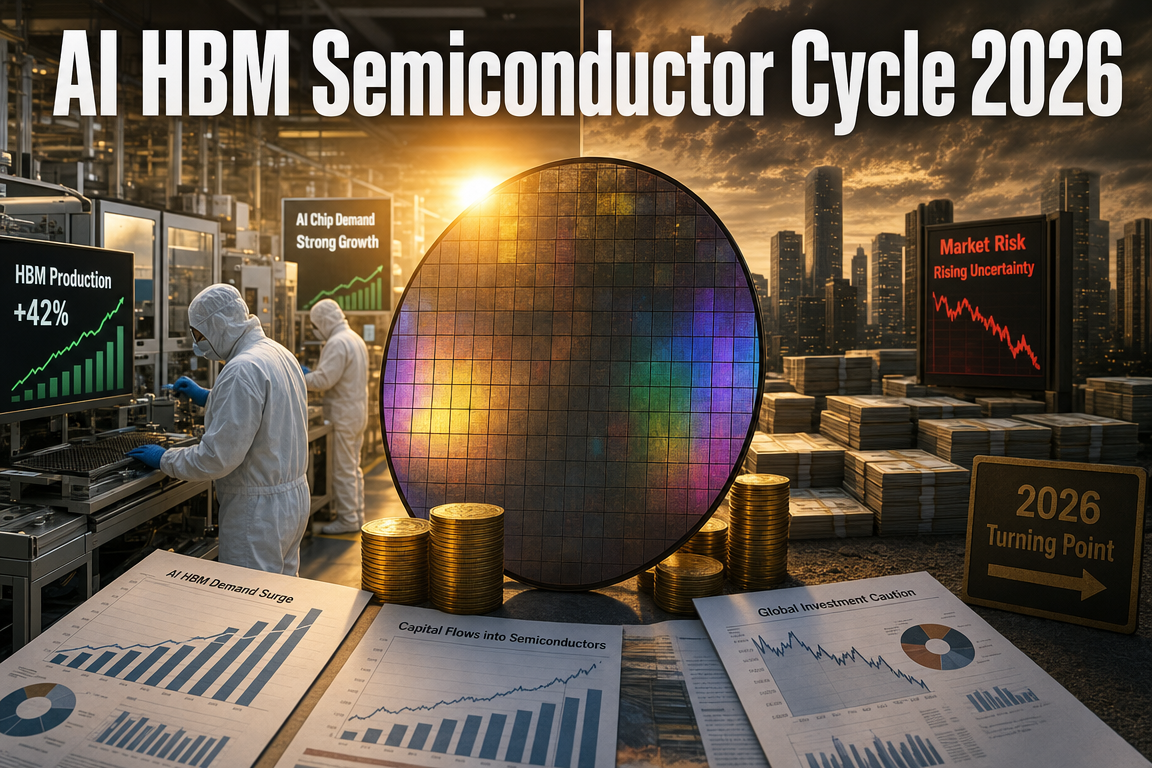
The semiconductor market is in a strong phase led by an HBM-centered price cycle.
Samsung Electronics and SK Hynix earnings are likely to remain strong near term, but equity markets may respond more to deceleration in growth rates.
Unlike prior cycles, this upcycle is supported by AI infrastructure build-out and US-China strategic competition, reducing the probability of a rapid downturn.
From late 2025 into 2026, market focus may shift from price to volume as supply expands, increasing volatility.
Samsung Electronics labor issues are a material variable linked to investment capacity, talent strategy, and Korea’s supply-chain stability.
Investors should evaluate structural transitions, growth-rate dynamics, and leadership shifts, not only headline earnings.
[Related Articles…]
- Semiconductor supercycle and AI investment strategy: latest analysis (https://NextGenInsight.net?s=semiconductor)
- HBM competition and outlook for Samsung Electronics and SK Hynix (https://NextGenInsight.net?s=HBM)
*Source: [ 경제 읽어주는 남자(김광석TV) ]
– [풀버전] 삼성전자 노조 이슈부터 2026년 반도체 전망까지, 지금 반도체 투자자가 봐야 할 진짜 시험대 | 경읽남과 토론합시다 | 이형수 대표
● Buffett Warns, Stocks Turn Casino, AI Bubble Risk, 2026 Strategy
The Real Rationale Behind Buffett’s “Stock Market as a Casino” Warning: Key Takeaways for 2026 Investment Strategy
This is not a single-quote issue. The relevant question is why market behavior is becoming increasingly speculative, what signals are building across the US and South Korean economies, why rates, FX, and USD liquidity have regained importance, and how the AI cycle is simultaneously creating distortions and opportunities. The objective is to connect these factors to 2026 macro assumptions and asset-allocation decisions across US equities, KOSPI, and gold.
1. Context for Buffett’s “The Stock Market Feels Like a Casino” Comment
The message is straightforward: a growing share of market participation is prioritizing short-term price action over business fundamentals.
Equity markets are intended to price long-term cash flows, earnings power, industry positioning, and management’s capital-allocation discipline. Recent market dynamics, however, have increasingly emphasized narratives and ultra-short-term trading.
Key elements embedded in the “casino” framing:
- Increased participation focused on trading price volatility rather than intrinsic value
- Expansion of options activity, leverage, and high-frequency/very short holding-period trading
- Excessive expectations concentrated in AI themes, thematic equities, and meme-style trades
- A prevailing assumption of sustained upside that underweights rate and business-cycle risk
The warning is not a rejection of rising equity prices; it is a critique of markets rising without disciplined assessment of the underlying drivers.
2. Drivers of “Casino-Like” Market Conditions
2-1. AI Expectations Are Running Ahead of Realized Earnings
Global equities have been materially influenced by the AI cycle across semiconductors, data centers, cloud infrastructure, power build-out, software automation, and robotics.
The central risk is overgeneralization: AI’s long-term structural significance does not imply uniform benefits across all companies. In parts of the market, “AI exposure” has been treated as sufficient justification for valuation premia.
Typical associated risks:
- Valuation expansion in companies where earnings have not yet validated expectations
- Price appreciation driven by narrative rather than revenue quality and profitability
- Index and market distortions driven by concentration in mega-cap technology
From a fundamentals perspective, long-term AI adoption and short-term AI-themed speculation are distinct.
2-2. “Peak Rates” Narratives Are Being Over-Discounted
Whenever US activity indicators soften, markets rapidly price rate cuts. Rate cuts are not uniformly supportive for equities; their implications depend on whether they reflect a benign disinflation/soft landing or a deterioration requiring recession mitigation.
A key risk is treating lower policy rates as mechanically bullish for risk assets. Rate cuts do not automatically improve corporate earnings; if cuts occur because growth is weakening, equity risk premia and earnings expectations may face pressure.
2-3. Options and Short-Term Flow Dynamics Have Gained Influence
Compared with prior cycles, options and derivatives activity can amplify short-term moves. Flow-driven rallies can trigger momentum chasing, which then feeds headline narratives, increasing volatility independent of intrinsic value.
This can create behavioral mispricing: rising prices are interpreted as confirmation, increasing the likelihood that late entrants absorb the subsequent volatility.
3. Why the Comment Matters for a 2026 Macro Framework
The statement functions as a practical checkpoint for 2026 planning rather than a moral critique.
3-1. United States: Headline Resilience, Internal Divergence
The US economy has remained relatively firm as consumption and employment have not collapsed. However, internal divergence is increasingly visible: higher-income consumption resilience contrasts with pressure in lower-income cohorts, while credit-card delinquencies, commercial real estate, and small-business financing conditions indicate stress.
In such conditions, equities can rise on the back of a narrow set of very large companies, widening the gap between market performance and broad economic conditions. The risk is that liquidity and expectations concentrate in specific assets, obscuring underlying fragilities.
3-2. South Korea: FX, Exports, and the Semiconductor Cycle as Core Variables
South Korea presents a more mixed setup. Export normalization, semiconductor cycle improvement, and AI infrastructure exposure are supportive. Offsetting factors include domestic demand constraints, debt and real-estate sensitivity, SME/self-employed conditions, and China-related demand uncertainty.
FX is critical to Korean equities and foreign flows. Sustained USD strength can pressure KRW, influencing foreign positioning, import prices, and the Bank of Korea’s policy flexibility.
A 2026 framework for Korean assets should jointly monitor:
- The US rate path
- The DXY trend and the USD/KRW exchange rate
- The semiconductor cycle and global IT capex cycle
- China demand normalization
- Domestic demand and household debt sensitivity
4. Asset Allocation: Practical Interpretation of the Message
The core implication is to increase diversification and reduce complexity as speculative conditions intensify. The traditional emphasis remains: durable cash flows, understandable business models, and avoidance of excessive leverage.
4-1. US Equities: Mega-Cap Following Risk and Concentration Management
US equities remain the primary destination for global capital, and large AI-linked technology platforms may continue to lead. The key risk is concentration: index gains may not reflect broad market health. A modest earnings disappointment or regulatory shift can transmit outsized volatility.
A structured view can separate exposures:
- AI infrastructure beneficiaries: semiconductors, servers, networking, power equipment
- AI application beneficiaries: software, cloud, productivity automation
- Defensive quality: healthcare, staples, dividend-oriented equities
- Cash allocation: liquidity for drawdown deployment
4-2. KOSPI: Semiconductor-Driven, with Rotation and FX Sensitivity
KOSPI has structural exposure to semiconductors and large exporters. AI-linked demand and a recovering global IT cycle are supportive. However, Korean equities are more sensitive than US equities to foreign flows and FX conditions, implying higher tactical volatility.
Sector-level dispersion should be prioritized over index direction:
- Semiconductors: direct exposure to upcycle and AI server demand
- Secondary batteries: structural growth, but valuation discipline and competitive pressure review
- Autos: FX leverage and earnings resilience
- Financials: dividend appeal with rate sensitivity
- Domestic demand sectors: require confirmation of consumption improvement
4-3. Gold and USD Exposure: Renewed Portfolio Relevance
As volatility rises, gold and USD assets tend to regain portfolio utility. Gold is sensitive to real rates, USD trends, and geopolitical risk; USD exposure typically benefits from global risk aversion.
In periods where equities appear strong but internal overheating risks increase, allocations to gold and USD can function as shock absorbers.
5. AI Cycle: Priority Analytical Points
AI is a structural technology shift, but “AI industry growth” and “AI equity returns” are not equivalent. Investment outcomes depend on pricing, margins, and sustainability of earnings.
5-1. Distinguish First-Order vs. Second-Order Beneficiaries
AI exposure spans multiple layers:
- First-order: GPUs, HBM, servers, data centers, power infrastructure
- Second-order: cloud platforms, AI software, cybersecurity, automation platforms
- Third-order: productivity gains in manufacturing, healthcare, finance AI, robotics
Early-cycle returns often accrue to infrastructure; durable returns typically shift to companies demonstrating measurable margin and productivity improvement.
5-2. AI Innovation and AI Bubble Risk Can Coexist
AI can be both a genuine innovation and a source of speculative excess in parts of the equity market. This is consistent with historical technology cycles in which the underlying paradigm persists while many individual equities experience severe drawdowns.
A disciplined approach requires evaluating not only technology direction but also price, unit economics, and profitability.
6. Headline-Style Checklist: 7 Items to Monitor
- First, Buffett’s warning targets speculative behavior, not the existence of equity market upside.
- Second, AI tailwinds remain valid, but not all AI-linked equities offer attractive risk-adjusted returns.
- Third, the US economy appears resilient in aggregates, while consumer and credit sub-indicators show emerging stress.
- Fourth, South Korea benefits from semiconductor and export recovery potential, but must manage FX and domestic-demand constraints.
- Fifth, equity upside cannot be assumed solely from rate-cut expectations.
- Sixth, asset allocation should balance US equities, KOSPI, gold, and USD exposure.
- Seventh, 2026 strategy should prioritize earnings, cash flow, and valuation discipline over momentum chasing.
7. Underemphasized Point in Typical Media Coverage
The main issue is not simply “excess optimism,” but a weakening of market selection mechanisms. Theme- and flow-driven markets can blur distinctions between high-quality and low-quality assets.
When the cycle turns, drawdowns can extend beyond overpriced names and transmit to fundamentally strong assets. The priority becomes quality discrimination across assets and securities rather than directional forecasting.
8. Actionable Implementation for Investors
8-1. Prefer Phased Entry Over Momentum Chasing
Use staged positioning across multiple price levels rather than buying after sharp moves.
8-2. Cash Weight Is a Strategic Tool
Cash is not only a low-return asset; it provides optionality to deploy during dislocations.
8-3. Treat AI as a Sector, but Evaluate Stocks by Financials
Acknowledge the technology trend, but require evidence in revenue conversion, operating profit, capex burden, and customer diversification.
8-4. Monitor FX and Rates in Combination
For Korean-based investors, US rates, USD conditions, and USD/KRW directly influence domestic asset returns.
8-5. Asset Allocation Functions as a Survival Framework
Single-theme concentration is increasingly fragile; multi-asset construction is central to risk control.
9. Conclusion
The “casino” characterization reflects concerns that short-term price action and crowd behavior are displacing business-value assessment. For 2026 planning, the relevant variables include potential US growth deceleration, South Korea’s FX sensitivity, the conditional nature of rate cuts, differentiation between AI beneficiaries and AI excess, and the role of diversified allocation.
The operational requirement is not stronger conviction, but stricter classification: innovation versus overheating, durable assets versus cyclical trades, and long-duration value creation versus narrative-driven repricing.
< Summary >
Buffett’s “stock market as a casino” comment is best interpreted as a warning about speculative market behavior and impaired selection. The US economy appears resilient in headline terms while showing internal cracks; South Korea combines semiconductor/export recovery potential with FX and domestic-demand constraints. AI is structurally significant, but AI-linked equities require differentiation. A 2026 investment framework should emphasize diversified allocation across US equities, KOSPI, gold, and USD assets, with security selection anchored in earnings, cash flow, and valuation discipline.
[Related Articles…]
- 2026 FX Outlook and the Impact of USD Strength on South Korean Asset Markets: https://NextGenInsight.net?s=exchange%20rate
- Reassessing AI Investment Strategy: Where the Next Beneficiaries May Emerge After Semiconductors: https://NextGenInsight.net?s=AI
*Source: [ Jun’s economy lab ]
– 버핏이 주주총회에서 증시가 도박장이라고 경고한 이유