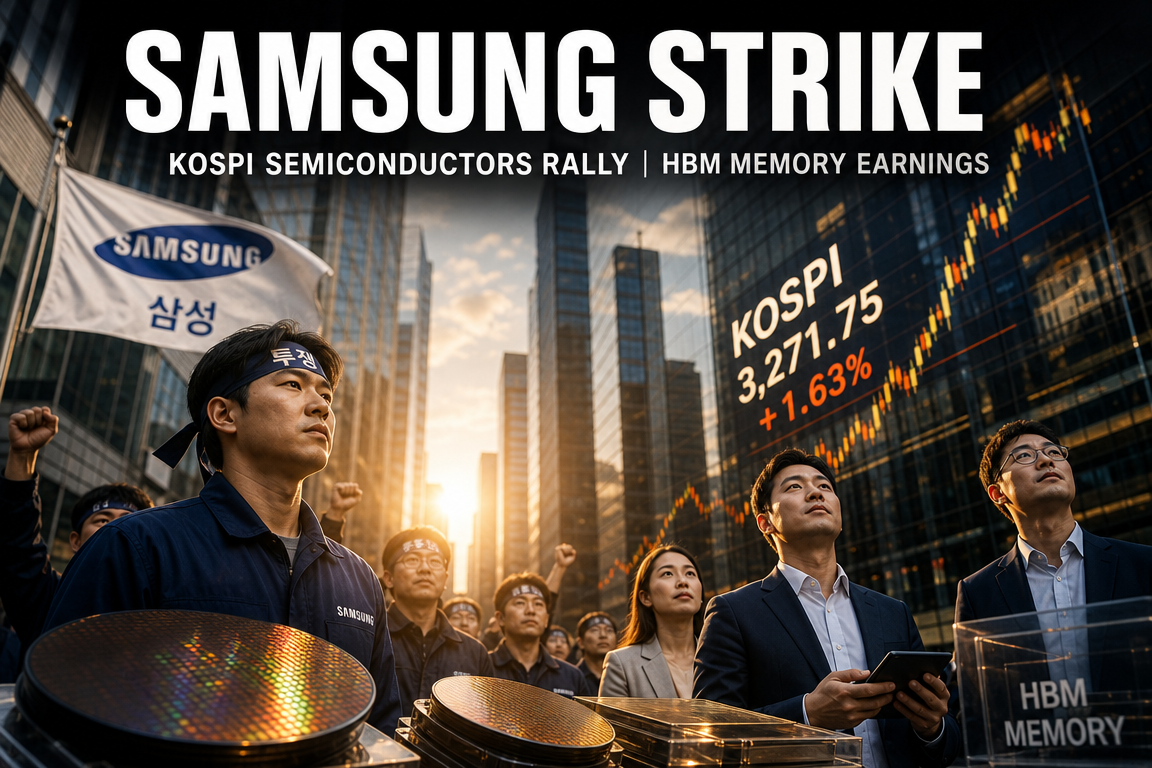
● Samsung strike, export shock, pay war
Will a Samsung Electronics Strike Materially Hit Korea’s Exports? Key Issues in the Semiconductor Bonus Dispute and Macro Spillovers
This is not simply a dispute over “higher vs. lower bonuses.” The issue concentrates on three dimensions:
1) Distribution: how much of the semiconductor upcycle should be shared with employees, and on what basis.
2) Structure: whether the current compensation framework is fit for retaining critical talent.
3) Macro risk: whether a strike lasting beyond two weeks could disrupt Korea’s exports, supply chains, corporate credibility, and equity-market sentiment.
The primary focus is not the probability of a strike per se, but why the compensation dispute can escalate into a broader economic risk; why expanding cash bonuses alone may be insufficient; why the core is not “equal distribution” but “critical talent retention design”; and why the current labor-management conflict highlights structural constraints in Korea’s industrial model.
1. What is at stake in the bonus dispute
The labor-management conflict centers on the semiconductor division’s performance-based pay system.
As SK hynix has reported strong earnings momentum driven by memory-market recovery and strengthened HBM positioning, internal comparisons have intensified at Samsung Electronics.
Samsung’s current framework includes a cap (up to ~50% of annual base salary) on variable compensation. The union views this cap as limiting employee participation in upside during favorable cycles.
Management argues that materially expanding the total bonus pool is difficult because semiconductors are highly cyclical; allocating a large share of peak-cycle cash flows to near-term compensation may reduce capacity for future capital expenditure and R&D.
The dispute is therefore less about “how much to share in a good year” and more about balancing employee compensation, future investment, and shareholder returns to sustain long-term competitiveness.
2. Why the dispute has intensified (numbers and expectations)
Market expectations around SK hynix’s earnings trajectory and potential employee payouts have raised industry-wide benchmarks, even if some public discussions contain imprecise figures.
Key driver: the memory upcycle and AI-led demand, particularly a higher mix of high-value products such as HBM, has increased compensation expectations at peer firms.
Because the peer group is directly comparable, relative pay levels materially affect internal satisfaction and turnover risk.
3. Union position: retention requires compensation redesign
The union’s argument is that semiconductors are talent-intensive; the loss of core engineers and researchers can weaken technology leadership.
Ongoing references to aggressive hiring offers from Chinese firms (multiples of existing pay) have reinforced concerns that rigid compensation structures may be insufficient to retain critical personnel.
In advanced semiconductor and AI fields, the marginal value of a single high-impact contributor can be outsized: patents, process innovations, yield improvements, and customer qualification milestones can translate into very large economic value. This supports the need for compensation innovation in principle.
4. The key issue is not “how much,” but “how”
Retention-oriented compensation and uniform, broad-based bonus distribution are not the same.
In many Korean firms, bonus debates focus on total pool expansion or equal distribution. This can fail to create strong incentives for the specific individuals most essential to competitiveness.
In semiconductor businesses where leading-edge process expertise, design capability, IP, and customer qualification experience are decisive, maximizing average satisfaction can be less critical than retaining high-leverage talent.
A more effective approach may be materially differentiated rewards for individuals with direct contributions to IP, process innovation, yield improvement, HBM and next-generation memory development, and early ramp/qualification execution.
5. Why shareholder and management constraints matter
Even if labor arguments are credible, opposing constraints are not trivial.
From a shareholder perspective, firm performance reflects both labor input and capital risk. A structure that channels a disproportionate share of profits into cash bonuses can be viewed as weakening disciplined capital allocation.
Global investors in large export-oriented equities emphasize dividends, buybacks, and long-term capital deployment strategy. A structurally higher cash compensation burden can be interpreted as reducing shareholder-return capacity.
From management’s operational perspective, semiconductors require persistent reinvestment: R&D, advanced tooling, HBM capacity, packaging capability, and next-cycle competitiveness demand substantial ongoing cash outlays. Peak-cycle earnings are not fully discretionary.
The conflict is therefore a multi-axis trade-off among compensation, shareholder returns, and future investment.
6. If a strike occurs, how large is the risk?
A limited or short strike may have contained impact, given automation and shift systems. Some level of labor disruption may be absorbed through non-union staffing and existing operating practices.
However, a threshold exists. If labor participation is sufficient to drive meaningful output reductions and persists beyond two weeks, the risk of real production disruption increases.
Semiconductors can benefit from inventory buffers, but if inventories are already tight during a recovery phase, the margin for absorbing disruption is smaller. If effective inventory coverage is only 1–2 weeks, disruptions beyond two weeks can translate into delivery shortfalls.
7. Export impact: why this extends beyond a single sector
Semiconductors are not only a major export category; they are also critical intermediate inputs across manufacturing.
Downstream exposure includes autos, consumer electronics, displays, smartphones, industrial equipment, and battery-related equipment. A semiconductor supply disruption can therefore affect broader production plans and export schedules, not solely semiconductor export values.
If disruptions persist and customer confidence weakens, the impact may be larger in future contract negotiations than in near-term monthly export data. In AI-era competition, delivery reliability is a core element of competitiveness.
8. The “price may rise” argument is only partially valid
Supply disruption can lift near-term DRAM/NAND pricing given the market’s sensitivity to inventory and supply expectations.
However, if competitors capture displaced volumes, the affected supplier can lose share. When the cycle turns, a weaker customer base can face heavier pricing pressure.
Short-term pricing benefits do not offset structural losses from market share erosion and reduced customer trust.
9. Why Korea’s labor-market structure complicates resolution
The dispute also reflects structural characteristics of Korea’s labor market.
The US combines high pay, performance-based incentives, and equity compensation with higher labor mobility and a deeper market for lateral moves.
Korea has a more limited set of top-tier semiconductor employers. Exit options are narrower, and moves to direct peers are not universally available.
As a result, importing a US-style “flexibility” model is constrained by the thinner domestic industry ecosystem. Compensation design must be tailored to this structure.
10. Practical approaches
Three approaches are highlighted:
10-1. Shift part of cash bonuses toward equity-based compensation
Expanding cash bonuses increases management’s investment concerns and shareholders’ capital-allocation concerns.
Equity-based pay or stock-option components can align employees with long-term value creation and reduce short-term cash strain, particularly where multi-year competitiveness (AI, HBM, next-generation memory) is decisive.
10-2. Strengthen differentiated rewards for critical talent rather than uniform allocation
Rewards should be meaningfully linked to value-driving contributions such as IP, process breakthroughs, yield improvement, customer qualification, and early mass-production execution.
Where warranted, long-term incentives with very large dispersion may be more effective than broadly distributed incremental cash.
10-3. Institutionalize goal-based gain-sharing with joint targets
Recurring disputes often reflect insufficient ex-ante agreement on allocation rules.
Jointly defined annual and multi-year targets, with pre-committed sharing formulas upon achievement, can reduce repeated renegotiation whenever the cycle turns favorable.
11. News-style summary
- Event: Labor-management conflict is intensifying over semiconductor bonus structures at Samsung Electronics.
- Backdrop: SK hynix’s earnings improvement and elevated payout expectations have increased internal comparisons and dissatisfaction.
- Union stance: Remove bonus caps and expand the total pool to prevent talent outflows.
- Management constraint: Larger cash payouts may reduce capacity for R&D, capex, and shareholder returns.
- Market focus: Whether any strike remains symbolic or becomes a production-relevant disruption.
- Operational risk: If disruptions exceed two weeks, low inventory buffers can lead to delivery shortfalls and weaker customer confidence.
- Macro spillover: Given semiconductors’ central role in exports and supply chains, the issue can affect broader industrial production and exports.
- Policy direction: Structural redesign (equity pay, differentiated retention incentives, institutionalized gain-sharing) is more material than one-off cash measures.
12. Key points often underemphasized
1) The core is a conflict in compensation philosophy, not only payout size: broad-based sharing vs. critical-talent differentiation.
2) In semiconductors, retaining high-leverage talent can matter more than maximizing average satisfaction.
3) The principal strike risk is long-term customer trust, not merely a short-term export print.
4) Low labor mobility reflects a thin industry ecosystem, not only labor bargaining dynamics.
5) The issue underscores a structural macro vulnerability: concentrated dependence on semiconductors can transmit shocks into exports, FX, equity indices, investment plans, and hiring sentiment.
13. Monitoring checklist
1) Whether negotiations lead to structural reform or end with a one-time special payment.
2) Whether strike participation expands into production roles and critical line-operations staff.
3) Any change in customer engagement across memory and foundry businesses.
4) Potential relative-benefit narratives for competitors (e.g., SK hynix, Micron).
5) Whether incentive-system reform discussions spread across the domestic semiconductor sector.
14. Conclusion
The dispute should be viewed as more than an internal labor issue. It reflects how the semiconductor value created in an upcycle is allocated, how critical talent is retained, how shareholder returns are balanced against reinvestment, and how concentrated Korea’s export model is.
Near-term sensitivity depends on strike scale and duration. Small or short actions may remain manageable. A production-relevant disruption exceeding two weeks raises the probability of inventory-driven delivery shortfalls, weakened customer confidence, and potential share loss.
Over the longer term, the objective is not to become a “higher cash bonus” employer, but an employer with a retention architecture that sustains technology leadership. The more durable solutions are differentiated incentives, equity-based compensation, long-term performance linkage, and institutionalized goal-based sharing.
< Summary >
- The bonus dispute reflects a structural collision among compensation design, talent retention, shareholder returns, and reinvestment needs.
- Limited disruptions may be contained; large-scale production disruption lasting beyond two weeks can materially affect supply chains and exports.
- The key variable is not “how much to pay,” but “who to pay and how.”
- Equity-based pay, differentiated retention incentives, and goal-based gain-sharing are more practical than uniform cash expansion.
- The issue connects to Korea’s broader exposure across exports, semiconductors, AI, and capital markets.
[Related Articles…]
- https://NextGenInsight.net?s=semiconductors
- https://NextGenInsight.net?s=AI
*Source: [ 경제 읽어주는 남자(김광석TV) ]
– 삼성전자 파업하면 한국 수출이 흔들린다? 반도체 성과급 논쟁의 진짜 쟁점 | 경읽남과 토론합시다 | 이주완 박사 [3편]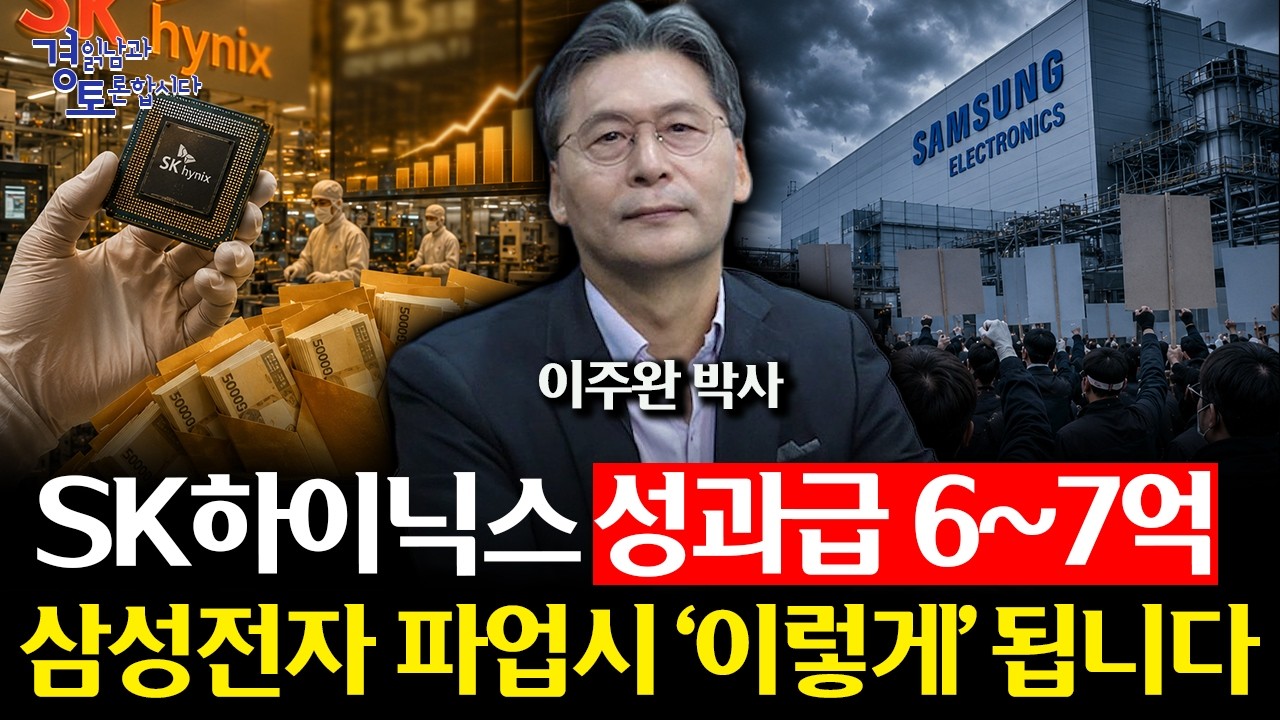
● KOSPI-Surges, Semiconductor-Rally, Bubble-Fears
KOSPI Surge: Is It Still Rational to Chase? 2026 Outlook, Semiconductors, FX, and Risk Management in One View
Today’s move exceeded a standard “rally.” The KOSPI’s sharp rise reflects a combined effect of semiconductor-led risk appetite, earnings expectations, and broader global macro sentiment.
This report consolidates:
- Why Samsung Electronics and SK hynix drove index performance
- Whether the move signals early-stage bubble dynamics or an extension of an earnings-driven cycle
- Practical positioning for retail investors: staggered profit-taking, hedging, and cash allocation
- Linkages across FX, rates, U.S. equities, asset allocation, and AI diffusion
Key under-discussed considerations addressed here:
- Why overheated markets can accelerate further
- Why “low” forward P/E can still coincide with elevated short-term drawdown risk
- Why a semiconductor rally is not equivalent to broad-based Korean equity market strength
One-line summary: The KOSPI surged, led by semiconductors
The market advanced at a rapid pace, contributing to expectations that prior highs could be revisited sooner than previously assumed.
Samsung Electronics and SK hynix rose strongly and mechanically lifted the index due to their large weights. The pattern is best characterized as a concentrated, semiconductor-driven rally rather than a broad sector rotation.
Key points observed in today’s market
1. The KOSPI surge suggests entry into a sentiment-acceleration phase, not only “good news pricing”
Signs of overheating indicate the market is partially moving beyond fundamentals-only explanations. As sentiment becomes self-reinforcing, valuation and news interpretation can be temporarily dominated by fear of missing out.
In such phases, repeated 2–5% daily gains can occur, with momentum attracting incremental flows. Overheating does not necessarily end the move immediately; historically, some of the strongest short-term returns occur during these periods.
2. Samsung Electronics and SK hynix are the primary drivers of the current tape
The strength in these names is a directional signal for Korean equities rather than an isolated stock event.
Primary drivers:
- Memory-cycle recovery expectations: improving DRAM and NAND pricing can lead to rapid upward revisions in earnings estimates.
- AI infrastructure capex: demand for HBM, server memory, and high-bandwidth components is central to data-center scaling; SK hynix sensitivity is high due to HBM exposure.
- Optically low forward P/E: in risk-on regimes, low forward multiples are interpreted as earnings leverage being pulled forward, supporting further multiple tolerance.
3. Overheated markets increase risk, but they often deliver the largest gains
The decision framework is less about “sell everything” versus “hold everything” and more about controlling downside while maintaining upside participation.
Overheated phases are difficult to manage emotionally and operationally, but they can produce outsized returns because expectations pull prices forward.
4. Execution and behavioral discipline matter more than forecasting
Typical progression in overheated markets:
- “It is up too much.”
- “It keeps going.”
- “Wait a bit longer to sell.”
- “If I sell and it rises further, what then?”
At this point, outcomes depend more on predefined rules (profit-taking, cash targets, stop/exit criteria) than on incremental research.
Retail investor playbook for a KOSPI melt-up
1. Staggered selling (partial profit-taking)
A pragmatic approach that reduces regret risk and drawdown exposure.
Examples:
- Reduce exposure by 10–20% at predefined profit thresholds
- Trim into sharp up-days rather than attempting full liquidation at a single price
Benefit: avoids binary timing error; retains participation if the rally continues while building cash for volatility.
2. Hedging and diversification
Objective: maintain upside exposure while reducing tail risk.
Potential tools:
- Raise cash incrementally
- Add positions that historically offset equity drawdowns
- Rebalance away from excessive sector concentration
If semiconductor exposure is elevated, consider balancing with USD exposure, gold, defensives, dividend equities, or short-duration bonds. Diversification functions as portfolio insurance during regime shifts.
3. Full exit and wait
Viable for investors with low tolerance for volatility.
Key requirement: post-exit discipline. Monitoring prices and re-entering at higher levels due to regret increases the probability of poor timing.
Why semiconductors are leading: AI and the memory cycle
1. The first-order beneficiary of AI investment remains semiconductors and infrastructure
Despite broad AI labeling across equities, capital flows are often concentrated first in compute and infrastructure: chips, memory, power, data centers, and networking.
As model size and inference demand rise, required compute scales, reinforcing demand for GPUs, HBM, server memory, and advanced packaging. Korean semiconductor firms remain strategically positioned within the global supply chain.
2. Memory pricing is the primary swing factor
The key variable is the durability of DRAM and NAND pricing improvements, given direct linkage to earnings power at Samsung Electronics and SK hynix.
Market focus points:
- Whether DRAM and NAND pricing continues to improve
- Whether AI server memory demand can offset weaker PC and smartphone demand
- Whether supply growth re-pressurizes pricing before demand fully normalizes
3. Why a low forward P/E does not imply safety
Forward multiples depend on earnings forecasts. If expected earnings fail to materialize, the apparent valuation support can disappear quickly. If earnings exceed expectations, valuation may re-rate favorably. The more relevant question is whether consensus upgrades remain sustainable.
Macro variables that must be monitored alongside the KOSPI
1. U.S. interest rates
Korean equities are highly sensitive to U.S. rate direction. Higher-for-longer pressures growth and tech valuations; renewed easing expectations can amplify flows into semiconductors and AI-linked assets. Monitoring the Fed, inflation, and labor data is essential.
2. FX and USD dynamics
KRW strength typically supports foreign inflows; KRW weakness can be mixed for exporters but may raise overall risk premia. In semiconductor-led foreign buying episodes, FX stability is a critical condition. Rapid USDKRW upside can increase perceived market fragility.
3. U.S. equities and Nasdaq direction
Korean semiconductor sentiment often tracks U.S. AI and semiconductor leaders. Developments involving Nvidia, AMD, Micron, and TSMC can transmit directly into local positioning. The key distinction is whether the rally is globally synchronized or locally isolated.
4. Politics and policy
U.S. election dynamics, China-related semiconductor restrictions, tariffs, and supply-chain realignment can drive valuation and volatility. Protectionism can increase near-term uncertainty; domestic AI/semiconductor investment initiatives can also create incremental demand opportunities.
Primary risks in the current regime
1. Small negative catalysts can trigger outsized moves
Fast rallies accumulate unrealized gains and increase the incentive to de-risk. As a result, minor adverse headlines can cause disproportionate selling pressure.
2. Index strength can mask weak breadth
When a small number of large-cap semiconductors drive the index, broader market participation may be limited. If semiconductors reverse, index downside can be larger than implied by headline strength.
3. Retail “chase risk”
Late-entry buying into extended moves increases the probability of selling into routine pullbacks. In high-volatility regimes, entry price and sizing can dominate stock-selection quality.
Under-covered considerations
1. Managing post-decision regret is more important than perfect timing
The objective is not to sell the top, but to implement a structure that secures gains while maintaining psychological and operational stability. Staggered selling, cash targets, and explicit re-entry rules reduce behavioral errors.
2. Semiconductor strength is not equivalent to broad economic recovery
Index performance driven by a narrow set of exporters does not necessarily signal improvement in domestic demand or a broad earnings recovery across sectors.
3. AI “winners” are often confirmed first in the supply chain, not in thematic equities
Capital typically appears first where capex converts to orders: chips, memory, power, data centers, and networking equipment. Emphasis should remain on companies with visible demand linkage rather than narrative-only exposure.
Implication of the National Pension Service reference: long-horizon framing
Long-duration allocators focus on structural shifts, demographics, global diversification, and long-run return targets rather than daily volatility.
In sharp-rally conditions, investors benefit from explicitly defining whether the account is managed as a trading book or a long-term accumulation portfolio. Without that distinction, risk behavior tends to become inconsistent across market regimes.
Practical checklist
- Confirm whether additional gains in Samsung Electronics and SK hynix are supported by sustained volume.
- Track persistence of foreign net buying; it materially affects rally durability.
- Monitor USDKRW for stability; FX stress can shorten risk-on phases.
- Observe Nasdaq and U.S. AI-semi performance to gauge global linkage.
- Validate whether memory pricing and earnings estimates are actually being revised upward; longer-run direction remains earnings-driven.
Conclusion: This is a strategy-driven regime, not a binary buy/sell call
The market is strong, and semiconductors are stronger, supported by AI infrastructure expectations and a recovering memory cycle. Overheating signals are also present, implying elevated short-term volatility and sensitivity to catalysts.
Priority actions:
- Use staggered profit-taking rather than all-in exposure
- Maintain disciplined cash and diversification parameters
- Monitor rates, FX, U.S. tech, memory pricing, and foreign flows
< Summary >
- The KOSPI surge was led by semiconductors, primarily Samsung Electronics and SK hynix.
- The move reflects a combination of earnings expectations, AI infrastructure expansion, and a memory-cycle recovery.
- Overheating signals imply higher short-term volatility and drawdown sensitivity.
- Risk management (staggered selling, cash control, diversification) is preferred to concentrated directional bets.
- Key variables: U.S. rates, FX, Nasdaq direction, memory pricing, and foreign flows.
[Related Articles…]
- https://NextGenInsight.net?s=KOSPI
- https://NextGenInsight.net?s=Semiconductors
*Source: [ Jun’s economy lab ]
– 코스피 미쳤다