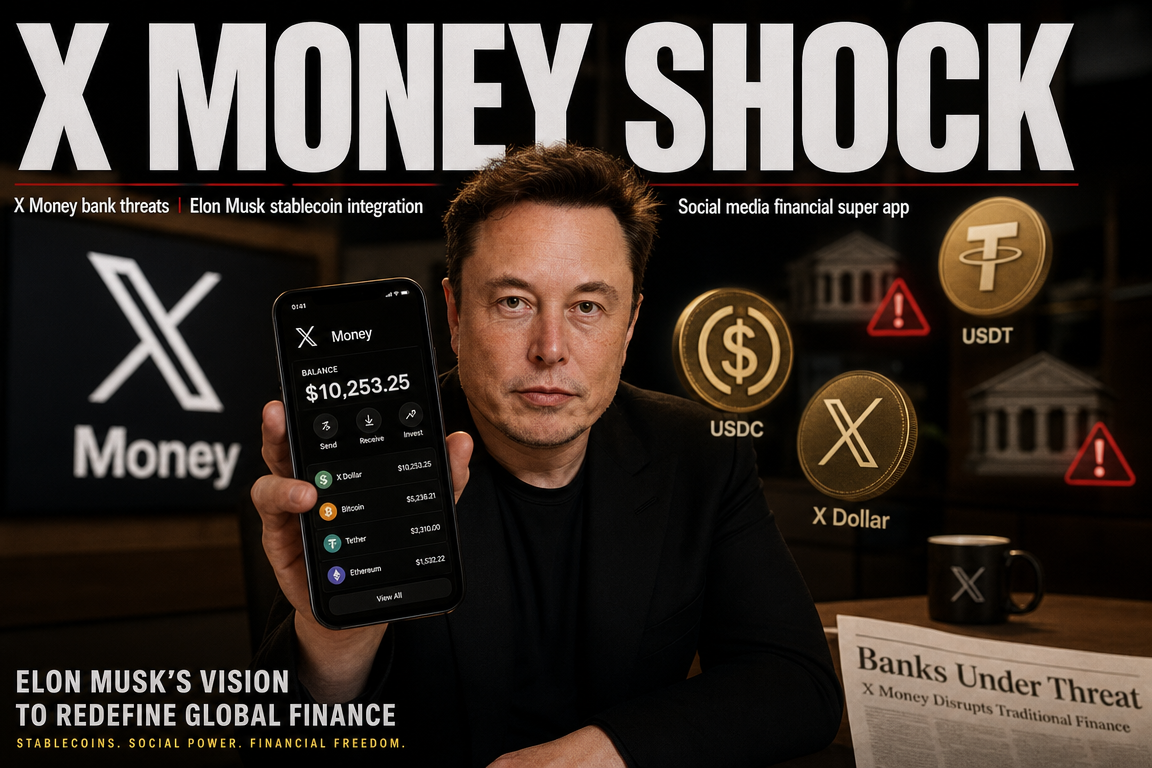
● X Money Threatens Banks Globally
Why Elon Musk’s X Money Is Making Banks Around the World Nervous Right Now
To get straight to the point, this issue is not just a simple payment service.
If X Money actually goes commercial, it could shake up the global financial markets, stablecoins, banking, digital payments, and even the economic outlook all at once.
In particular, when high-yield deposit benefits, cashback, 24/7 transfers, Visa card payments, and deposit insurance are combined, the competitiveness of existing banks will immediately be put to the test.
Today, I’ll organize this in a news-style format, while also unpacking the key risks and the real meaning that other places usually do not cover.
What Is X Money, and Why Is It Drawing So Much Attention?
X Money, being promoted by Elon Musk, is a financial feature within the X platform that lets users deposit money, send it, spend it, and receive rewards.
Simply put, it is similar to combining the functions of KakaoPay and KakaoBank more tightly inside KakaoTalk.
Users can send money, make payments, and store funds inside X as naturally as chatting.
If this structure is completed, X will no longer be just a social media platform, but the central axis of platform finance.
The reason the market is paying attention is that this model is not merely a payment app, but has the potential to expand into a super-app financial ecosystem.
The Aggressive Terms Offered to Beta Users
The currently known beta-stage benefits are quite aggressive.
It provides around 6% annual interest on money kept in the account, and 3% cashback when that money is used for payments.
On top of that, a Visa-based card is attached, making it usable both online and offline anywhere.
What shocked the market even more was the mention of deposit insurance.
If these terms are maintained at a commercial level, it could go beyond competing with U.S. bank deposits and actually change the way assets move.
Why Banks Are Alarmed: This Is Not Just a Promotion
At first glance, it looks like a “good service with high interest benefits,” but the essence is different.
X Money can reduce the marketing costs of acquiring customers by leveraging the enormous user base of the X platform.
If financial services are linked directly inside a platform visited by more than 600 million users each month, customers can come in without banks having to spend separately on advertising.
That is a very uncomfortable scenario for traditional banks.
Because the core of banking is ultimately deposit gathering, payment data, and customer lock-in, and X Money could take those directly inside a social network.
The Real Market X Money Is Targeting: Not Payments, but a Financial Super App
Many people see this issue and think, “Oh, so they’re just launching a payment app,” but that is only half right.
The real core point is a structure in which consumption, savings, transfers, payments, and data analysis are all connected inside X.
X already knows users’ lifestyle patterns and spending patterns, and once financial data is added on top of that, recommendations, lending, and benefit design become much more sophisticated.
In other words, X Money has strong potential to grow into an AI-powered financial platform.
This trend ultimately combines fintech, digital assets, stablecoins, and AI data businesses into one package.
Why the Potential Link to Stablecoins Matters
The most sensitive point is whether X Money can be combined with stablecoins.
Stablecoins are structured to be pegged 1:1 to a legal currency such as the U.S. dollar, making payments and transfers fast and convenient.
If stablecoins begin circulating inside X, users will have less reason to go out to external crypto platforms.
That is convenient for users, but it puts enormous pressure on existing banks, card networks, and cross-border remittance businesses.
In particular, because it could affect the U.S.-dollar-based financial order and cross-border remittance structure, U.S. financial authorities have no choice but to be sensitive to it.
Why Is There No Guarantee It Can Keep Paying 6% Interest?
Here, a reality check is necessary.
The average interest rate on demand deposits in the United States is currently very low, and a 6% interest rate is frankly aggressive.
To sustain that for a long time, money has to be consistently earned somewhere.
In the end, the revenue sources can be narrowed down to three.
First, payment fees.
Second, the expansion of internal financial products on the platform.
Third, highly refined monetization using user data.
In other words, the 6% may be less of a permanent fixed rate and more likely an introductory promotion to attract users.
How Strong Are U.S. Regulations?
Finance is a much more heavily regulated industry than social media.
X Money has already been securing money transfer and payment licenses in the U.S., but to operate fully like a bank, it would need much more complex approvals.
At present, it has obtained licenses in several states, but key hurdles still remain.
New York, in particular, is a core region of U.S. finance, so approval there carries both symbolic and practical significance.
If New York takes a strict stance, X Money’s nationwide expansion will inevitably slow down.
Why the Bank Partnership Strategy Matters
For X to become a bank, it would need to obtain a formal banking charter, but that takes too much time and is too heavily regulated.
That is why X appears to be moving toward a partnership model with banks.
On the surface, this is a payment service, but in practice, it is a structure that borrows bank infrastructure.
In other words, it is a strategy that seeks both regulatory workarounds and rapid expansion at the same time.
If this model succeeds, traditional banks may lose ground at the customer interface.
Why It Will Be Hard to Enter Korea Immediately
It is not easy to expand a similar service in Korea right away either.
Korea’s financial system has a more tightly structured licensing and regulatory framework than the United States.
Simple payment services may be possible, but combining deposit protection, high-interest benefits, and large-scale financial data utilization all at once would face very high barriers.
Therefore, in Korea, a KakaoPay-type payment service may be possible, but duplicating KakaoBank-level functions directly is realistically difficult.
However, the problem is not whether it enters Korea directly, but that if the global standard changes, Korean finance could still feel indirect shocks.
The Most Important Point That Others Usually Do Not Cover
In my view, the core point is not “Will X Money become a bank?”
What really matters is whether X can combine payment apps, banks, social media, and AI into a single user experience.
If that becomes possible, customers will have less reason to open a separate banking app.
What is even more concerning is that as finance becomes embedded in the social feed, user behavior data will be accumulated much more precisely.
In other words, the flow of money will happen at the same time as content consumption.
This is not just financial competition, but a matter of platform monopolies and data power.
Why Elizabeth Warren Raised the Issue
U.S. politics is not taking this issue lightly either.
The reason Senator Elizabeth Warren, the ranking member of the Senate Banking Committee, raised direct questions is not simply because of the interest rate.
The core issue is: “Who controls this service?”, “Is user money safe?”, and “If it connects to stablecoins, will systemic risk in the financial system increase?”
Once politics reacts sensitively, the market is likely to move more cautiously.
The Connection to Visa, Cross River, and the Crypto Industry
Looking at X Money’s partner ecosystem, it becomes even clearer that this is not just a payment service.
If it connects with Visa, it links to the global payment network.
If it connects with a bank like Cross River, it gets closer to crypto and stablecoin infrastructure.
In other words, X Money is trying to serve as a bridge between traditional finance and digital assets.
The more this intersection grows, the more the entire global financial markets will pay attention.
Competitive Landscape: Why Banks, Big Tech, and the Crypto Industry Are All Nervous
Banks are worried that deposits and transfers will flow out.
Card companies are uneasy that payment control may be shaken.
The crypto industry is aware that X could become a massive platform for stablecoin distribution.
Big tech companies are wary of the first-mover advantage of a social-based financial super app.
In the end, X Money is not just affecting one industry; it is a project that is simultaneously breaking down the boundaries of multiple industries.
What the Market Should Watch Next
First, the official launch timing of X Money.
Second, how long the 6% interest and 3% cashback actually last.
Third, whether a stablecoin will be issued.
Fourth, the licensing status in major U.S. states, especially New York.
Fifth, how deeply user data and AI recommendation functions are integrated into financial services.
These five factors will determine X Money’s success or failure going forward.
Summary
X Money is not just a payment service, but a project aimed at turning the X platform into a financial super app.
The initial benefits are highly aggressive: 6% annual interest, 3% cashback, and deposit insurance.
However, long-term sustainability, U.S. regulation, stablecoin integration, and the bank partnership structure are the key variables.
Ultimately, this issue could change the global financial markets, stablecoins, digital payments, banking, and economic outlook together.
[Related Articles…]
Why Stablecoin Regulation Is Tightening and How Global Banks Are Changing
The Fusion of Visa’s Payment Network and AI Finance: Who Will Be the Next Winner?
*Source: 경제탈곡기