● Nvidia, Power, Tokens, Photonics, Physical AI
The Core of the Next AI Competitive Cycle Highlighted by NVIDIA: Power, Tokens, and Optical Connectivity — Key Implications for Korea
This is not solely a semiconductor narrative. The AI industry is shifting from a training-centric phase to an inference-centric phase. To assess the full picture, training/inference economics, data centers, power infrastructure, AI semiconductors, optical connectivity, and physical AI must be evaluated as a single, integrated system.
This report addresses:
- Why performance-per-watt is becoming the dominant metric
- Why “cost per token” is emerging as a primary industry KPI
- Why optical connectivity and optical semiconductors could reshape data center architectures
- Why Korea may be structurally positioned to compete in physical AI
1. Structural Shift in AI: From Training to Inference
The most important transition is the industry’s pivot from training to inference.
Historically, competitive focus centered on: model scale, GPU availability, and time-to-train frontier models. The priority is increasingly shifting toward deployment economics: response speed, unit cost, and operational stability in production environments. Competitive intensity is moving from research to service delivery.
1-1. Why Inference Is Gaining Strategic Importance
Training is typically episodic, while inference is recurring and scales with users and use cases. Once AI is embedded into products and operations, token generation becomes continuous and cost-bearing across:
- Chatbots and search
- Autonomous driving and robotics
- Factory automation and defense systems
- Smart appliances and industrial vision inspection
As a result, operational cost and reliability become as important as model capability.
1-2. New Opportunities Enabled by Inference Expansion
While NVIDIA’s general-purpose GPUs are likely to remain central, inference growth expands the addressable market for specialized accelerators optimized for specific workloads.
A dual-structure may develop:
- General-purpose chips with broad applicability
- Specialized chips optimized for targeted inference workloads
Korean examples cited include inference-focused chip developers and NPU/MPU-class design firms. However, specialized inference chips may face limits in scalability and generality; evaluation should prioritize:
- Target workloads
- Customer segments
- Integration with surrounding infrastructure
2. AI Competition Is Shifting from Peak Performance to Performance per Watt
The primary KPI is moving away from peak FLOPS toward output per unit of power, i.e., performance-per-watt.
2-1. Why Power Has Become the Key Bottleneck
Hyperscale data centers can materially affect regional power balance. Site selection and build-out increasingly depend on power availability before hardware procurement.
This extends beyond engineering into:
- Power generation and grid capacity
- Transmission and distribution
- Cooling systems
- Permitting and policy
- Local economic constraints
AI competitiveness is increasingly linked to power access and infrastructure execution.
2-2. More Important Than Server Price: Tokens per Unit of Power
A central message is that server capex matters less than how many tokens a system can produce per unit of power, reliably and with acceptable latency.
The benchmark is shifting from hardware specifications to service efficiency. Low tokens-per-watt and high latency weaken unit economics and business viability, affecting:
- AI company profitability
- Cloud provider margins
- Public market valuation frameworks
2-3. Key Metrics to Monitor
- Tokens generated per unit of power
- Tokens processed per user per hour
- Latency
- Data center cooling efficiency
- Inter-server communication losses
- Cost per token
- Workload-specific optimization depth
AI is becoming an operational-economics business, not a procurement-driven business.
3. The Token Economy: Token Price Differentiation by Quality and Criticality
AI services may evolve beyond subscription competition toward differentiated token pricing based on quality and reliability requirements.
3-1. Why Cost per Token Becomes a Core KPI
AI outputs are delivered as tokens, but token value is not uniform across use cases.
Potential segmentation:
- Low-stakes tasks (search assistance, casual conversation, basic summarization): lower-cost tokens with higher error tolerance
- High-stakes tasks (financial risk analysis, medical decision support, defense, industrial control, autonomous driving, robotics control): premium tokens with stringent reliability and latency requirements
Tokens may stratify similarly to product tiers: mass-market, premium, and mission-critical.
3-2. Implications for AI Monetization
Competitive advantage may shift from model size to unit economics and pricing architecture, including:
- Lowering cost per token
- Capturing high-value token segments
- Designing industry-specific billing models
- Operating inference infrastructure efficiently
This suggests AI is converging toward platform, pricing, and service-industry dynamics.
4. “Remove Copper”: Why Optical Connectivity and Optical Semiconductors Matter
The transition from copper-based interconnects to optical connectivity is positioned as a potential structural change in data center design, not a component-level substitution.
4-1. Limits of Copper Interconnects
At scale, copper links introduce material power and heat losses in server-to-server and rack-to-rack connections. As AI data centers grow, these losses increase:
- Operating cost
- Cooling burden
- System stability risk
4-2. Why Optical Is Emerging as the Preferred Alternative
Optical connectivity, including co-packaged optics (CPO), can reduce losses and improve throughput and stability, particularly as density rises and facilities scale from megawatt-class toward gigawatt-class.
4-3. Why Optical Ecosystems May Be Re-rated
Market attention has concentrated on GPUs, HBM, and foundries, but the next constraint may be interconnect efficiency.
Areas likely to gain importance:
- Optical semiconductors
- Optical transceivers and modules
- CPO
- Silicon photonics
- Data center networking equipment
- High-efficiency switching technologies
This segment may be underrepresented in current market pricing relative to its potential role in system-level economics.
5. The Data Center Competitive Reality: Power and Cooling, Not Only GPUs
Operationally, the binding constraints are often power delivery and cooling, not hardware availability.
5-1. Data Center Siting Is Increasingly Power-Constrained
Hyperscale development requires coordinated planning across:
- Power procurement and reliability
- Cooling design
- Transmission infrastructure
- Network quality
- Regulatory constraints
- Power unit pricing
- Maintenance cost
Land availability alone is insufficient.
5-2. Cooling Is a Core Infrastructure Layer
Air cooling is increasingly insufficient for high-density AI. Adoption is expanding for:
- Liquid cooling
- Direct-to-chip solutions
- Immersion cooling
Cooling and thermal management are becoming integral to AI infrastructure economics and should be evaluated alongside compute hardware.
6. Interpreting the Priority Supply of 260,000 NVIDIA GPUs to Korea
The figure is symbolic but should be assessed in context.
6-1. Why the Number Should Not Be Overstated
At global scale, large technology firms procure GPUs in the hundreds of thousands to millions. The allocation alone does not establish top-tier AI leadership.
6-2. Why It Still Matters
The significance lies in industrial absorption capacity. Korea has a manufacturing-oriented value chain capable of deploying GPUs into revenue-generating use cases across sectors.
Potential deployment vectors:
- Samsung Electronics: semiconductor process, consumer electronics, manufacturing AI transition
- SK group: memory, data centers, AI infrastructure, cooling solutions
- Naver: cloud, LLM services, region-based AI demand
- Hyundai Motor Group: autonomous driving, robotics, physical AI
- Government, universities, research institutes: public R&D and talent ecosystem expansion
Korea is positioned not only as a compute consumer but as a downstream industrialization platform.
6-3. Why Korea Can Be Strategically Relevant to NVIDIA
Korea is not solely a customer market; it has broad industrial coverage required for physical AI commercialization across:
- Semiconductors and manufacturing
- Automotive and robotics
- Shipbuilding and defense
- Smartphones and home appliances
This increases the probability that NVIDIA’s compute can translate into real-world deployments and measurable industrial outcomes.
7. Why Korea May Be Stronger Than Expected in Physical AI
Physical AI refers to AI systems that move beyond on-screen text generation to control real-world machines: robots, vehicles, factory equipment, defense systems, and logistics.
7-1. Why Physical AI Is a Next-Stage Growth Vector
Physical AI represents post-chatbot deployment: AI embedded directly into industrial processes and mission-critical operations.
7-2. Korea’s Structural Advantages
Korea has competitive depth across:
- Semiconductors
- Automotive
- Robotics and smart factories
- Shipbuilding
- Defense
- Consumer electronics
- Batteries
- Telecommunications infrastructure
This combination is relatively scarce globally. Many countries have strong AI software but limited industrial hardware depth, or vice versa. Korea may have leverage in integrating AI with production systems and equipment.
8. The Semiconductor Ecosystem Is Shifting to Full-Stack Competition
The industry is moving away from “one superior chip” dynamics toward integrated ecosystem competition linking compute, memory, packaging, power, connectivity, cooling, cloud, and industrial deployment.
8-1. Value Chains Likely to Gain Importance
- GPUs and AI accelerators
- HBM and high-bandwidth memory
- Advanced packaging
- Optical connectivity and silicon photonics
- Power semiconductors
- Data center cooling solutions
- Inference-optimized chips
- AI cloud services
- Industrial AI software
A compute-only framework is increasingly insufficient for investment analysis.
9. Key Points (Investor-Focused)
9-1. Current Core Themes
- AI is shifting from training-centric to inference-centric deployment
- Performance-per-watt is becoming more important than peak performance
- Cost per token and token quality are emerging as core monetization variables
- Data center connectivity may shift from copper to optical
- Data center bottlenecks increasingly center on power and cooling
- Korea holds a value chain that may favor physical AI industrialization
- GPU priority supply is more meaningful as an industrial deployment catalyst than as a headline number
9-2. Monitoring Checklist
- Commercialization pace for optical connectivity and optical semiconductor technologies
- Adoption rates for cooling and power-efficiency solutions
- Evidence of customer acquisition and deployment for inference-specialized accelerators
- Whether token pricing becomes more granular by industry and criticality
- Speed at which Korean firms convert physical AI into measurable revenue
10. Underemphasized but Material Implications
10-1. Competition Is Shifting from “Model Performance” to “Operating Economics”
Sustained winners may be determined less by ranking on model benchmarks and more by system-level economics integrating power, tokens, latency, networking, and cooling.
10-2. Optical Connectivity May Become a Primary AI Infrastructure Driver
Interconnect architecture can materially influence data center efficiency and scalability. Optical solutions may shift from auxiliary components to core infrastructure.
10-3. Korea’s Strategic Focus May Be Physical AI Industrialization
Direct competition in frontier LLM platforms against the US may be structurally challenging. Korea’s comparative advantage may lie in connecting AI to factories, vehicles, robots, defense, shipbuilding, and consumer devices, accelerating commercialization.
11. Conclusion (Report Summary)
The current AI cycle contains both overheated segments and structural shifts. Key integrated drivers are:
- The transition toward inference-centric workloads
- The rise of power and token economics as dominant KPIs
- Expansion toward optical connectivity and physical AI deployment
The next competitive phase is likely to be determined not by a single superior model, but by the ability to deploy AI into the real economy with lower cost, lower latency, and higher reliability. Key variables include power, tokens, optical connectivity, and physical AI.
< Summary >
The AI industry is shifting from training to inference.
Competitive benchmarks are moving from raw performance to performance per watt, tokens per unit of power, and cost per token.
Data center bottlenecks increasingly include power infrastructure and cooling. The transition from copper to optical connectivity and optical semiconductors is emerging as a potential next inflection.
NVIDIA’s priority GPU supply to Korea should not be overstated, but it is relevant insofar as Korea has an industrial value chain capable of commercializing physical AI.
Korea’s likely strategic opportunity is less in general-purpose generative AI applications and more in physical AI industrialization linked to semiconductors, automotive, robotics, defense, shipbuilding, and consumer electronics.
[Related Links…]
- NVIDIA-driven restructuring of the AI semiconductor market: investment points to monitor (NextGenInsight.net?s=NVIDIA)
- Data center power infrastructure and cooling technologies: hidden battlegrounds in the AI era (NextGenInsight.net?s=data%20center)
*Source: [ 경제 읽어주는 남자(김광석TV) ]
– 엔비디아가 보는 다음 AI 전쟁 : 전력·토큰·광통신 | 경읽남과 토론합시다 | 유응준 대표 [3편]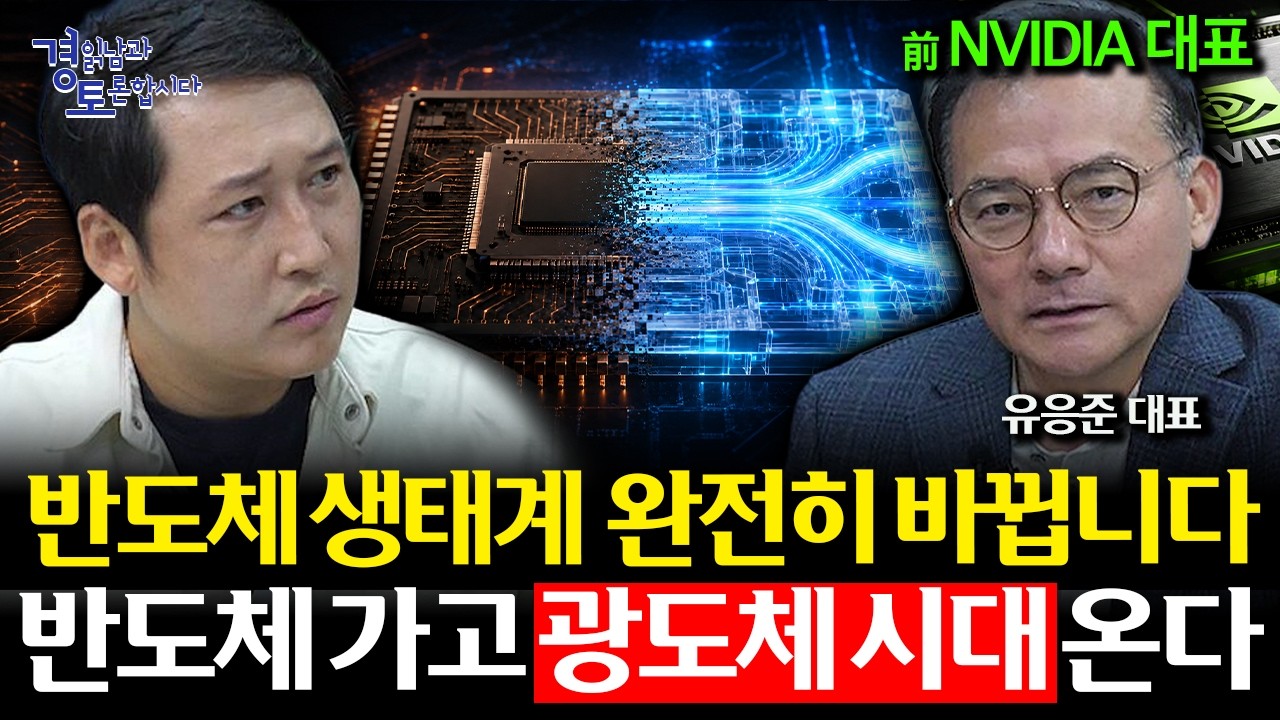
● Edge AI Surge, Next Big Bet
2026 AI Trend Outlook: Why Edge Computing Is Emerging as the Next Investment Theme
This report goes beyond a general overview of AI trends and addresses why Silicon Valley corporate venture investors are prioritizing edge computing, which industries are most likely to monetize first, and where Korean companies and investors can capture opportunities.
Most market commentary still interprets AI primarily through GPUs, cloud infrastructure, and large technology platforms. This report focuses on on-device AI, hardware monetization, privacy/security/cost structures, and why Korea can function as a practical testbed for edge AI commercialization.
The investment implication is shifting from a binary “cloud vs. edge” debate to an allocation question: which workloads are processed where, and how that decision reshapes unit economics and profitability.
1. Core Message: The Next AI Wave Is Edge Computing
Angelo Del Priore, Partner at HP Tech Ventures, highlighted edge computing as a key next-phase trend in AI.
Here, edge computing refers to processing data locally on endpoints or near-device infrastructure (e.g., smartphones, PCs, cameras, vehicles, industrial equipment, medical devices) before transmitting to remote cloud servers.
Key drivers:
- Lower latency
- Reduced cloud operating costs
- Improved privacy and protection of sensitive data
- Resilience in unstable network environments
- Potential for renewed profitability and valuation support for hardware-centric companies
This thesis implies that AI value creation may expand beyond cloud platform winners toward differentiated device and hardware ecosystems at the edge.
2. Why Edge AI Matters Now: The Market Is Moving Beyond a Cloud-Only Phase
2-1. Privacy and Security Are Becoming Binding Constraints
Keeping data on-device reduces the need to transmit sensitive information (e.g., personal conversations, medical records, internal enterprise documents, defense data) to external cloud environments.
In regulated sectors, the moment data leaves the endpoint, compliance costs and breach exposure can increase materially. Sectors with heightened sensitivity include finance, healthcare, defense, and public services.
Edge AI is increasingly a deployment requirement rather than an optional feature.
2-2. Generative AI Has Higher-Than-Expected Operating Costs
Generative AI cost stacks (token/API usage, servers, GPUs) compound as usage scales. Many deployments appear economical in pilots but become structurally unprofitable during enterprise-wide rollout.
Running compact models on-device can reduce repeated server calls and improve total cost of ownership (TCO). Edge AI therefore functions as a practical lever to make AI monetization sustainable.
2-3. Networks Are Not Always Reliable
Industrial sites, logistics facilities, outdoor operations, emergency response, defense, vehicles, and drones cannot assume consistent bandwidth and connectivity.
A hybrid architecture—local first-pass inference at the edge with selective cloud upload—can be superior for performance and cost, and is likely to be foundational for industrial AI, robotics, and autonomous systems.
3. Priority Investment Areas: Future of Work and Edge Compute Infrastructure
HP Tech Ventures emphasized two connected themes:
- Future of Work
- Edge Compute Infrastructure
Productivity gains increasingly depend on AI compute that runs continuously across environments, not only in centralized data centers.
3-1. Future of Work: Computing Shifts Toward New Form Factors
Examples of emerging interfaces:
- AI glasses
- Pendant-style devices
- Earbud-based interfaces
- Lighter, longer-lasting mobile compute devices
This is a competition for post-smartphone interfaces where category leaders are not yet fixed. The monetization hinge is not only software capability but device UX, price points, and distribution.
3-2. Edge Compute Infrastructure: From Cooling to GPU Virtualization
Edge AI requires enabling infrastructure beyond endpoints:
- Chip cooling
- GPU virtualization
- Model compression
- Inference under strict memory constraints
- Next-generation connectivity such as optical interconnects
As AI adoption broadens, competitive advantage may shift from “largest model” to “same performance at lower cost, lower power, and smaller form factors.”
4. Company Examples Illustrating the Direction of Edge AI
4-1. Multiverse Computing: Making Models Smaller, Faster, and Cheaper
Multiverse Computing focuses on compressing open-weight models to reduce compute and memory requirements while maintaining usable performance.
Compression expands deployability from high-end servers to PCs, mobile devices, and field equipment. “Deployability” becomes a core competitive dimension alongside raw model capability.
4-2. Mojo Vision: Deep Tech Resilience Through Strategic Pivots
Mojo Vision transitioned across adjacent domains (AR contact lens to micro-OLED displays to optical interconnects for server connectivity).
The investment takeaway emphasized team execution and persistence over initial product concept, reflecting typical deep-tech commercialization realities.
4-3. Edgerunner: Defense-Oriented Edge AI Commercialization
Edgerunner compresses models and retrains them for defense use cases, enabling deployment in classified environments.
Where requirements include sensitive data handling, low latency, and high security, edge AI’s advantages are amplified. Near-term commercialization may materialize faster in B2B, defense, public sector, and industrial segments than in consumer-only applications.
5. Sectors Likely to Monetize Edge AI Early
Highlighted sectors:
- Retail
- Healthcare
- Emergency response and defense
5-1. Retail: Real-Time Analytics and Cost Reduction
Edge AI can integrate with in-store cameras, inventory devices, unattended checkout, and digital signage. Local processing supports immediate action and reduces exposure from transmitting sensitive consumer data externally.
5-2. Healthcare: Privacy, Compliance, and Low-Latency Requirements
Use cases include clinical decision support, patient monitoring, medical imaging preprocessing, and wearable health management. Cloud-only architectures often face combined constraints of regulation, cost, and responsiveness, making edge deployment structurally attractive.
5-3. Emergency Response and Defense: Strongest Proof of Value
These environments combine weak connectivity, confidentiality, on-site decision-making, and ultra-low latency. On-device AI is frequently more operationally viable than cloud-dependent AI, supporting earlier measurable outcomes.
6. Hardware Companies May Be Re-Rated in the AI Era
Market consensus often centers AI upside on leading semiconductor suppliers and hyperscale cloud providers. A differentiated edge ecosystem could expand the profit pool available to device and hardware manufacturers.
Conditions for re-rating:
- Device-level differentiation beyond commodity hardware
- Integrated on-device AI features
- Improved battery efficiency
- Tight software integration and user experience
- Security and privacy advantages
To attract higher valuation multiples, hardware offerings must resemble platforms with durable differentiation rather than interchangeable products.
7. Why Korea May Be Positioned for Opportunity
Korea was characterized as technology-forward with strong hardware capabilities and an established manufacturing base, including large incumbents with relevant infrastructure.
7-1. Korea as a Commercialization Testbed for Edge AI
Key attributes:
- High adoption rate of new technologies
- High penetration of smart devices
- Strong telecom infrastructure
- Advanced manufacturing ecosystem
These factors support rapid validation of edge AI devices and services in real-world consumer and enterprise settings, positioning Korea as an early reference market.
7-2. Opportunity Set for Korean Startups
HP Tech Ventures indicated ongoing collaboration programs with Korean institutions and continued review of Korean startups.
Potential focus areas beyond consumer apps:
- On-device AI optimization
- Model compression
- Sensor fusion
- Industrial AI devices
- Security-focused AI solutions
- AI semiconductors and power-efficiency technologies
8. Investment Risk Controls: Key Cautions
8-1. Fraud Risk in Secondary Transactions of Private AI Shares
Heightened AI enthusiasm has increased fraud risk in private-market secondary transactions, including claims of ownership in high-profile AI companies without verifiable documentation or clear transferability.
Investor due diligence should prioritize legal structure, proof of ownership, and transfer mechanics.
8-2. For Early-Stage Exposure, Fund Structures May Be More Practical
Direct selection of early-stage startups carries higher risk than public equities. Diversified exposure via established venture funds can be more structurally appropriate for many investors.
8-3. Underwrite the Downside First
A disciplined approach emphasizes the scenario where investment value goes to zero and whether that outcome is tolerable, informed by historical bubble dynamics. AI offers significant opportunity, but profit capture remains uncertain across the ecosystem.
9. Underappreciated Point: Winning Will Depend on Deployability, Not Model Size
As AI moves from experimentation to scaled adoption, operational questions dominate:
- Can the model run on field equipment?
- Is power consumption feasible?
- Does it perform under memory constraints?
- Can it pass security and regulatory requirements?
- Does TCO work at scale?
Market leadership can shift to solutions that optimize deployment efficiency: smaller, faster, safer models that run reliably in real environments.
10. Post-2026 View: Edge AI as a Monetization Filter for the AI Industry
Edge AI should be viewed less as a separate market competing with cloud AI and more as a filter that determines whether AI becomes economically sustainable at scale.
Key commercialization criteria:
- Measurable cost reduction
- Lower security and regulatory exposure
- Reliable operation in field conditions
- Compatibility with existing device ecosystems
- Differentiated user experience and workflow impact
These factors are likely to influence earnings durability and valuation outcomes across the AI supply chain.
11. Practical Checklist
11-1. Investor Focus Areas
- Evidence of revenue linkage to devices and infrastructure, not only “AI exposure”
- Capabilities in on-device AI, model compression, power efficiency, and security
- Sector exposure where edge demand is structurally strong (healthcare, retail, defense)
- Hardware differentiation strategy and ecosystem integration
- For private exposure: verified structures and credible counterparties
11-2. Corporate Focus Areas
- Whether cloud-only data flows are economically and operationally optimal
- Identification of customer privacy sensitivity points
- Long-term operating cost sustainability of AI deployments
- Repositioning existing devices as AI-native products
- Bundling hardware and software to create new margin structures
12. Key Takeaways Often Missed in General Coverage
- Edge AI is fundamentally about improving cost structure and profitability, not novelty.
- Hardware re-rating potential exists, conditional on differentiated AI-enabled experiences.
- The next competitive axis is deployment efficiency, not maximum model size.
- Korea has structural advantages as an early commercialization and validation market.
- Private-market AI hype increases fraud risk; verification is critical.
13. Conclusion: The Next Battleground Is Post-Cloud Operationalization
Current attention remains concentrated on large models, hyperscalers, and data-center buildouts. Performance in markets and public equities may increasingly depend on the next layer: deploying AI cheaper, faster, safer, and at scale in real environments.
Edge computing sits at the center of this transition, linking semiconductors, devices, software, security, industrial automation, healthcare, defense, and retail. Korea is positioned with meaningful advantages in this shift.
< Summary >
Edge computing is a key vector for AI adoption after 2026, driven by privacy, security, cost reduction, low latency, and field deployability.
Priority sectors include retail, healthcare, and defense/emergency response.
Key investment factors include model compression, on-device AI, hardware differentiation, power efficiency, and security capabilities.
Korea can function as an effective testbed for edge AI due to hardware strength and rapid technology adoption.
The next phase of AI value creation may depend less on model size and more on the ability to deploy AI economically and reliably at scale.
[Related Articles…]
- Edge AI and the On-Device Revolution: 2026 Hardware Re-Rating Factors (NextGenInsight.net?s=edge)
- AI Investment Strategy 2026: Where the Next Profit Pool Emerges After the Cloud (NextGenInsight.net?s=AI)
*Source: [ Jun’s economy lab ]
– 다음 AI 트렌드는 엣지 컴퓨팅입니다(ft.Angelo Del Priore)