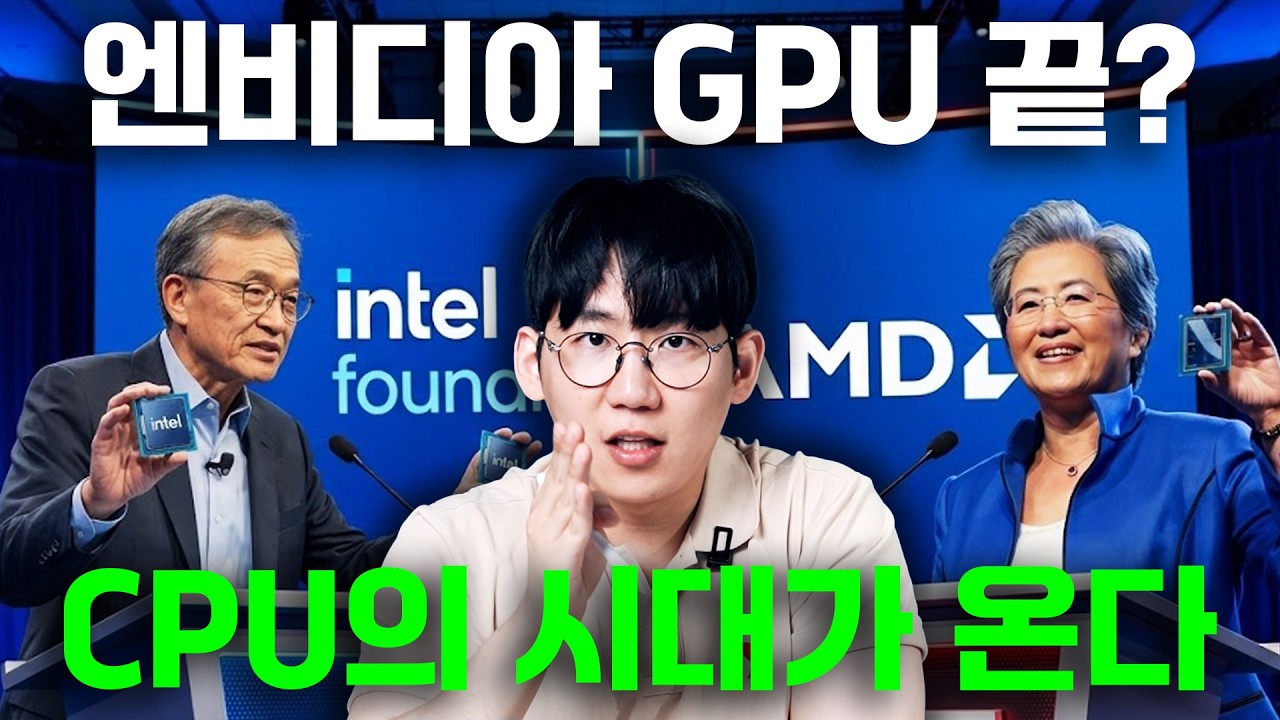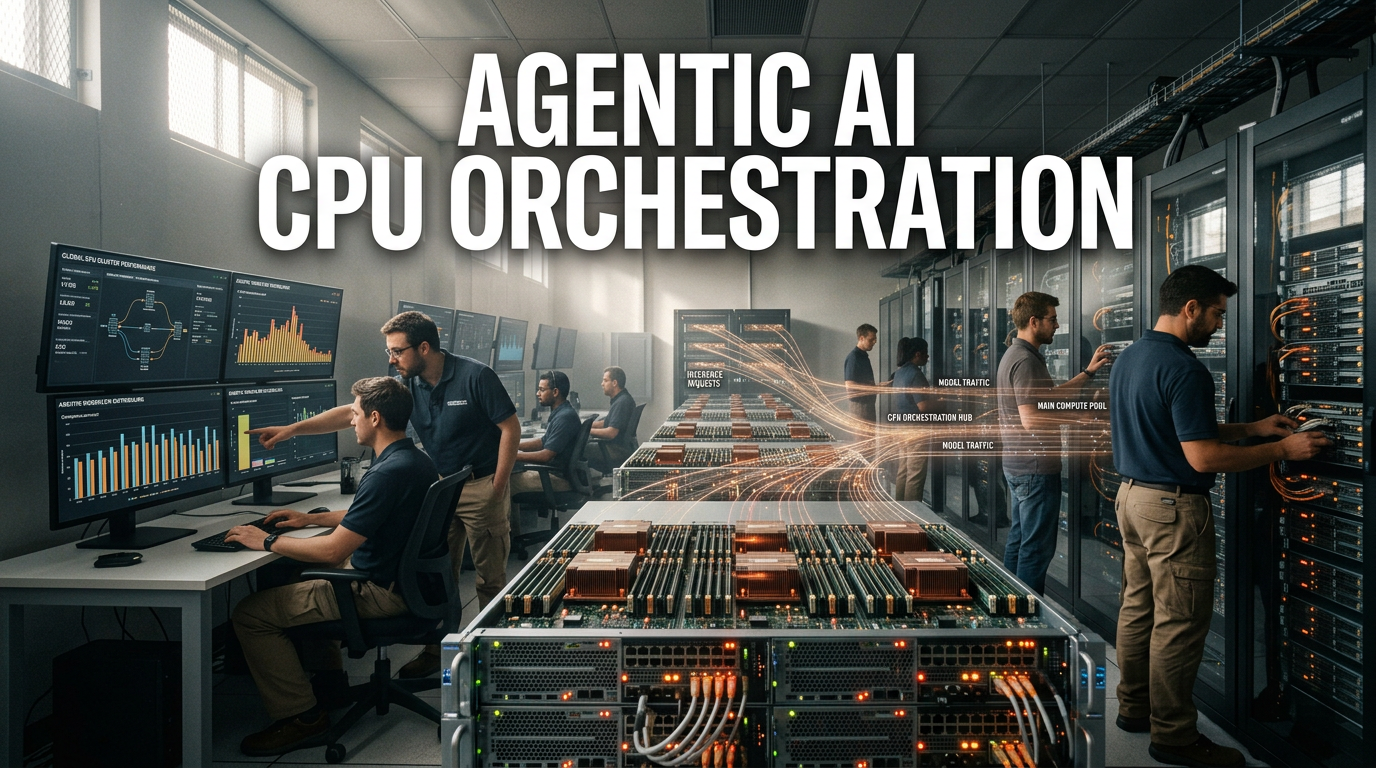
● Agentic AI drives CPU surge
“Not “The Next After NVIDIA GPU,”” the “main base” of the Agentic AI era is moving to the CPU: memory & storage explode, and Intel & AMD are reassessed
3 things you must check in today’s post (if you miss these, you can’t catch the follow-up flow)
- 1) AI investment theme shifting from GPU over-obsession to CPU-centered orchestration
- 2) Memory, network, and storage—once outside people’s radar—has already entered the “explosion” phase
- 3) As CPU supply bottlenecks (wafer & packaging) drag on, server CPU prices could remain strong
News key takeaway in one line
As Agentic (Agentic) AI moves from learning to the stage of “executing work (inference & orchestration),” the role of CPU (management, scheduling, and control of token/workflow) grows larger than the GPU. As a result, there is a flow where the broader infrastructure—including memory and storage—is being reassessed.
1) The market is looking for the “main base” again: memory, network, and storage ran first
1-1. Why the “sector nobody cared about” surged first
When AI grows, it’s easy to expect only GPUs, but in reality the costs for data processing, storage, and transmission required for AI also surge together. In particular, Agentic AI repeats not just “one question,” but “multiple steps of execution,” so as required token processing/waiting/pre-processing/connecting increases, demand for memory, storage, and network grows faster.
1-2. Supply/demand signals emphasized in the original: the stock price tells you first
- Samsung Electronics, SK hynix, Micron: strong sentiment for memory prices
- Top-gaining stocks in the US market: SanDisk (mentioned in the original)
- “Did the market imagine that storage would rise like this when AI starts?” → the market reaction is already priced in
Main points I want to convey (conclusion of this section)
It’s not that the GPU theme is cooling; the key point is that the infrastructure supporting GPUs (memory/storage/network) is being reflected in prices first.
2) Shifting weight from “GPU talk” to CPU: the “manager” of Agentic AI is the CPU
2-1. GPU is the “barbell-lifting athlete,” CPU is the “coach/manager”
If you use the original analogy as-is: the GPU is an athlete with powerful computation (strength), and the CPU is the role that makes good use of that athlete (scheduling, orchestration, management). And once Agentic AI fully kicks in, as it shifts from “learning” to “execution (handling tasks),” the CPU’s share grows larger in perceived terms.
2-2. CPU: a direction where the ratio to GPU shrinks compared to the past (1:8 → 1:4 → even smaller)
- Past: CPU:GPU ≈ 1 to 8 (mentioned in the original)
- Now (the transition period): can move to as much as 1 to 4
- Future (expected scenario): there are views it could get close to 1 to 1
2-3. The structure: the more agents, the more CPU you need
If you think of AI like people: a simple chatbot is closer to “one person’s conversation,” but an agent is closer to “a meeting/team operation.” Just like as more agents increase, the required management headcount (administration/scheduling/execution) rises, you need more CPU as well.
Main points I want to convey (conclusion of this section)
The point to watch in the Agentic AI era isn’t just “GPU performance,” but how much the “orchestration cost” of the CPU grows. That’s why the market’s attention is moving to the CPU right now.
3) Signals of increasing CPU share that actually show up in next-gen platforms “at the level of Rubin”
3-1. A design where CPU and GPU quantities are set to be similar (based on original figures)
In the original, it cites Nvidia’s next-gen platform (Verarubin) as an example and says the deployment ratio of CPU to GPU is designed at nearly the same level. Example: 108 CPUs, 1152 GPUs, etc. (original phrasing)
3-2. There exists a separate CPU block (“CPU rack”) to manage agents
It’s not just a matter of using general-purpose CPUs together; it mentions a design that separately includes components that manage agents. In other words, there is a high chance that CPU demand keeps occurring structurally, repeatedly, in the system architecture.
Main points I want to convey (conclusion of this section)
The most important point in this theme is on the “system design” side—not on the “talk”—that it is allocating a larger share to the CPU.
4) Token explosion + more execution steps: CPU has more work to process
4-1. Increase in tokens (work units): Agentic AI demands higher “throughput/rotation”
The original says it’s easy to understand tokens as if they were morphological units, and it explains that in the agent era, the volume of token generation can grow up to 15x versus the existing level. Ultimately, it means that even for the same result, you go through far more steps (connecting, reviewing, re-executing), so the range where the CPU gets involved increases.
4-2. What the CPU does: pre-processing, scheduling, orchestration, and application execution
- Data pre-processing (organizing/preparing inputs)
- Work scheduling (deciding when what to hand to the GPU)
- Orchestration (connecting multiple applications and managing the execution flow)
- Execution environment management (repeated interventions in large-scale systems)
4-3. Still, there are sections where the GPU remains more advantageous (the reality of bottlenecks)
The original assumes that “for the cost-performance of inference, the GPU is still absolutely superior,” and states that the CPU is in a structure where bottlenecks are prone to happen. And while GPU inference performance improves by around 10x every year, if the CPU can’t keep up by the same amount, bottlenecks can grow larger. If that happens, server designs are likely to shift toward needing CPUs more densely.
Main points I want to convey (conclusion of this section)
Agentic AI isn’t “GPU-only to the end”; it’s a structure where the management/execution layer handled by the CPU thickens, so you can view it as a phase where the quality of CPU demand changes.
5) Can we ramp up CPU production more? Reality is supply bottlenecks of “wafer + packaging”
5-1. Wafer process reservation bottleneck: AI GPUs take priority
The original says that at the world’s largest foundry (e.g., TSMC), the 3nm-class process is nearly fully booked, and there could be hundreds of waiting companies. Because higher-margin AI GPUs get priority, the logic is that server CPUs inevitably get pushed back relatively.
5-2. Lead times (supply lead) and price pressure
- As of Q1 of 2026, it’s mentioned that the lead time from delivery/shipment is about 52 weeks (1 year)
- If demand increases first and supply comes later, there’s a higher chance that server CPU prices remain strong
5-3. If packaging bottlenecks overlap too, CPU production capacity is even more limited
It’s not just the wafer stage; packaging processes like cutting, stacking, and heat dissipation are also required. The original suggests that CPUs could also become “waiting food” here, meaning production might not be easy.
Main points I want to convey (conclusion of this section)
Even if CPU demand grows, there are industrial constraints (wafer/packaging) that may prevent supply from immediately catching up, which could show up as strength in price and revenue.
6) Reordering beneficiary candidates: why AMD can win (positioning versus Intel & Nvidia)
6-1. AMD’s “two-sided port” strategy
The most directly stated point in the original is: “Companies that have both CPU and GPU at the same time are advantaged.” There were periods when AMD lagged Intel in CPUs and lagged Nvidia in GPUs, but in the Agentic AI era, the view is that expanding CPU share can directly translate into upside.
6-2. Signals of expanding server CPU market share (original figures)
- In the server CPU market centered on Epic (Epyc), it mentions a share up to 41% (original)
- Interpretation of the shift where Intel used to be strong but AMD quickly catches up
6-3. Second half of 2026: expectations for new products like MI450 (based on original specs)
- MI450: mentions HBM capacity around 432GB (original)
- Expectations that it won’t fall behind in the spec sheet, though actual performance needs testing
- Expectations for rebound/sentiment related to platforms such as Rexcale (Hyper/Helios, etc.)
Main points I want to convey (conclusion of this section)
The flow presented is that AMD isn’t a stock you buy by only following “GPU talk”; there is room for reassessment when CPU share expands.
7) Intel reassessed: data center revenue shifting into an “earnings season”
7-1. What changed behind the stock: Q1 data center revenue growth (original)
The original says that while Intel has suffered weak stock performance for a long time, the atmosphere changed recently because data center revenue increased meaningfully (a 22% increase in the original).
7-2. Consecutive earnings surprises + improved operating profit margin
- 6 consecutive quarters of earnings surprises (original)
- Operating profit margin starting to exceed 15% (original)
- The key in market reaction is not only “the numbers themselves,” but the leverage of data center revenue
7-3. Signals of customer/ecosystem adoption (examples from the original)
- Google: mentions full adoption of the next-gen Xeon CPUs
- Mentions Intel used as the host CPU in Nvidia DGX Rubin
- So, it’s a picture where “Intel returns to the center stage.”
Main points I want to convey (conclusion of this section)
Even if the GPU theme passes, there is a message that players like Intel can return to the center again if data center performance is strong enough to back it up.
8) Investment keeps going even amid the “AI bubble” debate (reinterpretation of the original big claim)
8-1. Why it’s hard to cut back on investment: competition at the national level + cost (personnel) scale
The original believes AI investment is difficult to reduce even if it goes through “bubble talk.” The reasons include the cost structure such as software developers’ salary (described as on the order of 3 trillion won per year) and competition at the national level (the gap with China, security/championship competition).
8-2. Core point: find infrastructure companies that have the “honey pot”
The conclusion here is simple. An AI boom can happen anywhere, but what matters are the companies sitting in the segments that actually absorb demand (memory, storage, network, CPU orchestration).
5 “additional most important points” that are commonly missed in YouTube/other news (separate recap)
- The battleground for AI isn’t just “computation,” but “execution flow (orchestration).”
- As agents explode token counts and step counts, the CPU involvement range increases.
- If supply bottlenecks can’t keep up with demand, prices may move first (wafer & packaging).
- Even if GPU performance improves quickly, if the CPU becomes the bottleneck, the system ultimately ends up needing more CPUs anyway.
- When choosing beneficiary companies, don’t look at only the GPU single theme; you should also view the linkage of “memory/storage/server CPUs/data center revenue.”
Main points I want to convey (one-paragraph conclusion)
The current market flow can be interpreted as a signal that it’s not “NVIDIA GPU is over,” but that as Agentic AI moves into real work execution steps, there is a structural shift where the CPU’s share and role increase underway. At the same time, infrastructure sectors like memory, storage, and network had their pricing reflected first, and because CPU supply can’t easily expand due to wafer/packaging bottlenecks, strength can continue in price and performance. So the next action isn’t to look only at GPUs—you should also check the trend of capturing CPU orchestration demand from a data center perspective.
Core keywords (naturally reflected)
Semiconductor cycle, data center investment, server CPU, memory prices, Agentic AI trend
< Summary >
- As Agentic AI moves from learning to the execution (orchestration) stage, the CPU’s role grows.
- Memory, network, and storage (e.g., Samsung/Hynix/Micron, SanDisk) surge first, showing strong infrastructure demand.
- The CPU:GPU ratio shifts from 1:8 to 1:4, etc., and there are observations that it could shrink further long-term.
- As token and work steps increase, the CPU intervenes more in scheduling, management, pre-processing, and execution.
- Because of wafer and packaging bottlenecks, CPU supply expansion may be limited—this can be a factor behind server CPU price strength.
- The flow presented is that beneficiary candidates like AMD (server CPU + data center expansion) and Intel (data center revenue and operating margin improvement) are being reassessed.
[Related posts…]
- The next cycle after Agentic AI: why CPU orchestration is growing
- Server CPU supply bottleneck (wafer & packaging) creating a price premium
*Source: [ 월텍남 – 월스트리트 테크남 ]
– 에이전트 AI 시대에는 엔비디아 GPU 말고 이게 오릅니다