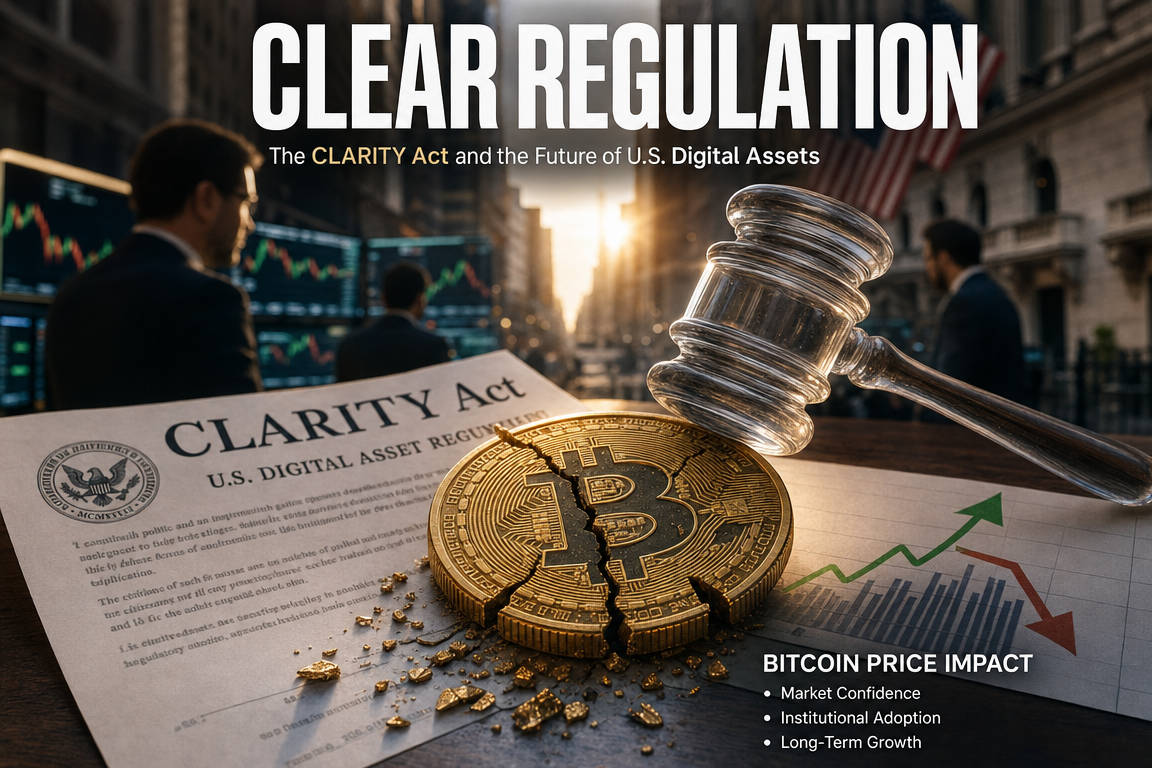
● CLARITY Act Breakthrough
U.S. digital asset regulation “CLARITY Act” passes Senate Banking Committee… why the biggest turning point is coming for the virtual asset market
As the U.S. Senate Banking Committee passed the comprehensive digital asset regulation bill, the CLARITY Act, by a vote of 15 to 9, a major turning point has emerged for virtual assets, Bitcoin, and digital asset regulation as a whole.
This vote should be read not simply as a bill moving one step forward, but as a signal that the United States has begun to seriously define how it will view cryptocurrencies as assets, who will supervise them, and how far it will recognize DeFi.
In particular, this news can directly affect Bitcoin prices, the financial markets, the U.S. stock market, and virtual asset investment, so the current trend should not be overlooked.
1) Core news summary
The U.S. Senate Banking Committee approved the CLARITY Act by a vote of 15 to 9 on the 14th (local time).
All 13 Republican lawmakers voted in favor, and two Democratic lawmakers joined them.
The remaining nine Democratic lawmakers voted against it.
In other words, while this is not a fully bipartisan consensus, the key point is that at least the possibility of negotiation remains open.
The bill includes provisions aimed at classifying digital assets as securities, commodities, or other assets, and clarifying the regulatory authority and legal standards applicable to each type of asset.
In simple terms, the United States has begun to seriously answer the long-standing question of whether a given coin is a security or a commodity.
2) Why this vote matters
The reason this passage matters is not simply because the bill cleared one stage.
In the virtual asset industry, the biggest risk is not just price volatility, but regulatory uncertainty.
If it is unclear what is permitted and what is prohibited, companies hesitate to invest and launch services, and investors focus on short-term trading rather than long-term holding.
Conversely, if the regulatory framework becomes clear, blockchain-based businesses, digital asset management, tokenization, and institutional investment can accelerate much faster.
In other words, this bill can be seen as the first signal pushing the virtual asset market from a “speculative market” into an “institutional market.”
3) The real reason some Democrats voted yes
What stands out in this vote is that two Democratic lawmakers voted in favor.
Senator Angela Alsobrooks explained that it meant “continuing good-faith negotiations.”
Senator Ruben Gallego also said that his position could change depending on further discussions before the final Senate floor vote.
This means the yes votes were less a full endorsement and more of a bargaining chip.
In other words, some Democrats likely agreed to open the door after securing amendments on issues such as stronger investor protection, the scope of banks’ digital asset activities, and the criteria for assessing DeFi.
The important point here is that U.S. virtual asset regulation may be shifting from “blanket prohibition” toward “conditional permission.”
4) The most important points in this bill
The core point of the CLARITY Act is definition.
Until now, it has remained unclear which assets are subject to securities law, which should be treated as commodities, and which authority should regulate them.
Because of this ambiguity, coin projects, exchanges, and DeFi services in the United States have remained exposed to legal risk.
This bill is an attempt to draw those boundaries.
In particular, the following three points are key:
- Clear asset classification: dividing virtual assets into securities, commodities, and other assets
- Regulatory jurisdiction alignment: clarifying which authority supervises which assets
- Legal standards presented: specifying the standards market participants must follow
If these three areas are clarified, exchange listings, custody, staking, token issuance, and DeFi service design in the U.S. market will become much clearer.
5) What remains ahead and the variables
This Senate Banking Committee passage is not the end.
The CLARITY Act must go through additional amendments and revisions before it can be brought to a Senate floor vote.
And to pass the Senate, it needs at least 60 votes.
In other words, from here on, the real hurdle is not committee approval but securing 60 votes on the Senate floor.
After that, it must also pass the House vote.
The main points of contention in this process will likely include the following:
- Measures to prevent the use of virtual assets and DeFi for financial crimes
- Whether government officials should be restricted from participating in the virtual asset industry
- The scope of banks’ allowed digital asset activities
- How high the level of investor protection should be
In other words, this time the first hurdle has been cleared, and the real outcome will depend on the negotiations ahead.
6) Market reaction: why did Bitcoin and virtual assets rise?
Following the CLARITY Act news, Bitcoin and the broader virtual asset market showed gains.
According to CoinMarketCap, Bitcoin traded at $81,410, up 2.5% from the previous day.
This reaction is not just simple optimism.
The market believes that clearer regulations could attract institutional capital.
In particular, trends such as Bitcoin ETFs, institutional investment, and tokenized assets are directly tied to regulatory clarity.
In the end, the market is interpreting this as “less uncertainty = more liquidity.”
7) The key point other news outlets do not emphasize enough
The most important thing here is that this bill is not just an issue for coin investors.
In fact, it is also a struggle over authority within the entire U.S. financial system.
Once the boundary between securities regulation and commodities regulation is redrawn, the business models of banks, exchanges, asset managers, and fintech companies will change.
And this shift will later influence digital asset regulation in other countries, including South Korea.
That is because once the United States sets the standard first, global capital moves in line with that standard.
In other words, this issue should be viewed not as “a U.S. bill passing,” but as “the drafting of a global virtual asset regulatory standard.”
8) Why this should be viewed together with the global economy and AI Trend
This issue is not only an economic news story, but also connected to AI Trend.
That is because as AI expands, demand also grows for data, payments, asset management, automated trading, and on-chain authentication infrastructure.
In particular, AI-based financial services can accelerate commercialization only when regulatory clarity exists.
That is why the CLARITY Act debate is not just about regulating coins, but may also determine the pace at which digital finance, blockchain finance, and AI-based asset management enter the institutional mainstream.
In short, digital asset regulation is like the foundation work for the financial infrastructure of the AI era.
9) What investors and readers should check now
Now is not the time to stop at “it is good” or “it is rising.”
What should be checked next are the following four things.
- Whether it is brought to the Senate floor: check the likelihood of securing 60 votes
- Amendment details: how much investor protection and DeFi criteria will be strengthened
- Scope of bank participation: how far banks will be allowed to engage in digital asset activities
- Altcoin reaction beyond Bitcoin: price differences may widen depending on asset classification
In particular, altcoins are unlikely to move in unison with “all coins rising together”; instead, strength and weakness may diverge depending on regulatory definitions.
So going forward, it will be more important to look at which assets fall under which regulations than to focus only on price.
10) In one sentence
The passage of the CLARITY Act by the Senate Banking Committee is the first major signal that the United States is seeking to bring virtual assets into the institutional financial market.
And this could change not only Bitcoin prices, but also the global financial markets, digital asset regulation, and the future of AI-based financial services.
< Summary >
The U.S. Senate Banking Committee passed the CLARITY Act by a vote of 15 to 9.
The legal classification of virtual assets and regulatory jurisdiction are now more likely to be clarified.
Bitcoin reacted higher, and the market is pricing in expectations of institutional integration.
However, the final passage still depends on additional negotiations, as the Senate floor vote with 60 votes and House procedures remain ahead.
This issue could have a major impact not only on virtual assets, but also on the global financial system, blockchain, and AI-based digital financial infrastructure.
[Related Articles…]
JPMorgan’s expanded tokenized MMF, the next stage of the digital asset market
*Source: https://zdnet.co.kr/view/?no=20260515093420