● Explosive AI Beta ETF Debut
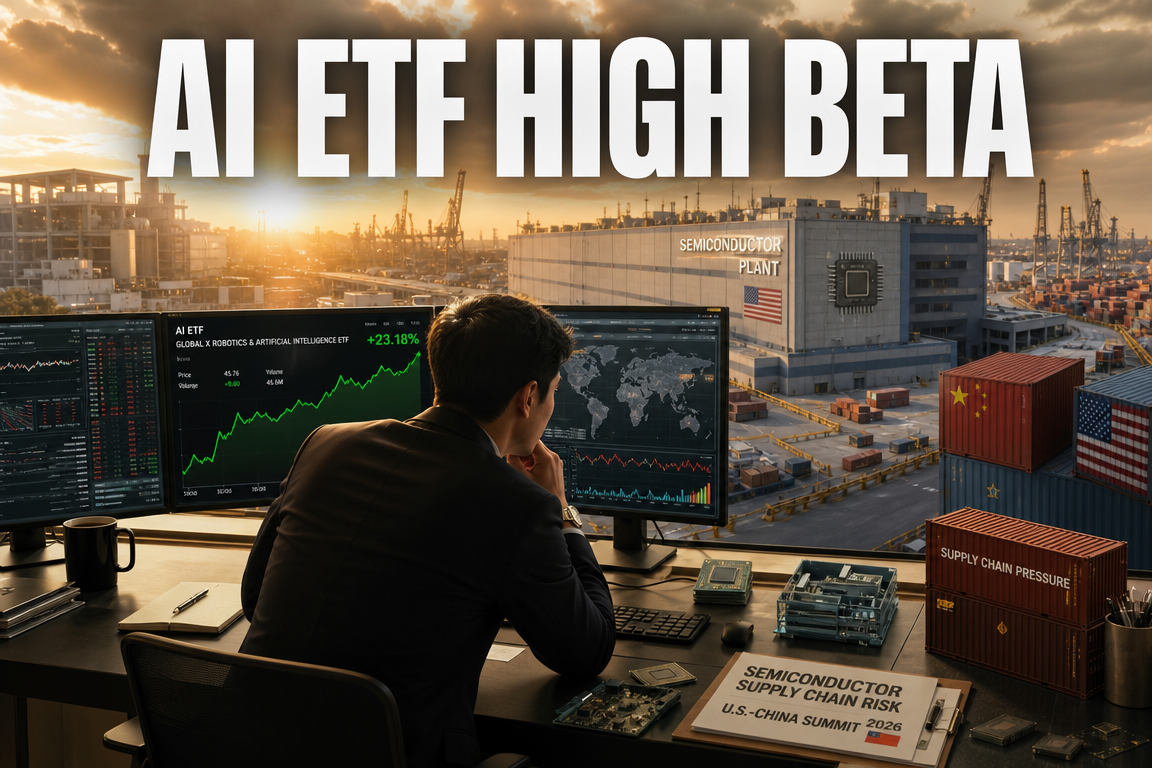
If You Missed SanDisk and Micron, How to Identify the Next U.S. AI Leaders: Key Takeaways on the KIWOOM U.S. AI Tech High Beta ETF to Watch in 2026
This report goes beyond a simple product launch. It explains why U.S. equities have recently rotated rapidly across semiconductors, optical communications, power infrastructure, space, and quantum computing, and how investors may seek to track these shifts systematically via an ETF rather than through single-name selection.
Key focus areas:
- Why market leadership is rotating more frequently
- Why high-beta stocks tend to outperform in risk-on phases
- Why quarterly rebalancing matters
- Core advantages and material risks of the ETF
A final section highlights points often underemphasized in mainstream coverage.
1. Key News at a Glance
The KIWOOM U.S. AI Tech High Beta ETF is scheduled to list on May 12, 2026.
The strategy screens U.S.-listed innovative companies, first selecting AI and frontier-technology related names, then choosing 30 high-beta stocks with elevated sensitivity to the broader market.
In practical terms, it is designed as an ETF that rotates into the most actively moving U.S. AI and innovation technology equities, refreshing holdings quarterly.
Current market behavior suggests that while “AI” remains the overarching theme, capital has rotated in short cycles among AI semiconductors, data centers, optical communications, power infrastructure, aerospace, and quantum computing.
Quarterly portfolio reconstruction is intended to respond to these rapid thematic rotations.
2. Why This ETF Is Drawing Attention Now
2-1. U.S. market leadership is rotating unusually fast
Previously, holding a small set of mega-cap Nasdaq technology names often produced performance close to broad market benchmarks.
Recently, leadership has shifted more aggressively across sub-themes: memory semiconductors, optical communications, power infrastructure and nuclear-related exposures, then further into quantum computing and aerospace.
The top-level “AI” narrative persists, but the sub-industries capturing flows and attention continue to change.
This environment increases the difficulty of managing exposure through individual stocks alone, particularly for time-constrained investors.
2-2. Market structure is increasingly momentum-driven
Recent outperformers have often delivered large gains over short timeframes.
Names such as SanDisk, Micron, optical equipment stocks, and data-center infrastructure plays have in some cases moved substantially faster than the S&P 500 once attention concentrated.
As a result, investor demand has increased for tools that may identify emerging leaders earlier, which this ETF seeks to address.
3. What “High Beta” Means
3-1. Definition: stocks that move more than the market
High beta refers to securities that, on average, move more than the benchmark. If the S&P 500 rises 1% and a stock tends to rise 2% to 2.5%, that stock is considered high beta.
Low-beta stocks exhibit more muted responses to market moves.
High beta implies higher upside participation in rising markets and larger drawdowns in declining markets.
3-2. Why high beta is common in innovation and frontier tech
The strongest movers are often companies priced primarily on forward growth narratives rather than current earnings power.
Typical areas include AI semiconductors, optical communications, data-center power systems, quantum computing, and aerospace.
When investor attention concentrates, these stocks can rally sharply; when attention fades, reversals can be rapid. This behavior aligns with high-beta characteristics.
3-3. Beta is not static
Beta can change over time.
For example, Nvidia historically displayed more pronounced high-beta behavior; as its market capitalization and index weight increased, its behavior at times became more benchmark-like, with periods of lower relative beta.
Conversely, newly emerging mid- and small-cap technology names may see beta rise as investor attention concentrates.
In this context, a high-beta approach can function as a rules-based method to reflect where market enthusiasm is statistically strongest.
4. Structure of the KIWOOM U.S. AI Tech High Beta ETF
4-1. Security selection framework
The universe starts from U.S.-listed equities and excludes extremely illiquid micro-cap names.
It then builds an “innovation” universe using AI and frontier-technology keywords.
Within that universe, the ETF selects 30 stocks with higher beta values and assigns weights considering factors such as market capitalization.
The result is closer to a rules-based passive framework rather than discretionary theme-stock bundling.
4-2. Rationale for including “frontier tech” beyond AI
AI-linked beneficiaries extend beyond traditional IT.
Rising data-center power demand can support power infrastructure names, as well as cooling, server rack, and facilities-related companies.
Compute intensity and scaling requirements can elevate optical communications companies, while longer-term attention may extend toward quantum computing and space infrastructure.
Including frontier tech aims to capture non-traditional innovation exposures that may not fit narrow sector classifications.
4-3. Why quarterly rebalancing is central
Theme leadership cycles have shortened.
Some names surge for two to three months and then lose momentum, replaced by new leaders.
Quarterly rebalancing removes stocks whose beta has declined and adds names newly exhibiting high market sensitivity, aiming to reflect where risk appetite is currently concentrated.
4-4. Partial risk controls
Because high-beta approaches are inherently aggressive, the portfolio incorporates constraints intended to limit excessive concentration, such as caps on single-name weights and adjustments based on market capitalization.
It is not a low-volatility product, but the multi-name structure provides diversification relative to single-stock exposure.
5. Investment Attributes Based on Current Inclusion Characteristics
5-1. A broad “U.S. innovation technology” basket
Disclosed examples indicate exposure to names that have recently drawn market attention, including SanDisk, Vertiv, Lumentum, Coherent, Bloom Energy, Rocket Lab, and Celestica.
By sector exposure, the ETF spans AI semiconductors, AI data centers, optical communications networks, aerospace, power infrastructure, and quantum computing.
This is not a single-theme concentration product but a multi-theme innovation allocation designed to reflect what is currently active in U.S. markets.
5-2. Reduced burden of sizing and stock selection
Individual investors often face difficulties deciding position sizing across aerospace, optical communications, and power infrastructure.
This ETF can partially outsource selection and weighting decisions, and may function as a satellite allocation for investors already holding core U.S. equity exposure.
6. What the Strategy Implies Through Prior Cycles
6-1. Early AI phase: initial beneficiaries
Historical portfolios captured early-cycle AI beneficiaries such as Nvidia, AMD, Tesla, Super Micro Computer, and Palantir, consistent with attention on compute, servers, and platform adoption.
6-2. Expansion: semiconductors and power infrastructure
Subsequently, exposure expanded toward Broadcom, Micron, Marvell, and power-related companies, reflecting AI’s diffusion from chips into infrastructure.
6-3. Recent expansion: optical communications and space
More recent portfolios included optical communications names such as Lumentum and Coherent, and space-related exposure such as Rocket Lab.
This suggests market attention has broadened from software and compute toward physical infrastructure and next-generation platforms.
7. Key Advantages
7-1. Lower probability of missing emerging leaders
The strategy is less about precisely picking a single winner and more about capturing a broad set of candidates that are attracting market attention.
7-2. Systematic response to theme rotation
Many thematic ETFs risk obsolescence as narratives mature.
Quarterly rotation is designed to reduce theme aging by reflecting current market leadership more frequently.
7-3. Diversification versus single-name frontier exposures
Space, quantum computing, and optical communications can carry high idiosyncratic risk, including persistent losses, dilution, commercialization delays, and customer concentration.
A portfolio of roughly 30 names can reduce the impact of single-company negative events.
8. Risks That Must Be Understood
8-1. Stronger in risk-on markets, more vulnerable in sell-offs
High beta increases upside participation but can amplify losses during market drawdowns.
Growth equities without fully mature earnings support can reprice sharply when sentiment deteriorates.
8-2. Higher likelihood of mid- and small-cap exposure
Large price sensitivity is more common among mid- and small-cap growth stocks than mega-caps.
In markets dominated by mega-cap leadership, relative performance may lag.
8-3. Long holding periods may be psychologically difficult
Higher volatility implies larger interim drawdowns.
Price moves approaching 10% in short intervals can occur, making the risk profile materially different from defensive or income-oriented ETFs.
Position sizing and time horizon discipline are essential.
9. Investor Fit
9-1. Potentially suitable for
- Investors constructive on U.S. equity risk-on conditions
- Investors seeking AI and frontier-technology growth exposure
- Investors unable to conduct deep single-name analysis but seeking higher-growth satellite exposure
- Investors looking to complement core allocations such as the S&P 500 or Nasdaq 100 with a more aggressive satellite sleeve
9-2. May require caution for
- Investors with low tolerance for short-term losses
- Investors preferring low-volatility or principal-stability profiles
- Investors unwilling to allocate retirement assets to high-volatility growth equities
- Investors unable to manage exposure through drawdowns
10. Portfolio Context
10-1. More appropriate as a satellite allocation than a core holding
Relative to broad market ETFs, this product is better characterized as an aggressive satellite allocation targeting potential excess returns.
For investors with existing U.S.-equity core exposure, it may serve as an overlay to increase innovation and AI-adjacent exposure.
10-2. Potential complement to trend-following approaches
High beta tends to magnify market moves, while momentum approaches emphasize directionality.
Combining high-beta exposure with trend-oriented disciplines may improve balance, particularly amid elevated macro uncertainty.
11. Most Important Points Often Overlooked
11-1. The product is less an “AI ETF” and more a “market attention rotation” ETF
While presented as an AI-tech ETF, the functional objective is to capture where attention and capital are concentrating, with beta used as the quantitative proxy.
It is therefore closer to a sentiment-and-narrative pricing instrument than a static industry classification product.
11-2. Innovation winners are not fixed
As industries expand, leadership often migrates across layers: memory, optical communications, cooling, power, space, and quantum.
This ETF is positioned to invest in the process of leadership migration rather than a single presumed winner.
11-3. Quarterly rebalancing as a mechanism to retire mature narratives
A principal risk in innovation investing is maintaining exposure to narratives already fully priced by the market.
Quarterly replacement is intended to remove weakening narratives and reflect newly strengthening ones.
12. Final Checkpoints
- Listing date: May 12, 2026
- Objective: dynamic exposure to U.S. innovation growth equities linked to AI and frontier technologies
- Key feature: quarterly rotation to reflect rapid thematic leadership change
- Key trade-off: higher upside capture in rallies versus materially higher drawdown risk in sell-offs
This ETF may be attractive as an aggressive thematic growth tool, but unmanaged sizing can result in higher realized risk than expected.
< Summary >
The KIWOOM U.S. AI Tech High Beta ETF is an aggressive, rules-based ETF selecting 30 U.S.-listed AI and frontier-technology candidates using a high-beta screen.
Its core proposition is quarterly rotation across fast-changing growth themes, including AI semiconductors, data centers, optical communications, power infrastructure, space, and quantum computing.
Key strengths:
- Reduced likelihood of missing emerging leaders
- Automatic adaptation to theme rotation
- Diversification relative to single-name thematic positions
Key risks:
- Amplified drawdowns in market sell-offs
- Potential tilt toward mid- and small-cap growth stocks
- High volatility that may challenge long-duration holding discipline
Most appropriate positioning is as a satellite allocation for investors seeking potential excess returns rather than as a core portfolio anchor.
[Related Links…]
- AI semiconductors: where does the next rotation go? Key points on U.S. sector rotation
https://NextGenInsight.net?s=AI - Global macro and innovation-tech allocation strategy through ETFs: updated analysis
https://NextGenInsight.net?s=ETF
*Source: [ 소수몽키 ]
– 샌디스크 마이크론을 놓쳤다면? 다음 대장주를 미리 찾는 방법
● US-China Summit, No Deal, Big Shift
Immediate Takeaways from the US–China Leaders’ Summit: “Managed Stabilization Without a Big Deal” — and the Market’s Real Focus
The summit was high-profile and the messaging was notably restrained. Substantively, however, outcomes resembled a limited “small deal” rather than a structural breakthrough.
The key issue is not whether a headline agreement was reached, but what the meeting signaled for the trajectory of the global economy, energy prices, semiconductors, artificial intelligence, and supply-chain realignment.
This note focuses on:1) Why the outcome is better framed as “managed de-escalation” rather than “no deal.”
2) Why the US was constrained to accept modest, incremental outcomes.
3) Why China gained more from status and framing than from disclosed numbers.
4) Why Iran, Taiwan, semiconductors, GPUs, and LNG are interconnected within one strategic system.
5) The most material follow-on variables for markets and investors.
1. One-line assessment: No big deal; crisis management and risk containment
Despite the event’s prominence, there was no decisive progress on core issues such as an Iran war-end roadmap, Taiwan, trade frictions, or technology controls.
Instead, both sides emphasized “strategic stability,” signaling an intent to reduce near-term collision risk rather than resolve underlying disputes.
For markets, the distinction matters: investors typically price whether tensions remain controllable more than whether disputes are fully settled.
2. What was delivered vs. what was not
2-1. Delivered: General alignment and highly limited “small deal” scope
Three elements were emphasized:
- The importance of keeping the Strait of Hormuz open.
- Shared opposition to Iran obtaining nuclear weapons (broad principle-level alignment).
- Limited cooperation potential in selective economic and trade items.
Frequently referenced items included US crude oil, LNG, agricultural products, and Boeing aircraft.
However, these signals were not accompanied by clear volumes, timelines, or contract sizes. The messaging implied “possible purchases/expansion” rather than immediately quantifiable commitments.
2-2. Not delivered: Structural “big deal” items
Absent or unclear were:
- A concrete roadmap to end the Iran conflict.
- Any new security arrangement or explicit stabilization framework on Taiwan.
- A structural easing of semiconductor and advanced GPU export controls.
- A reform-level agreement capable of resetting tariffs or the broader trade-war framework.
Accordingly, key sources of uncertainty remain intact.
3. What the US gained: Political optics and limited economic deliverables
3-1. US incentives: Deliverables suited for domestic messaging
Ahead of domestic political milestones, the US required near-term, communicable wins. The target list was consistent:
- Increased purchases of US agricultural products
- Increased LNG purchases
- Additional Boeing orders
- Ideally, contract-like figures that could be presented as measurable outcomes
These categories map directly to politically salient constituencies in manufacturing, agriculture, and energy.
3-2. Outcome quality: “Small deal” and low enforceability
While these items were mentioned, the results lacked binding, large-scale packages likely to drive immediate market repricing. The outcome supports a “not empty-handed” narrative but does not represent a regime shift.
Overall, US gains appear closer to short-term messaging and optics than to a material change in strategic positioning.
4. What China gained: Status elevation and narrative advantage
4-1. The core asset: Staging and symbolism over contract detail
China’s primary gain was the image of parity: hosting the US president and jointly highlighting strategic stability. The implicit message to third countries and capital markets was that China is no longer a reactive party but a co-equal agenda-setter.
In power transitions, perception often shifts before measurable reallocation of capabilities.
4-2. Long-horizon framing: Redefining the relationship’s structure
China prioritized a durable framework over near-term transactional announcements, with two consistent themes:
- Pressing the US to treat China not merely as a “controlled target,” but as a competitor that must be accommodated in any stable equilibrium.
- Reinforcing red lines regarding Taiwan.
China’s net benefit was therefore more about shaping future negotiating language and constraints than immediate cash-flow outcomes.
5. Iran: The hidden macro driver
5-1. Security headline, inflation channel
The Strait of Hormuz is central to global oil transport. Elevated risk premiums in this corridor can raise crude prices, feed into inflation expectations, and constrain the path for rate cuts.
For the US, Iran-related instability is not only a geopolitical variable but a direct input into inflation dynamics, financial conditions, and risk assets.
5-2. Cooperation constraints: Limited incentives for China without US concessions
The US likely sought more active Chinese pressure or mediation on Iran. China, however, maintains strategic ties with Iran and has limited reason to deliver unilateral support without reciprocal movement on Taiwan or technology controls. The summit showed broad alignment on principles but insufficient trade-offs to compel operational cooperation.
6. Taiwan: Quiet messaging, high-risk tail exposure
6-1. Low visibility does not imply low importance
Sparse public language suggests the issue remains highly sensitive and not readily negotiable. China treats Taiwan as a core sovereignty issue; the US views Taiwan as central to Indo-Pacific strategy and critical technology supply resilience.
The outcome is best characterized as continued “management” of a high-risk variable rather than resolution.
6-2. Market relevance: Taiwan is a semiconductor and AI supply-chain risk
Taiwan is foundational to advanced semiconductor manufacturing. Any escalation risk can transmit directly to:
- High-end GPU supply
- AI server availability
- Data-center capex cycles
- Advanced-node capacity and tooling demand
- Cloud investment cadence
Taiwan risk is therefore simultaneously geopolitical and AI-industrial.
7. Semiconductors and GPUs: The low-noise strategic battleground
7-1. China’s priority: Technology access over commodities
From China’s perspective, aircraft orders and commodity purchases are secondary to advanced compute access. With AI competition intensifying, high-performance GPU availability is increasingly tied to national competitiveness.
Scaling model training, industrial AI deployment, and data-center buildouts requires sustained access to compute.
7-2. No structural relaxation: Controls likely to remain the baseline
Markets focused on whether export restrictions on advanced AI accelerators would ease. The summit does not indicate a fundamental shift in the US technology containment posture. Some tactical flexibility is possible, but core restrictions are likely to persist.
In this context, AI leadership is increasingly determined by infrastructure realities—compute and power procurement—rather than model announcements alone.
8. Forward view: “Decent peace” rather than reconciliation
8-1. Softer language, unchanged strategic competition
The likely regime is a managed coexistence: reduced probability of immediate escalation, but persistent competition across technology, security, and economic systems.
Markets generally prefer controlled competition to uncontrolled confrontation.
8-2. Calendars favor management over rupture in the near term
Given the diplomatic schedule and political constraints, both sides have incentives to avoid immediate destabilization. Headline tone may improve while underlying competitive moves become more methodical.
9. Market impact: 5 variables investors should monitor
9-1. Crude oil and energy pricing
Hormuz risk is not fully resolved, implying continued volatility. Shared messaging on keeping sea lanes open may reduce near-term spike risk but does not remove the structural premium.
9-2. Gold and safe-haven demand
Acute risk-off impulses may moderate if escalation fears subside. However, ongoing structural competition supports a persistent, though less explosive, safe-haven bid.
9-3. Semiconductors and AI infrastructure
With tech frictions unresolved, the semiconductor complex remains policy-sensitive. Nvidia-linked GPU supply chains, servers, cloud capex, and power/grid equipment can react quickly to geopolitical and regulatory headlines.
9-4. US inflation and rate expectations
If Iran-related risk sustains higher energy prices, inflation pressure may persist and reduce the scope for monetary easing. The summit therefore links directly to the rates narrative.
9-5. China’s status shift and implications for emerging-market alignment
If China is increasingly perceived as a co-equal pole, third countries may pursue more balanced economic and technology partnerships. Over time, this can shape supply-chain reconfiguration and capital flows.
10. The most material implication: The negotiation structure is changing
The central takeaway is not “failed agreement,” but a shift in how the system negotiates during a power transition. The US is no longer the sole agenda-setter; China is increasingly shaping language, sequencing, and constraints.
Three implications matter most:
10-1. From trade dispute to systems competition
The competitive set now bundles semiconductors, AI, energy, maritime logistics, and elements of monetary and standards influence. This is not solvable by a single-issue concession.
10-2. AI leadership is infrastructure-led: power, GPUs, logistics, alliances
AI competition is increasingly physical and strategic:
- Power availability
- GPU procurement and supply security
- Maritime logistics continuity
- Alliance structures and resource access
The summit functions as a case study of AI-infrastructure competition expressed through diplomacy.
10-3. Status elevation transmits through expectations and institutional behavior
Structural shifts are often priced slowly. The summit reinforced perceptions of narrower relative power gaps, which can influence reserve preferences, commodity settlement practices, technology standards, and emerging-market alignment over time.
11. Concluding assessment: More important than “who won” is “what changed”
A winner/loser framing understates the outcome:
- The US secured limited deliverables and improved optics.
- China secured greater narrative and status gains.
The core point is that the cost of direct confrontation has increased for both sides, favoring a phase of managed competition.
For investors, the dominant linkage is:
- Iran risk influences crude, inflation, and rates.
- Taiwan risk influences semiconductors and AI supply chains.
- US–China relations sit above both as the primary coordination and constraint variable.
This summit is less an endpoint than a signal of the next stage in global order and technology-competition dynamics beyond 2026.
< Summary >
- The summit produced no structural “big deal,” despite prominent optics.
- The US emphasized limited “small deal” items (agriculture, LNG, Boeing) and domestic-facing messaging.
- China gained disproportionate value from status elevation and agenda framing.
- Iran remains a key variable for oil, inflation, and rates; Taiwan remains a central tail risk for semiconductors and AI supply chains.
- The relationship is better characterized as managed competition, with markets focused on risk containment rather than dispute resolution.
- The strategic contest is increasingly a systems competition linking AI, energy, semiconductors, and maritime logistics.
[Related Articles…]
- US–China strategic competition and key drivers of global asset-market reallocation beyond 2026 (https://NextGenInsight.net?s=US-China)
- AI semiconductor supply-chain shifts and post-Nvidia investment checkpoints (https://NextGenInsight.net?s=AI)
*Source: [ 경제 읽어주는 남자(김광석TV) ]
– [속보] 권력의 대이동, 체급 키운 중국. ‘이란-대만 빅딜’ 없이 끝난 세기의 담판 미중 정상회담 [즉시분석]