● Inflation Shock, Stocks Sink, Rates Spike, AI Holds Firm
Inflation Fears Reignite: A Consolidated View on Rates, Oil, and AI Capex—What the Market Is Actually Pricing
This move cannot be reduced to “the Nasdaq pulled back.” Key cross-asset signals suggest a broader repricing of inflation and rate expectations.
This report consolidates: why the Russell 2000 declined more than the Nasdaq; how higher oil feeds inflation expectations and pushes U.S. Treasury yields higher; why semiconductors and growth equities weakened in tandem; and why mega-cap technology companies such as Microsoft and Alphabet continue to expand AI investment despite the drawdown.
The market’s primary discomfort is less the inflation shock itself than the delay of rate-cut expectations and the resulting increase in discount rates. At the same time, resilient AI-related earnings may be limiting downside depth.
1. Market Snapshot: The Core Driver Is the Return of Inflation Anxiety
U.S. equities broadly weakened, with the Russell 2000 underperforming the Nasdaq—an important signal.
The Nasdaq is rate-sensitive due to its growth tilt. The Russell 2000, with higher small- and mid-cap exposure, is more directly affected by tighter funding conditions.
Russell underperformance indicates the market is treating inflation and rate risk as a macro-wide issue rather than a narrow technology correction.
- Nasdaq decline: valuation pressure on growth equities
- Russell 2000 sell-off: heightened rate sensitivity in smaller caps
- Bond weakness: global sovereign selling on inflation concerns
- Oil spike: renewed supply-shock risk
2. Why Inflation Fears Returned: Oil Is the Primary Catalyst
The immediate catalyst was crude oil.
With prolonged tension around the Strait of Hormuz, WTI moved above $104 and Brent surpassed $109, increasing concerns that energy prices could re-accelerate inflation.
Higher crude is not limited to retail fuel. It raises logistics costs, input prices, aviation and transportation expenses, and broadens inflation expectations.
This dynamic pushes the market to reprice Federal Reserve rate cuts further out.
The key chain is: “oil up → inflation expectations up → bond selling → U.S. yields up → equity discount rates up.”
3. Why the Jump in U.S. Treasury Yields Was Especially Damaging for Equities
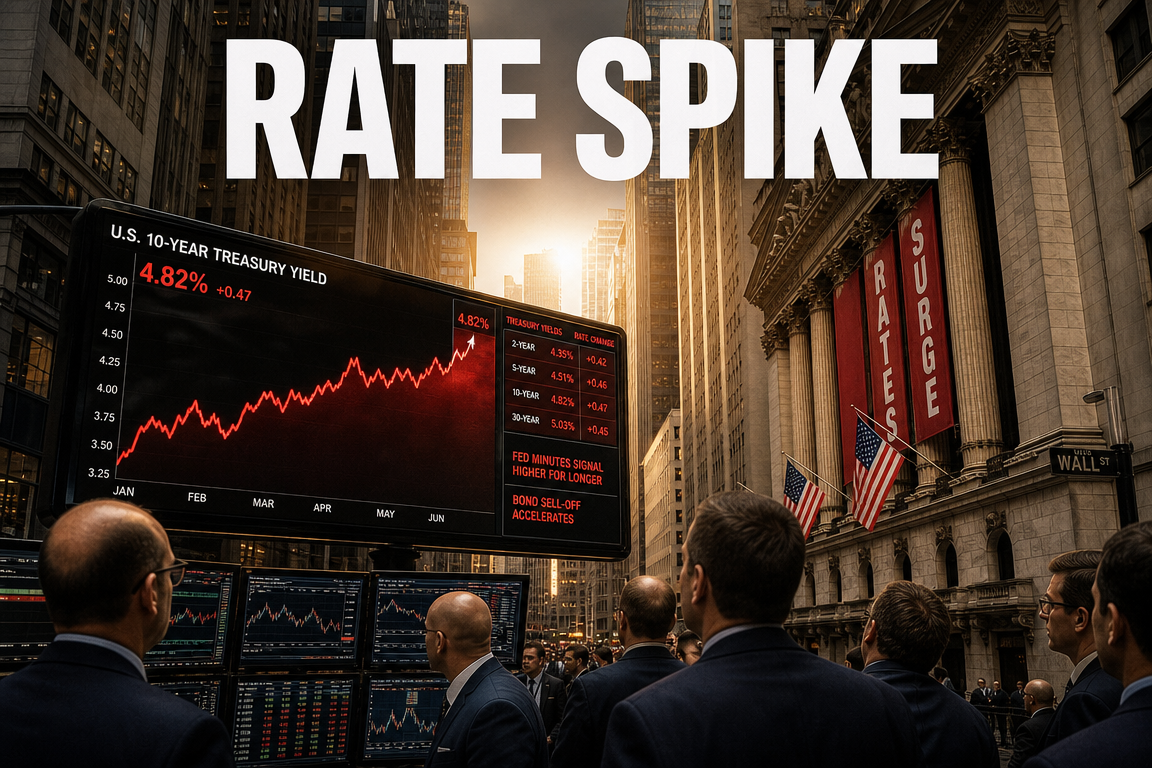
The U.S. 10-year Treasury yield breaking above 4.54% intraday suggests the market is recalibrating the expected path of policy and term premiums.
Equities are valued as discounted future cash flows. When yields rise, discount rates increase; the impact is larger for growth and technology stocks with more back-end weighted earnings.
This sensitivity contributed to heavier pressure on semiconductors and AI-linked growth stocks.
- Bond selling drives bond prices lower.
- Lower bond prices translate into higher yields.
- Higher yields raise corporate funding costs.
- Higher yields compress growth-equity multiples.
In this regime, strong earnings can coexist with multiple compression.
4. Why Global Bond Markets Also Sold Off: Not a U.S.-Only Issue
The move was synchronized across multiple sovereign markets, including the U.K. and Japan.
4-1. United Kingdom: Fiscal Expansion Concerns Pushed Gilt Yields Higher
Expectations of expanded fiscal spending amid political change lifted gilt yields.
The mechanism is straightforward: higher spending often implies higher borrowing, increased supply, and reduced relative attractiveness of existing bonds.
This adds pressure across global duration markets.
4-2. Japan: Producer Price Acceleration Revived Yen-Carry Unwind Risk
Japan’s April PPI rose 4.9% year over year, reinforcing the view that ultra-low rates may become harder to maintain.
The market focus is less on the rate hike itself than on the yen carry trade.
Given the scale of global positions funded in yen, a combination of yen appreciation and higher Japanese yields can force deleveraging and liquidity withdrawal.
Accordingly, Japanese rate dynamics can be interpreted as a signal of tightening global liquidity conditions.
5. Why Semiconductor Stocks Fell: Discount-Rate and Valuation Effects, Not an Earnings Collapse
Major semiconductor names—Nvidia, Broadcom, Micron, AMD, Intel—were broadly weaker.
The drawdown is not fully explained by deteriorating fundamentals. Recent semiconductor conditions, particularly in memory, remain comparatively strong on reported results.
Two drivers were prominent:
- Rising rates compressing growth multiples
- Profit-taking and valuation pressure following a sharp run-up
This resembles a rate-driven reset after strong performance rather than a cyclical breakdown.
6. Memory Conditions Remain Firm: Signals from Kioxia Results
Kioxia’s results are a relevant datapoint for NAND conditions.
- Revenue: +84% quarter over quarter
- Net income: +364% quarter over quarter
- Guidance: additional operating profit growth indicated
These figures suggest memory demand and pricing are stronger than market skepticism implies, with improvement extending beyond DRAM into NAND.
Relative resilience among NAND value-chain participants aligns with this trend.
However, markets price both earnings and discount rates. When yields rise, strong results may support prices but limit multiple expansion.
7. Why Microsoft Rose: Positioning and Re-Rating Expectations
Microsoft outperformed on a day when much of mega-cap technology and semiconductors weakened, driven by comments indicating Bill Ackman initiated a position.
This reinforced the view that the stock may be undervalued relative to perceived quality and durability.
- Forward P/E viewed as less demanding versus historical norms
- Potential under-reflection of OpenAI-related equity value
- Strong enterprise franchises in Azure and Microsoft 365
The market response highlighted Microsoft as a cash-flow-supported platform business rather than a purely thematic AI proxy.
8. Why Microsoft Still Lagged Other AI Beneficiaries in Recent Months
Despite strategic positioning, recent relative performance has been less dynamic versus certain AI beneficiaries, for two main reasons.
8-1. OpenAI Optionality: Expectations Rose Faster Than Visible Monetization
Microsoft was widely priced as a primary beneficiary of OpenAI. More recently, incremental OpenAI-driven upside has appeared less immediately evident in the stock’s narrative.
8-2. Monetization Pace of AI Features Has Been Slower Than Market Hurdles
Microsoft aims to sell AI functionality such as Copilot through the Microsoft 365 ecosystem to enterprise customers.
The strategy is coherent, but adoption and revenue conversion have not yet accelerated at a pace that consistently exceeds elevated expectations.
Ackman’s purchase can be interpreted as a signal that the market may be applying overly conservative assumptions despite intact long-term AI positioning.
9. What Alphabet’s Yen Bond Issuance Indicates: AI Investment Cycle Remains Intact
Alphabet’s large yen-denominated bond issuance is more than a routine financing event.
It suggests mega-cap technology companies are sustaining AI infrastructure capex at a scale that may exceed what operating cash flow alone would comfortably fund.
The rationale for yen issuance is primarily cost: Japan’s relatively low rates can reduce funding expense.
- AI infrastructure (data centers, semiconductors, cloud) is highly capital intensive
- Mega-cap firms appear to be underwriting a multi-year investment cycle
Short-term equity volatility does not negate the persistence of the long-duration AI growth and capex thesis.
10. U.S.-China Leaders’ Meeting and Middle East Risk: Markets Focused on Lack of Change
While a meeting occurred, markets saw limited evidence of actionable de-escalation.
When expectations exist and outcomes are inconclusive, the typical reaction is a “no-deal” repricing.
Key issues—Taiwan, Iran-related risk, and China-linked restrictions—remained unresolved, leaving uncertainty largely intact.
For markets, the reduction of uncertainty often matters more than marginally positive headlines; this time, uncertainty did not meaningfully decline.
11. Is This Similar to 2022? Similar Setup, Different Earnings Backdrop
Oil up, yields up, and growth equities down resembles 2022 at the surface level.
A critical difference is earnings. In 2022, both rates and earnings momentum pressured equities. Currently, AI, semiconductors, and cloud-linked earnings have been comparatively resilient.
This resilience can attract incremental dip-buying and reduce the probability of a sustained, disorderly drawdown absent further macro deterioration.
The market resembles a tug-of-war between “inflation/rates pressure” and “earnings/AI growth support,” rather than a one-directional regime.
12. Primary Investor Checkpoints
- Duration of crude oil holding above $100
- Whether the U.S. 10-year yield stabilizes above 4.5%
- Whether Russell 2000 weakness remains contained or signals broader credit stress
- Whether semiconductor earnings continue to support prices through the drawdown
- Whether mega-cap AI capex translates into measurable revenue acceleration
13. Underappreciated Market Drivers
13-1. The Core Fear Is Not Inflation Prints, But the Postponement of Rate Cuts
Markets do not necessarily destabilize on modest inflation increases. The main risk is that inflation delays rate cuts, pushing discount rates higher across asset classes.
The sensitivity is to a reset in the expected policy path, not a single CPI datapoint.
13-2. Semiconductor Weakness Reflects “Strong Fundamentals + Higher Rates,” Not a Downcycle Signal
Semiconductor pullbacks should not be mechanically interpreted as an industry downturn. Memory conditions are improving in reported results.
The more consistent interpretation is that elevated expectations collided with a higher-rate environment, prompting a valuation-driven consolidation.
13-3. Increased Mega-Cap Bond Issuance May Signal Intensifying AI Infrastructure Competition
Alphabet’s approach indicates that firms may be willing to borrow cheaply to accelerate infrastructure buildout.
What looks like near-term cost pressure may function as a strategic investment to secure scale advantages in cloud, data centers, and model capability.
13-4. The Current Regime Is “Decision Deferral,” Not Clear Trend Confirmation
Earnings remain firm, rates are restrictive, liquidity is less abundant than prior cycles, and AI remains a durable growth vector.
This environment rewards monitoring of key variables and data-dependent positioning rather than binary conviction.
14. Conclusion: Focus on What Is Setting Prices
The current macro and equity landscape is a multi-factor regime where inflation, U.S. yields, crude oil, semiconductors, and AI capex interact.
Despite prominent headwinds, earnings and investment intensity remain supportive pillars in key segments.
Working summary:
“Inflation fears have returned, but AI-linked earnings and capex are providing partial support and reducing the likelihood of an immediate, structurally deeper sell-off.”
Near-term volatility is likely to remain sensitive to oil and rates. Positioning should distinguish between (i) companies supported by durable earnings and (ii) assets disproportionately impacted by discount-rate shocks.
< Summary >
Rising oil prices revived inflation concerns, lifting U.S. Treasury yields and pressuring both the Nasdaq and the Russell 2000.
Russell 2000 underperformance highlights small- and mid-cap vulnerability to higher rates and tighter financing conditions.
Semiconductors corrected on rate pressure and profit-taking, while memory fundamentals remain firm, supported by datapoints such as Kioxia’s results.
Microsoft showed relative strength following disclosure of a new position by Bill Ackman.
Alphabet’s yen bond issuance signals continued expansion of mega-cap AI infrastructure spending.
The market’s core issue is not inflation in isolation, but the deferral of rate-cut expectations that pushes discount rates higher, while AI-linked earnings resilience is acting as a partial stabilizer.
[Related Links…]
- Analysis of AI Capex Expansion and Mega-Cap Financing Strategy
- Impact of Delayed Rate Cuts on U.S. Equities
*Source: [ 내일은 투자왕 – 김단테 ]
– 물가 공포 현실화 되나?