● Korea Stocks Surge, Samsung and SK Hynix Rocket on Nvidia AI Boom
KOSPI Surge: Why Korean Equities Have Regained Momentum Now — Three Key Drivers Through Samsung Electronics, SK hynix, and NVIDIA
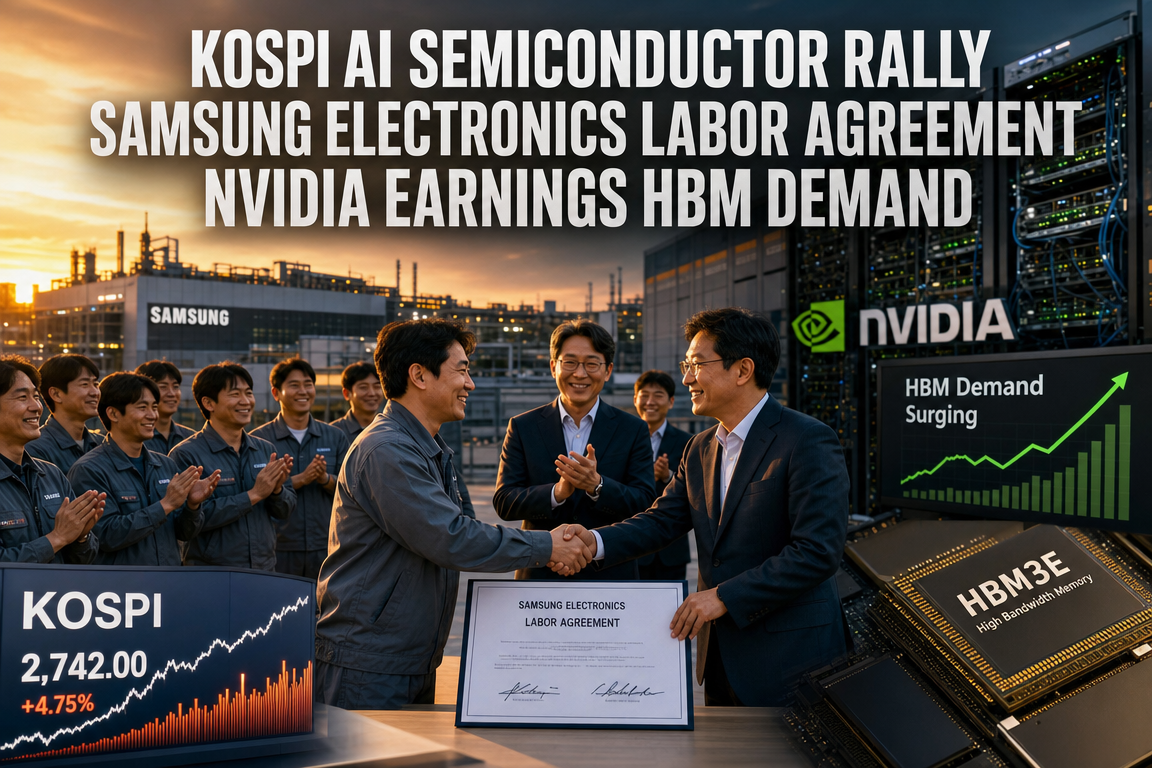
This move cannot be reduced to “semiconductors rose, so the KOSPI rose.” The rally reflects the concurrent alignment of (1) easing risk in domestic mega-caps, (2) a recovery in risk appetite in U.S. equities, and (3) NVIDIA earnings validating continued expansion in AI semiconductor demand.
This report explains (i) why Samsung Electronics and SK hynix have moved differently, (ii) how NVIDIA’s results transmit to Korea’s semiconductor complex, and (iii) whether the rebound is a one-off event or a potential shift in the medium-term market regime. Key linkages include corporate earnings, the memory cycle, AI capex, KOSPI outlook, and the global macro backdrop.
1. Core drivers of today’s KOSPI surge: three catalysts converged
1-1. Samsung Electronics labor-management agreement reduced a major domestic overhang
The first catalyst was a labor-management agreement at Samsung Electronics.
Given Samsung Electronics’ large index weight, reduced company-specific uncertainty materially improves KOSPI-level sentiment. Prolonged labor disputes typically elevate perceived risk via potential production disruptions, cost pressures, and slower decision-making, all of which can sustain valuation discounts. The agreement lowered this risk premium, supporting broader sentiment toward Korean large-cap technology. Foreign flows, which tend to concentrate in mega-caps, were an important transmission channel.
1-2. Improved U.S. market tone supported a renewed preference for risk assets
The second driver was a constructive tone in U.S. equities.
Korean equities are highly sensitive to U.S. market direction, particularly technology and semiconductors. Beyond a single-session rebound, the market appears to be re-weighting toward the view that the AI- and semiconductor-led growth narrative remains intact. This matters more than near-term positioning, as global capital typically rotates back into semiconductors and large-cap tech when growth visibility improves. Korea is structurally positioned to benefit from that rotation.
1-3. NVIDIA earnings confirmed AI demand is translating into realized spend
The third and most decisive catalyst was NVIDIA earnings.
Strong demand signals indicate the AI infrastructure investment cycle remains robust. This transmits directly to the Korean semiconductor sector because AI servers and high-performance computing require significant memory content, particularly high-bandwidth memory (HBM) and high-performance DRAM.
NVIDIA outperformance also implies strength across the broader supply chain—GPU, servers, advanced packaging, memory, power semiconductors, and data center equipment. Korea’s comparative advantage is memory; therefore, NVIDIA’s results were interpreted as a sector-wide positive for Korean semiconductors.
2. Why SK hynix reacted more strongly than Samsung Electronics
2-1. The market is assigning higher value to “AI memory purity” than to broad semiconductor exposure
Investors are increasingly differentiating among semiconductor companies by (i) direct exposure to the AI cycle, (ii) earnings visibility, and (iii) leadership in high value-added memory such as HBM.
Within this framework, SK hynix is widely viewed as a primary AI memory beneficiary. When NVIDIA delivers strong results, markets often translate this into sustained HBM demand and reflect that expectation more directly in SK hynix.
2-2. Higher expectations for earnings quality are concentrated in SK hynix
“Earnings quality” refers not only to revenue growth but to margin mix and the sustainability of profitability.
HBM carries higher technical barriers, tighter supply-demand conditions, and stronger linkage to AI investment, supporting premium pricing and margins. This underpins higher valuation support for SK hynix in the current phase.
Samsung Electronics has a broader portfolio (memory, foundry, smartphones, consumer electronics). While strategically beneficial over the long term, it can dilute perceived exposure when investors are prioritizing concentrated AI memory leverage.
2-3. Flow-related themes exist, but the key factor is position within the AI supply chain
Short-term flow narratives (e.g., access channels for overseas investors) may add near-term elasticity. However, the primary driver remains the company’s direct positioning in the AI hardware supply chain, which currently favors SK hynix.
3. Summary in a “news format”
3-1. Domestic headline
A Samsung Electronics labor-management agreement reduced uncertainty around a key index heavyweight, lowering perceived risk for foreign and institutional investors and supporting index directionality.
3-2. U.S. market headline
Stabilization in U.S. equities improved risk appetite, with technology-led strength reinforcing expectations for Korean semiconductor performance.
3-3. Global semiconductor headline
NVIDIA earnings reaffirmed ongoing AI infrastructure expansion, lifting expectations for HBM and high-performance DRAM demand and supporting both Samsung Electronics and SK hynix, driving the KOSPI higher.
4. Underappreciated but material implications
4-1. The move may signal a potential repricing of Korean equities, not only a one-day event
The simultaneous emergence of the three catalysts reduces key discount factors previously weighing on Korea: a softer semiconductor cycle, mega-cap uncertainty, global growth concerns, and geopolitical risk. The current alignment—AI-led capex expansion, improving memory conditions, and reduced large-cap uncertainty—raises the probability of a broader repricing phase, although confirmation requires follow-through in data and flows.
4-2. NVIDIA is the outcome; the driver is sustained AI capex
The more relevant signal for investors is continued AI data center and compute infrastructure spending by global technology companies. As long as AI capex remains resilient, memory demand is less likely to decelerate meaningfully, supporting a more structural framing for Korean semiconductor exposure rather than a short-lived theme.
4-3. Joint strength in Samsung Electronics and SK hynix links to Korea’s export recovery expectations
Semiconductors are central to Korea’s exports, capital expenditure, trade balance, currency dynamics, and large-cap earnings. A strengthening memory cycle can therefore influence not only sector performance but also expectations for aggregate corporate earnings and macro momentum.
5. Key variables to monitor: can the KOSPI extend gains?
5-1. Post-NVIDIA, confirm whether memory orders sustain
Earnings results must translate into ongoing orders and production plans. Monitor HBM, high-performance DRAM, and AI server-related memory procurement. Sustained strength would support further earnings revisions for SK hynix and Samsung Electronics.
5-2. Assess whether foreign inflows are persistent
Sustained KOSPI strength typically requires continued foreign buying. Given Korea’s large-cap and semiconductor-heavy index structure, foreign flows are a critical determinant. Breadth across Samsung Electronics, SK hynix, semiconductor equipment, and power/infrastructure beneficiaries would strengthen the signal.
5-3. U.S. rates and USD direction remain binding constraints
Even with favorable semiconductor fundamentals, renewed upward pressure in U.S. yields or excessive USD strength can weigh on emerging markets. Macro conditions remain a key co-factor in determining durability of the move.
6. Investment framing
6-1. Samsung Electronics: a proxy for reduced domestic risk
The labor-management agreement lowered a major uncertainty factor. If the memory upcycle continues, Samsung Electronics can reflect both improved stability and cyclical recovery.
6-2. SK hynix: higher beta to AI memory demand
SK hynix offers more direct leverage to the AI memory theme. If HBM-driven growth and margin durability persist, relative price sensitivity can remain higher than Samsung Electronics.
6-3. KOSPI: a semiconductor-driven index regime
The KOSPI remains heavily influenced by semiconductors. Portfolio strategy is therefore more effectively anchored in the trajectory of the memory cycle and AI-related demand than in index-level direction alone.
7. One-line conclusion
The KOSPI surge reflects a three-factor alignment: reduced Samsung Electronics risk, improved U.S. risk appetite, and NVIDIA earnings confirming continued expansion in AI memory demand; the combination may support a broader repricing narrative if corroborated by orders, earnings, and sustained foreign inflows.
< Summary >
- A Samsung Electronics labor-management agreement reduced mega-cap uncertainty.
- Stronger U.S. equity tone improved risk appetite.
- NVIDIA earnings validated expanding AI memory demand.
- Samsung Electronics and SK hynix strengthened, driving a sharp KOSPI advance.
- SK hynix outperformed due to higher HBM-linked AI exposure and earnings mix expectations.
- The move may indicate potential Korean equity repricing beyond a short-term rebound.
[Related Articles…]
- Semiconductor super-cycle re-acceleration: Korea exports and the next direction for the KOSPI (https://NextGenInsight.net?s=semiconductors)
- AI investment strategy after NVIDIA earnings: beneficiaries across memory and data centers (https://NextGenInsight.net?s=nvidia)
*Source: [ 내일은 투자왕 – 김단테 ]
– 코스피 역대급 상승의 3가지 이유 (5월 21일)
● AI-Defense Boom
Post–Middle East War Capital Flows: Why AI Defense, Drones, and Power Infrastructure Can Lead into 2026
This is not a typical thematic rotation. Post-conflict markets are increasingly organized around three structural forces:
- Expansion of asymmetric warfare
- Prolonged “unstable peace”
- Deepening geoeconomic fragmentation
These forces collectively support sustained capital allocation toward AI-enabled defense, drone ecosystems, and power infrastructure, with linkages to nuclear power and SMRs.
1. Core Message: Even if the War De-escalates, Capital Allocation Is Unlikely to Revert
Even with near-term stabilization, market positioning may not return to prior regimes because conflicts leave persistent institutional and budgetary changes. Markets tend to price system-level adjustments ahead of the event’s conclusion.
The relevant question is not short-term conflict beneficiaries, but what governments and enterprises structurally change after the conflict.
2. Current Market Developments (Condensed)
2-1. US–China Leaders’ Meeting: Tactical De-escalation, Strategic Competition Intact
Recent US–China engagement appears conciliatory at the surface, but is better characterized as limited tactical exchange rather than a strategic reset. Core disputes (Taiwan, advanced technology controls, semiconductors, GPU supply constraints) remain unresolved.
This environment resembles managed tension rather than durable rapprochement, reinforcing the “unstable peace” framework.
2-2. Why “Unstable Peace” Matters: Defense Budgets Tend to Be Sticky
When conflict risk is perceived as persistent, political coalitions more readily support higher defense spending. Following the Russia–Ukraine war, the Middle East conflict reinforces an existing multi-year rearmament trajectory.
Defense budget increases translate into procurement across:
- Weapon systems
- ISR (intelligence, surveillance, reconnaissance) and sensing
- Communications and C2/C4 systems
- Missile defense
- Counter-drone systems
- Data analytics platforms
This supports a clearer path from policy to revenues for contractors and suppliers.
2-3. Asymmetric Warfare: The Cost-Imbalance Problem
A defining feature has been the economics of low-cost drones stressing high-cost intercept systems (e.g., tens of thousands of dollars vs. multi-million-dollar interceptors). This shifts procurement priorities toward systems that are:
- Lower-cost per engagement
- Faster to deploy and scale
- More autonomous and software-defined
Implications include rising importance of AI-enabled surveillance, real-time target identification, autonomous systems, mass-producible drones, and counter-drone solutions.
3. Why AI Defense Is Central: AI and Defense Are Converging
3-1. Markets Are Increasingly Valuing Defense Through an AI Lens
AI is shifting from a standalone software growth narrative to a capability that changes defense performance and cost structures. The key theme is AI integrated into defense platforms and operations, including:
- Battlefield data analytics
- Real-time target recognition
- Autonomous flight and autonomy stacks
- Satellite intelligence exploitation
- Logistics optimization
- Drone swarming and coordinated autonomy
- Missile defense decision support
Companies combining platforms, data, and software may command higher strategic relevance than pure manufacturing.
3-2. Physical AI Scales Rapidly in Defense Applications
“Physical AI” (AI embedded into real-world systems) has direct defense analogs across aircraft, ground vehicles, naval assets, missiles, and unmanned systems. Investment focus therefore extends beyond AI chips to the broader ecosystem that commercializes AI through deployed hardware.
4. Drones Should Be Analyzed as a Multi-Domain System (Not Only Aviation)
The drone market is broader than small aerial platforms and can be structured into four domains:
4-1. Aerial Drones
Used for reconnaissance, strike, surveillance, targeting, and swarming. Intersects directly with air defense, expanding both offensive and defensive markets.
4-2. Ground Drones
Includes unmanned ground vehicles, autonomous logistics, and risk-area reconnaissance platforms. Potential integration with armored systems and pre-entry reconnaissance.
4-3. Surface (Maritime) Drones
Supports maritime surveillance, port security, distributed naval operations, and autonomous combat concepts. Enables force dispersion at lower cost.
4-4. Underwater Drones
Relevant for submarine detection, underwater surveillance, subsea cable protection, and mine countermeasures. Strategic value increases as seabed infrastructure becomes a priority.
Overall, drones represent a central axis of defense modernization and unmanned transformation rather than a single-stock theme.
5. Geoeconomic Fragmentation: The Return of Blocs
5-1. Fragmentation Is More Than Protectionism
The shift is from a rules-based global integration model toward a national-interest and security-first framework. Supply chains prioritize resilience over efficiency; trade emphasizes control over openness.
5-2. Investment Implications: Defense, Supply Chains, and Energy Converge
Fragmentation tends to drive reinforcement of:
- Defense self-reliance
- Critical supply chain security
- Energy security
These domains are interdependent: defense requires semiconductors and communications; supply chain stability requires reliable energy; energy security requires grid investment and generation capacity.
6. Post–Energy Shock Focus: Power Infrastructure as the AI-Era Bottleneck
6-1. Middle East Risk Revalidates Energy Security Exposure
Middle East instability can impact oil and gas prices, maritime logistics, and broader input costs, affecting inflation, manufacturing cost bases, and power planning. For policymakers, the signal is the need to redesign energy systems with higher resilience.
6-2. AI Growth Increases Power Demand and Grid Stress
Data centers, AI training/inference infrastructure, advanced semiconductor fabrication, and cloud expansion are power-intensive. As AI scales, grid stability and generation adequacy become binding constraints.
This broadens the AI investment perimeter to include:
- Grid equipment
- Cables and conductors
- Transformers
- Transmission and distribution build-out
- Generation-related supply chains
6-3. Why Nuclear, SMRs, and Renewables Must Be Viewed as a Portfolio
Rapid load growth typically requires a diversified generation mix rather than a single-source solution:
- Nuclear as baseload
- SMRs as distributed next-generation capacity (requiring ongoing feasibility and execution scrutiny)
- Renewables for long-term scale
- Transmission/distribution as the enabling backbone
Markets increasingly evaluate not only compute hardware, but also the electricity supply and delivery system required to operate it.
7. Practical 2026 Leadership Scenarios (Framework)
7-1. First Axis: AI-Enabled Defense
Supported by measurable demand drivers: higher defense budgets, changed warfare economics, and expanded procurement. Focus areas include:
- Military data platforms
- ISR and surveillance AI
- Autonomous systems
- Satellite and communications-based command networks
- Integrated drone operations platforms
7-2. Second Axis: Drones and Counter-Drone
Counter-drone is structurally linked to drone proliferation. Areas include detection, electronic warfare/jamming, neutralization, and kinetic interception. Both offense and defense contribute to market expansion.
7-3. Third Axis: Power Infrastructure and Energy Security
As AI capex rises, grid bottlenecks become more visible. Combined with energy security concerns, this supports sustained attention to:
- Grid equipment and upgrades
- Transformers and switchgear
- Transmission expansion
- Generation build-out, including nuclear-related supply chains
This segment is more dependent on policy, permitting, and deployment schedules than short-cycle sentiment.
8. Key Underemphasized Points
8-1. Primary Benefit Is System Redesign, Not Only Weapon Sales
The larger impact is reconfiguration of defense, energy, and supply chain systems, implying multi-year budget and procurement realignment.
8-2. The Next AI Spending Frontier Extends Beyond Consumer Software
Large, durable contracts are more likely in government, defense, power, communications, and data-center infrastructure where adoption cycles are longer and switching costs are higher.
8-3. “Unstable Peace” Sustains Budget Justification
Ambiguous, persistent tension can support defense spending more durably than short, decisive conflict endpoints. Markets focus on whether budgets contract or continue expanding.
8-4. Power Grids May Be the Underappreciated AI Value-Chain Beneficiary
Beyond semiconductors, electricity delivery and grid equipment can become critical constraints and therefore potential beneficiaries in the AI scaling cycle.
9. Consolidated Conclusion (Investor-Focused)
Markets are responding less to war headlines and more to post-conflict shifts in budgets, industrial structure, national strategy, and technology deployment priorities. Potential leadership themes are most likely where AI, defense modernization, and energy infrastructure intersect:
- AI-integrated defense industries
- Multi-domain drone ecosystems (air, land, surface, underwater)
- Counter-drone and surveillance systems
- Power infrastructure and transmission/distribution equipment
- Nuclear, SMR, and broader energy security supply chains
Capital flows may increasingly favor structural beneficiaries tied to procurement and infrastructure build-out rather than short-duration risk-off trades.
< Summary >
The post–Middle East war market focus is the structural change created by conflict rather than the conflict itself. As asymmetric warfare expands, “unstable peace” persists, and geoeconomic fragmentation deepens, capital allocation may increasingly favor AI-enabled defense, drones, power infrastructure, nuclear power, and SMRs.
US–China relations appear closer to managed de-escalation than strategic reconciliation, sustaining the rationale for higher defense budgets and energy security policies.
Potential 2026 leadership clusters include AI-defense convergence, drones and counter-drone systems, and grid/generation infrastructure linked to rising AI-driven electricity demand.
[Related Links…]
- https://NextGenInsight.net?s=AI
- https://NextGenInsight.net?s=SMR
*Source: [ 경제 읽어주는 남자(김광석TV) ]
– 중동전쟁 이후 돈은 여기로 몰립니다 AI 방산·드론·전력 인프라 주도주 시나리오 | 경읽남 x Bler. 콜라보 | 칠판강의 [3편]