● Samsungs 10-Year Share Incentive Deal Sparks Long-Term Stability, Avoids Strike Disruption Risk
Samsung Electronics’ Semiconductor Special Performance Bonus Applied for 10 Years, Labor and Management Reach Dramatic Deal…Production Disruption Risk Halted Just Before Strike
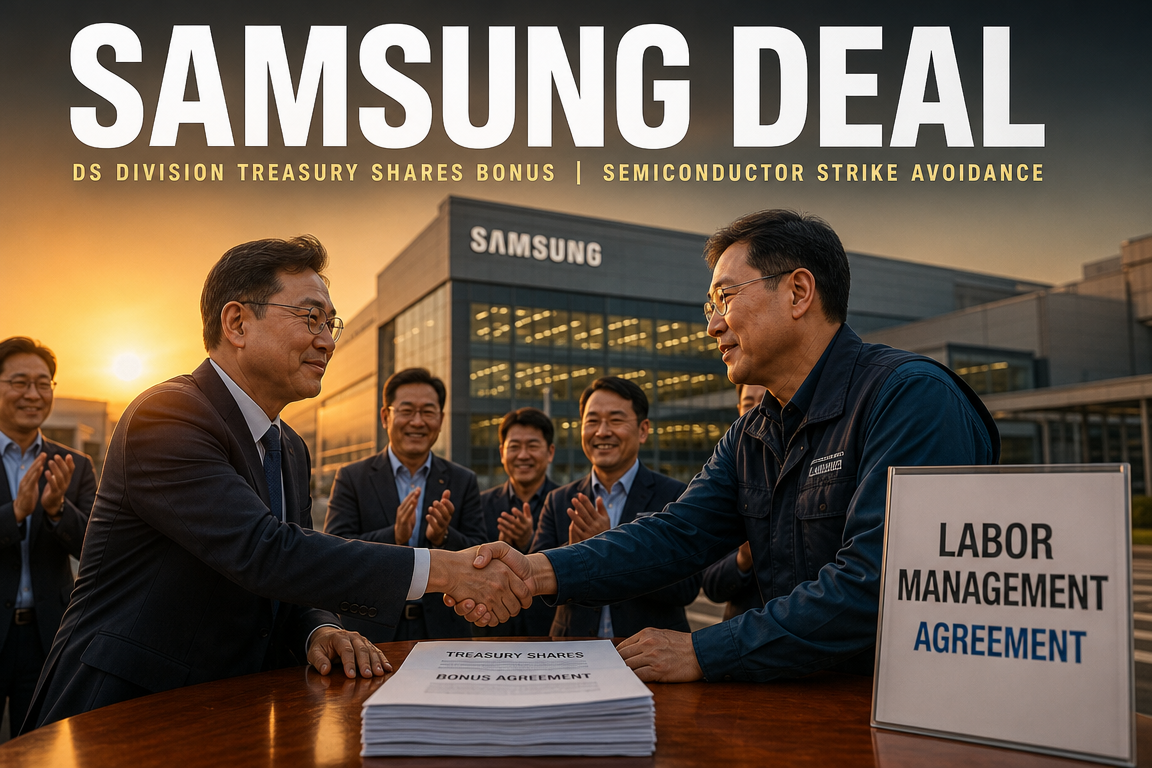
As Samsung Electronics’ labor and management agreed to operate the DS division’s special management performance bonus for 10 years, concerns over semiconductor production disruption have been temporarily avoided.
This agreement is significant because it is not just a simple wage negotiation, but an event that simultaneously reflects the semiconductor industry cycle, corporate governance, labor-management relations, stock compensation, and talent retention strategy in the AI era.
In particular, there is a core point in this report that is relatively less covered in other articles.
That is, the performance bonus is paid in treasury shares rather than cash, and it has been designed as a long-term incentive structure over a 10-year period.
This is not just a bonus; it can be seen as a signal that could change Samsung Electronics’ talent retention approach and semiconductor competitiveness.
1. News Summary: Samsung Electronics Labor and Management Reach a Tentative Deal Just Before the Strike
On the 20th, Samsung Electronics’ labor and management reached a tentative agreement in the DS division’s wage negotiations.
Since the union had planned a general strike for the following day, the market shock was significant.
If the negotiations had broken down, there could have been direct pressure on semiconductor production lines, and this could have affected the global supply chain.
In the end, this agreement can be interpreted as a positive signal not only for Samsung Electronics’ internal issues, but also for the stability of the Korean stock market and the semiconductor industry as a whole.
2. Key Points of the Agreement: The Performance Bonus Structure Has Changed Completely
The most notable part of this agreement is the performance bonus system.
The existing OPI system will remain, but a new special management performance bonus has been introduced for the DS division.
The structure is as follows.
A total performance bonus of around 12% will be paid, combining OPI at 1.5% and the special management performance bonus at 10.5%.
The special management performance bonus will be funded by 10.5% of business performance, selected through labor-management agreement.
It will be paid entirely in treasury shares on a post-tax basis.
There is no separate cap on the payout rate.
The reason this matters is clear.
Compared with cash compensation, treasury-share compensation gives employees motivation tied to the company’s long-term value.
In other words, this system is closer to a long-term performance-linked compensation model than a short-term bonus.
3. What Treasury-Share Compensation Means: Not Just a Bonus, but a Long-Term Incentive
The most important point in this agreement is that the special management performance bonus will be paid in treasury shares.
This has three implications.
First, it aligns the interests of employees and shareholders.
For employees, the company’s stock price and business performance are directly linked to their compensation.
For the company, this can reduce employee turnover and strengthen a performance-driven culture.
Second, it can reduce the burden of cash outflows.
Using treasury shares instead of large cash bonuses can relatively disperse the financial burden.
Third, it fits well with the semiconductor industry’s long-term investment structure.
In semiconductors, what matters is not a single quarter’s results, but years of investment, productivity, and technology accumulation.
That is why a long-term incentive structure like this aligns well with the characteristics of the industry.
4. Business Division Allocation Structure: A Realistic Compromise Between Memory and Loss-Making Divisions
Another important aspect of this agreement is the differentiated payout structure by business division.
The contentious allocation method was settled at a 40% division and 60% business-unit ratio.
The payout rate for common organizations was set at 70% of the Memory Division’s payout rate.
Loss-making divisions will receive 60% of the common payout rate calculated using division-level resources.
In short, this structure is a compromise between performance-based management and organizational integration.
Profit-making divisions secure compensation that reflects their performance, while loss-making divisions are protected from a sudden sense of deprivation.
For a company like Samsung Electronics, which has a large business portfolio, this kind of detailed design is a key mechanism for reducing organizational conflict.
5. One-Year Grace Period: Differentiated Payouts for Loss-Making Divisions Begin in 2027
The differentiated payout for loss-making divisions will not be applied immediately.
It will be implemented after a one-year grace period, starting in 2027.
This grace period is not just a temporary stopgap.
It can be interpreted as a measure to reduce shock within the organization and secure time to persuade employees.
In particular, for divisions that need profitability improvement, such as foundry and System LSI, this one year is extremely important.
If performance does not improve in the future, the logic of differentiated compensation is likely to become even stronger.
6. The 10-Year Special Management Performance Bonus Condition: It Is Essentially a Long-Term Contract
This system is not a one-off negotiation, but a structure that will be applied for 10 years.
From this year through 2028, the bonus condition is tied to the DS division achieving annual operating profit of 200 trillion won.
From 2029 through 2035, the condition will apply if annual operating profit reaches 100 trillion won.
This condition is highly symbolic.
It means compensation has been designed around long-term management goals, not short-term performance.
In other words, Samsung Electronics is signaling that it must maintain a large-scale profit creation system centered on its semiconductor business, and that it will link those results to employee compensation.
7. Separate Compensation for the DX Division Too…Balancing at the Company-Wide Level
Not only the DS division, but the DX division will also receive treasury shares worth 6 million won.
This appears to be a move to balance compensation fairness between the semiconductor division and the device solutions division.
Within a large corporation, if only one division receives excessive compensation, organizational conflict can intensify.
This measure is interpreted as a strategy to minimize such rifts while preserving performance-based management in the core business divisions.
8. Wage Increase of 6.2%, Plus Agreements on Living Stability Measures
The wage increase rate was set at 6.2%.
Specifically, it consists of a base increase of 4.1% and a performance increase of 2.1%.
What is notable here is that the agreement did not stop at a simple salary increase.
Items such as the company housing loan program, child-birth and family support payments, and an increase in the salary cap were also included.
This means Samsung Electronics is viewing not just annual salary, but welfare and life stability as more important in the competition for talent.
In the AI era and in a semiconductor boom environment, securing top talent is the key to corporate competitiveness.
9. Why This News Matters: It Is Not Just Samsung Electronics’ Problem
This agreement does not end as an internal issue for Samsung Electronics.
It has the following implications for the Korean economy as a whole.
First, it secures stability in semiconductor production.
If a strike had actually occurred, there could have been possible disruptions in memory semiconductors and system semiconductors production.
Second, it affects the KOSPI and investor sentiment.
Samsung Electronics is a symbolic stock in the Korean market.
When labor disputes are resolved, investors interpret it as a reduction in uncertainty.
Third, it could spread as a model for wage negotiations at other large companies.
Treasury-share-based performance bonuses, long-term incentives, and differentiated division-based payouts could influence labor-management negotiations at other major corporations as well.
Fourth, it is connected to the AI-era talent war.
As competition in AI semiconductors, high-bandwidth memory, and foundry intensifies, compensation systems that keep people in place become increasingly important.
10. The Core Point Other Reports Miss: This Agreement Is an ‘Organizational Stability Mechanism’
Many reports focus only on the strike delay and the size of the performance bonus, but the more important point is that an organizational stability mechanism has been created.
Samsung Electronics will now use performance bonuses not as a simple year-end reward, but as an operating tool that ties business performance, stock price, and long-term goals together.
That means future labor-management relations at Samsung will be less about “how much to pay” and more about “what kind of performance structure to share.”
In particular, the one-year grace period for differentiated payouts in loss-making divisions is essentially a way to apply pressure for performance improvement rather than restructuring pressure.
In other words, Samsung Electronics is not simply resolving conflict with money; it is changing the compensation system itself to reduce future disputes.
11. What to Watch Next: What Investors and Employees Should Look At
First, the result of the union members’ vote.
The final agreement will be confirmed through the approval vote held from the afternoon of the 22nd to the morning of the 27th.
Second, the actual implementation of treasury-share compensation.
Since sale restrictions are included, it will be important to watch how employees perceive the value and how the stock price responds.
Third, whether profitability improves in the foundry and System LSI divisions.
The one-year grace period for differentiated payouts means that the next year is essentially a test period for performance improvement.
Fourth, Samsung Electronics’ overall labor cost strategy.
With wage increases and treasury-share compensation both included, talent retention costs are likely to be managed more precisely.
Fifth, the pace of semiconductor industry recovery.
The premise of this agreement is ultimately semiconductor earnings.
Only if the industry recovers will the long-term performance bonus conditions become realistic.
12. One-Line Economic Interpretation: This Agreement Is Not Samsung Electronics’ ‘Performance Bonus Reform,’ but Its ‘Management Overhaul’
On the surface, this looks like a labor-management wage agreement, but the essence is different.
This agreement means Samsung Electronics has redesigned, all at once, its organizational culture, division competitiveness, stock-linked compensation, and long-term talent strategy through its performance bonus system.
And this trend is likely to affect Korean conglomerates, the semiconductor industry, and the AI talent market for quite some time.
Summary
Samsung Electronics’ labor and management reached a tentative agreement to apply the DS division special management performance bonus for 10 years, avoiding the risk of production disruption just before the strike.
The performance bonus totals about 12% when combining OPI and the special management performance bonus, and the special management performance bonus will be paid in treasury shares.
Differentiated payouts for loss-making divisions have been deferred by one year and will begin in 2027, while the DX division will also receive treasury shares worth 6 million won.
This agreement is not just a wage negotiation, but a signal that Samsung Electronics’ long-term compensation system and labor-management structure are being reshaped.
Related Articles…
In the AI talent war, why stock-based compensation determines corporate competitiveness
*Source: https://www.etnews.com/20260521000001