● Explosive Rally, Oil Crash, Chip Surge
Samsung Electronics Strike Risk Eases, US-Iran Talks Advance, Signals for a Semiconductor and Equity Rally — Consolidated Briefing
The key themes today are threefold:
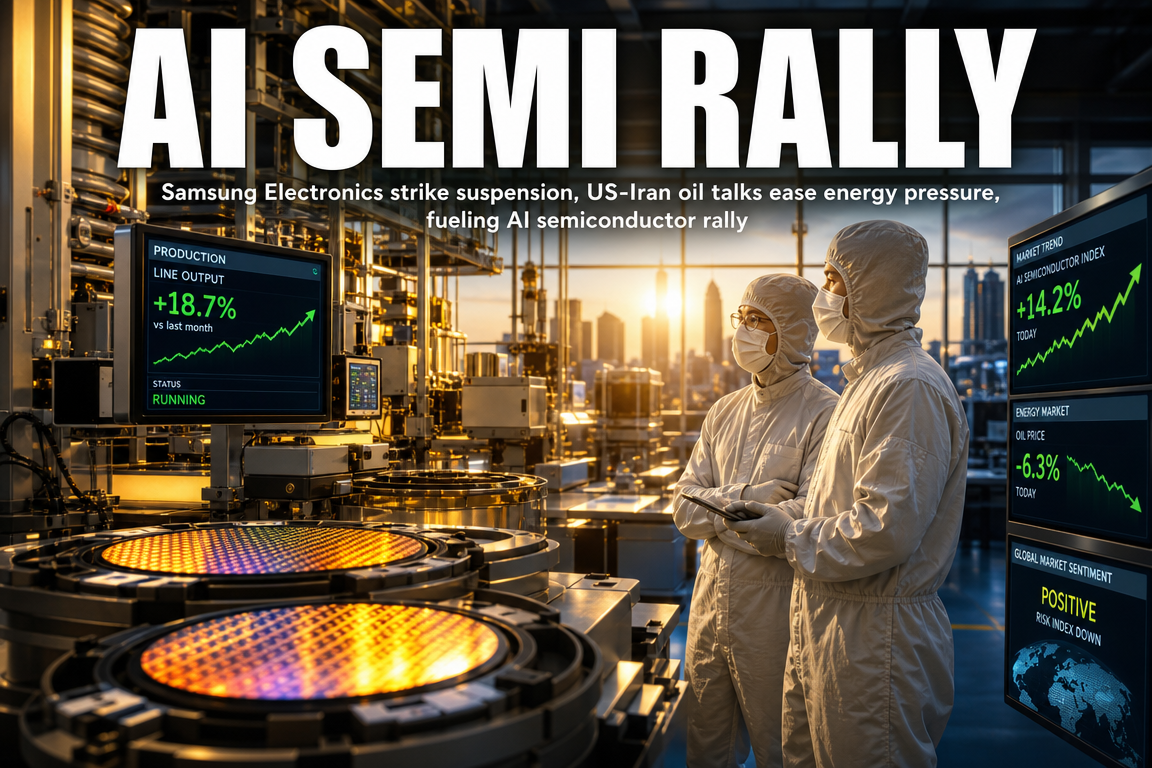
- Samsung Electronics labor-management negotiations shifted to a last-minute agreement ahead of a potential strike, materially reducing uncertainty across Korea’s semiconductor supply chain.
- Reports of progress in US-Iran negotiations drove a sharp decline in crude oil prices, increasing the likelihood of easing global inflation pressures.
- The combination of lower supply-chain risk and reduced energy-cost pressure may improve risk appetite across the KOSPI, US equities, and the broader semiconductor complex.
This is not merely “positive news.” The implications link semiconductor fundamentals, memory pricing, foreign flows, oil prices, rate expectations, and AI-related capex trends.
This report summarizes: (i) why reduced strike risk at Samsung Electronics may be more material than commonly assumed, (ii) why US-Iran headlines can affect both US and Korean equities, and (iii) how to frame Samsung Electronics, SK hynix, the KOSPI, the Nasdaq, and AI-related equities in the current context.
1. One-line market summary
Samsung Electronics’ labor dispute has effectively moved into a strike-avoidance phase, while improved odds of a US-Iran agreement triggered a sharp decline in oil prices. Together, these developments are supporting a renewed risk-on tone in both Korean and US markets.
For semiconductors, reduced disruption risk and potentially lower energy-cost pressure can support both earnings visibility and valuation.
2. Samsung Electronics strike issue: why markets view it as “largely resolved”
Key points from the labor-management negotiations
The critical factor is that Samsung Electronics’ labor and management reached a tentative agreement immediately before a strike deadline.
Formal steps (e.g., ratification procedures) may remain, but markets are primarily pricing a materially lower probability of a full-scale strike, focusing on reduced operational uncertainty rather than legal process.
Why avoiding a strike matters for Samsung Electronics’ equity
Samsung Electronics is not only a bellwether Korean equity; it is central to the global memory semiconductor supply chain and a key driver of Korea’s exports and the KOSPI’s direction.
A strike would likely have been priced through multiple channels:
- production schedule disruption
- customer delivery and continuity concerns
- changes to memory shipment plans
- reduced responsiveness to AI-related semiconductor demand
The tentative agreement reduces these risk factors, supporting production stability and customer confidence. This can translate into a lower risk discount applied to the stock.
Why this is not only a Samsung Electronics issue
Samsung Electronics’ operating stability affects the broader Korean semiconductor ecosystem, including equipment, materials, components, packaging, and export-linked names.
For foreign investors, semiconductor cycle conditions and supply stability are core inputs in assessing Korea exposure; this development is supportive on that dimension.
3. Implications for SK hynix and the memory cycle
Expectations for improved stability in memory supply-demand
Lower strike risk implies reduced uncertainty around industry-wide supply. While reduced disruption risk could be viewed as diminishing “tight-supply” price upside, market preferences in the current cycle are more focused on:
- stable production and shipments
- visibility on high-value product mix aligned with AI server demand
In this context, the market may favor normalized supply paired with improving earnings visibility over disruption-driven price spikes.
Why the development may be supportive for SK hynix
The broader sector risk premium can compress as Korea’s semiconductor headline risk declines.
With ongoing strength in AI-server memory demand (including HBM), attention may remain concentrated on both Samsung Electronics and SK hynix, reinforcing sector-level positioning.
The key investment lens is increasingly tied to AI infrastructure expansion and the strategic value of advanced memory rather than only commodity DRAM cycle dynamics.
4. US-Iran negotiation progress: why oil prices fell
Core driver of the market move
Media reports suggesting negotiations are nearing completion, including indications of final-stage documentation, coincided with a rapid decline in crude oil prices (approximately 5% intraday). This suggests markets are partially pricing a higher probability of incremental supply and/or reduced geopolitical risk premia.
Why lower oil supports equities
A decline in oil prices is typically associated with easing inflation pressures via:
- logistics and transportation costs
- manufacturing input costs
- broad consumer price transmission
This can support expectations for a less restrictive rate path, which is generally constructive for the Nasdaq, growth equities, technology, and semiconductors.
For Korea, lower oil also supports:
- trade balance dynamics
- corporate cost structure
- inflation and currency stability channels
The key variable: policy and financial conditions transmission
The primary equity-market relevance is whether lower oil feeds into lower inflation prints and reduced central-bank tightening pressure, thereby easing financial conditions and reinforcing risk appetite.
5. KOSPI overnight futures surge and US equity strength: durability considerations
Interpretation of the KOSPI futures move
A sharp rise in KOSPI overnight futures indicates the market is simultaneously discounting:
- reduced Samsung Electronics strike risk
- improved global macro conditions via lower oil
Given the high semiconductor weight in the index, improved sentiment toward Samsung Electronics and SK hynix can drive outsized index-level sensitivity.
Why US equities are reacting strongly
The mechanism is largely:oil down → inflation risk down → rate pressure down → tech and semiconductors up
Nasdaq and semiconductor benchmarks are particularly rate-sensitive and are also levered to AI capex expectations, increasing responsiveness to such catalysts.
Why a sustained rally should not be assumed
Key near-term risks remain:1) the Samsung Electronics agreement may still require final procedural completion
2) US-Iran negotiations may face implementation and verification uncertainties
3) rapid pricing can be followed by profit-taking and higher volatility
Directional support is positive, but follow-through should be monitored via data and positioning.
6. Five macro points that matter
1) Higher confidence in the semiconductor recovery narrative
As labor-related uncertainty fades, investor focus can revert to fundamentals:
- memory pricing trajectory
- HBM competitiveness
- AI server demand
- data-center investment
Reduced headline risk can allow core business value to be reflected more directly.
2) Lower oil increases the probability of easing inflation pressures
Markets are currently more sensitive to inflation and rates than to growth. Sustained energy-price declines could support a less restrictive policy outlook, contingent on subsequent inflation data.
3) A clearer rationale for foreign inflows into Korea
Foreign allocation to Korea typically incorporates semiconductors, FX, and macro stability. A combination of lower sector risk and improved inflation/rate expectations can be supportive for KOSPI flows.
4) Stronger linkage between the AI capex cycle and memory semiconductors
The current regime is driven by interconnected AI infrastructure spending across GPUs, HBM, servers, power, networking, and data centers. This structure raises the strategic relevance of advanced memory suppliers.
5) Potential for a thematic shift beyond a one-day catalyst
While the labor and geopolitical headlines are distinct, both point toward:
- supply-chain stability
- cost stability
- reduced policy constraint
- improved risk appetite
This combination may influence market leadership over coming weeks, subject to confirmation.
7. Underemphasized but critical interpretations
The key is not “strike avoided,” but “discount rate compression”
The principal equity impact is not an immediate step-change in earnings, but a potential reduction in uncertainty-related risk discount embedded in valuation.
The core benefit of lower oil is rate pressure relief, not consumer spending
For current equity pricing, the dominant channel is the effect on the expected central-bank path and broader financial conditions.
In the AI era, supply reliability can command a premium
For AI servers and high-performance computing, continuity of supply can be valued more highly than marginal price swings. Strike avoidance therefore supports customer confidence and delivery credibility.
8. Forward indicators to monitor
Samsung Electronics union ratification outcome
A remaining procedural variable; markets are constructive but confirmation matters.
Persistence of oil-price declines
Trend persistence is more important than a single-day move.
US Treasury yields and Nasdaq sensitivity
The key test is whether oil-driven disinflation expectations translate into lower yields and sustained support for rate-sensitive equities.
Direction of foreign flows
Whether KOSPI strength extends beyond a short-term reaction depends on sustained foreign buying, particularly in Samsung Electronics and SK hynix.
9. Investor framing
Today’s developments combine a Korea-specific supply-chain catalyst with a global macro tailwind. Reduced strike risk directly supports Korean semiconductor sentiment and the KOSPI, while oil-driven inflation relief supports global liquidity and rate-sensitive segments such as US technology and semiconductors.
Given the degree of immediate repricing, near-term volatility and profit-taking risk remains; confirmation should be sought in follow-on data, yields, and flow trends.
10. News-style core briefing
Samsung Electronics reached a last-minute labor-management agreement ahead of a potential strike, reducing Korea semiconductor supply-chain risk. Despite remaining procedural steps, markets are treating full-scale strike risk as materially lower, improving sentiment toward Samsung Electronics, SK hynix, and the broader semiconductor complex.
Separately, reports of late-stage US-Iran negotiations drove a sharp decline in crude oil, supporting expectations for easing inflation and reduced rate pressure. US equities and KOSPI overnight futures reflected these developments with strong gains.
The prevailing market setup is characterized by simultaneous stabilization in semiconductor supply and energy costs, reinforcing risk appetite.
< Summary >
- Reduced Samsung Electronics strike risk is supportive for semiconductor supply stability and KOSPI sentiment.
- US-Iran negotiation progress contributed to lower oil prices, increasing the likelihood of easing inflation and rate pressures.
- Samsung Electronics, SK hynix, the Nasdaq, and AI-semiconductor-related equities may see renewed valuation support under improving supply-and-rates conditions.
- Ongoing monitoring is required for agreement finalization, negotiation implementation, and near-term profit-taking risk.
- The combined signals can influence semiconductor fundamentals, oil, rates, and global equity direction concurrently.
[Related Articles…]
-
Semiconductor cycle rebound and KOSPI flow shifts: key takeaways
https://NextGenInsight.net?s=Semiconductors -
AI investment expansion and US equity strength: what to monitor now
https://NextGenInsight.net?s=AI
*Source: [ 내일은 투자왕 – 김단테 ]
– 삼전 파업 끝? 미장 국장 폭등 시작! (5월 21일)
● Samsung Rally Signal, Union U-Turn, Market Relief
Samsung Electronics Union Suspends General Strike: A Near-Term Positive for the Stock? Seven Points Investors Should Focus On
Samsung Electronics’ union suspended a planned general strike roughly one hour before it was set to begin.
While headlines emphasize a “tentative wage agreement,” the market focus is broader.
This event intersects with Samsung Electronics’ equity direction, semiconductor supply-chain stability, changes to performance-bonus schemes, foreign investor sentiment, non-memory competitiveness, government industrial-policy signaling, and overall risk perception in the Korean equity market.
Near term, the tentative deal is supportive. Over the medium to long term, the key issue is not only the reduction in strike risk, but also the design of a sustainable incentive framework amid compensation friction between profitable and loss-making divisions and potential shifts in the memory cycle.
1. What Was Actually Agreed
Samsung Electronics and the union signed a tentative agreement related to the 2026 wage and collective bargaining framework.
After post-mediation talks at the National Labor Relations Commission effectively broke down, strike risk rose materially. Negotiations resumed following direct intervention by the Minister of Employment and Labor, culminating in an overnight agreement.
Accordingly, the general strike previously scheduled from the 21st through the 7th of next month has been suspended.
This is not final. The union will decide acceptance via a member vote. At this stage, the outcome is a temporary containment rather than a definitive resolution.
2. The Core Issue: Performance Bonuses
The primary dispute centered less on the headline wage increase rate and more on the funding base and allocation mechanism for performance bonuses.
The union sought a more predictable, performance-linked bonus structure, including:
- Formalizing bonuses more directly tied to operating profit
- Expanding shared funding pools within the DS (Device Solutions) division
The union’s position: when the company generates significant profits, concentration of rewards within specific business units is difficult to justify to the broader workforce.
Management’s position: incentives should reflect performance differences between business units.
This is a standard trade-off: strict performance-based compensation can support competitiveness but weaken cohesion; broader pooled distribution can support cohesion but dilute performance discipline.
3. Metrics Investors Should Read in the Tentative Terms
Based on the reported details, the most relevant change is a revision to the bonus calculation framework:
- Higher weighting to operating-profit linkage versus the prior structure
- A compromise on the funding ratio relative to the union’s initial demand
- A time-bounded or interim institutional arrangement rather than a fully permanent scheme
The agreement appears to be a practical compromise reflecting semiconductor cyclicality. While memory profitability has improved with pricing tailwinds, the durability of the cycle remains uncertain, supporting the company’s reluctance toward a rigid long-term bonus commitment.
4. Why Internal Friction Rose Despite Strong Memory Results
Current earnings momentum is led by memory semiconductors, including DRAM and NAND, supported by price increases.
By contrast, non-memory areas such as System LSI and foundry operations have been comparatively weak, with ongoing losses or margin pressure.
This divergence creates compensation tension:
- A strict performance-based pool increases payouts to memory units and reduces payouts to underperforming units.
- For employees in loss-making units, prolonged investment cycles combined with lower compensation can amplify perceived inequity and retention risk.
This was a key sensitivity in negotiations.
5. Expected Equity-Market Reaction
Near term, the suspension is likely to be interpreted positively.
Strike risk had contributed to an uncertainty discount. The tentative agreement reduces concerns around production disruption and supply-chain shocks, potentially supporting:
- Improved foreign investor risk appetite
- Reduced institutional risk-off positioning
- Lower perceived valuation overhang for the semiconductor complex
However, a durable trend reversal would depend more on operating fundamentals than labor developments. Key variables include:
- HBM and high-value memory competitiveness
- Realized benefits within the Nvidia-related supply chain
- The pace of foundry loss reduction
- Global rates and USD dynamics
- US tech earnings and semiconductor risk sentiment
The agreement is closer to a necessary condition for upside than a sufficient one.
6. Why This Matters for the Korean Economy and Equity Market
Samsung Electronics’ labor stability is macro-relevant due to its weight in exports and manufacturing sentiment.
Escalating production-disruption risk can transmit into:
- National export momentum
- KOSPI large-cap investor sentiment
- Revenue expectations for components and equipment suppliers
- Broader KRW asset preference
In an AI-driven cycle where supply-chain reliability is strategically priced, production stability functions as a macro-level variable.
7. Why the Government Intervened at Ministerial Level
High-level government mediation suggests the issue was treated as strategic-industry risk rather than a conventional labor dispute.
Semiconductors sit at the center of Korea’s industrial agenda, spanning exports, investment, employment, technology competitiveness, and supply-chain security.
This also signals to overseas investors that Korea prioritizes stability in its core semiconductor platform.
8. The Underappreciated Point
The key issue is not the strike suspension itself, but how Samsung Electronics manages internal growth imbalance.
The tension is between:
- Businesses generating near-term cash flow
- Businesses consuming investment for future competitiveness
If the “memory profits, non-memory investment” structure persists, compensation disputes are likely to recur. This is less an isolated wage issue than a symptom of portfolio transition.
To execute across AI semiconductors, advanced foundry, high-performance memory, and packaging, the company must credibly balance “current performance” and “future investment” in its incentive framework.
9. Five Investor Watch Items Going Forward
9-1. Union Ratification Vote
Whether the tentative agreement is approved is the immediate catalyst. A rejection would reintroduce strike risk.
9-2. Persistence of Memory Price Tailwinds
Recent earnings improvement has been materially price-driven. Any reversal in DRAM/NAND pricing would increase sensitivity around bonus funding.
9-3. Non-Memory Loss-Narrowing Trajectory
Improving profitability in System LSI and foundry would structurally reduce internal compensation tension.
9-4. Foreign Flow Normalization
Reduced labor risk can support foreign buying, but flows remain more dependent on global semiconductor conditions and US equity sentiment.
9-5. Samsung’s Position in the AI Semiconductor Supply Chain
Long-term equity performance remains tightly linked to AI exposure: HBM, advanced memory, packaging, and foundry competitiveness relative to market expectations.
10. One-Line Take on the Stock
Near term, the strike suspension and tentative deal should reduce uncertainty and support sentiment; medium term, semiconductor fundamentals—AI demand, memory pricing, and non-memory profitability—remain the primary drivers.
11. Key Takeaway
The central message is that Samsung Electronics’ compensation system is under increasing strain.
A memory upcycle can temporarily suppress tension, but AI-era competition requires capabilities beyond memory alone, including foundry, system semiconductors, advanced packaging, and customer-specific production.
How the company balances performance-based discipline with funding for future-growth units may affect long-term competitiveness. The tentative deal should be viewed as a signal of internal adjustment pressures during a transition from a single-engine advantage to a multi-strategy semiconductor platform.
12. News-Style Summary
- Samsung Electronics and the union reached a tentative 2026 wage/collective-bargaining agreement shortly before a planned general strike.
- Talks resumed following direct mediation by the Minister of Employment and Labor and concluded in roughly six hours.
- The union suspended the strike initially scheduled to begin on the 21st.
- Finalization depends on a union member ratification vote.
- The primary dispute concerned performance-bonus funding criteria and allocation by business unit.
- The backdrop is a widening gap between strong memory results and weaker non-memory performance.
- Near term, the outcome is supportive for the stock and broader semiconductor sentiment.
- Over the medium to long term, incentive-system design and portfolio balance remain the key issues.
< Summary >
The general strike has been suspended, which is likely to be a near-term positive for Samsung Electronics and Korean equities through reduced uncertainty.
The core issue is the compensation conflict between memory and non-memory businesses and the redesign of an AI-era incentive system.
Key forward indicators include the ratification vote, memory pricing, non-memory loss reduction, foreign flows, and Samsung’s competitive position in the AI semiconductor supply chain.
[Related Links…]
- Samsung Electronics stock outlook and key semiconductor cycle shifts: https://NextGenInsight.net?s=Samsung%20Electronics
- AI semiconductor investment strategy and global supply-chain restructuring: https://NextGenInsight.net?s=AI
*Source: [ 경제 읽어주는 남자(김광석TV) ]
– [속보] 삼성전자 노조 “총파업 유보” 협상 극적 타렬. 삼성전자 주가는? [즉시분석]