● AI Power War, Energy Shock, Korea at Risk
In the AI era, power constraints are existential. The US–Korea–Japan energy security contest: where the outcome is decided
This is not a standalone energy headline. It must be evaluated as an integrated system spanning AI data centers, semiconductor fabs, manufacturing competitiveness, nuclear power and SMRs, LNG supply chains, maritime shipping lanes, and trilateral US–Korea–Japan economic security coordination.
This report moves beyond generic claims such as “nuclear is necessary” or “LNG matters” and focuses on:
- Why the United States treats Alaska LNG as a strategic asset
- Why Korea is structurally vulnerable in energy security
- Why AI competition is fundamentally a competition in power infrastructure
- Why US–Korea–Japan cooperation is industrial policy, not only diplomacy
1. One-line takeaway: In the AI era, the decisive constraint is power before semiconductors
The central message: insufficient power supply undermines industrial competitiveness.
Semiconductors alone are not sufficient. Data centers require uninterrupted 24/7/365 electricity. Semiconductor fabs are similarly exposed: even brief outages can destroy wafers and disrupt entire production lines.
Computing capacity depends on semiconductors; semiconductor output depends on power; national competitiveness therefore depends on energy security.
2. Why Korea is viewed as the most exposed
2-1. Structural vulnerabilities in Korea’s economy
Three primary factors were emphasized:1) Low energy self-sufficiency
2) High dependence on imported oil and gas
3) High share of Middle East-sourced energy, creating direct geopolitical exposure
A rise in conflict risk in the Middle East can rapidly transmit to Korea through import prices, logistics costs, and supply reliability. The impact extends beyond oil prices to power costs, manufacturing input costs, inflation, export competitiveness, and the trade balance.
2-2. Similar to Japan, but with higher manufacturing sensitivity
While Japan faces comparable constraints, Korea’s higher manufacturing share means power costs and reliability translate more directly into broad-based industrial competitiveness.
Energy-intensive sectors (e.g., semiconductors, steel, petrochemicals, autos, batteries) are highly sensitive to electricity pricing and grid stability. Incremental demand from AI data centers increases the likelihood that legacy power planning becomes insufficient.
3. Energy security has expanded in scope
3-1. Legacy definition: resource procurement
Historically, energy security focused on securing oil and gas volumes at favorable prices via stable import channels.
3-2. Current definition: infrastructure, sea lanes, and control
Energy security now requires:1) Resource access
2) Investment and resilience across power grids, generation, terminals, and related infrastructure
3) Protection and control of maritime chokepoints (e.g., Strait of Hormuz, Strait of Malacca)
Even with financial capacity to buy oil or LNG, disruptions in sea lanes, inadequate port/terminal capacity, or an unstable grid can prevent reliable industrial supply. Energy security is therefore a combined economic-security issue integrating infrastructure, foreign policy, and defense considerations.
4. Lessons from Europe’s experience
4-1. The cost of over-dependence on Russia
After the Russia–Ukraine war, Europe faced a significant energy shock due to high dependence on Russian coal, gas, and oil. The policy response (e.g., RePowerEU) prioritized energy mix adjustments and import diversification.
Key lesson: excessive reliance on a single supplier or region can destabilize both industry and households during crises.
4-2. Risks from weakened baseload capacity
The issue was not renewable expansion itself, but insufficient firm capacity (e.g., LNG and nuclear) to manage variability. Power systems require real-time balance; electricity remains difficult to store at scale. As AI and manufacturing loads expand, the value of stable baseload supply increases.
5. Why the United States treats energy security as a primacy strategy
5-1. US priority: control of energy shipping routes
The US approach was framed less as resource acquisition and more as control. Strategic focus includes major sea lanes and transit nodes (Hormuz, Malacca, Arctic routes, Panama). The objective extends beyond protecting flows to monitoring and, if necessary, constraining adversarial energy logistics.
5-2. The focus is not only China
In addition to China, the US monitors Russia’s role in energy markets. Arctic LNG and Russia’s “shadow fleet” were cited as destabilizing variables that can distort global price formation and supply-chain governance through opaque trade networks.
5-3. Alaska LNG is a geopolitical project, not only a gas project
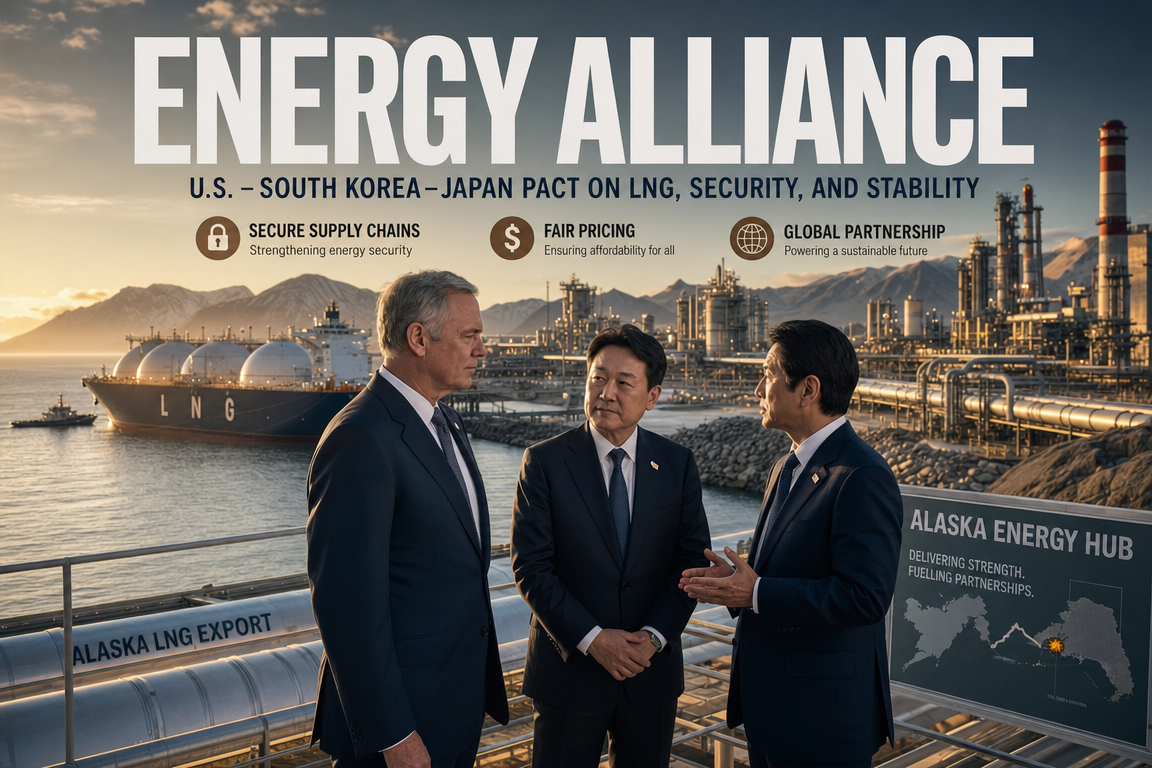
Alaska LNG was characterized as integral to US Indo-Pacific strategy. It aims to create an additional supply axis into Asian markets, reducing relative dependence on the Middle East and lowering exposure to chokepoint risks such as Malacca and Hormuz.
For Korea and Japan, the project can function as an additional long-term supply stability option.
6. Why LNG is re-emerging as a strategic energy source
6-1. Renewables alone are insufficient for reliability
LNG is being reframed as a practical energy security tool, not merely a transitional fuel. As renewables expand, flexible dispatchable generation is required to offset intermittency; LNG is positioned as the most feasible near-term option. Coal-to-gas switching can reduce emissions while supporting stable supply.
6-2. Why trilateral LNG cooperation is commercially plausible
LNG requires large-scale capital, long-term contracting, and infrastructure buildout. The complementarity is clear:
- United States: supply capacity
- Korea and Japan: large demand, engineering capability, shipbuilding, and terminal operation experience
A Pacific-oriented LNG platform connecting US supply to Asian demand can complement Middle East-centric supply structures.
6-3. LNG + data centers as an emerging infrastructure model
Co-locating LNG generation with data centers can improve reliability and potentially enhance cooling and site efficiency. Repurposing coal plant sites to LNG and building adjacent data centers can address both grid access and land-use constraints. Data centers are power- and cooling-intensive, reinforcing the view that energy infrastructure and AI infrastructure must be evaluated jointly.
7. Why nuclear power and SMRs are returning as core options
7-1. Rationale for renewed nuclear interest
Nuclear provides:
- High reliability
- Large-scale firm power
- Continuous baseload supply
- Relatively low carbon intensity
AI-era load profiles increase the premium on dependable baseload rather than intermittent generation.
7-2. SMRs: significant potential, early commercialization
SMRs are viewed as potentially suitable for data centers, industrial parks, and remote power supply. However, they remain early-stage relative to market expectations; US projects still face design and commercialization hurdles. SMRs are not positioned as an immediate universal solution.
7-3. Korea’s advantage: an intact supply chain and execution capability
The differentiated strength is not only technology but continuity across the nuclear value chain: design, manufacturing, construction, operations, licensing, and workforce. Many countries face schedule delays and cost overruns due to degraded supply chains and skills. Korea’s relatively complete ecosystem can translate into execution leverage in cooperation with the US and Japan.
8. Why US–Korea–Japan cooperation is structural, not optional
8-1. Complementary national strengths
- United States: resources and geopolitical leverage
- Korea: manufacturing competitiveness; nuclear and infrastructure EPC capability
- Japan: capital, technology, and long-horizon project management
This combination enables practical cooperation across LNG, nuclear, SMRs, critical minerals, grids, and data centers.
8-2. Governance matters more than declarations
Effective cooperation requires a multi-layer structure: leader-level strategy alignment, ministerial regular dialogues, permanent working-level mechanisms, corporate partnerships, and legislative/regulatory frameworks. Energy projects are long-cycle and complex; policy volatility can undermine investment and supply-chain continuity.
8-3. Primarily an industrial policy and growth issue
Stable power enables data center siting; data centers scale AI; AI adoption raises manufacturing productivity; productivity supports growth. Energy security therefore functions as both national security and a growth strategy.
9. News-style key points
9-1. Core issue
At a US–Korea–Japan industrial cooperation conference energy session, power infrastructure and energy security were treated as primary conditions for AI-era industrial competitiveness.
9-2. Key discussion points
- Korea’s low energy self-sufficiency and Middle East exposure increase vulnerability to external shocks.
- Energy security now includes grids, infrastructure, and maritime routes, not only resource procurement.
- The US is strengthening Indo-Pacific strategy and energy leverage via Alaska LNG and chokepoint management.
- LNG is being re-rated as a practical balancing resource for renewable variability; data center-linked infrastructure strategies are emerging.
- Nuclear and SMRs are being re-evaluated for firm baseload supply; Korea’s strength lies in supply-chain completeness and execution.
9-3. Market implications
The global economy is likely to operate as a linked chain across semiconductors, manufacturing, AI, data centers, and power infrastructure. Investment and industrial strategy may increasingly require integrated energy–AI analysis rather than siloed views.
10. Under-covered but high-importance points
10-1. AI competition is constrained by power procurement, not only model performance
The likely differentiator is the ability to secure stable, affordable power over long durations. AI should be evaluated as an energy-intensive infrastructure competition as well as a software and hardware competition.
10-2. Alaska LNG is geopolitical, not purely economic
It is a US strategic instrument to complement Middle East supply exposure and reshape Asian energy supply architecture.
10-3. The key to nuclear competitiveness is ecosystem continuity
Nuclear competitiveness requires a functioning end-to-end ecosystem (components, construction, operations, regulation, workforce), not only a strong design.
10-4. Energy security transmits to inflation and employment
Higher energy prices raise generation costs, increase manufacturing costs, weaken export price competitiveness, and pressure consumer inflation and corporate investment sentiment.
11. Forward indicators to monitor
11-1. Institutionalization of trilateral energy cooperation
Track whether leader-, minister-, and working-level channels become regularized. Without institutionalization, execution risk remains elevated.
11-2. Progress on Alaska LNG and a Pacific LNG platform
Monitor movement from concept to investment decisions and the depth of participation by Korean and Japanese firms.
11-3. Nuclear/SMR cooperation moving into projects
Assess whether US nuclear expansion policy, Korea’s supply chain, and Japan’s capital/technology converge into executable projects.
11-4. Data center siting competition
Regions with easier access to firm power and integration with LNG or nuclear assets are likely to gain advantage in data center attraction.
12. Conclusion
The session emphasized that AI-era competition is not only a chip race but also a power race.
Korea remains a manufacturing and semiconductor leader, but its energy structure is comparatively vulnerable. Energy security should be treated as a core pillar of industrial competitiveness.
Near-term: LNG as the most practical reliability tool.
Medium-to-long term: nuclear and SMRs as baseload solutions.
Execution framework: US–Korea–Japan cooperation as the most feasible platform.
Macroeconomic outlook assessments increasingly require inclusion of power infrastructure, energy security, supply chains, data centers, and LNG/nuclear dynamics alongside traditional variables such as rates, FX, and exports.
- The core constraint in AI competition is power availability.
- Korea is vulnerable due to low self-sufficiency and high Middle East dependence.
- US–Korea–Japan cooperation links LNG, nuclear, SMRs, data centers, and supply-chain restructuring as industrial strategy.
- Alaska LNG is a US Indo-Pacific energy strategy instrument, not only an import project.
- Nuclear advantage is driven by supply-chain continuity and execution; Korea is positioned strongly on this dimension.
- Global growth and competitiveness increasingly require an integrated view of energy security and AI infrastructure.
[Related]
- AI Data Centers and Power Infrastructure: Where Is the Next Investment Opportunity? (NextGenInsight.net?s=AI)
- Nuclear and SMR Market Reshaping: Why Korean Companies Are Gaining Attention (NextGenInsight.net?s=nuclear)
*Source: [ 경제 읽어주는 남자(김광석TV) ]
– AI 시대, 전력 없으면 끝납니다. 한미일 에너지 안보 전쟁이 시작됐다 | 한-미-일 산업협력 컨퍼런스 | Session2_에너지
● FIFA, Fiasco, Fare Hike, Infuriates Fans
2026 World Cup (North America): Why a 15-Minute Train Ride Costs $98 (Approx. KRW 130,000) — A Convergence of FIFA Economics, Infrastructure Constraints, and Policy Failure
This issue is not a simple case of “prices rose because it is the World Cup.”
Three structural factors matter.
First, major global sports events can expose and amplify weaknesses in public infrastructure rather than strengthen local economies.
Second, monopoly-like governing bodies such as FIFA capture substantial revenues, while transport, security, and operational costs are largely transferred to local governments and residents.
Third, this is not merely a fare dispute; it is a case study where US inflation dynamics, public finance stress, underinvestment in urban infrastructure, and platform-style pricing mechanisms appear simultaneously.
This report summarizes the New York–New Jersey transportation controversy around the World Cup final in a news-style format; explains why a 15-minute train ride reached $98; identifies who captures revenue versus who bears cost; outlines what investors should monitor from a regional-economy and capital-allocation perspective; and highlights points often underemphasized in mainstream coverage.
1. Key Developments: What Happened
The 2026 World Cup final will be held at MetLife Stadium in New Jersey.
The focal issue is access cost.
During the World Cup period, round-trip train fares to the stadium have been set at $98, triggering public backlash.
This compares with an ordinary round-trip fare of approximately $12.90, implying an increase of nearly 8x.
The travel time is short, but pricing has moved into the range of airfare or premium live entertainment.
A central constraint is the limited set of alternatives.
Walking is effectively infeasible,roads are subject to controls,and parking is priced at elevated levels,leaving visitors and residents with limited ability to avoid high transport costs.
2. Quantifying the Issue
2-1. Transport Fare
Round-trip rail access to MetLife Stadium during the World Cup period is priced at $98.
This is a sharp increase from the typical $12.90 round-trip fare.
Price shock is amplified by the short distance of the trip.
2-2. FIFA Revenue
FIFA’s expected revenue from this World Cup is cited at approximately $11 billion.
This is a record-scale figure for a global sports event.
2-3. Ticket Pricing
Final-match tickets are expected to be subject to dynamic pricing, with top-end levels discussed up to $10,000.
The admission right is therefore being priced and traded more like a scarce asset than a standard consumer good.
2-4. Local Government Burden
New Jersey is understood to face incremental World Cup-related costs on the order of hundreds of billions of KRW-equivalent.
Meanwhile, the public transport operator already faces structural deficits and aging assets.
3. Structural Drivers: A Four-Step Decomposition
3-1. FIFA’s Model: Centralized Revenue, Localized Costs
The primary issue is FIFA’s economic structure.
FIFA largely centralizes key revenue streams, including broadcasting rights, sponsorships, ticketing, and licensing.
Host cities and regions, by contrast, carry transportation, policing, emergency response, crowd management, and operational risk.
In effect, monetizable rights accrue to the global center, while high-cost execution is borne locally.
This resembles platform-economy dynamics: headquarters retains brand, data, and pricing power, while the field absorbs infrastructure, labor, complaints, and operational risk.
3-2. Contract Revisions as the Mechanism of Cost Transfer
Initial terms reportedly included free transport, later shifting toward a cost-recovery structure.
This is not an administrative detail; it reallocates who pays.
Transport cost is ultimately transferred to residents and visitors.
3-3. Long-Running Policy Underinvestment Amplifies the Shock
Severity increased because the system was already capacity- and reliability-constrained.
New Jersey’s public transport has faced prolonged underinvestment.
Political incentives to avoid tax increases, combined with deprioritization of transit budgets, have contributed to aging rolling stock, frequent delays, and persistent operating deficits.
Under these conditions, a mega-event acts less like a stress test and more like a failure risk.
3-4. Limited Substitutes Create De Facto “Forced Price Acceptance”
Price increases are less politically costly when consumers can substitute.
Here, substitution is constrained.
Pedestrian access is restricted,private vehicles face controls and high parking charges,and on-site circulation is not comparable to an open, urban stadium footprint.
The rail fare functions as a quasi-mandatory add-on cost of attendance rather than a discretionary travel choice.
4. Economic Interpretation: Why the “Local Growth” Narrative Weakens
4-1. Mega-Events Do Not Reliably Lift Local Economies
Olympics, World Cups, and similar events are typically marketed as catalysts for tourism, jobs, city branding, and real estate uplift.
However, realized net benefits are frequently lower than advertised.
A common reason is distribution: direct gains concentrate among organizing bodies, international institutions, major sponsors, hotel chains, and global platforms, while transportation, policing, environmental mitigation, and congestion costs fall on local governments and residents.
Macro-level statistics can appear positive even when residents primarily experience higher costs.
4-2. Market Power Matters More Than General Inflation
At face value, price spikes can be misattributed to broad inflation.
This case is better explained by monopoly-like access control, constrained supply, and event-driven demand concentration.
The pricing outcome reflects market power under limited alternatives more than cost-push inflation.
This aligns with broader US patterns in which consumer burden increasingly reflects pricing power concentrated among a small set of operators.
4-3. Transit Deficits and Underinvestment Return as Higher Future Bills
Avoiding near-term tax increases can reduce immediate political cost.
But deferred investment raises long-term costs: fleet replacement, disruption-driven productivity losses, commuting delays affecting labor stability, and temporary event-response expenditures.
Insufficient routine investment tends to produce larger, more visible costs during peak-demand shocks.
5. Investor and Business Implications
5-1. For Mega-Events, Infrastructure Bottlenecks Can Dominate the “Tourism Tailwind”
Investors often view the World Cup as supportive for airlines, hotels, restaurants, advertising, and sportswear.
That remains partially valid, but this case underscores infrastructure bottlenecks as a material risk.
If mobility systems underperform, customer experience deteriorates, satisfaction declines, and city brand equity can be impaired.
5-2. Implications for Infrastructure, Construction, and Mobility Technology
Incidents of this type clarify the capital need for infrastructure upgrades.
Rail modernization,smart traffic control,demand-forecasting AI,event-operations platforms,and security automationcan be framed as multi-year investment themes.
The issue is not only transportation; it signals a broader need to digitize and optimize city operations.
5-3. Expansion of Dynamic Pricing May Increase Consumer and Regulatory Pushback
Dynamic pricing is now common across airfare, hotels, concerts, sports, and ride-hailing.
For operators, it supports revenue maximization; for consumers, it increases uncertainty and perceived unfairness.
When applied to quasi-public services such as transportation, political resistance and regulatory scrutiny are likely to rise.
6. AI Trend Lens: Why This Case Matters
6-1. AI Can Reduce Congestion; the Governance Question Is “Optimized for Whom”
AI-based demand forecasting, real-time crowd dispersion, routing optimization, train dispatch adjustment, and pricing simulation are technically feasible.
The outcome depends on objective functions: citizen welfare versus revenue maximization.
Without appropriate governance, AI can be deployed to refine price discrimination rather than reduce household burden.
6-2. Smart Cities Require Sustainable Finance Before Sensors
Smart-city narratives often emphasize apps, sensors, digital twins, and AI control centers.
However, if core assets are obsolete, staffing is insufficient, and budgets are structurally constrained, marginal technology layers deliver limited improvements.
AI value realization depends on parallel investment in physical infrastructure and operational capacity.
6-3. The World Cup as an “AI-Era Public Goods” Case Study
Large-event operations increasingly require AI: flow prediction, threat detection, real-time traffic control, pricing governance, and emergency response.
Control over data and algorithms determines distributional outcomes.
Public-led models can prioritize access and safety, while concentrated private control can prioritize yield and price differentiation.
This makes the case relevant to AI governance and the boundaries of public goods provision.
7. Most Underemphasized Points
7-1. The Core Issue Is Not $98; It Is a Privatized Billing Logic Applied to Public Systems
The headline is the fare.
The deeper issue is that public transit is being mobilized as an adjunct to an event monetization stack.
Public transport is intended to guarantee mobility access.
Under mega-events, it can be transformed into a paid bottleneck corridor.
This sets a precedent for future international events, major concerts, and expos.
7-2. Treat Mega-Events as “Livability Infrastructure Stress Tests,” Not Only Revenue Opportunities
Coverage often focuses on incremental spending inflows.
Operationally, these events test a city’s electricity, transportation, policing, communications, and lodging capacity.
The heaviest burden frequently falls on low-income commuters and local residents.
The World Cup functions as an operational capability audit, not only a tourism program.
7-3. “No Taxpayer Money Spent” Is Not Necessarily Positive
Policymakers may frame reduced public spending as a success.
In practice, costs can be shifted into sponsorship structures, gambling-related revenue channels, user fees, and indirect charges.
If cost has not disappeared but has moved into less transparent and more regressive mechanisms, the policy outcome can be worse.
The key question is not whether cost exists, but whether cost allocation is equitable and transparent.
8. Relevance for Readers in Korea
This is not a US-only issue.
Similar controversies can recur in Korea around international events, large-scale concerts, sports tournaments, and mixed-use tourism megaprojects.
When metro-area transport networks, regional development, real estate, private-finance initiatives, and platform pricing interact, household burdens can rise rapidly.
This case offers a practical reference for urban policy, infrastructure investment strategy, and AI-enabled public service design.
9. Conclusion: The World Cup Is a Festival, but the Cost Structure Is Not
The New Jersey transportation controversy is not a routine “price gouging” story.
It reflects centralized revenue capture by a global governing body, chronic local underinvestment, aging public infrastructure, cost transfer under limited substitutes, and the direction of AI-era public service governance.
Public reaction reflects distributional imbalance: substantial event revenue is centralized, while inconvenience and incremental costs are borne by fans, commuters, and residents.
A mega-event’s long-term success is determined less by ceremony and more by whether residents can credibly say the event improved local conditions after it ends.
Current signals suggest that benchmark has not been met.
< Summary >
MetLife Stadium, host of the 2026 World Cup final, has become a focal point for transportation cost escalation.
A typical $12.90 round-trip rail fare is set to increase to $98 during the event period, highlighting a stark contrast between FIFA’s large-scale revenue capture and the cost burden shifted to local government and end users.
The core drivers are not general inflation but access market power, aging public infrastructure, policy underinvestment, and limited substitution.
From an investment perspective, infrastructure bottlenecks elevate operational risk while strengthening the strategic case for smart mobility and AI-enabled city operations. From a policy perspective, attention should shift from headline economic impact to cost-transfer mechanics and distributional outcomes.
In summary, the World Cup functions as a global festival, while the associated billing structure increasingly falls on local residents.
[Related Articles…]
- The Reality of World Cup Economic Effects: Why Local Experience Diverges
- The AI Infrastructure Investment Era: Who Wins in Smart Cities and Mobility Transformation
*Source: [ Maeil Business Newspaper ]
– 기차 15분에 13만 원? 북중미 월드컵이 한 동네를 박살낸다 | 홍키자의 美쿡 | 홍성용 특파원