● AI-Bubble-Reality-Check
AI Bubble Debate Through the Lens of a Former Google Executive-Turned Investor: What the Market Is Missing
The central issue in today’s AI bubble debate is not whether AI is a bubble. More material questions are: how far AI has penetrated real industrial workflows; who is realizing profits; why enterprise AI transformation remains early-stage; and which framework investors should use when evaluating semiconductors, HBM, and Big Tech valuations.
This report consolidates key points across AI investment, NVIDIA, SK hynix, semiconductors, HBM, foundation models, manufacturing AI, Palantir, AX (AI transformation), digital transformation, and smart-money flows. It prioritizes two fundamentals: (i) industrial AI adoption is still limited, and (ii) equity drawdowns may be driven more by macro variables than by a breakdown in the AI industry.
1. Core takeaway: Bubble or early cycle?
The discussion converges on a common conclusion expressed in different terms:
- View A: AI has barely begun in industry.
- View B: AI valuations may include bubble-like elements, but are unlikely to deflate quickly.
These are not contradictory. Market pricing can look overheated, while real-economy adoption remains underdeveloped, leaving room for sustained multi-year growth.
2. Clarifying “AI bubble”: Separate industry fundamentals from equity valuation
Many narratives conflate two distinct questions.
2-1. Is the industry itself illusory?
The view presented is largely “no.” AI has not yet scaled broadly across enterprise problem-solving, manufacturing optimization, service automation, and data-driven decision processes. Limited penetration implies substantial runway.
2-2. Are stock prices overheated?
Potentially yes. If price appreciation outpaces earnings growth, bubble-like characteristics can emerge. NVIDIA, SK hynix, Big Tech, and AI infrastructure equities often discount expectations aggressively. The industry can be structurally real while individual equities are tactically overpriced.
3. A key driver of drawdowns: Macro conditions may matter more than industry fundamentals
AI-sector corrections may be driven primarily by macro factors rather than deterioration in AI demand:
- Re-acceleration of inflation
- Rate hikes or “higher for longer”
- Elevated geopolitical risk
- USD strength and liquidity contraction
- Broad risk-off sentiment
Therefore, AI equity weakness should not be mechanically interpreted as an AI-industry failure. Technology adoption and asset-pricing cycles can diverge.
4. Smart money vs. retail flows: The signal is who is selling
In drawdowns, the more relevant question is seller composition rather than price movement alone.
4-1. Retail capital and smart money behave differently
Retail flows are more sensitive to headlines, fear, and FOMO. Smart money typically emphasizes fundamentals, talent migration, and structural industry shifts.
Key observations:
- During AI equity volatility, evidence of broad smart-money capitulation appears limited.
- Capital allocated to foundation-model plays does not yet show clear structural exits.
- Price instability may be driven disproportionately by retail flow volatility.
This implies long-horizon capital continues to underwrite AI’s structural thesis.
5. The operating reality: Enterprise AI transformation remains limited
Consumer adoption (e.g., ChatGPT-class usage) does not translate directly into enterprise deployment maturity.
5-1. Consumer AI vs. enterprise AI
- Consumer use: search, writing, summarization, translation, ideation
- Enterprise use: data integration, security constraints, network segmentation, cost governance, legacy system integration, operational deployment, ROI validation
Enterprise deployment typically progresses far slower than consumer adoption.
5-2. Implication from MIT-referenced research
The discussion highlights that many US enterprises fail to operationalize AI successfully. The implied conclusion is that adoption in many Korean enterprises is also early and uneven.
5-3. Primary failure modes
Failures often reflect upstream organizational issues rather than model capability:
- Poor problem definition
- Incorrect partner selection for operational context
- Repeated PoCs without scaling to production
- Unstructured or inaccessible data
- Security, segmentation, and access-control constraints
- Executive ambition not matched by internal incentives and change management
AI transformation is positioned as a management and operating-model challenge, not a model-accuracy challenge.
6. Manufacturing AI and AX: Why adoption is slow even in leading manufacturers
Manufacturing AI (process optimization, predictive maintenance, smart factory) is strategically important for Korea, but deployment is constrained by execution realities.
6-1. Gap between leadership intent and plant-level execution
Common blockers during implementation:
- Data cannot be used
- Systems cannot be externally integrated
- Cross-functional cooperation is limited
- Security rules prohibit data movement
- Work practices cannot be changed
As a result, AI vendors can only apply a fraction of their capability.
6-2. Conditions required for manufacturing AI to scale
Manufacturing AI scales when the following align:
- Precise, operational problem definition
- Feasible data capture and cleaning
- Organizational willingness to move from pilots to enterprise rollout
- Framing AI as a productivity investment, not discretionary cost
- Integration into multi-year digital transformation strategy
If these conditions are met, manufacturing AI leverage can be significant; absent them, even strong solutions underperform.
7. Foundation models vs. local models: The enterprise battleground
Enterprise AI architecture is bifurcating beyond consumer-facing foundation models.
7-1. Wrapping foundation models
Enterprises can build quickly by layering UI, workflow, security, and data connectors on top of large models.
- Advantage: speed to product
- Risk: unit economics can deteriorate as usage scales
7-2. Proprietary or local models
Firms with strict requirements for segmentation, security, data control, and cost may prefer proprietary or local models. For narrow tasks, large general models can be unnecessary.
Task-specific domains (e.g., image-to-video transformation) may be more efficient with local models. This distinction is material for AI infrastructure and capex allocation.
8. Why semiconductors, NVIDIA, SK hynix, and HBM remain central
Regardless of software narratives, AI scaling is constrained by physical compute infrastructure. HBM has become a strategic component.
8-1. Why HBM matters
Large-scale AI requires extreme data movement and throughput. HBM is critical to realizing GPU performance, which supports the case for analyzing memory, packaging, and the broader supply chain—not only GPU vendors.
8-2. Why Samsung Electronics and SK hynix are not “just memory”
In AI infrastructure, memory becomes an optimized, strategic asset rather than a commoditized input. Traditional “cyclical semiconductor” framing is less complete; investors should consider an AI-infrastructure-driven cycle.
8-3. Market blind spot
AI value creation extends beyond a single winner and diffuses across the value chain:
- Memory
- Data centers
- Cooling
- Power
- Networking
- AI servers
- Foundry and advanced packaging
- Software stack
AI exposure should be evaluated as a value-chain expansion rather than a single-equity narrative.
9. Talent migration as a leading indicator
A key indicator emphasized is where top-tier talent reallocates.
9-1. Why talent flow matters
Elite researchers, students, and founders tend to move toward domains with high expected value, combining technical feasibility, capital inflow, and ecosystem formation.
9-2. From crypto to AI
The shift of top talent from crypto toward AI is interpreted as a structural change in where hard problems and monetizable opportunities are concentrated. This supports a longer-duration growth thesis.
10. Education and organizational culture: Slower-moving constraints than technology
AI reshapes workforce capabilities and organizational processes, not only software.
10-1. Capabilities likely to increase in importance
- Problem definition
- Collaboration
- Execution using AI to deliver outcomes
- Linking domain knowledge with data understanding
- Question design over memorization
Enterprise transformation is constrained primarily by people and operating-model change.
11. Investor-style summary: Key points
11-1. Market assessment
AI-related asset prices may embed bubble-like characteristics, but the AI industry is unlikely to be a “non-event” structurally.
11-2. Investment interpretation
AI-sector drawdowns may be driven more by rates, inflation, and liquidity than by an AI demand collapse.
11-3. Enterprise reality
Enterprise AI transformation remains early-stage; failure points concentrate in problem definition, data readiness, partner selection, and cross-functional execution.
11-4. Industry structure
Foundation-model competition persists, while local models and enterprise-specific AI are rising in strategic importance.
11-5. Semiconductor focus
NVIDIA, SK hynix, HBM, and AI data-center infrastructure remain core pillars; the AI growth narrative should be evaluated with the semiconductor supply chain.
11-6. Long-horizon signal
Top-talent migration toward AI is a strong indicator of sustained ecosystem and capital commitment.
12. Under-discussed fundamentals
12-1. Outcomes depend more on problem definition than model capability
In enterprise settings, incorrect problem selection is a primary bottleneck.
12-2. Failure is more often organizational than technical
Without data access, cross-functional alignment, and operational change, model quality does not translate into performance.
12-3. Do not equate equity corrections with industrial failure
AI equity declines can reflect macro tightening rather than industry breakdown.
12-4. Talent flow is a cleaner leading indicator than headlines
Talent concentration suggests durable problem density and monetization potential.
12-5. “Healthy froth” can accelerate technology maturation
Periods of aggressive investment and experimentation can speed scaling, including in HBM, infrastructure, and foundation-model competition.
13. Reframed conclusion: This is an AI infrastructure accumulation phase
The current period is better characterized as infrastructure accumulation than end-state AI maturity. Typical features include:
- Capital concentrating in semiconductors and data centers
- Enterprises cycling through pilots and failures
- Talent reallocating rapidly toward high-potential segments
The largest value creation may occur in the next phase when vertical and industrial AI deployments scale. The relevant investor question is which layer of the stack is accumulating durable value.
14. Forward indicators to monitor
- US rates and liquidity and their impact on AI equities
- Diffusion of gains beyond NVIDIA across the semiconductor value chain
- Evidence of scalable AX success cases in Korean manufacturing
- Foundation-model cost curves vs. adoption of local enterprise AI
- Rising incidence of AI translating into revenue and productivity gains
< Summary >
AI valuations may include bubble-like elements, but the industry is unlikely to be structurally illusory. Enterprise AI transformation remains early-stage; the dominant bottlenecks are problem definition and organizational execution rather than model performance. AI equity corrections may be driven more by rates, liquidity, and inflation than by industry collapse. NVIDIA, SK hynix, semiconductors, and HBM remain core infrastructure pillars, while top-talent migration into AI supports the long-duration growth thesis. The current stage is best framed as infrastructure build-out and early industrial transition, not AI maturity.
[Related Articles…]
- https://NextGenInsight.net?s=AI
- https://NextGenInsight.net?s=HBM
*Source: [ 경제 읽어주는 남자(김광석TV) ]
– 구글 임원 출신 투자자가 보는 AI 거품론의 착각 | 경읽남과 토론합시다 | 조용민 대표 [1편]
● Middle East Shock, Oil Spike, AI Risk
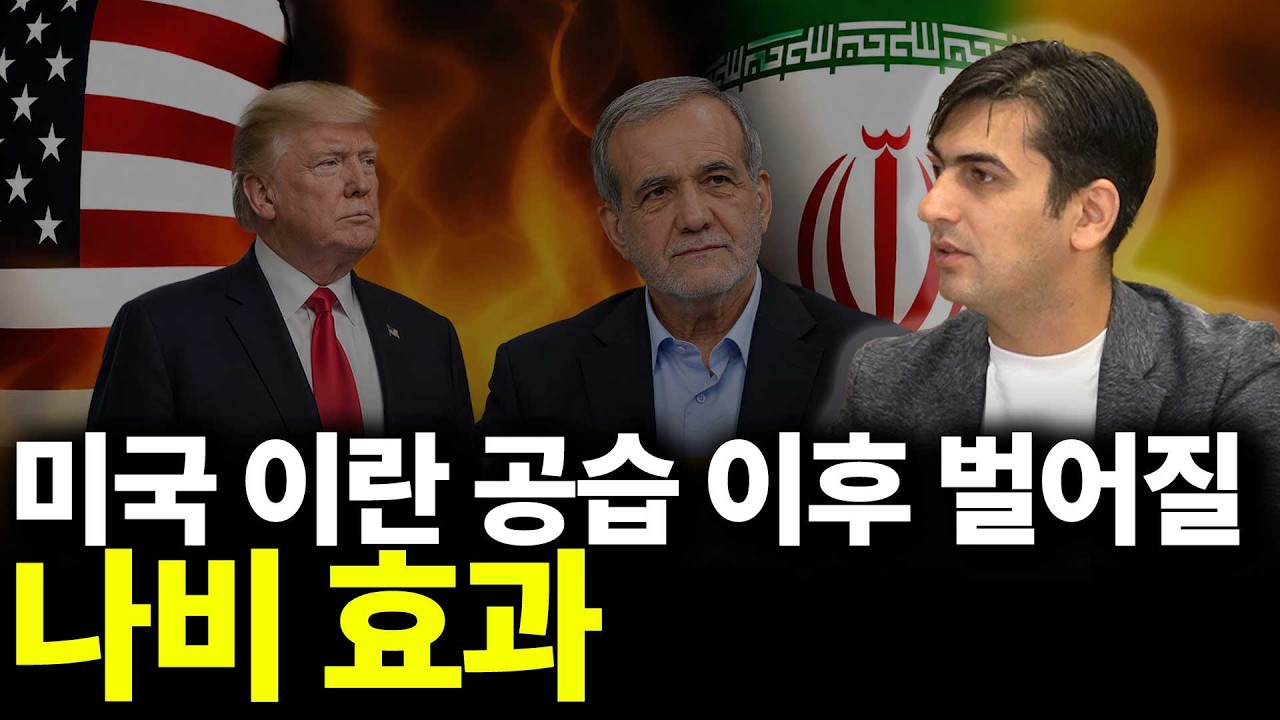
The Post-Strike Ripple Effects of US Action Against Iran: The Key Variables Investors Must Track
This issue extends beyond a bilateral US-Iran confrontation. It connects to the operational dynamics of Middle East conflict, the divergence between US and Israeli endgames, the core contention in Iran’s nuclear file, crude oil and macro implications, and the geopolitical signals relevant to AI-era portfolios.
The central point is that this is not a short-lived war headline. It is a macro variable linked to energy markets, dollar hegemony, inflation, interest rates, equities, and AI-related capital allocation.
1. Why the Latest US Strike on Iran Matters
Although it appears to be a discrete military event, it should be analyzed as a combined negotiation-and-coercion strategy typical of regional power bargaining.
A key factor is the lack of a unified US internal view on Iran:
- One camp prioritizes rapid de-escalation given the political and economic costs of prolonged conflict (higher oil, inflation pressure, election-related constraints, weaker consumption).
- Another camp expects increased military pressure to force larger Iranian concessions.
Accordingly, the strike can be interpreted both as:
- a signaling move to increase negotiating leverage, and
- a move by factions seeking to constrain or disrupt negotiations.
2. The US and Israel: Aligned Alliance, Divergent Objectives
Many observers assume strategic alignment, but objectives differ materially in this case.
2-1. The US Objective
The US priority is to prevent Iran from becoming a direct threat to the US homeland or to the broader US-led order. The principal strategic competitors remain China and Russia.
From this perspective, if Iran does not field an operational nuclear weapon, other issues (missiles, proxy networks) are often treated as manageable risks within a containment framework.
2-2. The Israeli Objective
For Israel, Iran is an existential threat. Israel views Hamas, Hezbollah, and the Houthis as connected to Iran’s support architecture; reducing Iranian regional influence is therefore treated as a necessary condition for security.
Since October 7, 2023, domestic Israeli risk tolerance has shifted toward prevention of recurrence rather than ceasefire-first preferences. When the US leans toward negotiation, Israeli policymakers can perceive this as restoring an unacceptable pre-crisis threat environment.
3. Iran’s Nuclear Issue: The Core Dispute Is Access and Capability, Not Only “Possession”
Public coverage often reduces the issue to “nuclear development,” but negotiations tend to focus on capability retention and access rights.
3-1. Iran’s Baseline Position
Iran frames a total prohibition on nuclear activity as a sovereignty violation. It has generally argued for:
- no nuclear weapons, but
- permission to maintain enrichment and research activities.
In practice, this implies retention of nuclear infrastructure and know-how even absent weaponization.
3-2. The US Pragmatic Calculation
A recurring US approach is to prioritize preventing weaponization while allowing limited enrichment under verifiable constraints, in exchange for concessions in other security domains.
This shifts negotiations from “complete dismantlement” toward “weaponization prevention plus broader issue-linkage.”
3-3. High Enrichment Is Not Equivalent to a Weapon
Rising enrichment levels do not automatically translate into a deliverable nuclear weapon. However, enrichment around 60% increases proliferation risk by reducing breakout timelines. Weapon-grade levels are typically above 90%, but market sensitivity often centers on intent and time-to-weaponization rather than a single threshold.
4. Post-Khamenei Iran: Why Instability Could Increase
A reduction in the Supreme Leader’s authority does not necessarily imply regime collapse. A higher-risk pathway is increased militarization of governance.
4-1. Potential Shift Toward IRGC-Centered Rule
Iran’s system has operated via balancing among clerical authority, political institutions, and the Islamic Revolutionary Guard Corps (IRGC). If clerical authority weakens, the most organized and coercive institution (IRGC) may consolidate power.
This would likely increase policy rigidity and security-first decision-making.
4-2. Why Militarization Increases Risk
Militarized governance can intensify internal power competition. It can also raise incentives to externalize conflict to strengthen domestic cohesion, increasing unpredictability in regional risk profiles.
4-3. Nuclear Policy Could Shift
A prior constraint has been religious-legal interpretation discouraging nuclear weapons. If authority structures change, that constraint may weaken, increasing tail risk that may not be fully priced by markets.
5. What the US Gains From This Intervention
Near term, tangible gains appear limited: no immediate regime change and no clear surge in domestic opposition. In some scenarios, external pressure can consolidate regime narratives.
However, the intervention may be aimed less at rapid overthrow and more at persistent pressure that deepens structural stress over time.
A key divergence remains the time horizon:
- The US can tolerate gradual pressure via sanctions and diplomacy.
- Israel may view time as scarce given perceived existential threat.
6. The “Hidden Beneficiary” Debate: Why Pakistan Is Mentioned
This point is often under-covered but relevant: Pakistan’s diplomatic and strategic value can rise during heightened regional tension.
6-1. Role as a Geopolitical Buffer
Deeper US involvement would elevate the importance of border dynamics and minority regions near Iran. Pakistan can leverage:
- adjacency to sensitive border regions,
- its relationships with Gulf states, and
- its status as a nuclear-armed state.
6-2. Strategic Links With Saudi Arabia
Saudi-Pakistani ties span defense cooperation, labor markets, and security networks. As regional order becomes less stable, Pakistan can gain relevance as a mediator and strategic counterpart.
This suggests the situation is not only a US-Iran-Israel triangle but a multi-layered game involving Saudi Arabia, Pakistan, and Turkey.
7. Will Global Oil Prices Rise Again or Recede?
This is the principal investor focus.
7-1. Why Oil Is Sensitive in the Near Term
Middle East risk affects oil not only through physical supply disruption but via:
- insurance premiums,
- shipping and routing risk, and
- maritime security premia.
Therefore, price normalization typically requires logistics and insurance normalization, not only a ceasefire headline.
7-2. Negotiated Settlement Scenario
If a credible agreement is signed and markets accept enforceability, oil could face downward pressure. This would reduce inflation stress and may shift interest-rate expectations. Energy-import-dependent economies, including South Korea, would likely benefit.
7-3. Prolonged Conflict Scenario
If talks fail or Israel expands unilateral action, volatility can increase. Likely market implications include:
- weaker risk appetite,
- stronger USD,
- higher demand for safe assets, and
- relative strength in defense and energy sectors.
8. Why the US Cannot Fully Exit the Middle East
The rationale is not limited to oil.
8-1. Israel
US commitments to Israel involve military, political, religious, and domestic electoral factors, making full strategic disengagement difficult.
8-2. The Petrodollar and Dollar Hegemony
Oil trade remains materially USD-centric. If major producers shift settlement away from the USD, US financial influence could face greater structural pressure. The region is therefore connected to the global payment architecture supporting US leverage.
8-3. The China Variable
China has expanded influence across energy, infrastructure, EV supply chains, manufacturing networks, and digital payment rails. This increases the strategic cost for the US of reducing regional presence. The Middle East is also an arena of infrastructure and settlement-system competition.
9. Why AI-Era Investors Must Track This Middle East Risk
This topic is directly relevant to technology and AI portfolios.
9-1. AI Is Energy-Intensive
Beyond semiconductors, AI scaling depends on data centers, cooling, grid capacity, and energy prices. Oil and gas volatility can transmit into power costs, corporate margins, and capex timing.
9-2. Geopolitics Affects AI Supply Chains
Higher regional risk can increase maritime and logistics costs, indirectly affecting flows of semiconductor equipment, components, industrial inputs, and battery materials.
9-3. Risk Shifts Change Capital Flows
Rising conflict risk can redirect capital from growth to defensives, energy, commodities, and USD assets. De-escalation can support re-risking toward the Nasdaq, AI-related equities, and other growth segments.
10. Market Checklist (News-Style Summary)
First. The US has not fully closed the negotiation channel and appears to avoid full-scale war.
Second. Israel prioritizes weakening Iranian influence over a negotiation-first outcome.
Third. Post-Khamenei risk may skew toward militarization rather than democratization.
Fourth. Oil stability depends on normalization of maritime insurance and logistics, not only ceasefire language.
Fifth. US regional engagement is linked to dollar-system durability and China containment, not only energy supply.
Sixth. AI and global equities are jointly exposed to energy costs, rates, and geopolitical risk.
11. Under-Discussed Core Takeaways
1) Militarization may be more dangerous than regime collapse. It can increase unpredictability in nuclear posture and external operations.
2) US and Israeli interests diverge structurally. The US prioritizes global order management; Israel prioritizes immediate survival security.
3) The key oil variable is restoration of trust. Markets respond more to enforceable agreements and reduced maritime risk than to verbal commitments.
4) The situation links to dollar hegemony. Instability can stress energy settlement norms and financial networks.
5) AI investing cannot ignore geopolitics. Energy volatility and logistics risk can affect the AI value chain.
12. Scenario Outlook
12-1. Negotiated Agreement
Higher probability of oil stabilization; partial inflation relief; improved conditions for rate-cut expectations. Equities may favor growth and technology, including AI.
12-2. Persistent Low-Intensity Conflict
Oil volatility likely remains elevated. USD strength and preference for defense/energy may persist. Equity performance may become more sector-differentiated than index-driven.
12-3. Accelerated Internal Militarization in Iran
Medium- to long-term uncertainty increases. Risks include renewed nuclear escalation, expanded proxy conflict, and heightened Strait of Hormuz risk. This scenario is the most adverse for global growth visibility.
13. Practical Investor Monitoring Points
Track oil alongside maritime insurance and shipping indicators. Prioritize signed documents and compliance signals over official statements. Treat Israeli unilateral action risk as an independent driver. Monitor the DXY and US Treasury yields as key risk-interpretation signals. For AI exposures, incorporate energy and power-cost structure alongside technology catalysts.
< Summary >
US strikes on Iran should be analyzed as a combined coercion-negotiation interaction rather than a standalone military event. The US emphasizes non-proliferation and global order management; Israel emphasizes reduction of Iranian influence as a security necessity. Post-Khamenei Iran may carry higher risk via militarization rather than collapse. Oil stability depends on enforceable agreements and normalization of maritime risk premia. The episode links to dollar-system dynamics, inflation, rates, equities, and AI-industry cost structures.
[Related Articles…]
- https://NextGenInsight.net?s=oil
- https://NextGenInsight.net?s=AI
*Source: [ Jun’s economy lab ]
– 미국 이란 공습 이후 벌어질 나비효과(ft.알파고 시나씨 기자)