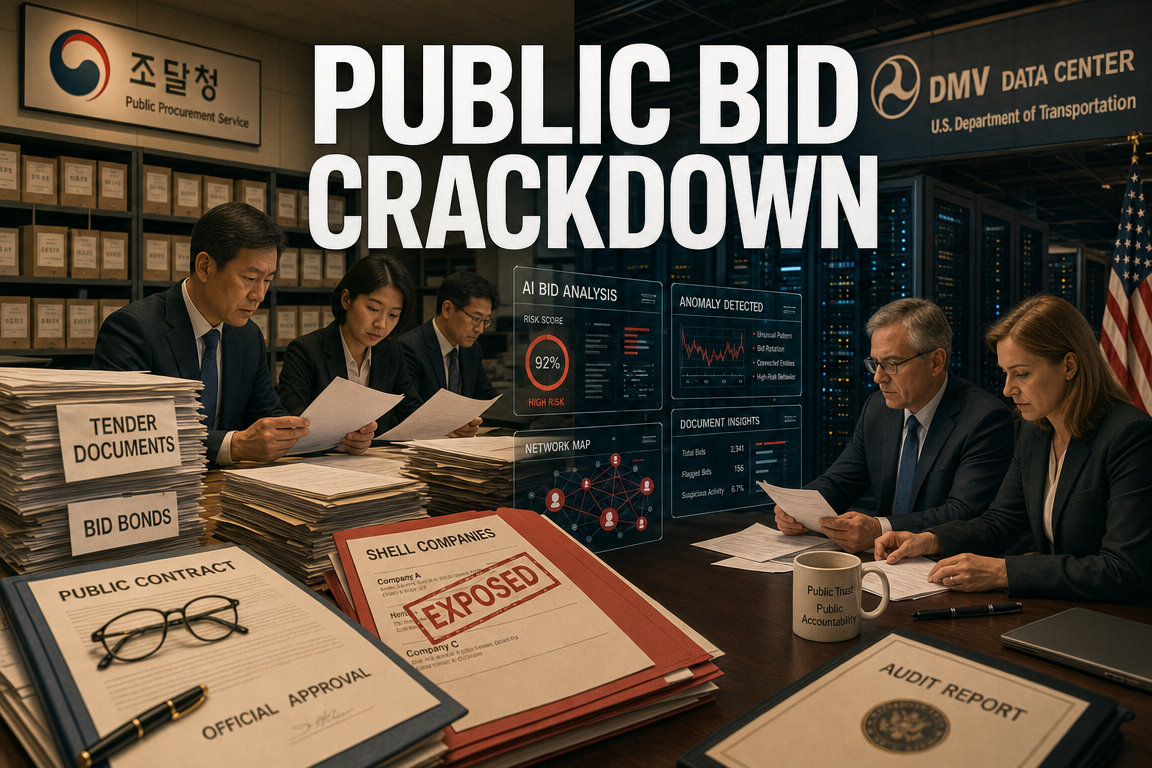
● Potholes, Payoffs, and AI, Korea’s Procurement Shockwave
Critical Leakage Point for Taxpayer Funds: Core Takeaways on Public Procurement Reform, Supply-Chain Response, and AI Procurement
This is not an institutional overview. It consolidates why public procurement is a structural pillar of the Korean economy; why blocking shell entities is foundational to fiscal efficiency and SME competitiveness; and why supply-chain resilience, bid-system reform, and domestic AI adoption should be assessed as one integrated policy track. It also covers nonferrous metals and automotive urea responses after the Middle East conflict, the practical rationale for strengthening bid bonds, the role of innovation procurement for startups/SMEs, and how public-sector AI adoption creates both opportunities and constraints for domestic AI firms. Key points underrepresented in mainstream coverage are summarized separately.
1. One-line thesis: Procurement is not purchasing; it is the design of taxpayer-fund flows
The Public Procurement Service (PPS) enables central government, local governments, and public institutions to secure goods, services, and facilities on time and to specification. Functionally, it is a core gate through which public budgets flow into the private sector. Weak controls divert funds to non-viable suppliers; robust controls improve SME/startup scaling opportunities, raise public-service quality, and support productivity and industrial competitiveness.
2. News-style summary: Main issues highlighted
2-1. Supply-chain stability: The Middle East conflict as a procurement stress test
The conflict is a direct economic variable affecting domestic supply chains, prices, industrial operations, and public procurement, particularly in a resource-import-dependent economy. The government operates a response framework under the Supply Chain Stabilization Act with the Ministry of Economy and Finance coordinating, and item-level responsibilities distributed by ministry/agency.
Examples:
- Crude oil and naphtha: Ministry of Trade, Industry and Energy
- Fertilizer and agricultural film: Ministry of Agriculture, Food and Rural Affairs
- Nonferrous metals and automotive urea: PPS
This is a decentralized, item-accountable structure rather than a single-agency model.
2-2. Nonferrous metals: Aluminum managed for systemic price spillovers, not import share
PPS prioritized proactive management of aluminum supply. Middle East-origin aluminum accounts for roughly 5% of total imports, but disruption risk can propagate across alternative sourcing prices and raise domestic manufacturing costs. PPS accelerated contracting early in the conflict to secure volume. The key risk is structural price contagion rather than the direct share.
2-3. Automotive urea: Prepared procurement to prevent a repeat of the urea-solution shock
Automotive urea previously triggered domestic disruption after export restrictions by China. Policy response has focused on diversification toward Vietnam and the Middle East. With heightened risk under the current conflict, PPS conducted on-site engagement to secure supply, obtaining approximately two months of inventory. Limited public visibility reflects preemptive action rather than absence of risk.
2-4. Remaining exposure: Construction and agricultural inputs require broader monitoring
Outside PPS’s direct remit, field-level pressure may persist, particularly in agricultural film, fertilizer, pesticides, and construction materials. Construction-material inflation can transmit into housing prices, reduce supply, and affect broader inflation and growth. Supply-chain policy therefore links to inflation dynamics, housing supply, and regional economic conditions.
3. Public tender vulnerabilities: Preventing shell entities and budget arbitrage
3-1. Why shell entities are material, especially in construction
Construction is registration-based rather than license-based. Entities can register by meeting formal criteria (office, technical staff, capital), enabling practices such as credential leasing, shared offices, and nominal staffing. A key signal: approximately 2,000 construction firms close annually, while more firms are newly established, suggesting repeated market entry by entities with limited substance.
3-2. Why this is an economic inefficiency, not only misconduct
When shell entities win public tenders:
- Higher probability of poor workmanship or non-performance
- Displacement of capable, compliant firms
This undermines fair competition, penalizes firms that invest in capability, and reduces system-level efficiency, contributing to productivity drag and lower market trust.
3-3. PPS response: Enhanced on-site verification to exclude “form-only” firms
PPS will strengthen on-site inspections to verify operational capability beyond documentation. Firms deemed unable to perform may be excluded from awards. The policy emphasis is ex ante screening rather than ex post punishment.
4. Meaning of stronger bid bonds: Deterring non-credible participation
4-1. Typical issue in goods procurement
Low-cost tender entry invites “try-and-see” bidding by firms lacking execution capacity. If awarded, they may withdraw or attempt transfer, disrupting procurement discipline and imposing uncertainty and costs on legitimate suppliers.
4-2. Why bid bonds matter
PPS positions bid bonds as a commitment screen:
- Require a bond at bidding
- Forfeit/collect upon failure to execute or contract breach
This functions less as a penalty and more as a mechanism to ensure credible participation and improve tender reliability.
5. Start of the AI procurement era: Who benefits from public-sector AI adoption
5-1. Why the public sector is accelerating AI deployment
Public institutions are shifting AI from pilots to operational infrastructure across chatbots, citizen services, analytics, document automation, forecasting, security, and operational efficiency. AI is increasingly tied to digital transformation, productivity, administrative modernization, and industrial policy. Infrastructure dependencies (data centers, power grids, compute capacity) are integral.
5-2. Core concern: AI budget growth may not translate into domestic software scaling
A primary risk is that increased public AI spending may not proportionally benefit domestic AI software firms. Large procurements may effectively favor entities with substantial GPU capacity, concentrating awards. Field feedback highlights that GPU access can become a de facto bid advantage. Rapid adoption of foreign solutions can also limit domestic firms’ opportunities to build references. Public procurement is not only a revenue channel but a validation and diffusion platform.
5-3. PPS position: Lower entry barriers and prevent “AI washing”
PPS outlines three priorities:
- Proactively identify AI-applied products
- Reduce barriers to public-market entry
- Strengthen expert evaluation to filter “AI washing”
A notable measure is easing or removing prior-performance requirements for AI-related products, addressing the “no track record, no entry” cycle for startups and early-stage firms. PPS also emphasizes rigorous assessment to prevent mislabeling basic automation as AI, which would dilute productivity impact.
5-4. Practical approach to domestic AI and domestic NPUs
International rules and government procurement agreements limit explicit country-of-origin mandates. However, procurement design can incorporate evaluation criteria or scoring incentives that favor solutions leveraging domestic technology, such as servers or systems using domestic NPUs. This is framed as a sustainability-oriented, capability-building approach rather than overt protectionism.
6. Strategic value of innovation procurement: Government as the first customer
6-1. Why first public references matter for startups and SMEs
Innovation procurement positions government as an initial buyer of innovative products. Early-stage firms often face demand friction due to preference for proven solutions, including within public institutions. Under this program, PPS purchases products and supplies them to user institutions for trials, then returns operational feedback to suppliers.
Key outputs for firms:
- Initial purchase reference
- Field validation results
- Product improvement direction
These references can accelerate adoption across other public entities and the private sector.
6-2. Why innovation procurement matters at the macro level
This is positioned as industrial policy rather than welfare-style support: leveraging public purchasing power to create early markets for strategic technologies (e.g., semiconductors, AI, digital transformation, clean tech, smart cities, domestic software) when private buyers remain risk-averse.
7. Decentralization of local procurement: From centralized efficiency to regional-fit competition
7-1. Strengths and limits of the current centralized model
The current system emphasizes centralized efficiency, including mandatory purchasing of centrally contracted items. Advantages:
- Economies of scale
- Concentrated contracting expertise
- Standardization and price efficiency
Limitations under regional decentralization:
- Heterogeneous local demand and preferences
- Need for local enterprise development
- Reduced ability to reflect regional specifics under uniform central contracting
7-2. What local procurement autonomy implies
Greater autonomy enables local governments to design procurement strategies aligned with regional needs and potentially broaden support for local firms. It also increases competitive pressure on PPS to enhance expertise and service quality, reducing reliance on statutory exclusivity.
7-3. Risks and safeguards
Key risks:
- Higher local-level corruption exposure
- Potential weakening of SME and vulnerable-group support
- Uneven contracting capability across regions
Outcomes depend on safeguards: audit systems, transparency, procurement data disclosure, standardized contract models, and refined evaluation criteria.
8. Undercovered but decisive points
8-1. The core is not “reform” but restoration of market-selection function
Public procurement sends strong market signals that affect supplier credibility, financing access, private-sector sales, and hiring capacity. Procurement operates as an industrial-structure lever, not only a spending mechanism.
8-2. Blocking shell entities is primarily protection of compliant firms
Beyond anti-corruption framing, the key is protecting firms that invest in capability. If compliant firms are displaced by form-only entrants, the system teaches adverse incentives and weakens investment discipline across the broader market.
8-3. AI procurement success depends on domestic ecosystem accumulation, not only adoption speed
Short-term efficiency may favor rapid integration of high-performing foreign solutions. However, a central question is whether public AI budgets generate learning effects and accumulation for the domestic ecosystem (references, operational experience, and data). Procurement design should balance efficiency with industrial competitiveness and technology sovereignty constraints.
8-4. Supply-chain outcomes depend on pre-crisis preparedness
Automotive urea illustrates that diversification and on-the-ground networks built during calm periods determine crisis resilience. The relevant lens is a national supply-chain portfolio spanning nonferrous metals, energy, agricultural inputs, and construction materials.
9. Policy implications from an investor lens
9-1. Fiscal efficiency links to macro stabilization capacity
Inefficient execution reduces growth impact and fiscal multipliers. Effective procurement can redirect budgets toward competitiveness, innovation diffusion, and regional economic activity.
9-2. SMEs and startups should treat procurement as a growth market
Despite procedural burden, procurement can function as a high-leverage credibility and scaling channel, especially via innovation procurement, reduced AI entry barriers, and public proof-of-concept opportunities.
9-3. Procurement data and evaluation systems become decisive
Reform effectiveness is likely to hinge on data-driven management: repeat contract withdrawals, inspection failures, and AI-washing patterns by category. Data accumulation can make procurement a more precise market-governance tool.
10. Conclusions (at a glance)
- Supply-chain stability is evolving from item-level management to economic-security policy.
- Blocking shell entities protects taxpayer funds and compliant firms.
- Bid bonds are a key mechanism to improve tender credibility.
- Innovation procurement creates first-customer references for startups and SMEs.
- AI procurement should be designed to support domestic ecosystem accumulation within treaty constraints.
- Local procurement autonomy requires a new balance between scale efficiency and regional fit, with strong safeguards.
Public procurement is an institutional infrastructure that influences productivity, industrial policy, technology capability, regional economies, and supply-chain resilience. As screening and evaluation become more rigorous, budget quality improves and viable firms gain clearer scaling pathways.
< Summary >
PPS is a major gate connecting public budgets to private suppliers; public procurement materially affects fiscal efficiency and industrial competitiveness. Post-conflict responses in nonferrous metals and automotive urea were relatively preemptive; broader supply-chain management is expected to expand to construction and agricultural inputs. Strengthened on-site verification and bid bonds are central to restoring tender discipline by filtering shell and non-performing firms. Innovation procurement functions as a first-customer mechanism for startups and SMEs. AI procurement requires more precise design to ensure domestic ecosystem benefits while recognizing constraints from international procurement rules. Local procurement autonomy seeks a new equilibrium between centralized efficiency and region-tailored procurement.
[Related links…]
- https://NextGenInsight.net?s=supply-chain
- https://NextGenInsight.net?s=AI
*Source: [ 경제 읽어주는 남자(김광석TV) ]
– 국민 세금, 엉뚱한 기업에 새지 않게 막겠습니다 | 경읽남과 토론합시다 | 백승보 조달청장님
● US AI Soars, DMV Crawls
The United States Uses AI for Real-Time Battlefield Intelligence. Why Do Citizens Still Need to Take a Day Off to Obtain a Single Driver’s License Document?
This issue is not adequately explained by the generalization that “U.S. public offices are slow.” The core drivers include structural bottlenecks in administrative service delivery, budget separation between federal and state governments, COBOL-based legacy systems, links to broader productivity constraints, and the reasons public-sector digital transformation lags in the AI era. Key focus areas include: (i) why defense AI scales quickly while citizen-facing administration remains slow, (ii) how these inefficiencies affect labor markets, inflation, investment sentiment, and infrastructure competitiveness, and (iii) which industries and companies may benefit as modernization accelerates.
Key Takeaways
- In the U.S., driver’s licenses, vehicle registration, and identity-related documentation often require appointments booked months in advance, with multi-hour waits common even on scheduled days.
- Documentation requirements are strict; minor formatting errors can trigger rejection and require rebooking.
- Digital transformation remains incomplete, and legacy channels such as fax, mail, and repeat in-person visits persist.
- In contrast, the U.S. is investing aggressively in AI, cloud, and data center capacity for defense and national security. The issue is not technological capability, but highly uneven allocation of funding and execution capacity.
What Operational Frictions Citizens Encounter
1. Appointment Backlogs as a Structural Feature
A representative example is the DMV (Department of Motor Vehicles). In high-population areas such as New York and New Jersey, appointments at preferred locations can be scheduled months out. For users accustomed to near-real-time mobile booking, same-day processing, and automated e-document integration, this is a material service gap.
Backlogs are not limited to scheduling. Even with an appointment, applicants often take a number and wait for hours. The bottleneck is less about individual staff performance and more about process design and system constraints.
2. Strict Compliance Rules Supported by Outdated Infrastructure
Some states apply complex identity verification frameworks (e.g., multi-point verification). Applicants may need passports, permanent residency documents, Social Security-related documentation, bank statements, utility bills, and other proofs. Small deviations in dates or formats can result in denial.
The key mismatch is that requirements are sophisticated, while operational infrastructure is inefficient. Limited digital document interoperability increases manual review, which amplifies counter-level variance, queue times, and re-visit risk.
3. Why Fax and Mail Still Appear in 2026
In the U.S., fax, mail, and in-person visits remain core administrative channels. This reflects delayed modernization in the public sector relative to private industry. While large technology firms operate with generative AI, cloud automation, and data-driven workflows, many public agencies still rely on scanning, manual input, and legacy databases. This drives a credibility gap between the nation’s advanced AI capabilities and citizen-facing service delivery.
Structural Drivers of Administrative Inefficiency
1. Federal vs. State Government Separation
This is the central point. Many citizen-facing services, including DMV operations, are primarily state-level responsibilities. Large federal AI budgets do not automatically translate into local administrative modernization.
Defense AI, federal cloud programs, and centralized digital infrastructure initiatives operate under different budget lines, decision structures, and priorities than state-level public service systems. As a result, federal announcements of large-scale AI investment can coexist with hours-long waits at local offices.
2. Low Political Visibility Reduces Priority
Defense spending is directly tied to national security, enabling political alignment and budget momentum. By contrast, DMV system replacement is framed as service convenience rather than a strategic imperative, despite its measurable economic impact.
In practice, missile-tracking AI is treated as “national strategy,” while license renewal throughput is treated as “administrative improvement.” This pushes public-sector digitalization down the priority stack, even when it affects baseline productivity.
3. Legacy Systems, Including COBOL, Create High Switching Costs
Many U.S. public systems still run on decades-old legacy code. COBOL-based systems remain common in finance, insurance, and public administration; large-scale social benefit systems have also been reported to operate on substantial COBOL codebases.
In such environments, superficial UI updates do not resolve core constraints. Legacy back ends limit data interoperability, automated validation, real-time processing, and error traceability. The talent pool capable of maintaining these systems is also shrinking.
This is not an “app replacement” problem. It requires changes to data models, identity and authentication, state-by-state regulatory requirements, procurement, budgets, and workforce allocation, resulting in high modernization costs and long implementation cycles.
Why This Matters for the U.S. Economy
1. Slow Administration Is a Productivity Drag
Taking a day off work to complete basic administrative tasks represents direct productivity loss. Employees lose paid work time, small businesses lose operating hours, and firms absorb administrative overhead. These “hidden costs” are often undercounted but scale across the economy.
The burden is regressive: immigrants, lower-income households, and workers with limited schedule flexibility are disproportionately impacted. Lower administrative accessibility delays employment, driving, relocation, vehicle compliance, and insurance onboarding, reducing labor mobility and market flexibility.
2. Inflation and High Rates Amplify Friction Costs
In a high-inflation, high-rate environment, time and administrative costs increase in salience. Transportation, mailing, notarization, re-visit expenses, and leave utilization add to household financial pressure. These frictions reduce effective consumption capacity and strain cash flows.
For macro assessment, administrative efficiency functions as a productivity variable alongside rates, inflation, and employment. The U.S. can remain technologically dominant while still exhibiting large service gaps in routine public functions.
3. Administrative Inefficiency and Physical Infrastructure Share Common Roots
Road maintenance backlogs, transit delays, aging public facilities, and slow public offices often reflect the same underlying drivers: deferred maintenance, complex procurement, reduced political priority, state-level fragmentation, and aging systems. The result is an increasingly visible two-speed economy: fast private-sector innovation alongside slow public-sector modernization.
Why the Gap Looks Larger in the AI Era
1. Defense AI Advances Faster Than Citizen-Facing Administrative AI
The U.S. is moving quickly on AI adoption in defense and intelligence: real-time analytics, target identification, automated surveillance, and federal cloud transitions. These domains concentrate funding and talent due to strategic importance.
Citizen-facing services move in the opposite direction. License renewal, vehicle registration, benefits verification, and identity document validation are highly automatable but remain slow. This divergence is a potential driver of future political dissatisfaction.
2. Generative AI Does Not Automatically Modernize Government Operations
Public-sector modernization is not solved by deploying chatbots. It requires data standardization, security architecture, privacy compliance, accountability frameworks, legal validity of digital outputs, and auditability.
In the U.S., state-by-state rule differences make nationwide deployment difficult. The rapid release and update model of private SaaS does not map cleanly onto regulated public administration.
3. The Long-Term AI Opportunity Set Includes Public-Sector Automation
Over the long run, one of the largest underappreciated AI markets may be public administration: document understanding, identity verification, appointment optimization, case intake and routing, rule-check automation, anomaly detection, and legacy code modernization.
Legacy-to-cloud migration and modernization into contemporary languages represent a multi-year, high-budget market. While markets emphasize generative AI demonstrations, sustained revenue may concentrate in operational modernization that is less visible but mission-critical.
Investment and Industry Implications: Monitoring Points
1. Cloud and Government IT Demand May Expand
Once modernization begins, the scale of U.S. government and public institutions is substantial. Demand can expand across cloud infrastructure, security, data management, identity systems, back-office automation, and public-sector SaaS.
This can form a medium- to long-term equity theme, with relevance for digital transformation, cybersecurity, data centers, and AI infrastructure segments that are sensitive to procurement cycles and policy direction.
2. Legacy Modernization Providers May Be Re-Rated
Market attention remains concentrated on generative model developers, but operational demand is acute for firms that replace or modernize aging systems. Areas include mainframe transitions, data migration, government identity systems, workflow automation, and regulatory software.
This domain tends to offer longer-duration contracts and more predictable revenue than short-cycle AI applications. If the U.S. seeks broad productivity improvement, public infrastructure digitalization may carry higher marginal impact than incremental AI demonstrations.
3. Korea vs. the U.S.: A Notable Inversion
Korea offers high citizen-level digital government penetration (integrated portals, mobile identity, electronic issuance, streamlined authentication). The U.S. leads in private-platform innovation but remains comparatively analog in public administration.
National competitiveness is not determined solely by semiconductors, AI models, or GDP. The speed and accuracy of everyday administrative services affect productivity, social trust, and the operating environment for entrepreneurship.
Under-Discussed Core Interpretation
1. Not Cultural; Primarily Resource Allocation and Prioritization
The slow pace of U.S. public administration is often framed as culture or “typical inefficiency.” A more structural interpretation is that the U.S. allocates top-tier resources to defense and private innovation while leaving citizen administration under-resourced. This reflects political economy and prioritization rather than capability constraints.
2. The U.S. Productivity Puzzle Is Hard to Explain Without Public-Sector Bottlenecks
The U.S. hosts many high-innovation firms, yet everyday frictions remain high. Public-sector bottlenecks can prevent private-sector innovation from translating into broad-based, lived productivity gains. For U.S. macro outlook, public digital transformation speed is relevant alongside large-cap earnings.
3. The Next Phase of AI Is Back-End Reform, Not Front-End Demonstrations
The current cycle emphasizes visible generative outputs. Larger structural gains are likely to come from less visible domains: document processing, administrative decision support, legacy code interpretation, and data integrity. The public-sector gap illustrates that the primary AI value capture may be in back-office automation and system modernization.
Forward Monitoring Checklist
- Whether state-level administrative digital transformation budgets increase materially.
- Whether state-level modernization programs expand independently of federal AI spending.
- Whether public-sector legacy modernization and cloud migration beneficiaries are re-rated in U.S. markets.
- Whether structural administrative inefficiencies persist even as inflation and rates normalize, limiting productivity improvements.
- Whether competitive advantage increasingly depends on the ability to modernize national systems, not only private AI model development.
Conclusion
Slow U.S. administrative services are not a minor inconvenience. They reflect structural inefficiency, underinvestment in public infrastructure, distorted political prioritization, and uneven development in the AI era.
The U.S. can deploy AI to track adversaries while citizens remain constrained by fax workflows and long queues for routine documentation. Understanding this gap is important for evaluating U.S. productivity trajectories, public-sector digital transformation, and the evolving AI opportunity set.
< Summary >
- Slow U.S. public administration reflects state-centric governance, low political prioritization, COBOL-based legacy systems, and delayed public-sector digital transformation.
- Defense and federal AI investment progresses rapidly, while citizen services remain reliant on fax, mail, and repeat in-person visits.
- These inefficiencies affect labor productivity, household cost burdens, labor mobility, and overall competitiveness.
- Potential AI beneficiaries include public-sector automation, cloud migration, and legacy modernization providers.
- U.S. macro and market analysis should incorporate public infrastructure and administrative efficiency alongside large-cap technology and rates.
[Related Posts…]
- https://NextGenInsight.net?s=AI
- https://NextGenInsight.net?s=interest-rates
*Source: [ Maeil Business Newspaper ]
– 서류 한 장 떼려다 하루 연차 날리는 미국 관공서 현실 | 홍키자의 美쿡 | 홍성용 특파원