● AI Stocks Selloff Alert
Should Investors Buy AI Equities Now? The Only Signals That Justify Selling
The market’s key questions are:
- “Is it reasonable to add exposure now?”
- “When should positions be reduced?”
The current AI leadership trend has not conclusively broken. However, exposure should be reduced decisively if specific macro and capital-market signals emerge. The central issue is less “AI is good or bad” and more whether capital can continue to fund AI investment. This depends on rates, inflation, and confidence in capital formation.
Key topics addressed include:
- Why US 10-year Treasury yields at 5.0% and 5.3% matter
- Why core CPI at 3% is a risk threshold
- Why Big Tech AI capex is structurally difficult to stop
- How an OpenAI IPO or funding setback could transmit systemic risk
1. Bottom line: Buying may still be justified, but sell on these signals
Core conclusion:
- AI leaders are not yet in a definitive downtrend, but investors should exit or reduce exposure rapidly if the following signals confirm.
Primary sell signals:
- US 10-year Treasury yield breaks above 5.0% and approaches or exceeds 5.3%
- US core CPI re-accelerates and becomes anchored above 3.0%
- OpenAI’s IPO or broader fundraising narrative weakens, impairing AI investment sentiment
The practical focus is the sustainability of funding for AI capex and ecosystem financing, not headline performance alone.
2. Why Big Tech is unlikely to cut AI investment quickly
Big Tech’s AI spending is difficult to reverse for structural reasons:
2-1. Scaling expectations remain influential
The prevailing view still prices in performance gains from more compute, better chips, and more data. If marginal gains fall sharply relative to incremental spending, unit economics could deteriorate; however, market positioning still assumes further upside, particularly in agentic AI, coding tools, and multimodal systems.
2-2. Losing the AGI race risks platform control
AI is integrated across search, cloud, productivity software, advertising, devices, and enterprise solutions. A competitive loss in AI can pressure existing core businesses, limiting willingness to optimize near-term earnings by cutting investment.
2-3. Platform adoption and habit formation are central
Once AI workflows are embedded (automation, coding assistance, document production, search substitution, customer service), switching costs increase. As a result, market share and lock-in often take precedence over short-term margins.
2-4. Sunk-cost and commitment dynamics
Large commitments have already been made across data centers, GPU procurement, power infrastructure, talent, and long-term supply agreements. Abrupt pauses can increase total losses, reinforcing capex inertia.
3. The primary risk is capital supply, not corporate intent
Even if Big Tech intends to invest, the cycle can weaken if capital markets restrict financing. The AI ecosystem relies on external funding channels beyond operating cash flow:
- Corporate debt issuance
- Bridge financing
- Venture capital
- Private capital
- Strategic investors
- Sovereign wealth-related flows
Potential triggers for a downturn in the AI investment cycle:
- Growth slowdown
- Rising rates
- OpenAI IPO failure or broader impairment in capital-market confidence
Currently, the most important variables are rates and IPO/funding credibility.
4. Why a 5% US 10-year yield is a market warning level
Historically, market sensitivity increases when yields break prior cycle highs, not merely when they rise. At sufficiently high yields, investors reassess whether risk assets are adequately compensated versus risk-free returns, increasing the probability of rotation out of high-multiple growth equities.
4-1. Why the 10-year matters more than the 2-year
The 2-year is dominated by policy-rate expectations. The 10-year reflects a broader set of factors: trend growth, inflation expectations, fiscal risk, and supply-demand dynamics. In environments with elevated political and policy uncertainty, the 10-year can be the more informative signal.
4-2. Practical risk ranges
- US 10-year at 5.0%: prior-cycle upper bound / initial risk threshold
- US 10-year at 5.3%: higher-shock boundary for equities
A move from the mid-to-high 4% range into sustained levels above 5% can materially change the discount-rate regime, compressing multiples in high-valuation AI and technology equities.
5. Why core CPI at 3% is a critical threshold
Rising yields are often inflation-driven; therefore core CPI should be monitored alongside rates. Markets tend to treat ~3% as a key line. If core CPI reclaims and holds above 3%—as re-acceleration rather than a temporary fluctuation—tightening risk rises, yields can increase further, and valuation compression risk increases for AI-related growth equities.
6. Why an OpenAI IPO setback could become a systemic AI equity risk
The relevant risk is not only company-specific; it is the credibility of AI financing structures.
6-1. Linkage to leveraged capital providers
If OpenAI’s IPO is delayed or priced below expectations, the funding-and-exit framework for major investors and leveraged intermediaries may weaken, potentially tightening financing conditions across the AI ecosystem.
6-2. IPO weakness as a sentiment fracture
If a frontier AI firm fails to secure strong public-market validation, follow-on effects may include more cautious behavior from:
- Venture capital
- Credit markets
- Strategic investors
This could transmit to slower investment in:
- Data center buildouts
- Model development
- Semiconductor procurement
- Power infrastructure
In this framing, an OpenAI IPO is a valuation and financing test for the broader AI complex.
7. How to frame OpenAI risk
Competition has shifted from model benchmarks toward monetization in:
- Coding agents
- Productivity tools
- Enterprise automation
Execution in commercialization can reduce IPO downside risk. Conversely, strong performance by competitors (e.g., rapid growth and evidence of profitability) could validate industry-wide monetization rather than represent isolated weakness.
8. Coding is the earliest large monetization market for AI
AI penetration is advancing rapidly in software development:
- Code generation
- Debugging assistance
- Test generation
- Documentation automation
- Legacy code interpretation
- Workflow orchestration
Developer roles may shift toward supervision and verification of AI outputs. This implies a near-term expansion in addressable market as AI captures a portion of global software labor spend.
9. Similarities between the dot-com bubble and the current AI cycle
While not identical, liquidity and sentiment dynamics show comparable patterns.
9-1. Late-cycle leadership concentrates in “real” winners
Broad participation can narrow to firms with clear infrastructure positioning and durable narratives. In the current cycle, areas with tangible demand and supply constraints may persist longer:
- Semiconductors
- Memory
- Power
- Data centers
- Server infrastructure
9-2. High-multiple “story” equities tend to break first
Late-cycle weakness often begins in companies driven primarily by expectation rather than earnings. Current analogs may include:
- Certain robotics
- Quantum computing
- Space themes
- Early-stage AI applications with limited fundamentals
Revenue- and cash-flow-supported infrastructure names often weaken later in the sequence.
10. Equity groups to monitor for early stress
Core principle: the highest-multiple equities typically de-rate first.
10-1. Higher early-downside risk
- Loss-making robotics equities with elevated expectations
- Quantum-related equities with distant commercialization
- Small-cap thematic AI equities with weak fundamentals
- Long-duration narrative themes (space, next-generation mobility)
10-2. Potentially more resilient (not guaranteed)
- HBM, memory, and GPU supply-chain exposures
- Data center and server infrastructure
- Large-cap semiconductors with validated earnings power
- Big Tech platforms supported by cash flow
11. Practical portfolio interpretation
Attempting to time exact peaks is unreliable. In AI-led markets, expensive assets can remain expensive for extended periods. A practical approach:
- Respect leadership trends while uptrends remain intact
- Reduce exposure when meaningful breakdowns and downside acceleration appear
- Avoid aggressive averaging-down in established downtrends
- Predefine risk limits and exit criteria
12. News-style key points
12-1. Macro
Rising US 10-year yields are a primary risk factor for AI leadership. Markets often reference 5.0% as the first boundary and 5.3% as a stronger warning level. Core CPI above 3% increases the risk of renewed inflation concerns and valuation pressure on technology.
12-2. Industry
Big Tech is constrained by platform competition and AI infrastructure commitments; data center, GPU, memory, and power capex retains momentum.
12-3. Capital markets
The dominant risk is funding structure stability. If credit, bridge financing, or strategic capital weakens, the AI capex cycle can slow.
12-4. Company-level
OpenAI vs. Anthropic competition is increasingly a test of monetization capacity and valuation benchmarks for the broader AI sector.
13. Under-discussed leading indicators
13-1. Funding stress may precede earnings deterioration
AI is capital-intensive. Even with strong operating performance, higher external funding costs can interrupt price momentum.
13-2. The 10-year yield represents a “risk-asset abandonment” threshold
5% is a behavioral and valuation boundary that can change allocation decisions, not merely a psychological round number.
13-3. Early breakdowns in “story” equities are a leading signal
Before core semiconductor leaders weaken, highly valued thematic names may sell off first, signaling broader risk appetite deterioration.
13-4. Coding is the first major monetization battleground
Coding automation may monetize faster than search substitution or advertising, potentially resetting valuation frameworks if clear winners emerge.
14. Reframed key takeaways
- The AI cycle is not conclusively finished; technology, platform, and infrastructure competition remains active.
- The durability of the rally depends on rates and liquidity; higher yields and inflation re-acceleration are primary risks.
- Differentiate holdings: tangible earnings and infrastructure exposure versus multiple-driven narratives.
- Selling should be response-driven, based on trend and macro/capital signals rather than peak prediction.
15. Checklist: indicators to monitor
- US 10-year Treasury yield: break above 5.0%
- US 10-year Treasury yield: approach/exceed 5.3%
- Core CPI: re-break and persistence above 3.0%
- Big Tech AI capex: continuation of growth trajectory
- OpenAI and other frontier labs: financing/IPO developments
- Early drawdowns in high-multiple thematic equities
- Evidence of demand deceleration in HBM, GPUs, and data center buildouts
< Summary >
AI leadership is not definitively over. Risk increases if US 10-year yields move above 5%, core CPI remains above 3%, and capital-market events such as an OpenAI IPO/funding setback undermine financing confidence.
Big Tech may be slow to reduce AI spending, but shifts in capital supply can change market conditions rapidly. Late-cycle dynamics often show multiple-driven thematic equities weakening first, while semiconductor, memory, and infrastructure exposures may remain more resilient.
Priority should be disciplined response over peak forecasting: respect trends while intact, but act quickly if rates, inflation, funding conditions, and leading industry indicators deteriorate.
[Related…]
- AI investing and US equity market overview: https://NextGenInsight.net?s=AI
- How rates affect semiconductors and growth equities: https://NextGenInsight.net?s=rates
*Source: [ 내일은 투자왕 – 김단테 ]
– 이 신호가 보이면 주식을 팔아야 합니다.
● NVIDIA-Intel,AI-PC-Shift,Memory-Surge,Market-Risk
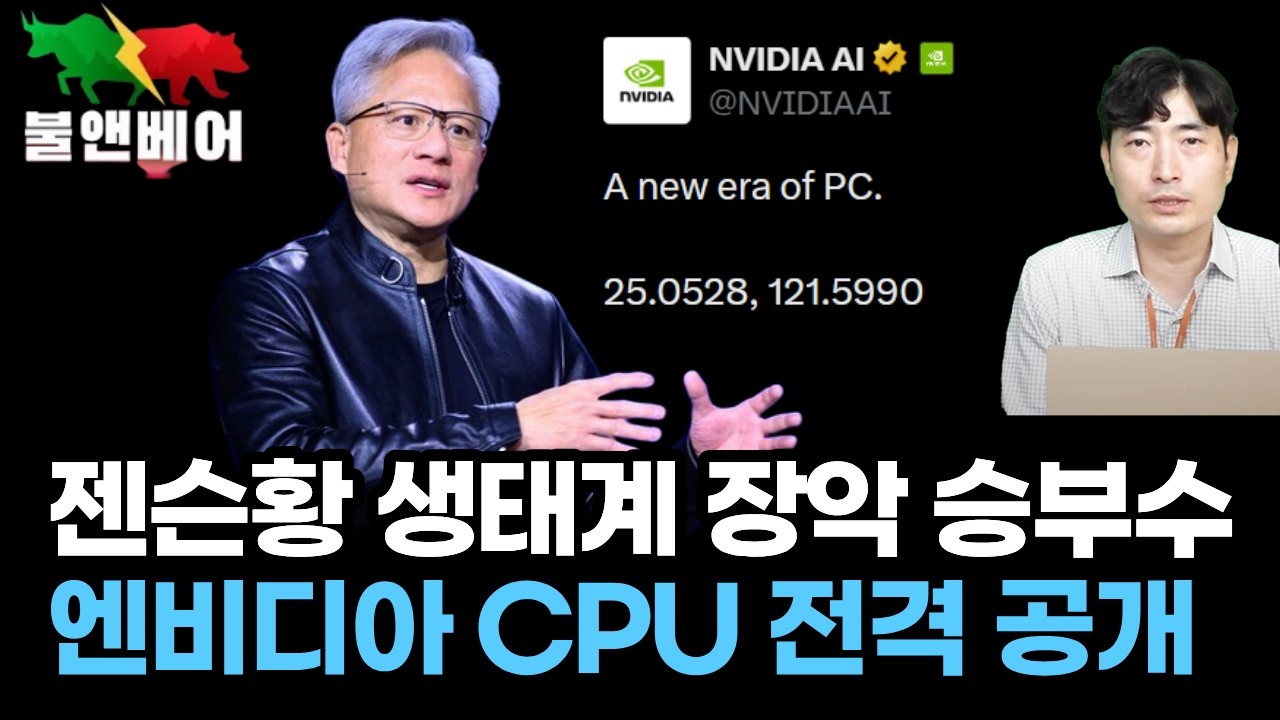
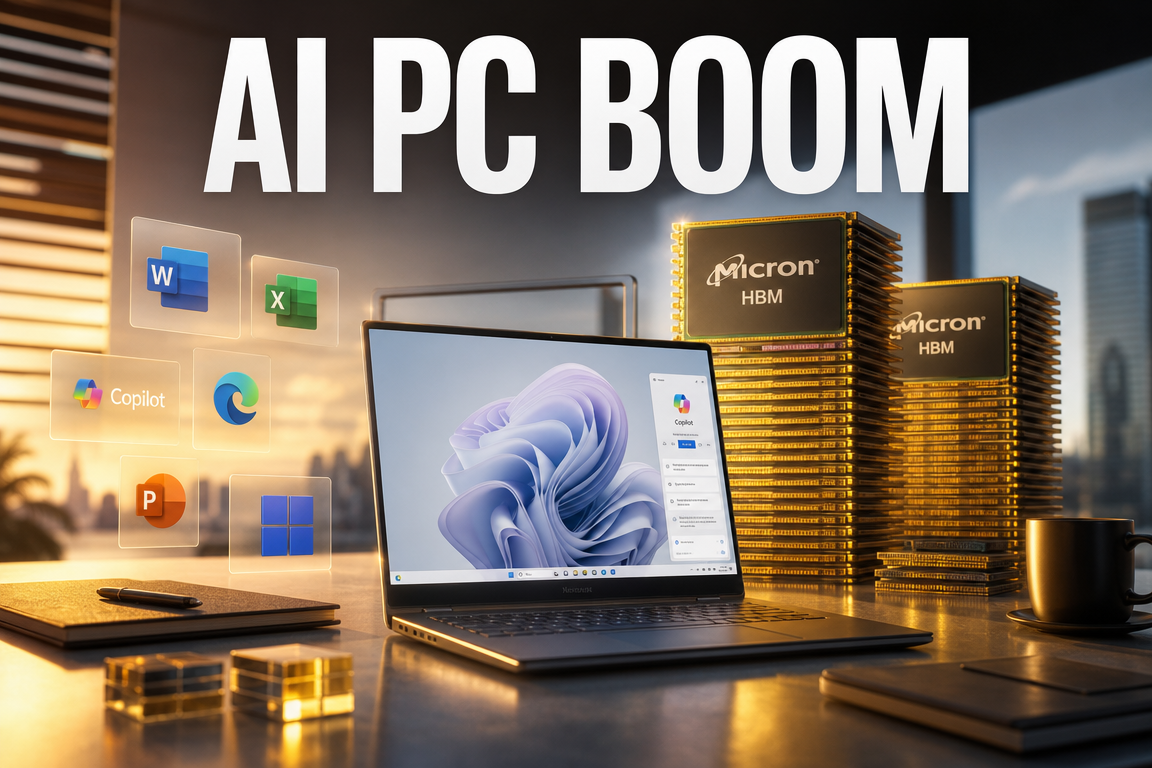
A “New Era of the PC” Led by Nvidia, Micron Target Raised to $1,750: What Investors Should Actually Monitor
This development should not be reduced to an Nvidia product cycle or a Micron price-target revision. Three issues matter:
1) AI is expanding beyond cloud servers to personal PCs and edge devices.
2) Nvidia is moving beyond GPUs toward an integrated stack spanning CPU, PC, robotics, and AI agents.
3) US equities remain strong on AI semiconductors, but market leadership is increasingly concentrated.
This report summarizes: Nvidia and Microsoft’s PC strategy, the implications of Micron target upgrades, how ARM-based Windows PCs could alter industry structure, and the risk embedded in today’s narrow US market breadth.
1. Primary development: Nvidia may directly catalyze the “AI PC” cycle
Recent reporting suggests Nvidia may unveil, as early as next week, its first Windows PC design using Nvidia silicon as the main processor. The initiative is reportedly co-developed with Microsoft, increasing strategic significance.
Potential venues include Computex and Microsoft Build, signaling coordinated hardware-software positioning. The strategic implication is a potential inflection point: AI compute shifting from data centers toward consumer devices.
2. Why it matters: AI execution is moving from servers to local PCs
Most generative AI has been cloud-centric: user prompts are processed in centralized servers and returned to endpoints. The next phase may shift a portion of workloads to local execution on PCs, accelerating edge computing adoption.
Microsoft may pair this shift with software enabling local AI agent functions on Windows PCs. Target use cases include document summarization, speech processing, image enhancement, workflow automation, and personal-assistant functions with reduced dependence on connectivity and external servers.
Key implications:
- Lower latency
- Improved security and privacy handling
- Broader enterprise deployment scenarios
- Increased utility in constrained-connectivity environments
3. Nvidia’s strategic intent: from GPU vendor to end-to-end platform control
The PC push is best viewed as part of an end-to-end ecosystem strategy rather than a standalone product expansion.
If integrated across tiers:
- Data centers train models on Nvidia infrastructure.
- Developers build AI applications on Nvidia-based PCs.
- Deployed models run on Nvidia-equipped notebooks and edge devices.
- The same architecture extends to robotics and autonomous systems.
The core investment variable is not only hardware performance, but the degree to which the CUDA ecosystem expands across development and deployment endpoints.
4. Competitive impact on Intel, AMD, and Qualcomm: potential structural change in PCs
Windows PCs have historically been dominated by Intel and AMD. Qualcomm has promoted ARM-based Windows PCs with limited disruption, largely due to weak developer incentives to optimize away from x86.
If Nvidia materially supports ARM-based Windows PCs, developer and OEM incentives may improve, particularly as AI applications prioritize integrated architectures optimized for AI execution. The competitive shift would extend beyond notebooks into workstations, industrial endpoints, and robotics development stacks.
5. AI agents and PCs: rationale behind “a new era”
“A new era of the PC” implies a shift in interaction models. Traditional PCs are primarily user-driven tools; agent-enabled PCs are positioned to interpret intent, plan tasks, and execute workflows across applications.
Representative workflows:
- Parse emails and auto-organize calendars and meeting materials
- Transcribe meetings, generate notes, and extract action items
- Generate drafts for design, code, reports, and presentations locally
- Automate repetitive tasks based on learned workflow context
If adoption scales, a replacement cycle could form around AI-capable Windows PCs, supporting demand across semiconductors, memory, operating systems, and software.
6. Micron target upgraded to $1,750: why memory is being repriced
Wall Street sentiment has strengthened, including a $1,750 price-target view. This reflects a broader re-rating of memory in an AI-driven compute cycle.
If AI servers and AI PCs scale in parallel, memory demand could strengthen structurally due to higher data movement and bandwidth requirements. High-performance memory, particularly HBM, becomes a limiting factor for system-level AI performance.
7. What Micron’s strength implies: memory may be less “late-cycle” than before
Memory has historically been treated as cyclical and macro-sensitive. AI infrastructure investment and high-performance compute demand may be shifting the mix toward higher value-added memory.
The distinction is between:
- Commodity memory, and
- AI-optimized high-margin memory
Memory is increasingly treated as a strategic enabler that alleviates bottlenecks in AI systems, supporting higher valuation frameworks for companies such as Micron, Samsung Electronics, and SK Hynix.
8. Market conditions: strong indices, increasingly narrow leadership
Nasdaq and large-cap technology remain resilient. However, internal breadth is tightening. A cited indicator is the unusually low cross-stock correlation within the S&P 500, consistent with a market driven by a small subset of leaders rather than broad participation.
AI semiconductors, servers, and memory have materially outperformed, while many other segments have lagged. Index strength may therefore overstate the median investor experience.
9. Why it can become a risk signal: correlation can rise rapidly in drawdowns
In concentrated leadership regimes, a reversal in a few dominant names can destabilize the broader market. With high passive and ETF ownership, drawdowns in key constituents can propagate into index-level selling.
Potential sequence:
- Sharp declines in leaders
- Passive/ETF-linked selling pressure
- Rising cross-stock correlation
- Broader index correction
This environment warrants attention to valuation sensitivity and expectation risk in core AI leaders.
10. Linkages for Korea-focused investors
The cycle connects directly to Korea via Samsung Electronics and SK Hynix. Expansion of AI PCs and AI data-center investment would support memory demand expectations and could benefit adjacent segments including HBM, DDR5, advanced packaging, and server-component ecosystems.
A PC replacement cycle tied to AI capability could also create second-order effects across displays, batteries, storage, thermal solutions, and substrate/material suppliers. The theme is relevant to export-linked capex and the global technology investment cycle.
11. News-style key takeaways
1) Nvidia and Microsoft
Potential unveiling of Windows-based AI PCs reinforces the shift from cloud-centric AI toward local and edge execution.
2) PC industry structure
ARM-based AI PCs introduce a new variable into a historically Intel/AMD-led Windows ecosystem.
3) Nvidia’s strategic direction
A clearer end-to-end architecture spanning servers, PCs, developer environments, and robotics.
4) Micron price-target upgrades
Memory is being re-rated as a core AI beneficiary, supported by expectations for high-performance memory demand.
5) Market risk
Historically low internal correlation in the S&P 500 highlights fragility from concentrated leadership.
12. Underappreciated point: the location of AI compute is shifting
The most important change is the migration of AI execution from centralized data centers to everyday endpoints such as PCs, notebooks, industrial devices, and robots. This widens both the potential beneficiary set and the competitive landscape beyond a single-name narrative.
Potential beneficiaries include:
- Operating system platforms
- Memory suppliers
- OEM manufacturers
- Enterprise software vendors
- Robotics and automation companies
- Edge infrastructure providers
Risk remains that markets may be pricing the transition too quickly; industry direction and equity timing should be evaluated separately.
13. Investor checklist
1) Nvidia’s announcement content
Distinguish between partnership signaling and a commercial product roadmap.
2) Microsoft’s software enablement
Assess usability of AI agent functions, developer tooling, and application ecosystem readiness.
3) Scalability of the ARM-based Windows ecosystem
Developer and enterprise adoption will determine the magnitude of PC market reconfiguration.
4) Persistence of memory demand
Separate transitory theme effects from a durable investment cycle.
5) Reversal risk in concentrated leadership
The current mix of rate-cut expectations, AI growth narratives, and megacap strength can reprice quickly if any leg weakens.
14. Conclusion
This development signals a transition from the data-center-centric phase of AI toward a consumer and endpoint-driven phase. Nvidia’s objective appears to be ecosystem expansion across where AI is developed and where it runs. Micron’s re-rating aligns with the view that memory bandwidth and data movement are critical drivers of AI system performance.
Markets typically discount future growth early; separating structural change from near-term valuation risk is essential.
< Summary >
Potential Nvidia–Microsoft AI PC launches are less about a single device and more about AI expanding from cloud to local endpoints. Nvidia is strengthening an integrated ecosystem spanning servers, PCs, and robotics, while Micron is being re-rated on expectations for AI-driven high-performance memory demand. However, US equity performance is increasingly dependent on a small set of AI leaders, implying higher fragility despite strong index levels.
[Related Articles…]
Nvidia ecosystem expansion and AI semiconductor investment points:
https://NextGenInsight.net?s=Nvidia
Micron price-target upgrades and the potential return of a memory upcycle:
https://NextGenInsight.net?s=Micron
*Source: [ Maeil Business Newspaper ]
– [홍장원의 불앤베어] 젠슨황 “PC의 새 시대가 온다” 마이크론 이번엔 1750달러 전망