● Debt Shock, KOSPI Defies Doom, Real Break Comes Later
Why the KOSPI Is Holding Up Despite a Treasury Yield Shock—and the Actual Turning Point Lies Elsewhere
Recent price action has been difficult to interpret.
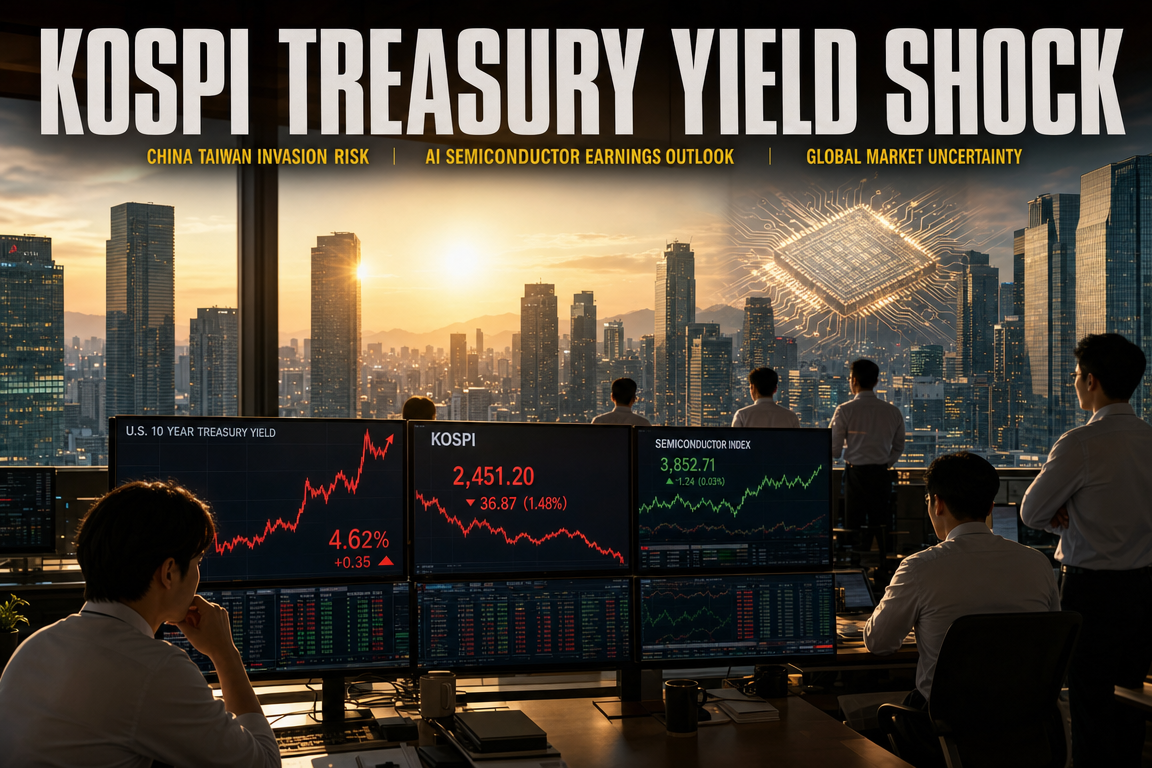
U.S. Treasury yields are rising sharply and inflation concerns are resurfacing, yet the KOSPI and global equity markets have remained relatively resilient.
The current regime cannot be explained by a simplistic “higher rates automatically mean lower equities” framework.
This report summarizes: (i) why equities have not broken down despite the spike in yields, (ii) the key factors supporting the KOSPI, and (iii) the conditions under which the market trajectory is likely to change.
It distinguishes “war-driven risk sentiment” from “real-economy inflation pass-through,” outlines three triggers that can halt a liquidity-driven rally, and explains how semiconductor earnings, yen carry trade unwinds, and U.S. CPI dynamics interact.
1. Current market setup
Three forces are moving simultaneously.
First, global long-end yields, including U.S. Treasuries, are rising rapidly.
Second, Middle East risk and crude oil trends are reviving inflation concerns.
Third, earnings momentum—particularly in semiconductors and AI—has been strong enough to keep equity markets from deteriorating quickly.
In short, macro conditions are a headwind while earnings are a tailwind.
In this regime, both unconditional bullishness and unconditional crash calls are high-risk interpretations.
2. Why yields are rising
2-1. Inflation vigilance is the most direct driver
Rising yields imply falling bond prices and reflect markets pricing a higher probability of persistent inflation.
Long-end yields are more sensitive to inflation expectations, while front-end yields are more closely tied to policy-rate expectations.
The outsized move in 10- and 30-year yields signals that the dominant narrative is less about near-term policy moves and more about concerns that inflation may not normalize quickly.
2-2. Beyond rates: a shift toward a structurally higher-cost regime
This upswing in yields may reflect more than a short-lived event.
Post-pandemic liquidity expansion, reopening demand, the Russia-Ukraine war, and renewed Middle East geopolitical risk have reduced the likelihood of a return to the prior low-inflation/low-rate equilibrium.
Energy security, supply-chain reconfiguration, commodity sourcing diversification, and strategic industrial policy have increased the preference for resilience over lowest-cost production.
This structurally supports higher input costs and can keep inflation elevated relative to the prior regime.
3. Why the KOSPI is holding up despite higher yields
3-1. Markets have partially adapted to higher rates
Higher rates typically weigh on equities through higher financing costs, increased attractiveness of cash and bonds, and reduced leverage demand.
However, markets have become less reactive to the level of rates alone.
The key variable has shifted toward whether companies can sustain earnings in a higher-rate environment.
3-2. Earnings strength, led by semiconductors and AI
Earnings expectations are the primary support for both the KOSPI and U.S. equities.
Samsung Electronics, SK Hynix, and NVIDIA remain central to index-level resilience.
AI-related investment and semiconductor demand trends continue to underpin expectations.
The market has liquidity-driven characteristics, but earnings provide an additional support layer, reinforcing downside resilience.
Macro conditions pressure valuations, while earnings momentum supports prices; to date, earnings have dominated.
4. Key distinction: war risk sentiment vs. real-economy inflation pass-through
4-1. Markets price the peak in fear faster than the duration of the conflict
Equities, FX, and crude often react most strongly when perceived war-related risk peaks.
Even if conflict persists, risk assets can stabilize or rebound as fear subsides.
Market pricing tends to track changes in sentiment faster than developments on the ground.
4-2. The real economy absorbs the shock later if conflict extends
The critical risk emerges when elevated oil prices persist.
As inventories are drawn down, refiners, chemical producers, and manufacturers eventually procure replacement inputs at higher prices, pushing costs into realized inflation.
Oil-related cost pressure can cascade into naphtha-linked products, industrial inputs, fertilizers, feed, grains, meat, and services such as dining-out.
This is the inflation pass-through mechanism.
Accordingly, the primary market risk is not the headline war news flow, but the timing and extent of oil-price transmission into CPI and PPI.
5. When the KOSPI is likely to turn: three triggers that change the market path
A rise in yields alone may not be sufficient to break the market.
However, the following conditions can materially alter equity market direction, including the KOSPI.
5-1. Trigger 1: Semiconductor/AI earnings fail to meet expectations
Earnings are the main pillar of support; a disappointment would change the risk balance.
Semiconductor earnings are driven by the interaction of price and volume.
To date, HBM and memory price appreciation have been meaningful contributors.
The key question is whether pricing strength is sustainable.
Some spot indicators suggest early signs of peaking, while competition from China and global peers is intensifying.
As competitive dynamics broaden, pricing may face downward pressure.
AI demand can expand structurally as adoption spreads across consumer appliances, autos, finance, education, content, and manufacturing.
However, equity prices respond primarily to results relative to expectations rather than long-term narratives alone.
During upcoming earnings seasons, if index-leading names such as Samsung Electronics and SK Hynix fail to clear expectations, equity downside risk increases materially in a higher-yield environment.
5-2. Trigger 2: Re-emergence of yen carry trade unwind risk
Japan is a key cross-asset variable.
Rising Japanese government bond yields are relevant to global liquidity conditions.
The yen carry trade has been supported by a weak yen and very low funding costs, enabling investors to borrow yen to purchase higher-yielding assets.
If the probability of further Japanese tightening rises and the yen strengthens, incentives to repatriate increase, raising the risk of carry unwind.
In isolation, this may not be sufficient to trigger a systemic selloff.
If it coincides with earnings weakness or re-accelerating inflation, the impact on risk assets can be amplified.
5-3. Trigger 3: Re-acceleration of inflation
The dominant macro risk is inflation.
Recent U.S. CPI dynamics show a larger contribution from energy.
If the rebound remains energy-led and temporary, markets may absorb the shock.
If pressures broaden into core and services inflation, the policy outlook changes.
If crude prices remain elevated for an extended period and pass-through spreads across goods and services, the Federal Reserve’s reaction function may shift.
This is the principal risk to the current market regime.
The effective switch that halts a liquidity-driven rally is not the yield level itself, but inflation strong enough to force a material shift in policy expectations.
6. U.S. CPI and the KOSPI: key indicators to monitor
Primary checkpoints are as follows.
- Whether U.S. CPI and PCE increases are energy-driven or broadening into core inflation
- Whether crude oil is experiencing a temporary rebound or a sustained high-price regime
- Whether leading earnings (Samsung Electronics, SK Hynix, NVIDIA) continue to exceed expectations
- Whether Bank of Japan tightening risk and yen strength increase, raising carry unwind probability
- Whether the Fed maintains a prolonged hold or shifts toward a more restrictive stance
These variables must be assessed jointly; single-factor interpretations increase the risk of misreading the market.
7. One-page news-style summary
■ Bond market
Long-end sovereign yields across major markets, including the U.S., remain in an uptrend.
Markets are pricing higher inflation expectations and a structurally higher-cost environment.
■ Equity market
Despite the rise in yields, the KOSPI and global equities have remained relatively firm, supported by earnings expectations.
Semiconductors and AI-related equities are central to index stability.
■ Commodities
Middle East geopolitical risk and crude oil trends remain key variables.
If oil strength persists, the probability of real-economy inflation pass-through increases.
■ FX market
Rising Japanese yields and potential yen appreciation can translate into renewed yen carry unwind concerns.
This is a potential source of higher volatility in global risk assets.
■ Monetary policy
The Fed appears more likely to hold than to hike in the near term.
However, a renewed rise in CPI and PCE could alter the policy path.
8. Key points often underemphasized
First,
for markets, the duration of conflict matters more than the initial outbreak.
Sentiment reacts quickly, while realized inflation pressure emerges later as high-cost replenishment begins.
Second,
a yield shock alone may not be sufficient to reverse the KOSPI.
The directional shift typically requires a combination of earnings deterioration and a policy-relevant inflation impulse.
Third,
AI investment may still be in an early diffusion phase across industries.
Nevertheless, equity performance remains highly sensitive to whether results meet elevated expectations.
Fourth,
the highest-risk configuration is a chained sequence:
“crude oil up → CPI re-acceleration → Fed stance shift → yen carry unwind → earnings expectations deteriorate.”
9. Strategy implications
This is a regime where neither blanket optimism nor blanket pessimism is justified.
Positioning should reflect both the drivers of the current advance and the conditions that would invalidate it.
Near term, earnings momentum and residual liquidity expectations can support the index.
However, the market’s most sensitive inflection points are identifiable:
- Whether semiconductor price peaking translates into earnings deceleration
- Whether U.S. CPI broadens from energy into core components
- Whether yen strength and Japanese tightening accelerate carry unwind dynamics
Monitoring should extend beyond headline yields to the combined dynamics of inflation, earnings, liquidity conditions, FX, and crude oil.
< Summary >
The rise in sovereign yields reflects inflation vigilance and a shift toward a structurally higher-cost regime.
The KOSPI has remained resilient primarily due to strong earnings expectations led by semiconductors and AI.
A durable market reversal is more likely under: (i) earnings expectation deterioration, (ii) renewed yen carry unwind risk, and, most importantly, (iii) CPI re-acceleration sufficient to change the monetary policy trajectory.
The central issue is not the yield shock itself, but the degree to which inflation disrupts the real economy and policy expectations.
[Related articles…]
- Semiconductor supercycle re-ignition: key takeaways on Samsung Electronics and SK Hynix earnings outlook
- Inflation re-acceleration risk: why U.S. CPI must be assessed alongside rate expectations
*Source: [ 경제 읽어주는 남자(김광석TV) ]
– [풀버전] 국채금리 발작에도 코스피 더 갑니다, 하지만 ‘이때’ 코스피 꺾이는 순간 옵니다. | 클로즈업
● China Taiwan War Shock, Korea, AI, Chips, Defense Boom
Will China Actually Attack Taiwan? 2026 U.S.–China Rivalry, Taiwan Contingency Risk, and a Korea Survival Playbook
This assessment should not be reduced to a binary question of whether China will or will not attack Taiwan. The decision-relevant issues are:
1) How difficult a Taiwan invasion would be from an operational and military perspective.
2) Why a low-probability conflict cannot be ruled out despite adverse cost–benefit arithmetic.
3) How Korea’s economy, global supply chains, AI infrastructure, and defense industries may face both risks and opportunities in a structurally more volatile environment.
This report links U.S.–China competition, geopolitical risk, global macro conditions, semiconductors, AI-era infrastructure, and Korean Peninsula security dynamics into a single investment-relevant framework. A final section highlights under-discussed but decision-critical takeaways.
1. Key News Briefing: Why the Statement Moved Markets and Diplomacy
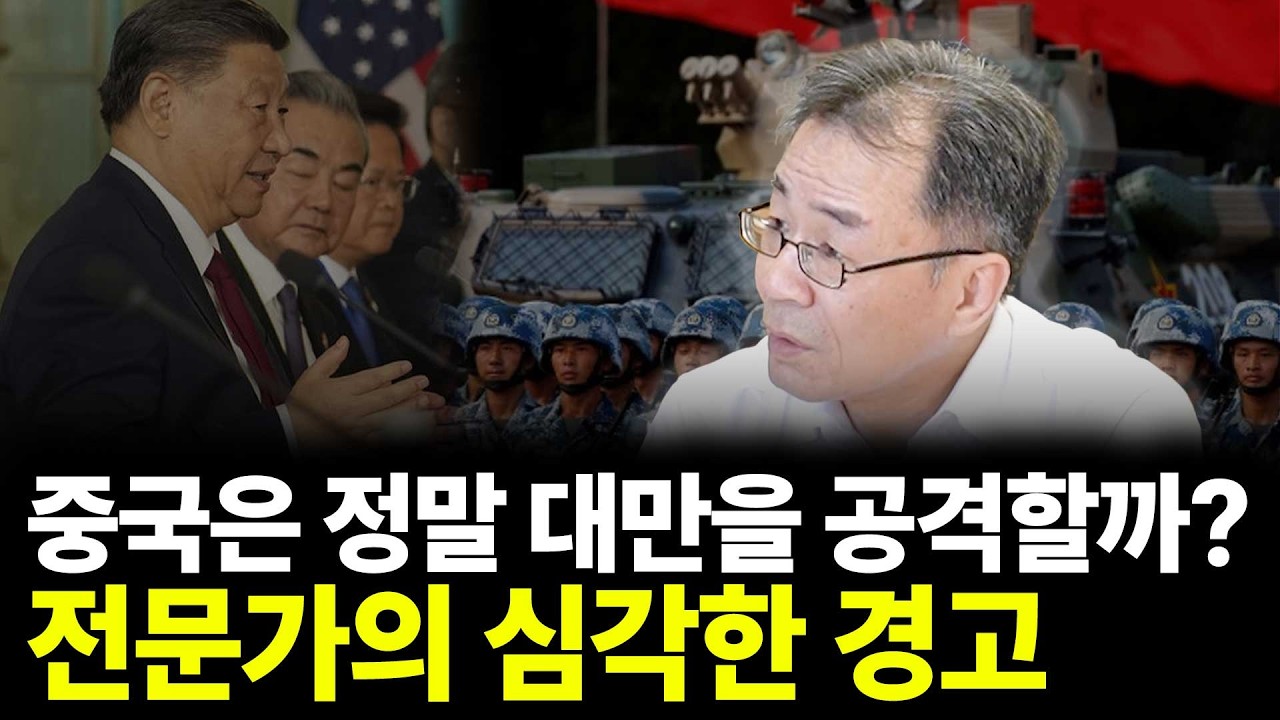
A central point is that Xi Jinping reportedly raised the possibility of a Taiwan invasion directly in front of Donald Trump. Historically, Beijing has relied on formulaic language (e.g., not renouncing the use of force) rather than explicit references to “invasion.”
This shift matters because markets typically price geopolitical risk through forward-looking signals before policy actions materialize. FX, rates, USD dynamics, defense equities, semiconductors, and shipping/transport names are all sensitive to changes in perceived tail risk.
2. China’s Taiwan Invasion: Is It Feasible in Practice?
2-1. Base case: Under rational cost–benefit assumptions, a full-scale invasion is highly difficult
The core argument is that a conventional, full-scale amphibious invasion is close to infeasible under standard operational and economic assumptions, primarily due to geography and the complexity of contested amphibious operations.
2-2. The Taiwan Strait is materially challenging
- Dover Strait: ~35 km at its narrowest point
- Taiwan Strait: ~130 km at its narrowest; ~180 km on average
This is not merely a distance differential. It increases complexity across lift capacity, air cover, sea control, logistics, sustainment, and follow-on reinforcement.
2-3. Amphibious warfare is not “total force size”; it is execution risk
Force size alone is not decisive. Amphibious assaults against prepared defenses are among the most complex military operations. Taiwan has spent decades optimizing defenses for the invasion scenario, meaning China would be engaging Taiwan at its highest-preparedness contingency.
2-4. Taiwan can impose costs on the mainland
Taiwan’s posture is not purely defensive. It has pursued asymmetric capabilities that could threaten coastal industrial concentrations. Given that China’s manufacturing and export base is heavily concentrated along the coast, China is not insulated from material disruption in a conflict.
This would represent a major shock to global supply chains.
2-5. The economic cost is potentially prohibitive
A Taiwan conflict would likely stress China simultaneously across exports, FDI, financial credibility, RMB stability, and access to advanced semiconductors. In an environment already characterized by slowing global growth, absorbing these costs is difficult to frame as economically rational.
3. Why Analysts Still Price a Taiwan War Risk
3-1. Wars can occur despite unfavorable economics
Historical precedents indicate that leaders have initiated wars that appear irrational ex post (e.g., Hitler’s invasion of the Soviet Union, Napoleon’s Russia campaign, Putin’s invasion of Ukraine). Therefore, “it would be too costly” is insufficient as a standalone forecast model.
3-2. For Xi, Taiwan is tied to regime legitimacy and historical consolidation
From Beijing’s perspective, Taiwan is linked to party legitimacy, national rejuvenation narratives, and potential personal legacy. If political-symbolic objectives dominate economic calculation, market assumptions can break down.
This is a key risk channel for investors: decision-making may be driven by political imperatives rather than welfare-maximizing economics.
4. The Strategic Context: A Transition Toward a More Fragmented System
4-1. A move toward a system without a single stabilizing hegemon
A major theme is a weakening of clear global order. U.S. influence is perceived as less dominant than in prior decades, while China’s rise has not produced a stable alternative order. The result is higher baseline instability.
4-2. Conflict resolution in one theater does not imply systemic stabilization
Across Iran, Ukraine, Taiwan, the South China Sea, and the Korean Peninsula, the common factor is reduced ability of any single power to enforce durable order. This increases structural volatility in:
- Energy prices
- Shipping and freight rates
- Supply-chain redesign and redundancy spending
- Defense procurement cycles
- Commodity pricing
- FX volatility and risk premia
4-3. U.S.–China strategic competition persists across administrations
While leadership style affects tactics, the underlying rivalry is structural. Investors should emphasize durable trends over short-lived political headlines. The competition will continue to shape semiconductors, AI, batteries, shipbuilding, energy, defense, and financial architecture.
5. China’s Constraints
5-1. “Peak China” risks are not purely narrative
Constraints frequently cited include: middle-income trap dynamics, property downturn, local government debt, worsening demographics, and political rigidity under a centralized system. These factors can cap medium-term growth and policy flexibility.
5-2. Limited “normative” or cultural leadership
The argument is that China’s manufacturing scale is strong, but its ability to set broadly attractive global norms and standards remains limited versus the U.S., which retains advantages in culture, finance, technology standard-setting, and global talent attraction. This affects AI governance, technical standards, capital flows, and alliance structures.
6. Korea’s Positioning
6-1. Korea requires an interest-based coordinate system, not binary alignment
A purely binary approach (“always the U.S.” for security or “always China” for market size) is viewed as risky. Policy and corporate strategy should separate security, economic, technology, and diplomacy into layered choices guided by national interest.
6-2. In a fragmented system, resilience is insufficient; selective control points matter
Periods of structural change can create openings for new leaders. As supply chains and strategic industries are reconfigured, countries and firms that secure control points can gain durable advantage.
7. Why Some View This Period as a Potential Korean Upswing
7-1. Rare convergence of capabilities
Korea combines globally visible cultural exports with critical manufacturing and technology roles, and is increasingly relevant in shipbuilding, nuclear, and defense. This is material for capital allocation and strategic partnering.
7-2. Korea’s position in semiconductors and AI-era infrastructure
AI growth is constrained by infrastructure: data centers, power, semiconductors, networking, cooling, materials, and industrial capacity. Korea is positioned across multiple nodes, including HBM, memory, advanced manufacturing, and power-adjacent industrial capabilities.
The implication is that AI winners will include countries with scalable electricity supply and manufacturing depth, not only software platforms.
7-3. Shipbuilding, nuclear, and defense warrant reassessment
Higher security risk tends to increase demand for naval capacity and defense systems. AI-driven data center expansion raises power demand, supporting renewed interest in nuclear power. Korea holds capabilities across LNG carriers, naval platforms, submarine-related supply chains, SMR and nuclear EPC, and broader manufacturing ecosystems.
Korea can be framed not only as a trade-dependent exporter but as a holder of multiple “geopolitical transition beneficiary” industries.
8. Why North Korea Could Become More Unstable
8-1. Nuclear capability is both deterrent and structural constraint
Nuclear programs impose large maintenance burdens, intensify sanctions pressure, inhibit modernization, and harden governance. This can create long-run internal stress even as deterrence improves.
8-2. Abandoning reunification narratives can weaken regime coherence
If Pyongyang shifts toward explicitly defining the South as a separate country and deprioritizes reunification, it risks ideological inconsistency versus prior leadership narratives. This can create internal legitimacy friction.
8-3. The practical equilibrium resembles a “special relationship” framework
Near-term reunification is unlikely, while formal negation is politically complex on the South’s side. The workable approach is sustained interaction under a special-status framework. Unification, if it occurs, is more likely to be the outcome of long-run structural change than of declarations.
9. What Investors and Professionals Should Monitor
9-1. Geopolitical risk reshapes industrial maps
Taiwan risk, Middle East conflict, and U.S.–China tension directly affect equity sector rotations, FX, USD cycles, commodities, and the relative valuation of exporters versus security-linked industries.
9-2. Priority industry keywords
1) Semiconductors: Rising Taiwan risk can increase the strategic value of Korean capacity.
2) AI: Integrated demand across chips, power, data centers, networks, and cooling.
3) Nuclear and power infrastructure: Power availability becomes a binding constraint in AI scaling.
4) Shipbuilding and logistics: Maritime tension increases the value of fleet capacity and secure transport.
5) Defense: Rearmament and procurement cycles may become secular in a fragmented order.
10. Under-Discussed but Decision-Critical Points
10-1. More important than invasion probability is the persistence of disorder
The central issue is not whether a Taiwan war occurs immediately, but that the system may remain unstable for an extended period. Even without a Taiwan conflict, elevated risk premia can persist.
10-2. Korea may be both exposed and positioned to benefit
Korea is often described as vulnerable between major powers, but it also holds rare combined strengths in semiconductors, AI infrastructure, shipbuilding, nuclear, defense, manufacturing depth, and cultural influence.
10-3. The core North Korea risk includes internal narrative inconsistency
Beyond missiles and provocations, internal ideological and legitimacy contradictions may become a longer-term destabilizer and a source of nonlinear outcomes.
10-4. AI winners include countries with power and manufacturing, not only application-layer firms
AI scaling depends on semiconductors, nuclear and grid capacity, cooling systems, telecom equipment, and industrial materials. This structure supports Korea’s strategic relevance.
11. Final Synthesis: Will China Attack Taiwan?
Under rational assumptions, a full-scale invasion remains operationally difficult and economically costly, with uncertain success probability. However, historical precedent suggests conflicts can occur despite unfavorable economics.
A practical investor framing is:
The key is not certainty of invasion, but that the market and governments must price persistent Taiwan-related risk over time.
Korea is among the countries that must interpret this environment with high discipline, aligning policy and capital allocation to national-interest objectives and industrial control points.
< Summary >
- A full-scale Taiwan invasion is highly challenging due to amphibious complexity, economic blowback, and Taiwan’s asymmetric capabilities.
- Conflict cannot be ruled out because political-symbolic incentives can override economic rationality.
- The global system is moving toward fragmentation; even if one conflict subsides, instability may persist, raising structural volatility across macro and supply chains.
- Korea has a rare portfolio of potential beneficiary sectors: semiconductors, AI infrastructure, shipbuilding, nuclear, defense, advanced manufacturing, and cultural exports.
- North Korea’s longer-term risk includes internal identity and legitimacy stress linked to nuclear lock-in and narrative shifts.
- The priority is an interest-based strategy and a clear read-through from geopolitics to sector-level industrial outcomes.
[Related Articles…]
-
Taiwan Risk and Global Supply-Chain Reconfiguration: Implications for Korean Semiconductors
https://NextGenInsight.net?s=Taiwan -
AI Infrastructure Competition: New Opportunities in Nuclear, Semiconductors, and Power
https://NextGenInsight.net?s=AI
*Source: [ Jun’s economy lab ]
– 중국은 정말 대만을 공격할까? 전문가의 심각한 경고(ft.조한범 박사 2부)