● KOSPI-8000-Euphoria,-AI-Shift-in-Investing
The “KOSPI 8000” Feeling of Real Estate Investors…And the Moment Investment Decisions Change in the AI Era
1) The biggest message today’s video delivers: “It’s normal to feel good when the market is good (KOSPI rising)”
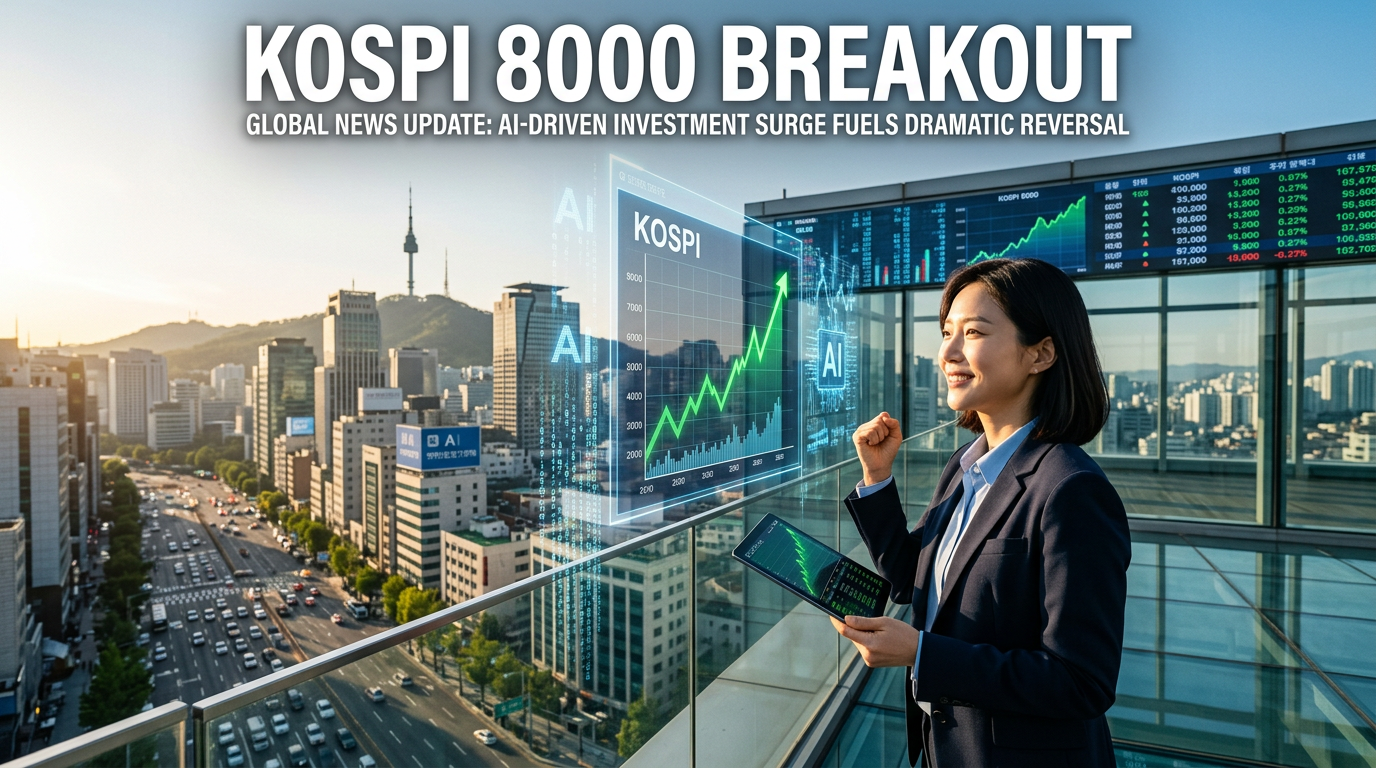
- When I heard the news about the KOSPI breaking through 8000, I first brought up “a happy mood” in a light humorous tone.
- This isn’t just bragging—it’s a scene that shows how the market phase changes investment psychology.
- In particular, like admitting you’re in a “state where you could make mistakes” as a beginner driver, it openly reveals the pace of personal emotion, in the sense that “once it goes up by just one tick, you feel better.”
Key Takeaway
- More than the investment return itself, the core point is why people want to act more aggressively at certain times (or want to act more safely).
- As the market gets better, people are more likely to develop stronger confidence that “I’m right,” but in the AI era, you need to be more wary of this psychological bias.
2) Tesla and autonomous driving: “Even though it’s the kind of thing shareholders might hate,” the direction was clear
- The argument introduced in the video is this.
- When talking about Tesla, it says that some shareholders might feel upset, but it emphasizes the value of autonomous driving from an “efficiency/safety” perspective.
- Through details like American road experience (driving is rough and scary),
- “If people drive, accidents happen”
- “If autonomous driving works properly, traffic efficiency and traffic distribution should improve”
- “When I rode it in California, it was great”
- It also mentions that, statistically, it’s safer than humans.
- In other words, this isn’t just praise—it reinterprets autonomous driving from the perspective of improving the efficiency of the social system.
Key Takeaway (News-style Summary)
- The Tesla issue is easy to be consumed only as “the stock price goes up and down,” but the video encourages you to also look at the industrial structure changes autonomous driving brings.
- This kind of trend is especially important for AI-themed investments. (Because you should look at the “process the technology changes,” not short-term events.)
3) Interpreting the “Rocket Lab (space) surge” as anticipation: the reason for a short-term rise is often the ‘narrative (story)’
- With the opening of the window/display, Rocket Lab went up, and he says it felt sweet because he bought it with “anticipation.”
- And by connecting it even to the CEO (mentioning Delie/background),
- the story of originally making rockets in a warehouse
- taking them to NASA and starting the business
- emphasizing that determination and execution power (pure propulsion)
- What makes this part interesting is that it doesn’t explain the reason for the surge using only the chart—it bundles it into “people/technology/narrative.”
Key Takeaway
- In sectors with high CAPEX and heavy dependence on regulation/infrastructure—such as space, aviation, defense, and robotics—
- it’s often not just about short-term returns;
- the market expectations are frequently moved by “who is executing it / what kind of technology roadmap exists.”
- Ultimately, this also connects to flows like generative AI.
- Because AI-driven simulations, design automation, and operational optimization increase “execution speed.”
4) Why the Korean stock market became special: “indirect benefits” created by U.S.-China conflict
- There’s context that Samsung Electronics is among the top companies by global market cap (mentioning 12th place), and that it’s almost right next to Meta.
- And the core is the structural explanation that “Korean companies get indirect benefits.”
- The point is this.
- When the U.S. and China fight, global supply chain reshuffling accelerates
- Korea has a strong manufacturing base, so it’s easier to benefit
- Especially in defense,
- raw materials are imported
- it leads to manufacturing
- while offshoring to the U.S. proceeds
- the share Korea can take becomes larger—that’s the logic
Key Takeaway (Remember This!)
- If you view “KOSPI rising” as just luck, you’ll miss it.
- This video emphasizes a chain: geopolitics (U.S.-China conflict) → supply chain reshuffling → Korea’s manufacturing/defense benefits.
- The same perspective applies to AI investing as well.
- In the AI world, it matters not only that there is “technology,” but
- “which country/which industry will actually pull adoption/investment/production.”
5) Warning about investment psychology: “I missed the Korean market due to cognitive bias”
- There’s something he admits about himself in the video.
- He says he had the perception that “even just a while ago, if you invest in the Korean market, you’re being foolish”
- The numbers were actually fine, yet he didn’t manage to capture it until the end
- By acknowledging bias (cognitive bias), he explains that it was “not logically supported to keep being that way going forward,” yet it hardened through inertia
- And in the conclusion,
- you don’t need to invest only in the Korean market
- the sector/country/position should be changed flexibly
- and he emphasizes that the starting point of that flexibility is “overcoming bias.”
Key Takeaway
- In the AI era, the most dangerous thing in investing isn’t “lack of information”—it’s “fixation of judgment bias.”
- His self-reflection ultimately makes readers ask questions like this:
- “Is my portfolio maintained not by ‘facts,’ but by ‘mood/preferences/memories’?”
6) Comparison perspective: “Samsung is a diversified semiconductor player, while SK hynix has clearly defined strengths”
- Samsung uses a frame of being a diversified semiconductor company (including the contrasting firms that are mentioned).
- SK hynix has strengths, but it shows a balanced view along the lines that “performance depends on which division/role it’s in.”
- Then it follows with
- questions like “If it’s economic rationality (homo economics), shouldn’t we go with SK hynix?”
- and even so, it wraps up by saying it could be a decision to maintain Samsung’s pushing will and its heritage.
Key Takeaway
- Semiconductors connect directly to AI.
- Spread of generative AI = demand for GPUs/memory = affects the semiconductor cycle
- So the video’s conclusion can be summarized in one line.
- “You can’t lump a company together by only one sector characteristic”
- “Your position should be set based on what the company does well”
7) Mention of tax-saving/account strategy: touching the “leverage of taxes” with marriage-gift-ISA-pension
- There’s a flow emphasizing that just like growing investment returns, “after-tax returns” are also important.
- The strategy points from the video can be organized like this.
- A gift strategy using capital gains tax deduction (mentioning 600 million won) for a spouse upon marriage
- A method of gifting stocks with unrealized gains to your spouse to change your average purchase price (according to the video’s explanation 기준)
- Adjusting annual gains/losses and trading at year-end (mentioning a limit of 2.5 million won)
- Using an ISA account:
- considering the separate taxation structure within the annual limit (mentioning 20 million won)
- explaining differences in tax rates versus ETFs (including U.S.-listed ETFs)
- Mention of tax credits related to IRP/retirement pension savings (expressed roughly at around 15%)
Points to note
- He also says this isn’t “the right answer for everyone,” and it can vary depending on your individual financial situation.
- Still, the message the video delivers is clear.
- Don’t just look at AI/big-tech growth
- you need to “optimize the tax structure together” to change long-term performance
8) “YouTube is studying” + anxiety in the AI era: worrying about falling behind the pace of technological progress
- He lays out the logic that through content production, he becomes “fully familiar” with the material.
- Collect data → read/study → edit → review, repeating
- He says that if you run it a few times, it stays in long-term memory
- At the same time, he honestly admits modern people’s anxieties.
- “Will I be left behind?”
- Technology is advancing at a frightening speed, and you need to keep up
- Finally, there’s a direction that he will connect investment information to “handling AI well and adapting to change.”
Key Takeaway (What most people don’t say elsewhere)
- A lot of investment content focuses only on “buy this stock,”
- but this video provides the view that the learning structure itself (repetition/verification/output) builds investment capability.
- Ultimately, in the AI era, investors
- aren’t only advantaged by choosing stocks, but
- by those who increase their own learning/verification speed.
9) Closing tone: “You should do it slowly”—a matter of attitude more than returns
- At the end of the video, he emphasizes the philosophy that “invest slowly.”
- He talks about imagining making a lot of money through gifts/short ticks (feels like a cyber monkey),
- but says he actually doesn’t do that,
- and also shows a sense of responsibility as the producer, worrying about what viewers should do.
Key Takeaway
- The better the market gets, the more you crave speed,
- and what you need then is “controlling speed (trading frequency).”
Main content to convey (the ‘most important thing’ I selected)
- “Good news” like KOSPI rising changes investment psychology immediately → but it’s dangerous if psychology ends up ruling investment decisions.
- Tesla/autonomous driving should be viewed not by the stock price, but by “efficiency, safety, and changes in industrial structure.”
- For surging stocks (like space), the reason for the rise often moves first through anticipation and an execution story—not the chart.
- Korea’s benefits are not luck, but structure (U.S.-China conflict → supply chain reshuffling → defense/manufacturing indirect benefits).
- Investment performance must be optimized not only by stock selection, but also by cognitive bias (inertia) and even the tax structure.
- In the AI era, “the way you learn/verify/output” becomes competitiveness—not “information.”.
The keywords in this article are naturally woven around generative AI, semiconductor investing, autonomous driving, KOSPI, and tax-saving strategies.
< Summary >
- Although the “good feelings” about the KOSPI 8000 breakthrough come first, it suggests that those emotions can distort investment judgment.
- Tesla/autonomous driving is interpreted not as a simple stock price matter, but from the perspective of industrial structure changes like improved safety and efficiency.
- The Rocket Lab surge shows that anticipation and an execution story (determination/roadmap) can create a short-term rise.
- Korea’s stock market strength is linked to indirect benefits from supply chain reshuffling created by the U.S.-China conflict (especially in defense/manufacturing).
- The cognitive bias he admitted himself (avoiding the Korean market) is warned as a risk that can repeat even in the AI era of investing.
- Through tax-saving strategies (gifting, ISA, pensions/IRP, and annual gain/loss adjustments), the need to optimize after-tax returns is mentioned.
- With the viewpoint that producing YouTube videos equals repeating learning/verification/output, it’s concluded that adaptation in the AI era comes from the “learning structure.”
- The final message emphasizes an investment attitude of “slowly, with responsibility.”
[Related posts…]
- A checklist for KOSPI rebound and AI-benefiting industries
- Investment scenarios for traffic/semiconductors changed by autonomous driving commercialization
*Source: [ 월텍남 – 월스트리트 테크남 ]
– [밥 친구 영상] 미장 투자자로서…코스피 8000 돌파 소식에 즐거운 마음으로 찍었습니다 재밌게 봐주세요…