● Nvidia AI Frenzy, Agent Boom, Supply Chain Shock
Nvidia CEO Jensen Huang is prioritizing “agents” over “robots,” tying CPU, memory, power, and the Taiwan-centric supply chain into a single thesis.
Key takeaways from the GTC on-site Q&A were direct:
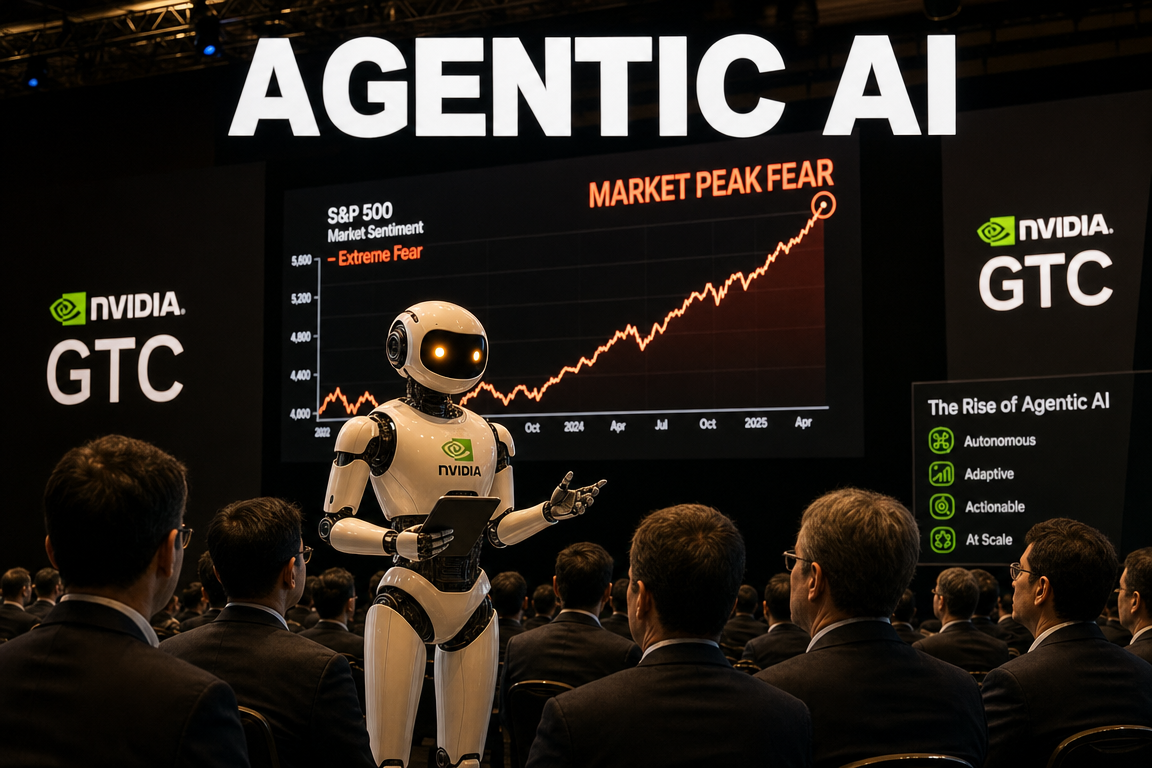
Market attention has centered on physical AI, humanoids, and robotics. However, Huang repeatedly emphasized agentic AI as the primary near- to mid-term growth vector.
This is not a generic “smarter AI” narrative. It reframes the productivity ceiling from labor availability to compute availability, and it expands the bottleneck discussion beyond GPUs to include CPUs, networking, LPDDR-class memory, data center power infrastructure, and Taiwan-led semiconductor manufacturing capacity.
Focus areas:
- Why Nvidia views “agents” as the most important market opportunity now
- Why Nvidia is elevating CPUs as a first-order priority
- Why LPDDR and broader memory demand could structurally increase
- Why the binding constraints may be power, memory, and foundry capacity rather than GPUs
- Why GTC functioned as both a technology and geopolitics signal
1. Core message: Nvidia is positioning for an “agent economy”
The central framing was:
“AI shifts from a tool that assists people to a unit of labor that continuously executes work.”
In the prior digital economy, productivity was ultimately capped by headcount, human response time, and working hours. Agentic systems change the constraint: once assigned an objective, agents execute continuously, parallelize tasks, and reduce idle time.
Implication: enterprises increasingly optimize around “how many agents to run” rather than “how many employees to hire,” with downstream impact on capital expenditure and compute infrastructure demand.
2. The bottleneck shifts: from human response time to system orchestration, especially CPU
In human-in-the-loop computing, CPU utilization is often limited by human input speed and attention. Under agentic workloads, the limiting factor shifts to system performance because agents:
- schedule and launch tasks continuously,
- perform frequent context switching,
- call tools and services repeatedly,
- run many concurrent lightweight control flows.
This elevates CPU importance in agentic AI systems. The infrastructure requirement becomes system-wide: CPU architecture, memory hierarchy, and networking design matter alongside GPUs.
3. Why Nvidia is pushing CPUs: confidence in “Vera CPU” reflects a system-control strategy
Huang’s responses indicated a shift from “adding a CPU next to the GPU” to “designing the full agent-optimized system.”
Key drivers:
3-1. Legacy server CPUs were optimized for human-centric and traditional enterprise workloads
Agentic workloads favor:
- high single-thread performance,
- rapid task dispatch,
- efficient context switching,
- scalable parallel execution of many agents.
3-2. Nvidia has already built CPU capability through Grace
Grace provided design and integration learning, reducing execution risk versus purely partnering for CPUs.
3-3. Clearer full-stack positioning
With Vera CPU, GPUs, networking, rack-scale systems, software, and OEM ecosystem alignment, Nvidia increasingly resembles an AI infrastructure platform rather than a component supplier. This supports standard-setting influence across the AI stack.
4. RTX Spark and the AI PC direction: Nvidia is not limiting the strategy to data centers
Mentions of RTX Spark and AI PC concepts signal an intent to drive tighter CPU-GPU integration and extend AI workloads to edge/local compute.
Strategically, Nvidia emphasizes ecosystem expansion (OEM partnerships such as Dell and HP) rather than direct displacement narratives, indicating a platform-led approach to distribution and scale.
Investor implication: expansion beyond data centers into edge/local AI is being positioned as an incremental demand layer.
5. Underappreciated signal: potential surge in LPDDR-class memory demand
For investors, a key implication is that agent-centric, integrated system designs may increase LPDDR demand alongside HBM.
As memory footprints expand and system architectures evolve, memory suppliers may see structural changes in product mix and volume drivers. The demand narrative extends beyond smartphone/PC cycles to AI infrastructure-driven memory consumption across multiple categories (HBM, LPDDR, packaging, interconnect, power-efficient memory).
6. Binding constraints may be memory, power, and TSMC capacity rather than GPUs
Scaling AI infrastructure is constrained by non-GPU bottlenecks:
6-1. Memory constraints
AI servers and agentic systems require large memory capacity and bandwidth. Insufficient memory can limit deployment even when GPUs are available.
6-2. Power constraints
Data center expansion is power-bound. Transmission, on-site generation, fuel sourcing, and adjacent power infrastructure can cap growth. This expands the investable theme to utilities, grid equipment, and energy infrastructure.
6-3. Foundry capacity constraints (TSMC)
Leading-edge chip output is limited by advanced-node foundry capacity. The AI cycle is therefore both a technology race and a supply-capacity competition.
Summary: AI infrastructure growth is shaped by what memory supply, power availability, and foundry capacity can support, not solely by demand.
7. Big Tech financing signals: the AI capex cycle may be larger and longer-duration
References to large-scale capital raising by major technology companies highlight:
- AI investment may still be early-cycle in infrastructure buildout terms.
- required capex may exceed internal cash flow for some players, increasing reliance on external financing.
AI has shifted from R&D emphasis to industrial-scale buildout: servers, chips, power, facilities, networking, and memory. Cost of capital and endurance in multi-year investment cycles become increasingly relevant.
8. GTC as a geopolitics signal: Taiwan remains the center of the AI supply chain
Questions around Taiwan and supply chain diversification reflect core industry realities. Taiwan’s ecosystem remains central across:
- advanced manufacturing,
- server and system production,
- component sourcing,
- rapid execution and integration.
Diversification efforts may progress, but Taiwan’s centrality is unlikely to change quickly. Geopolitical risk is therefore less a binary disruption assumption and more a valuation and risk-premium variable.
9. Market interpretation: Nvidia is being valued as a platform with a visible coalition
Post-event reactions suggested investors focused on ecosystem positioning and partner enablement, not only on product announcements. Outperformance of certain collaborators relative to competitors indicates the market is tracking “platform adjacency” and ecosystem participation as a key factor.
10. Agents before physical AI: robots are a longer-horizon narrative; agents are the execution plan
Physical AI remains strategically important but faces longer timelines due to real-world constraints (safety, sensors, control, manufacturability). Agentic AI can be deployed immediately across enterprise software: support, coding, research, and operations automation.
Core message: near-term monetization and infrastructure pull-through are more directly tied to agents than to robotics.
11. Key points often missed in mainstream coverage
11-1. Agents are a capex trigger, not merely a software feature
More agents imply more demand for CPU, GPU, memory, networking, power, and data center capacity.
11-2. Nvidia’s CPU emphasis is market definition, not a defensive patch
The objective is to define agent-era system architecture under Nvidia control.
11-3. Memory upcycle could be longer than expected due to AI-driven breadth
The demand story extends beyond HBM into LPDDR and other memory categories.
11-4. The ultimate ceiling may be electricity, not compute design
Even if chips are available, power constraints can limit deployment rates.
11-5. Taiwan risk is a pricing variable
Geopolitical exposure can influence valuation multiples and risk premia across the AI hardware supply chain.
12. Checklist for investors and industry operators
12-1. Evaluate AI infrastructure as a system: CPU, memory, networking, packaging, and power
Single-chip analysis is insufficient; performance and capacity are system-determined.
12-2. Demand remains strong, but supply expansion follows bottleneck speed
Deployment trajectories can diverge from demand due to constraints.
12-3. Big Tech AI capex is a structural multi-year cycle
Treat spending as a strategic buildout rather than a one-off wave.
12-4. Korea’s opportunity extends beyond memory, but system competitiveness matters
Packaging, power, server ecosystem, materials/equipment, and foundry collaboration influence capture of value.
13. News-style summary
First, Nvidia emphasized agentic AI more than robotics at GTC.
Agents remove human response time as the primary bottleneck and position productivity scaling around compute.
Second, CPUs emerge as a critical bottleneck in the agent era.
Agent workloads require fast scheduling, context switching, and flexible parallelism, elevating CPU performance requirements.
Third, Nvidia strengthened positioning as a full-stack AI infrastructure company.
Vera CPU, GPUs, networking, systems, and software point to expanded platform control.
Fourth, LPDDR-inclusive memory demand may expand.
System architecture shifts suggest broader memory demand beyond HBM.
Fifth, key constraints may be memory, power, and TSMC capacity.
Infrastructure expansion is bounded by supply chain and energy realities.
Sixth, Taiwan remains central to AI supply chains.
Diversification is progressing, but Taiwan’s ecosystem retains near-term primacy.
14. Conclusion: the strategic focus is building an economy where AI performs work
The consolidated message is not solely “better chips,” but platform control over the infrastructure required for AI agents to operate at scale.
Executing this requires integration across GPU, CPU, memory, networking, servers, power infrastructure, supply chain capacity, and geopolitics. Robotics remains a longer-horizon opportunity; agentic AI is presented as the immediate deployment and monetization pathway.
< Summary >
Nvidia CEO Jensen Huang emphasized agentic AI over physical AI at GTC. The framing positions AI agents as continuously operating labor units that scale productivity beyond human constraints. This shifts attention from GPUs alone to CPUs, LPDDR-class memory, networking, data center power, and Taiwan-centric supply chains. Nvidia’s CPU push is positioned as redefining agent-era system architecture and strengthening full-stack infrastructure control. The core implication is a platform-led buildout of the infrastructure required for an agent-driven economy.
[Related articles…]
- Nvidia AI infrastructure expansion and semiconductor supply-chain realignment: key points (NextGenInsight.net?s=nvidia)
- Memory semiconductor supercycle: why LPDDR matters after HBM (NextGenInsight.net?s=memory)
*Source: [ 내일은 투자왕 – 김단테 ]
– 엔비디아 젠슨황은 ‘이것’에 가장 집중하고 있습니다. (GTC 젠슨황 90분 Q&A 후기) with @unrealtech● Market Shock Peak
June Equity Markets: Focus on the “Peak of Fear,” Not the War Headlines
The primary driver in the current regime is not whether the Middle East conflict persists, but how severely markets are pricing geopolitical risk.
This report consolidates the key signals likely to influence June equity performance, including: why equities have remained resilient despite higher sovereign yields; why USD strength and the KRW-USD exchange rate appear to have passed an inflection point; and why capital-market mechanics can matter more than inflation headlines. The core framework is that the real economy and capital markets often move on different timelines.
1. Core message: The “peak of fear” matters more than the war’s duration
The critical distinction is between the real economy and capital markets:
- The real economy typically deteriorates as conflicts extend.
- Capital markets react less to the conflict’s path than to whether fear has already peaked.
Markets discount forward and frequently pivot before headline conditions improve. Under this framework, the peak in fear is interpreted as occurring in late March. Even if the conflict continues, markets may transition once maximum fear has been absorbed.
2. Timeline-style summary: What happened in late March
2-1. War-related fear reached a local peak in late March
Fear increased not immediately after the outbreak, but as the perception solidified that the conflict would not end quickly. Risk indicators such as Korea CDS are interpreted as having approached peak levels around that period.
2-2. USD strength and the KRW-USD spike also peaked around the same window
The dollar index, the KRW-USD exchange rate, and broader safe-haven demand were strongest around late March, consistent with elevated risk pricing.
2-3. Equities formed a trough near the peak in fear
The interpretation is that major equity indices, including the KOSPI and global markets, established lows when fear was highest. The rebound was less about improved news flow and more about risk premia no longer worsening at the margin.
2-4. Oil and long-end sovereign yields moved in the same fear regime
Oil prices and long-term sovereign yields also moved in alignment with the risk-off phase, then shifted as fear moderated.
3. Why markets look less unstable despite an unresolved conflict
Markets are more sensitive to whether a risk is new and shock-inducing than to its ongoing existence. As time passes:
- Attention and media intensity typically decline.
- Investors reduce real-time monitoring.
- The event becomes partially normalized into the risk backdrop.
This pattern is framed as recurring across prior shocks (pandemic, Russia-Ukraine war, trade conflicts, and current Middle East risk): the event may persist, but market adaptation reduces incremental fear premia.
4. Same structure as a tariff conflict: real-economy impact later, markets price fear earlier
The same framework is applied to tariff risk:
- Real-economy impact depends on implementation and lagged effects on earnings and trade.
- Capital markets respond earlier to the intensity of fear and uncertainty.
This explains why equities can rebound while the real economy has not yet improved: markets trade expectations, not contemporaneous conditions.
5. Why equities held up despite rising sovereign yields
Rising yields are typically negative for equities via higher financing costs, stronger competition from fixed income, and higher discount rates. The interpretation here attributes the resilience to two factors.
5-1. Inflation risk and increased sovereign issuance
Long-end yields rose due to:
- Inflation concerns, including energy-related supply risks.
- Expectations that major central banks may be constrained in easing.
- Expanded government bond issuance tied to defense spending, reconstruction, energy transition, and strategic investment.
Higher bond supply can pressure bond prices lower and yields higher.
5-2. Asset reallocation: flows favored equities over bonds
With heavier supply and weaker marginal demand for bonds (including reductions in US Treasury exposure by some entities), capital is interpreted as reallocating toward assets with higher expected returns, including equities.
From an asset-allocation lens, capital rotates among gold, crypto, bonds, real estate, and equities. In this phase, equities were treated as the relatively stronger destination, supporting prices despite higher yields.
6. The structural driver: markets are adapting to a “higher-for-longer” regime
The key point is not merely the level of rates, but whether markets treat high rates as a temporary shock or as a baseline. The argument is that markets increasingly price a high-rate environment as the new normal, supported by a higher-cost regime:
- Energy security shifting toward costlier supply mixes
- Supply-chain resilience prioritized over lowest-cost sourcing
- Structurally higher fiscal outlays for defense and strategic industries
This cost structure can contribute to a higher equilibrium rate environment.
7. Why weak real-economy signals can coexist with stronger capital markets
Real-economy headwinds include prolonged conflict risk, tariff burdens, higher cost structures, and export slowdown concerns. Capital markets, however, can decouple because they are often more sensitive to:
- Liquidity conditions
- Policy expectations
- Risk-premium compression
- Cross-asset flow dynamics
A key framing is that higher government debt can be both a fiscal risk and, through spending and issuance channels, a liquidity impulse for capital markets. Defense replenishment, reconstruction, energy infrastructure, nuclear/SMR investment, refining and storage expansion are cited as mechanisms through which spending can flow into corporate revenues and market liquidity.
8. The practical question for June: what constitutes a genuine correction signal
With equity levels elevated and sensitivity high, material drawdowns are more likely when multiple triggers overlap rather than from a single headline. Key signals to monitor include:
- Additional sharp increases in long-term sovereign yields
- Re-acceleration in the dollar index and renewed KRW-USD depreciation
- Evidence of inflation re-heating
- Re-ignition of war-related fear premia
- Shifts in expectations for Federal Reserve policy
- Reversal of equity-heavy positioning and related flow unwind
The focus is on concurrency: simultaneous movement across rates, FX, policy expectations, and sentiment.
9. Underemphasized points in common commentary
9-1. Declining consumption of war news as a market signal
A reduction in coverage intensity and public attention can indicate that fear premia are fading, often before it is visible in macro data.
9-2. Government debt: real-economy burden vs. market liquidity
Rising debt can impair fiscal metrics while simultaneously supporting near-term liquidity and activity through spending programs and strategic investment.
9-3. The key variable is adaptation to high rates, not the rate level itself
The same nominal rate can be destabilizing when unexpected, and neutral when normalized into valuations and positioning.
9-4. Corrections typically require trigger overlap
In extended markets, larger moves are more often associated with multi-factor shifts rather than isolated bad news.
10. Investor-oriented interpretation
10-1. An unresolved conflict does not automatically imply a sustained risk-off regime
Differentiate between risks already priced and risks that are re-escalating.
10-2. A weaker real-economy outlook does not mechanically translate into weaker equities
Incorporate liquidity and cross-asset flows rather than relying solely on growth narratives.
10-3. Higher correction risk emerges when rates, FX, and sentiment shift together
Monitor correlated regime changes rather than headline events.
10-4. Portfolio frameworks must adapt to a high-rate environment
Valuation and positioning anchored in the ultra-low-rate era can misread the current regime, which features higher costs, higher rates, fiscal expansion, and security-driven capex.
11. Key conclusions
- Conflict persistence and sustained market fear are not equivalent.
- Capital markets prioritize whether fear has peaked over the conflict’s day-to-day trajectory.
- Late March is interpreted as a convergence window for peak risk indicators, peak USD strength/FX stress, and an equity trough.
- The rise in sovereign yields reflects inflation concerns and increased bond supply.
- Equity resilience is attributed to relative flow preference for equities over bonds.
- Markets are increasingly treating high rates as a baseline regime.
- Separating real-economy dynamics from capital-market pricing is essential for interpreting current conditions.
- June downside risk is most likely when multiple triggers activate simultaneously.
< Summary >
June equities are framed as more sensitive to a renewed rise in market fear than to the conflict’s continuation. The real economy may remain pressured under prolonged geopolitical and policy risks, while capital markets can rebound once fear premia peak. Equity resilience amid higher yields is attributed to cross-asset reallocation favoring equities. The principal correction risk is a synchronized shift in yields, FX, policy expectations, and sentiment.
[Related Links…]
- https://NextGenInsight.net?s=market-outlook
- https://NextGenInsight.net?s=sovereign-yields
*Source: [ 경제 읽어주는 남자(김광석TV) ]
– “증시 즐기십시오.” 6월 증시 결정지을 시그널. ‘진짜 조정 신호’는 따로 있다 | 월간특강 세미나 [1편]