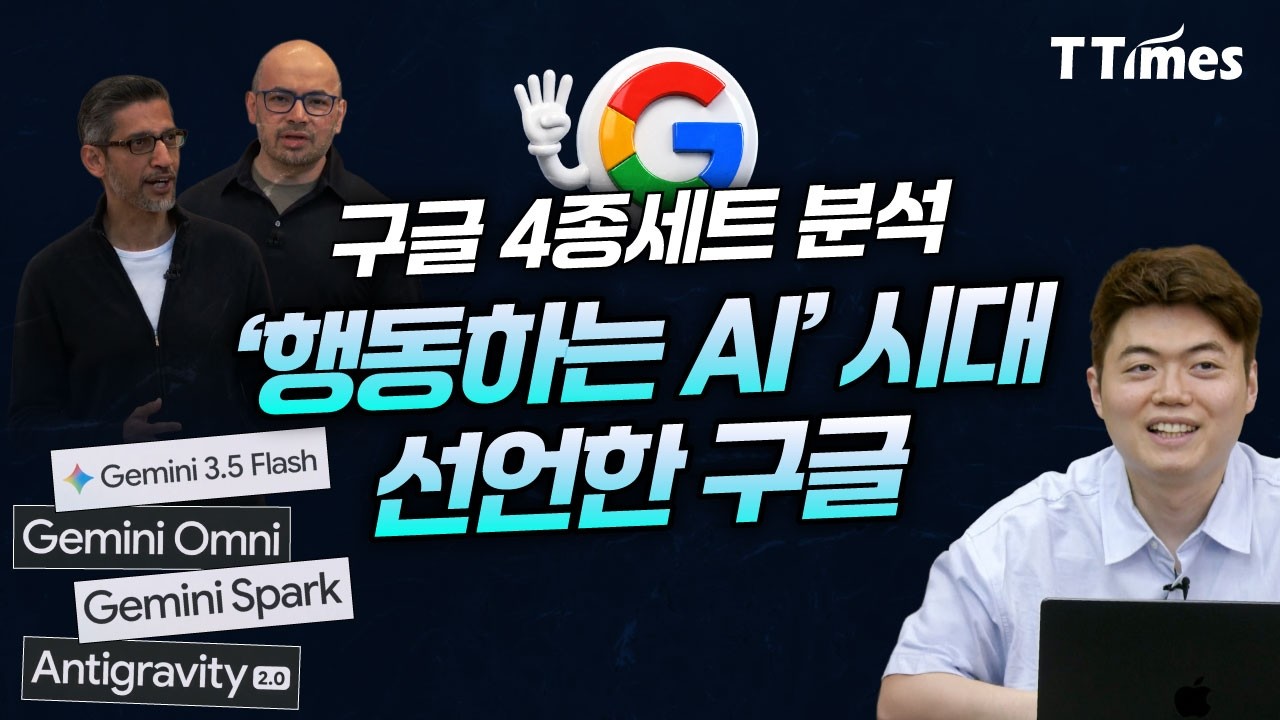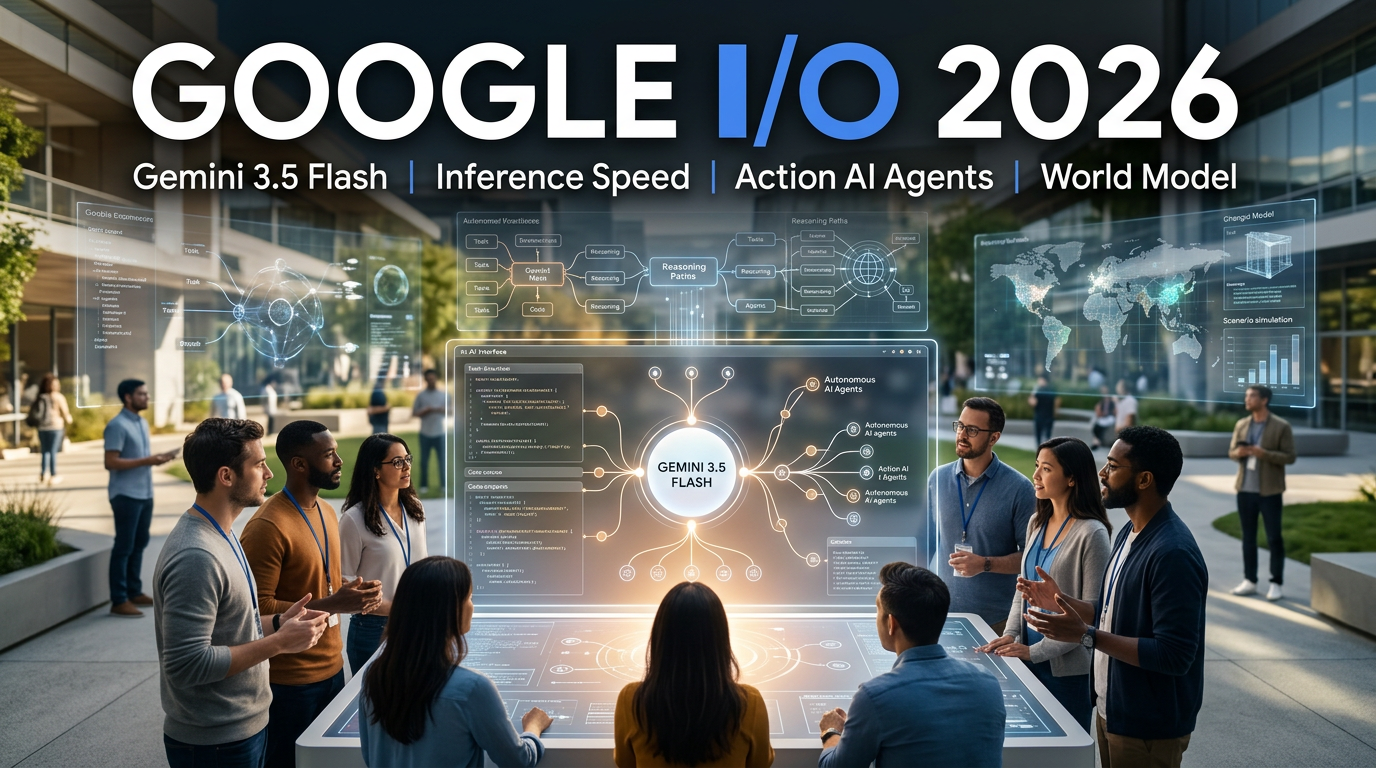
● Gemini 3.5 Flash Sparks an Agent Speed War
Google I/O 2026 core point: A strategy that flips the game with “inference speed” and “action-oriented agents,” like “not the Grandeur, but the Avante”
In this Google I/O 2026, the most impressive points are exactly three.
1) Gemini 3.5 Flash: It positioned “a lightweight model” at the forefront, but the conclusion wasn’t a performance race—it was a race for speed (throughput).
2) World Model and Agentic (action-oriented) AI: It clearly locked onto the direction of “AI that reflects the world and actually gets things done,” not chatbots.
3) Omni·Spark·Antigravity 2.0: It goes beyond the “making videos” step into a “structure that breaks things down and collaborates” and even “vibe coding” that develops without looking at the code.
So the key keywords this article covers are “speed race,” “action-oriented AI,” “world model,” “agent collaboration,” and “development tools (Antigravity 2.0).”
In particular, the backbone of this presentation is the view that as you boost inference speed, you handle more context and think longer—ultimately changing the lived experience of “smartness.”
1) This year’s Google game rule: Gemini 3.5 Flash that flips “performance vs speed”
① Gemini 3.5 Flash: The core isn’t “superior performance,” but “4x faster inference speed”
- What Google pushed first in I/O 2026 is Gemini 3.5 Flash.
This model was positioned not as a “top performance model,” but as one that dramatically improves response/inference speed. - In video and development work, what matters isn’t just “accuracy”—it’s how quickly you solve problems and how often you can run the work repeatedly.
② Meaning of the “not the Grandeur, but the Avante” analogy: Fast—and good enough
- Like the car analogy from the original text, the logic appears that moving away from insisting only on “Pro (Grandeur-class) models” and going with “Avante-class wins in real scenarios.”
- In benchmarks, it emphasizes that the Flash maintains solid performance while having overwhelmingly faster speed, rather than “beating the top model by a huge margin.”
③ If you treat benchmarks like a “workbook,” here’s the core
- The benchmarks Google released are bundles of AI missions (coding, translation, multimodal tasks, etc.), and they compare how well it solves by numbers for each domain.
- However, from the perspective of the original interview, what matters isn’t “being #1 no matter what is best,” but rather that what feels like in real work is throughput (processing volume) and repeat speed.
④ “Harness Engineering” makes performance “real-world ready”
- Recently, AI isn’t improving by simply boosting model parameters and calling it done; it’s more about creating an environment/setting (harness) where AI can do the work to raise performance.
- For example, the argument is that if you just drop in college-entrance exam / real test questions as-is, the reason they’re hard to solve may not be “insufficient model capability,” but because the necessary tools/settings/work environment aren’t attached.
⑤ Conclusion: The axis of how “smartness” feels shifts toward “inference speed & throughput”
- The presentation flow isn’t summarized as a single rule like “bigger models = smarter.” It’s summarized as if you infer faster, you can process more context and think longer.
- So instead of chasing only “#1 frontier performance,” it feels like Google changed the game by asking how many times AI can make itself do work in real use.
2) Advice-oriented AI → Action-oriented AI: formalizing the “working agent” era
① Key declaration: AI that used to advise is done—the age of AI that acts
- There’s a line in the interview that’s summarized in one stroke. It’s a declaration that AI has moved from an advisor that gives answers to an agent that carries out tasks.
- People imagined “AI that makes reports/videos/images for me,” but, they expected real-life tasks like doing dishes and doing laundry—yet Google pushes more toward “action,” and that’s how it’s being interpreted.
② One robot vs the battle → Many robots cooperating: a “sub-agent” structure
- In the era where one long-form agent handles everything, there’s a viewpoint that it will shift to a structure where many small agents (sub-agents) are attached and made to collaborate.
- Real work is split into steps like research → organizing → documentation → verification, so the logic is that having several fast agents move at the same time is advantageous.
3) Gemini Omni: the early sign of the world model that turns video production into a “collaborative task”
① What the name Omni implies: the direction to handle Everything (anything)
- Omni isn’t just interpreted as a “video generation” tool; it’s understood as being updated toward splitting the video production process into multiple agents to handle it.
② World Model: from generating at the pixel level to understanding “relationships/physics”
- In simple terms, a world model is described as a model that reflects to some extent the rules and relationships that would exist in the real world.
- Like the analogy in the original text, there’s an embedded direction that learning environments must move from “knowledge that only reads books in a cave” to understanding that reflects the physical world more.
- The core is moving away from “videos that are drawn roughly,” like pixel art— toward first establishing relationships via multimodal inputs, then generating the video.
③ “Maintaining global service quality” is Google’s realistic strength
- While competing models (other ultra-large models) may have strengths in specific functions (like depicting people), it’s assessed that Google is strong at servicing at a consistent quality level for a large user base.
4) Gemini Spark: Google’s OpenClo strategy—“AI twin that takes over routines”
① Spark’s position: an agent that keeps running repetitive work and tasks
- Like OpenClo, it learns the user’s intent (including tone of voice) and performs repetitive work connected to email/calendar/notes, and so on.
- The important part isn’t “generating answers.” It’s the structure where it keeps working, accumulates results, and outputs them.
② Execute routine work by splitting it into “skills” and “schedules”
- The original text summarizes that it’s operated by splitting into skills (repeating work units) + schedules (repetition based on conditions/time).
- Example: – If your clothes get dirty while you’re walking by, find a dress purchase location within 30 minutes – Remind / review important emails That’s the kind of direction where “situation → action” is connected.
③ Cloud-based: works even when the laptop is off (reducing operational burden)
- If OpenClo can be burdensome in terms of local resources/settings, Google Spark explains a structure aimed at making you feel like it’s always on, based on cloud infrastructure.
- It also mentions the billing step (beta pool unlocking from the top plans), suggesting it could spread quickly.
5) Antigravity 2.0: a development tool that confirms the “code-not-looking era,” beyond vibe coding
① Antigravity 2.0 is in the same line as the “Codex/Claude Code” family
- Antigravity is a tool that helps with writing code, but this 2.0 focuses on an “agent-friendly development environment” by significantly changing the UI/concepts/development flow.
② Don’t look at code—“work on a blank screen”: the UI philosophy becomes the main point
- The strongest trend said in the interview is this. In the future, instead of looking at a code screen, it may become the norm to direct work through chat (or voice).
- The perspective is that since AI already generates a lot of code, the structure is such that the user’s share of “directly reviewing/modifying” code will decrease.
③ Changes to CLI/SDK naming & configuration: a strategy to bundle agent development into a “product ecosystem”
- As the names and stack of components like CNI/SDK change, the approach shifts from “developers manually taking apart and editing code” to pushing things through AI frameworks/tools.
- The original text also mentions parts that were switched from open source to closed in the process. This could become controversial, but I think strategically it has aspects intended to dominate the ecosystem.
④ Changed to a performance-optimized language (mentioned as Go): connected to the “speed race” mindset
- According to the original description, the shift from the original NodeJS family to changes considering performance (mention of Go) reveals a flow where the tool’s own responsiveness and execution speed are raised together.
6) From an investor/industry practitioner perspective: Why you should watch this presentation (additional recap)
If you pull out only the most important things here
- The benchmark for AI competition is moving from “top model #1” to “speed-based throughput.” → So it’s not strange that “lightweight models (Flash)” are front and center—it’s a strategy aligned with market reality.
- Beyond chatbots, “action-oriented agents” became the center of products. → Ultimately, company adoption may be evaluated less by “conversation quality” and more by “work-execution automation.”
- The world model is the next stage of video generation. → It’s a direction that reflects not just plausible outputs, but context/relationships/physical constraints.
- If you split agents into multiple units and make them collaborate, the speed of completing work becomes more important than the accuracy of any single model.
- Development tools converge to a “UX where you don’t look at code.” → Agent-friendly IDEs/tools and vibe coding could become a means to widen productivity gaps faster.
In one sentence, Google I/O 2026 showed a clear shift of the weight from “AI that chats well” to “AI that works quickly.”
SEO core keywords (context naturally not reflected in the article):
artificial intelligence models, AI agents, global AI competition, inference speed, world model
< Summary >
- The reason Gemini 3.5 Flash was put front and center at Google I/O 2026 is that the key is a competition in inference speed (throughput), not “best-in-class performance.”
- AI’s direction is shifting from advice-oriented (chatbots) to action-oriented (agents). The structure that “carries out work” becomes central to products.
- Omni turns video production into agent collaboration, expands it with the world model, and emphasizes the “reflect the world” direction.
- Spark is Google’s OpenClo strategy: split routine work into skills + schedules and run it repeatedly, bringing along tone-of-voice/operations like an AI twin.
- Antigravity 2.0 is geared toward “vibe coding,” where developers see less of the code screen (agent-friendly IDEs/tools).
[Related posts…]
*Source: [ 티타임즈TV ]
– 구글은 왜 그랜저가 아닌 아반떼를 내놨을까? (최지웅 유캔랩스 대표)