● AI Semiconductor Guidance Miss Shock
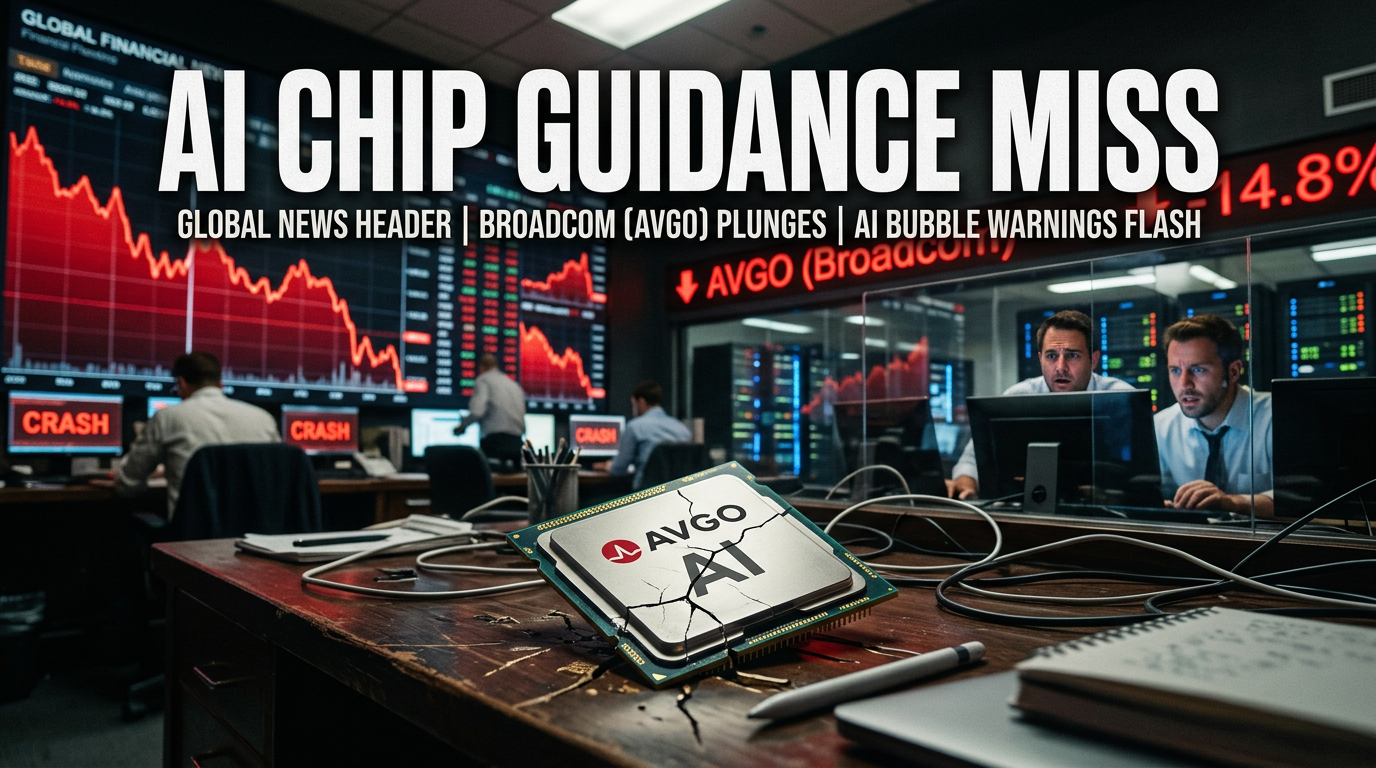
AI Semiconductor “Unstable Signals” Detected…Broadcom Plunges 15%—Why the Market Shook Again in the Bubble Zone
3 Key Points the Market Reacted to Most Sensitively Right Now
Even though Broadcom reported strong earnings, its stock dropped sharply
within a single day.
Here, the core point is that the market overreacted not to an “AI momentum collapse,” but to the fact that
the “AI revenue guidance” was slightly lowered versus expectations (consensus).
At the same time, the issues below also came together, increasing volatility.
1) Demand for AI-dedicated chips did not concentrate on “one company” and instead spread to competitors
2) Renewed U.S.–Iran tensions reignited worries over oil and interest rates
3) Private lending (redemption pressure) issues fueled risk sentiment in financial markets
In particular, the reason this combination is problematic is that,
AI semiconductor stocks had already priced in a lot of expectations, and
this was a market environment where even a “small deviation” hits hard.
News Briefing 1) The Direct Cause of Broadcom’s Plunge: AI Revenue Guidance Misses the Consensus
Broadcom’s earnings themselves (EPS, revenue) beat expectations, and
the outlook for the next quarter was not bad either.
Still, the reason the stock dropped by about 13–15% was clear.
The next-quarter AI revenue guidance was provided at around $16 billion, and
the market (analyst) expectation was $17.2 billion.
In other words, it wasn’t that “AI broke down,” but rather that
a signal that the pace slowed slightly versus expectations was interpreted strongly by the market.
✅ A phrase that often shows up in this stretch is “AI semiconductor bubble,” but
the nature of this drop is more convincing to be seen as
a correction caused by overlapping short-term expectation hype + profit-taking + news noise, rather than a pure “momentum collapse.”
News Briefing 2) Structural Change in the “AI Chip” Market: Demand for Tailored Dedicated Chips Is Dispersing Across Competition
The area Broadcom is pushing hard is
tailored, big-tech-dedicated AI chips, not “general-purpose GPUs.”
A typical lineup mentioned includes these.
- Google TPU
- Amazon Trainium
These dedicated chips have different characteristics.
They’re not about chasing only “top performance,” but rather
optimizing for specific customers’ (big tech) cost-efficiency demands.
The market shook for one main reason here.
A signal emerged that even if demand is strong, some of it could move to other competitors.
News Briefing 3) Suspicion of “demand shifting” caused by Marvell’s surge (up 40% in a day)
If we follow the original flow of the article, Marvell recording about
a 40% surge in a single day became a burden for Broadcom.
The market interpreted it like this.
- Broadcom’s AI revenue guidance gets lower
- But Marvell shows strong momentum
- As a result, the interpretation is added that “some demand may have shifted”
What’s important here is that,
it’s not “AI disappeared,” but rather
a shift within the competitive landscape of AI semiconductor demand (market share / supply structure) is underway.
News Briefing 4) Geopolitical risk flares up again: U.S.–Iran tensions → higher oil prices → increased interest-rate burden
Even if it could shake the market by itself,
geopolitics overlapped here as well.
In the original article, there’s a flow indicating that U.S.–Iran tensions have reignited.
- Attacks using drones
- Reports of damage to U.S. forces
Why would this kind of situation affect stocks right away?
Because the path energy (oil prices) → inflation → interest rates moves quickly.
And in fact, oil prices also move again per the original text.
- Brent crude re-accelerates, near the $90 range
- WTI also rebounds from the high-$80s
If oil prices rise again, the market worries about “inflation reigniting,” and then in the next step, the interest-rate level (especially long-term rates) is pressured.
News Briefing 5) The interest-rate red line logic: the 10-year yield 4.4–4.5 range is a psychological turning point
The original text suggests that the 10-year yield recorded in the late 4.4% range.
The key point here is the interpretation that “4.5” acts like a psychological red line.
What happens if rates go higher?
- As the stock discount rate rises, it’s unfavorable for growth stocks / semiconductors / AI-related stocks
- If it’s interpreted as “rates rising further,” disappointment selling could appear
So,
the AI semiconductor correction isn’t just a problem of earnings / guidance—
macro (interest-rate) conditions worsened as well.
News Briefing 6) Private lending (redemption pressure) issue: Financial instability shakes software/AI expectations even more
In the original text, the “private lending problem” is mentioned as an additional variable.
The core is this.
- Outflows continue from private lending funds
- Investors’ redemption requests increase
- Redemption pressure could connect to software/AI theme funds
In particular, the original text shows this kind of linkage.
- Software stocks (e.g., portfolios with high exposure to AI-related software)
- The narrative that “AI replaces software” (SaaS/apocalypse-type) spreads
- This could increase volatility in the software sector
To summarize,
even just geopolitical risk + interest-rate burden made the market overly sensitive, but
adding the signal of financial leverage/liquidity instability from redemption pressure together meant
that risk assets overall could swing even more.
Conclusion: Not an “AI momentum collapse,” but a combination of “post-surge correction + noise + macro negatives”
The direction of the conclusion in the original text is as follows.
- The AI momentum itself hasn’t disappeared
- However, short-term volatility is likely to expand significantly
Because the market had already risen quickly.
- Related stocks like Marvell surged in a short period
- Expectations for the network / semiconductor / AI pipeline reached an overheated state
- In that state, if you overlap consensus misses / guidance misses / geopolitics / interest rates / redemption pressure,
even small news can shake the market significantly.
So there is one “most important message” to read right now.
AI investment continues, but in the short term the market reacts even more sensitively to “expectations rather than earnings” and to “macro variables”.
“Separate takeaway” you must get from this article (the real core)
- The essence of Broadcom’s drop is not weak earnings, but that AI revenue guidance failed to meet the consensus.
- It wasn’t that demand disappeared; rather, there’s suspicion it could move (disperse) depending on competitive dynamics in the tailored dedicated chip market.
- Geopolitics (U.S.–Iran) → oil prices → interest rates pressured stock market sentiment directly.
- Private lending redemption pressure amplified financial instability and expanded volatility across risk assets overall.
- As a result, it’s more rational to view it as a simultaneous burst of post-surge correction phase + expectation misses + macro negatives, rather than an “AI semiconductor bubble collapse.”
SEO Keywords (naturally reflected within the sentences): Today’s watchpoints
Ultimately, this issue is about one axis: competition between AI semiconductors and tailored AI chips, while interest rates and oil prices, and also liquidity / redemption risk are another axis.
When these 3–4 axes shake at the same time, the market becomes even more sensitive, and
“one line of guidance” can move the entire stock price.
< Summary >
Although Broadcom’s earnings were better than expected, its stock price fell sharply because its next-quarter AI revenue guidance came in below consensus (160 vs 172 billion dollars).
At the same time, with Marvell’s surge, an interpretation emerged that demand for tailored AI chips could shift partially to competitors, and as renewed U.S.–Iran tensions pushed oil prices higher, the interest-rate burden increased.
On top of that, concerns over redemption pressure in private lending funds further expanded volatility.
The conclusion is that rather than AI momentum breaking down, it is more likely a short-term correction phase where expectation misses and macro/financial noise occurred simultaneously after the surge.
[Go to the two links below for related articles]
- Summary of the latest articles on AI semiconductor competitive dynamics and investment timing
- Summary of the latest articles on how changes in interest-rate levels affect the AI sector stock prices
*Source: [ 월텍남 – 월스트리트 테크남 ]
– AI반도체.. “불안한 신호”포착에 15% 폭락중