● Semiconductor Supercycle, Samsung, SK Hynix, Next Winners, 2026 Strategy
Should Investors Buy Samsung Electronics and SK Hynix Now? Semiconductor Supercycle, the Next Market Leaders, and an Investment Framework Through 2026
The primary market variable is not the KOSPI level itself, but which equities are driving performance.
This report consolidates the key points on whether Samsung Electronics and SK Hynix remain actionable at current levels, how to frame holding periods, why semiconductors continue to function as the core leadership group, and which sectors are most likely to attract incremental capital next.
It also addresses commonly overlooked factors: index distortion, the lifecycle of market leaders, peak signals driven by decelerating earnings growth rates, and downstream beneficiaries created by AI infrastructure bottlenecks.
1. Core takeaway: leadership matters more than the index level
Korea’s equity performance is being disproportionately driven by Samsung Electronics and SK Hynix. In the U.S., mega-cap technology remains influential, but incremental opportunity has increasingly shifted into the more granular AI infrastructure value chain.
Accordingly, “Is the index expensive?” is less relevant than “Is the leadership cohort intact?”
- KOSPI influence is highly concentrated in Samsung Electronics and SK Hynix
- In the U.S., viewing the market solely through mega-cap tech can be misleading
- Bull markets are frequently driven by a narrow set of leaders
- Leadership tracking can be more effective than index-level positioning
2. Samsung Electronics and SK Hynix: are they still buyable?
The view presented was constructive: initiating or adding exposure remains reasonable, based on leadership-cycle dynamics and the earnings trajectory rather than sentiment.
2-1. Why semiconductors remain central
The semiconductor cycle is not assessed as being near completion. The leadership phase was framed as having begun around September of last year, implying roughly eight months into the move at the time of discussion.
In practical terms: the cycle is characterized as early-to-mid stage rather than late stage.
- Semiconductors are still viewed as early-to-mid in the leadership cycle
- Earnings growth remains supportive
- Valuation is not characterized as extreme
- AI demand, HBM, DRAM, and broader memory upcycle signals are aligned
2-2. Structural reason these two names dominate the market
Given their market capitalization weights, KOSPI direction is tightly linked to semiconductor performance. As a result, index-level valuation concerns can be partly an artifact of concentration.
The more relevant question is whether Samsung Electronics and SK Hynix can sustain leadership.
3. Holding period and exit discipline: key framework
The key question is timing: if buying is still rational, what defines an exit?
3-1. Leadership “two-year” lifecycle heuristic
A leadership-cycle heuristic was emphasized: market-leading themes frequently reach an exhaustion point within roughly two years. The “culminating point” concept describes the phase when upside momentum fades and prices begin to stall or reverse.
- Leadership is not permanent
- The strongest upside often occurs in year one
- Survival probability declines materially into year two
- By this framing, semiconductors still have time runway
3-2. Semiconductors still early, but monitoring intensifies next year
The baseline expectation remains supportive into this year. However, as the cycle matures, growth-rate comparisons become more challenging and expectations risk increases.
The implication is not that a peak is imminent, but that monitoring the quality and direction of revisions becomes more important over time.
4. Primary peak signal: deceleration in earnings growth, not absolute earnings
Headline results such as “record profits” are lagging indicators. Markets typically respond earlier to the inflection in growth rates.
4-1. Why stocks can weaken despite improving earnings
If earnings rise from 100 to 200, growth is 100%. If they then rise to 300, earnings are higher but growth slows to 50%. Markets may interpret this as a post-peak growth regime and adjust valuation accordingly.
- Growth rate often matters more than absolute earnings
- Decelerating growth tends to reduce price momentum
- Sensitivity increases when expectations are elevated
- This explains consolidation even during strong earnings prints
4-2. Key indicators for Samsung Electronics and SK Hynix
A focus on revenue and operating profit levels alone is insufficient. The key monitoring set:
- Whether HBM and DRAM pricing trends inflect downward
- Whether higher shipments offset any price softening
- Whether full-year operating profit estimates continue to be revised upward
- Whether AI-driven demand broadens from HBM into the wider memory complex
A price-times-volume (P×Q) framework is required: mild pricing moderation can be offset by mix and volume; simultaneous weakness in price and volume would materially change the leadership interpretation.
5. Why investor sentiment remains uneasy
Elevated prices can still coincide with uncertainty due to positioning and experience effects.
5-1. FOMO and limited stress-testing experience
Two behavioral drivers were highlighted:
- Fear of missing out among those without exposure
- Regret among those under-allocated
Additionally, a growing cohort of newer market participants may have limited experience with macro shocks such as tightening cycles, geopolitical events, and liquidity withdrawal, increasing sensitivity to short-term volatility.
5-2. Leadership may matter more than macro inputs
The view emphasized not over-weighting macro headlines (rates, FX, geopolitics) at the expense of leadership identification. Even in weak tape conditions, a small number of sectors can generate strong returns.
The actionable priority is tracking capital flow and leadership persistence rather than attempting to forecast the entire market.
6. Where Korea’s leadership cycle appears to be
6-1. Sectors viewed as late-stage or near completion
- Shipbuilding
- Defense
These are assessed as having largely consumed a multi-year leadership run. Re-acceleration is possible if incremental catalysts emerge (e.g., geopolitics or AI infrastructure spillovers).
6-2. Late-stage but with remaining runway
- Nuclear power
- Power equipment
AI data center expansion increases structural electricity demand, supporting an industrial-demand-led interpretation rather than a purely thematic trade. Additional upside may depend on sustained global power infrastructure investment.
6-3. Current primary leadership sector
- Semiconductors
AI infrastructure, HBM, memory cycle improvement, and the expansion of the Nvidia-related supply chain remain the core drivers.
6-4. Potential early-stage candidates
- Automobiles
- Robotics
This cluster is described as more theme-driven than earnings-proven at present. Durable leadership would likely require confirmation in revenue and profit delivery.
7. U.S. market focus: beyond mega-cap tech into AI infrastructure sub-chains
While U.S. index performance remains influenced by large technology names, leadership is increasingly distributed across AI infrastructure supply chains:
- Semiconductors
- Storage memory
- Communications infrastructure
- Optical communications networks
- Data center connectivity equipment
As AI competition intensifies, the market focus may shift from GPUs alone toward bottlenecks in power, networking, memory, cooling, and connectivity. This has broader macro linkage via capex, grid investment, industrial automation, and supply-chain reconfiguration.
8. What could lead next?
The discussion offered cautious but actionable indications.
8-1. Robotics: future-driven optionality
Robotics is not yet fully validated as an earnings-led leadership group, but is frequently cited as a candidate for the next cycle. If physical AI scales, industrial robots, humanoids, logistics automation, and autonomous mobile robotics could be re-rated together.
Hyundai Motor, Boston Dynamics, and the manufacturing automation ecosystem were identified as relevant pillars.
8-2. Secondary batteries: cautious stance, not structurally dismissed
Secondary batteries remain in a post-peak, de-rated phase, but are not viewed as permanently impaired. However, analysis must incorporate intensified China competition, chemistry transitions, and EV demand-shape changes rather than relying on prior-cycle assumptions.
8-3. Conditional re-acceleration: space, defense, and power infrastructure
Not immediate leaders, but capable of renewed leadership under specific triggers:
- Defense modernization driven by asymmetric conflict dynamics
- Power infrastructure demand driven by AI data center growth and grid constraints
- Long-term commercialization of the space industry
Leadership can re-emerge when conditions and catalysts reset.
9. Under-discussed but material points
9-1. KOSPI is increasingly analogous to a semiconductor-concentrated index
High concentration in Samsung Electronics and SK Hynix can create index-level distortions, limiting the usefulness of KOSPI as a proxy for broad corporate conditions.
9-2. In AI, beneficiaries are often bottleneck owners, not applications
Economic rents tend to accrue at constrained points in the supply chain. Bottlenecks have shifted from GPUs toward HBM, DRAM, power, optical networking, cooling, and network equipment.
The operational question is less “what is trending?” and more “where is scarcity?”
9-3. Peaks often occur when headlines are strongest
Equities frequently bottom on weak data and peak when news flow is most optimistic, reflecting forward discounting of slowing growth rates.
9-4. Retail investors may be less structurally disadvantaged than before
AI tools can reduce information asymmetry. The differentiator becomes the ability to structure information into a coherent framework rather than access alone.
10. Practical portfolio framework
10-1. Near-term monitoring
- Persistence of semiconductor leadership
- Direction of full-year earnings revisions for Samsung Electronics and SK Hynix
- HBM/DRAM/NAND pricing and shipment trends
- Durability of U.S. AI infrastructure capex
10-2. Key risks to avoid
- Chasing after “record earnings” headlines without rate-of-change analysis
- Assuming any favored sector leads indefinitely
- Over-trading on macro news flow
- Anchoring to prior winners after leadership rotation
10-3. Preparing for the next rotation
- Track where AI infrastructure bottlenecks migrate
- Monitor timing of earnings validation in robotics and physical AI
- Define re-acceleration conditions for power equipment, nuclear, and defense
- Re-evaluate secondary batteries at inflection points in technology and demand structure
11. One-line synthesis
The decisive variable is not whether the index is high, but whether semiconductor leadership remains intact; the cycle is not broadly assessed as complete. The key peak signal is decelerating earnings growth rather than absolute profit, while potential next leadership candidates include robotics/physical AI and power infrastructure.
< Summary >
Korea’s market performance is being driven primarily by Samsung Electronics and SK Hynix.
Semiconductors are interpreted as early-to-mid cycle, with leadership plausibly extending through this year. Peak assessment should prioritize deceleration in earnings growth rates rather than absolute earnings levels.
Shipbuilding and defense appear late-cycle; power equipment and nuclear are mid-to-late; robotics is an early-stage candidate.
In the U.S., the focus is shifting from mega-cap tech as a monolith toward the detailed AI infrastructure value chain.
Potential next leaders to monitor include robotics, physical AI, power infrastructure, and conditionally secondary batteries and space.
[Related Posts…]
- Semiconductor Supercycle and Re-Rating Drivers for Korea’s Equity Market (https://NextGenInsight.net?s=semiconductors)
- Robotics and Physical AI: Signals of Leadership Rotation (https://NextGenInsight.net?s=robotics)
*Source: [ 경제 읽어주는 남자(김광석TV) ]
– [풀버전] 삼성전자·SK하이닉스, 지금이라도 사야 할까? 다음 주도주는 ‘이것’입니다. | 경읽남과 토론합시다 | 한규범 대표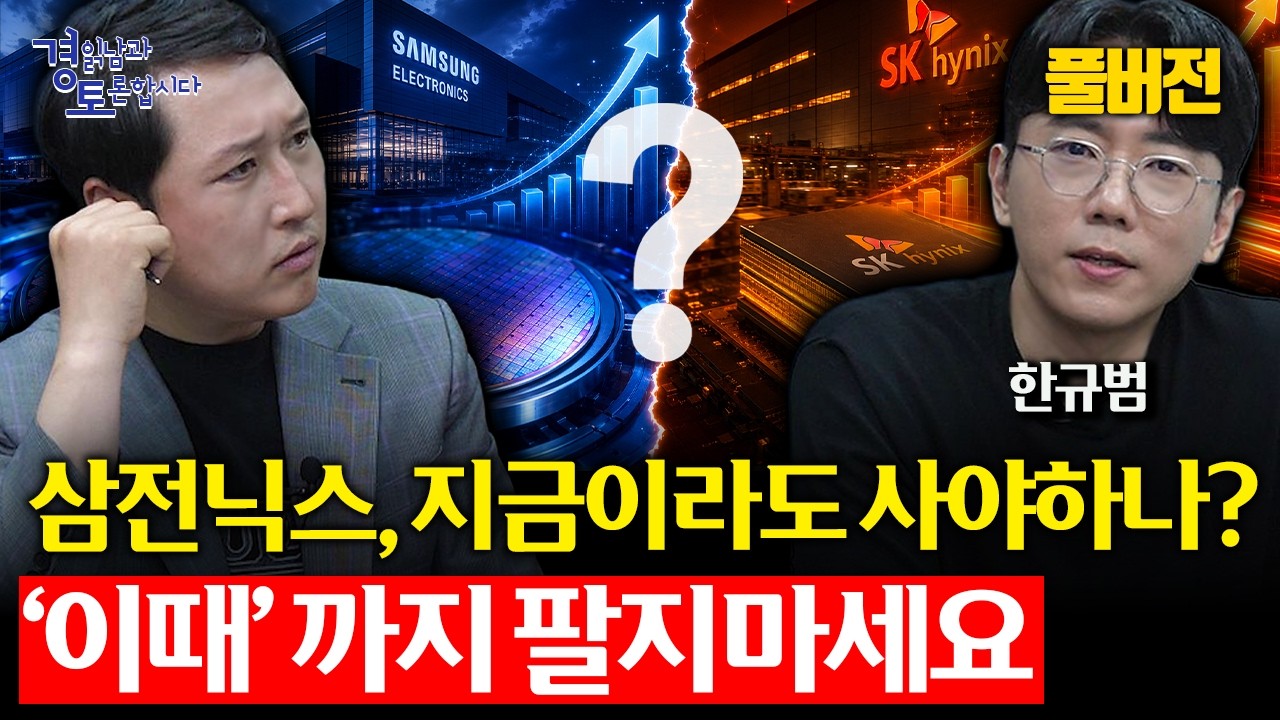
● Nasdaq Crash, AI Cashflow Shock, Fed Rate Fear
The Nasdaq Sell-Off: The Real Driver Is Now Cash Flow, Not Earnings
This decline has characteristics that extend beyond a routine technology-sector pullback.
Three points are central:
1) The sell-off is better explained by structural pressure tied to interest rates and the cost of capital than by short-term headlines.
2) Large-cap technology companies previously viewed as clear winners in the AI investment cycle are now facing rising data-center capex burdens, with potential equity financing increasingly discussed.
3) The market is shifting from a focus on earnings momentum to an assessment of which firms can sustain elevated investment requirements over time.
This report summarizes: the drivers of the Nasdaq drawdown; the linkage between rates and inflation; cash-flow developments at major platforms (Alphabet, Meta, Amazon); hidden risks embedded in AI data-center investment structures; and the implications for the macro outlook and equity strategy.
1. Why this Nasdaq decline may be more consequential
Market sensitivity is best assessed by examining why investors reacted sharply, not only what the headline catalyst was.
Near-term triggers included: concerns around Broadcom’s results and outlook; stronger labor data; and potential liquidity dispersion linked to SpaceX IPO expectations.
The broader backdrop is more important: the market was extended, and optimism around AI-related US equities was heavily priced in.
In that setting, modest uncertainty can prompt re-rating rather than routine profit-taking, amplifying the move.
2. The core issue remains interest rates
AI, semiconductors, cloud, and data centers are long-duration growth themes with valuations supported by expectations of substantial future cash flows.
Higher rates reduce present-value assumptions and increase actual investment and financing costs, including:
- Data-center construction
- Server/GPU procurement
- Power infrastructure expansion
- Lease costs
- Debt funding costs
As a result, investor focus is shifting from “Can AI generate profits?” to “Can firms fund AI investment until profits materialize?”
3. Risk that AI investment contributes to inflation pressures
Some research has emphasized that AI may introduce near-term inflationary pressures alongside longer-term productivity gains, including:
- Higher electricity demand and potential power-price increases
- Rising demand for memory and semiconductor equipment, lifting input prices
- Infrastructure buildout competition increasing project costs
If inflation re-accelerates, the Federal Reserve may have less flexibility to cut rates, extending pressure on growth-equity valuations.
4. Why the “Broadcom shock” mattered
A single company’s commentary does not explain the entire market move, but its impact signals positioning.
With “AI demand is structurally strong” widely assumed, any comments raising doubt about demand durability, investment continuity, or payback timing can catalyze rapid de-risking.
Given elevated expectations across semiconductors and mega-cap technology, downside sensitivity was high.
Broadcom functioned more as a trigger revealing latent concerns than as the root cause.
5. SpaceX IPO expectations and potential liquidity dispersion
Large IPOs can redirect capital flows toward new listings.
As expectations rise for major index inclusion (Nasdaq or S&P 500), portfolio rebalancing may pressure existing large-cap technology holdings in the short term.
This is a flow dynamic rather than a fundamentals issue, but it can weigh on highly appreciated names.
6. Why strong labor data was treated as a negative
Strong employment typically indicates resilient growth.
However, in the current regime, markets may prioritize the implications for rate policy:
- Persistent wage pressure
- Sustained consumption
- Potential re-acceleration in inflation
This delays rate-cut expectations, which is typically unfavorable for Nasdaq-style long-duration equities.
7. The key risk is not earnings, but free cash flow
The market is increasingly emphasizing free cash flow (FCF) rather than operating profit.
Mega-cap platforms continue to generate strong revenues across advertising, cloud, software, and platform services.
The issue is the acceleration of investment spending relative to cash generation:
- Accounting profits remain solid
- Residual cash after capex is compressing
AI capex escalation is driving the reassessment.
8. Why equity issuance is being discussed for Alphabet, Meta, and Amazon
Historically, equity issuance was not commonly associated with mega-cap technology.
The scale of AI data-center investment is now large enough that internal cash generation may be insufficient for some firms to fund capex while preserving balance-sheet flexibility.
Equity issuance is not necessarily a distress signal; it can be a cash-preservation strategy to maintain investment capacity.
9. Alphabet: strong operations, faster-rising investment burden
Alphabet’s core businesses remain competitive, with resilient advertising, cloud expansion, and AI service growth.
However, capex growth may outpace operating cash flow in certain periods.
In addition, AI data-center lease commitments may increase effective obligations beyond what is visible in headline financial-statement figures.
This weakens the simplifying thesis that “Alphabet has ample cash, therefore capex is not a constraint,” and supports discussion of opportunistic external capital raising.
10. Meta: strong profits, heavier contractual structure
Meta’s reported results appear robust, supported by advertising and accelerating operating income.
Yet, AI investment structures may be increasingly burdensome:
- Capex can exceed operating cash flow in certain periods
- Long-term leases and non-cancelable purchase commitments can create substantial future cash outflows
Even if such obligations are not fully reflected as on-balance-sheet debt, the market is increasingly pricing the duration and rigidity of these commitments.
11. Amazon: investment pressure beyond seasonal effects
Amazon historically exhibits first-quarter seasonality in profitability.
In this cycle, the pace of investment spending has increased, making cash-flow pressure more visible.
AWS remains competitively positioned, but faster AI infrastructure expansion raises capital intensity.
While near-term liquidity risk may be limited, the market may question the continued use of internal cash for prolonged investment, increasing the probability that external financing becomes more relevant over time.
12. Mega-cap capex: 2025–2027 as the principal stress window
Investor concern is not limited to a single quarter, but to the capex path beyond 2025.
Capex has increased materially from 2025 and may rise further into 2026.
From 2026 onward, cash-flow strain could broaden across firms, and sustaining investment through 2027 may be challenging under current funding assumptions.
This implies two primary adjustment mechanisms:
- Capex moderation
- External funding (equity issuance, strategic equity investment, expanded structured financing)
Even if AI demand remains strong, equity performance is likely to differentiate based on capex burden and payback duration.
13. Why Apple was relatively less affected
Apple’s relative stability reflects lower exposure to aggressive AI data-center capex compared with other mega-cap peers.
In the current regime, the market may reward cash-flow stability and capital efficiency over maximal investment intensity.
14. Hidden risks in AI data-center investment structures
Data-center expansion is often presented as a robust partnership model involving mega-cap sponsors, private capital, and lenders.
A common structure:
- Mega-cap and AI firms hold a minority equity stake
- Private capital funds an SPV
- The SPV uses leverage to build data centers
- Mega-cap firms sign long-term leases or usage agreements to support project cash flows
Advantages:
- Scale investment without fully consolidating debt
Key sensitivities:
- Memory/input price increases raise costs
- Higher power prices compress operating margins
- Higher rates increase funding costs
If project economics degrade, private capital and lenders may demand higher returns, reduce new commitments, or tighten terms, potentially shifting more cost and risk back to the mega-cap counterparties.
15. If the structure weakens, the stress is ecosystem-wide
This is not only a mega-cap issue; the AI ecosystem is interconnected.
Model developers (e.g., OpenAI, Anthropic) have not yet demonstrated durable, large-scale profitability.
If monetization is slower or usage fees become difficult to sustain, mega-cap platforms may face slower payback on infrastructure investment, extending the period of cash-flow pressure.
The perceived “self-funded flywheel” may be more dependent on external capital and forward revenue assumptions than often recognized.
16. Why this differs from short-lived headline shocks
One-off geopolitical or political events can fade quickly.
Here, multiple structural variables are linked:
- Interest rates
- Power costs
- Memory/input pricing
- Funding conditions
- AI monetization timing
- Long-term lease and purchase commitments
This reduces the likelihood that the issue resolves through a brief pullback alone and increases the probability of continued differentiation across AI-exposed equities.
17. What investors should monitor now
Earnings and EPS are insufficient. Key items to track include:
- Sustainability of free cash flow
- Capex growth-rate inflection
- Size of unused lease capacity, long-term leases, and purchase commitments
- Specificity and credibility of AI payback guidance
- Any indication of equity issuance or external capital raising
- Cloud pricing actions and customer churn risk
The key test is whether AI expansion can proceed without material deterioration in cash-flow resilience.
18. Macro interpretation
This is not only a technology-sector development; it connects to the global macro outlook.
The US economy faces both growth-slowdown risk and potential inflation re-acceleration.
Before productivity gains are realized, AI infrastructure investment can raise near-term capex and energy demand, which may support inflation and higher-for-longer rates.
This environment typically increases equity volatility, particularly for long-duration growth indices.
Korea’s equity market is also sensitive due to high linkage to semiconductors and the AI value chain. Higher US yields and a stronger USD can add pressure to Korean equities and growth exposures.
19. Key takeaways (news-style)
- Market drivers: The Nasdaq drop reflects a combination of Broadcom-related concerns, strong labor data, and potential liquidity dispersion tied to SpaceX IPO expectations.
- Root cause: Interest rates and the cost of capital are the dominant variables.
- Industry variables: AI data-center expansion can raise electricity costs, semiconductor/input pricing, lease expenses, and financing costs.
- Company variables: For Alphabet, Meta, and Amazon, free cash flow risk is becoming more important than near-term earnings strength.
- Financing variables: Equity issuance may function as a cash-preservation strategy rather than a distress indicator.
- Market implication: AI-related US equities may shift from broad-based appreciation to a more selective regime.
- Strategy: Prioritize cash flow, capex trajectory, and long-term contractual obligations alongside growth metrics.
20. Underappreciated point
The issue is not that mega-cap platforms lack cash.
The key risk is that AI investment structures can appear less risky in accounting terms while embedding large future cash outflow commitments via:
- Leases
- SPVs
- Long-term purchase obligations
- Non-cancelable contracts
If markets increasingly incorporate these off-balance-sheet-like obligations into valuation frameworks, the basis for re-rating changes from “AI intensity” to “AI plus cash-flow durability and capital efficiency.”
This shift can mark a transition in market leadership.
21. Upcoming catalysts and signals to monitor
- US CPI and PCE trends
- US Treasury yields and USD direction
- Mega-cap earnings guidance on capex (upward revisions)
- Formal announcements of equity issuance, stake sales, or external capital raising
- Data-center lease rates, power costs, and memory-price trends
- Cloud pricing policy and AI monetization velocity
Deviations from consensus expectations in any of these variables may reintroduce volatility.
22. Portfolio approach: increased rotation discipline
In this regime, rigid commitment to a single theme may be less effective than monitoring capital rotation and relative cash-flow strength.
Market leadership is rarely permanent, particularly when rates, inflation, and capex burdens rise.
AI remains a long-term structural trend, but performance may increasingly depend on capital efficiency within the AI complex rather than indiscriminate exposure.
< Summary >
The key driver of the Nasdaq sell-off is not a one-off headline, but the interaction of interest rates and escalating AI investment costs.
Mega-cap platforms may show strong reported earnings while experiencing declining free cash flow due to accelerating capex and long-term contractual commitments, prompting discussion of equity financing.
Alphabet, Meta, and Amazon are increasingly evaluated on capex discipline and lease/commitment burdens.
AI data-center investment structures are more complex than they appear; higher rates, power costs, and memory prices can quickly impair project economics.
The market is likely to place greater weight on cash-flow resilience and capital efficiency than on AI growth narratives alone, favoring selective positioning over broad mega-cap exposure.
[Related Articles…]
- Nasdaq Volatility Rising: Why US Tech Equity Strategy May Need Recalibration
https://NextGenInsight.net?s=Nasdaq - AI Data-Center Investment Race: Metrics That Matter More Than Big Tech Earnings
https://NextGenInsight.net?s=AI
*Source: [ Jun’s economy lab ]
– 나스닥 급락과 유상증자를 해야 하는 빅테크들 이야기