● AI-Bubble, Nvidia, HBM, Korea, Shock
The AI Bubble Debate Misses the Real Issue: A Former Google Investor’s View on AI Valuations, Semiconductors, Manufacturing, and Policy
The AI “bubble” narrative is often reduced to a binary question—bubble or not—obscuring more material issues.
1) AI appears overheated in markets, yet enterprise adoption in real operations remains at an early stage.
2) More important than short-term moves in semiconductor and Big Tech equities are (i) where smart money remains positioned and (ii) where top talent is reallocating.
3) Corporate AI transformation fails more often due to incorrect problem definition than insufficient technology.
4) In Korea’s manufacturing, finance, public sector, policy, data centers, and talent strategy, the core question is whether AI is being used as a tool or whether the business is being redesigned as AI-native.
This report summarizes: the AI bubble debate, investment signals implied by Nvidia and SK hynix (HBM), the realities of manufacturing AX, AI investment considerations, policy direction, and implications for companies and individuals.
1. Core takeaway: AI looks overheated, but remains early-stage in industry adoption
Despite market enthusiasm, AI transformation has not broadly materialized in operating environments. A cited MIT-affiliated finding that 95% of 300 companies fail at AI transformation implies adoption maturity remains low; Korea is likely earlier still.
Markets and headlines have moved ahead of on-the-ground deployment, with many enterprises stuck at POC. The market–deployment gap is central to interpreting the “bubble” discussion.
2. Why the AI bubble debate is frequently misframed: “bubble exists” vs. “bubble bursts” are different questions
Two compatible views were presented:
- AI exhibits bubble-like characteristics in asset pricing.
- A near-term collapse is not necessarily imminent; “healthy bubbles” can accompany technology diffusion.
Key points:
- When AI-related asset prices rise faster than fundamentals, bubble dynamics can emerge.
- Whether a bubble bursts is a separate issue.
- Timing is often driven more by macro variables (rates, liquidity, geopolitics, inflation) than by structural defects in the AI industry.
A more complete framework evaluates:
- Strength of industry fundamentals
- Degree of price pre-discounting
- Whether smart money is exiting
- Whether top talent continues to flow in
3. Smart money has not meaningfully exited: where long-duration capital remains
Short-term price volatility does not, by itself, indicate smart money outflows. According to the discussion:
- There has been no clear, broad smart-money exit from foundation-model companies.
- Volatility in AI SaaS and infrastructure has not translated into sustained withdrawal by long-term investors.
- Pullbacks have occurred, but structural exit signals remain limited.
The principal risk is less valuation in isolation and more whether monetization scales quickly enough to justify pricing. Improved liquidity conditions (e.g., rate-cut expectations) could re-accelerate AI and semiconductor momentum, but this is conditional.
4. Semiconductors (Nvidia, SK hynix, HBM): the primary bottleneck remains hardware
AI is perceived as a software-led innovation, but capacity is constrained by semiconductor supply and infrastructure. Nvidia GPUs and HBM function as strategic resources for AI scaling. SK hynix’s rising importance should be viewed as part of a broader AI supply-chain reconfiguration.
Implications:
- AI demand translates directly into compute demand.
- Compute demand increases GPU and high-bandwidth memory demand.
- Long-term AI growth is tightly coupled to the semiconductor cycle.
- AI investment analysis should include semiconductors, power, data centers, and network infrastructure (including subsea cable connectivity).
AI should be evaluated as an industrial infrastructure stack, not only an application layer.
5. The primary cause of enterprise AI failure: incorrect problem definition
Many AI deployments fail not due to model performance, but because the problem is mis-specified. Common operational failure modes include:
- Misaligned project scoping
- Poor partner selection
- POCs run by teams without execution capability
- Constraints from data access, security, and organizational resistance, limiting realized impact to a small fraction of theoretical potential
A frequent mistake is defining initiatives along existing org charts. AI functions more as a value-chain redesign mechanism than a departmental automation tool.
6. Two illustrative cases: AI creates more value via revenue-model redesign than operational automation
Two examples were used to highlight decision-design over surface-level optimization:
- Watermelon retail case: demand uplift was attributed not to “cutting service” per se, but to increased trust and purchase confidence from showing the cutting process for the customer-selected item. The underlying issue was trust/experience, not labor reduction.
- Convenience-store “buy-one-get-one” layout case: conventional approaches optimize inventory and sell-through. A more AI-native approach optimizes profit and customer response by segment, time, and product-bundle effects, even if waste increases marginally.
This distinguishes AI-assisted operations from AI-native decision engines.
7. Manufacturing AX in Korea: why deployments often capture only a small fraction of potential
Manufacturing AI deployments often begin with broad mandates (“transform everything”), but operational constraints reduce usable impact:
- Data quality and availability are weaker than perceived
- Data ownership is fragmented
- Tacit know-how is not codified
- Accountability and exception-handling are unclear
- Security and organizational barriers constrain implementation
In many cases, governance, operating model, KPI design, and decision-rights redesign matter more than the model itself. Effective AX requires clarity on:
- Which process
- Which decision
- Who delegates decisions to AI
- How responsibility and risk are allocated
8. Public policy: the key weakness is a “technology distribution” mindset
A central critique is that policy remains oriented toward distributing tools rather than redesigning business transformation pathways. Illustrative patterns:
- Enterprise-wide copilots deployed with low utilization (e.g., below 20%)
- Building proprietary foundation models without clear use-case definition
- Automating public-service workflows while reinforcing legacy back-office structures due to incomplete data readiness
Policy success should be measured by productivity gains, service-quality improvement, new-industry formation, and higher trend growth—not by deployment counts. AI policy should prioritize structural reform over procurement-scale targets.
9. Data centers and the “AI highway”: siting and buildout should follow industrial economics
Data center location decisions driven primarily by political or regional-balance logic can impose material opportunity costs. Practical criteria include:
- Where real demand resides
- Feasibility and cost of power procurement
- Connectivity to subsea cable landing stations
- Telecom and grid infrastructure efficiency
Data centers are strategic infrastructure linking power, networks, semiconductors, cloud capacity, and national security.
10. Organizational communication in the AI era: advantage shifts from execution to question design
Some AI-native organizations are designing workflows where AI output substantially exceeds human output (ratios cited as 9:1, 99:1, and even higher). Human roles shift toward:
- Deciding what to delegate
- Designing verification and control tasks
- Formulating high-quality questions
- Interpreting outputs and owning accountability
Communication shifts from reporting chains toward prompt design and validation systems.
11. KPI evolution: overlapping objectives can increase speed relative to rigid role separation
Rather than narrowly segmented KPIs, some organizations are moving toward partially overlapping goals to accelerate cross-functional problem solving. In the AI era, solutions are rarely contained within single departments.
At the macro level, innovation increasingly requires coordinated progress across semiconductors, power, software, regulation, education, and finance.
12. Incentives, fiscal windfalls, conflict management: distribution rules become more consequential
The discussion broadened to allocation of AI-driven surplus:
- Within firms: how excess profits are distributed and justified
- At the national level: how fiscal windfalls are allocated among consumption, debt reduction, and investment
A principle-based rationale (e.g., talent retention) is positioned as more sustainable than ad hoc concessions. Given talent’s role as a core factor of production in AI and semiconductors, compensation design becomes strategic.
On fiscal policy, prioritizing debt reduction under established fiscal rules, followed by support for vulnerable groups and future-oriented investment, was presented as a growth-consistent sequencing.
13. Signals for individual investors and professionals
- AI remains early-stage by adoption metrics, despite market pricing
- Monitor smart-money positioning and talent flows over short-term volatility
- Hardware bottlenecks (semiconductors, HBM, data centers, power) remain critical
- Enterprise success is driven more by problem definition and organizational design than model choice
- Individual differentiation increasingly depends on question design and delegation capability, not only execution speed
AI is better framed as a productivity transformation with slower, more structural diffusion than headline cycles suggest.
14. Under-covered points with high signal value
- The central issue is not whether prices are “too high,” but whether enterprise adoption has barely started.
- Enterprise failure is primarily due to poor problem definition, not insufficient model performance.
- AI delivers larger value when used to redesign revenue and decision structures, not only automate tasks.
- Policy should shift from technology distribution to transformation design.
- Top-talent migration into AI is a high-conviction fundamental indicator and a leading signal relative to headlines.
15. Final synthesis: the higher risk is shallow AI adoption, not the bubble narrative
The principal risk is treating AI as a superficial productivity add-on (e.g., summarization and basic automation) rather than using it to redesign decision rights, workflows, and profit models. This distinction is likely to drive divergence in corporate value, industrial competitiveness, national growth potential, and individual career outcomes.
< Summary >
The AI bubble debate is not primarily a valuation argument. Industry adoption remains early, and many enterprises struggle due to problem-definition failures. Smart money and top talent continue to concentrate in AI, while semiconductors, HBM, and data-center/power infrastructure remain binding constraints.
The highest-value use of AI is redesigning revenue and decision architectures rather than incremental automation. Korea’s corporate strategies and national policies should shift from tool distribution toward AI-native transformation design.
[Related Articles…]
- AI semiconductor investment strategy and global macro outlook: key points summary (https://NextGenInsight.net?s=AI)
- HBM demand surge and SK hynix growth scenario analysis (https://NextGenInsight.net?s=HBM)
*Source: [ 경제 읽어주는 남자(김광석TV) ]
– [풀버전] 구글 임원 출신 투자자가 보는 AI 거품론의 착각 | 경읽남과 토론합시다 | 조용민 대표
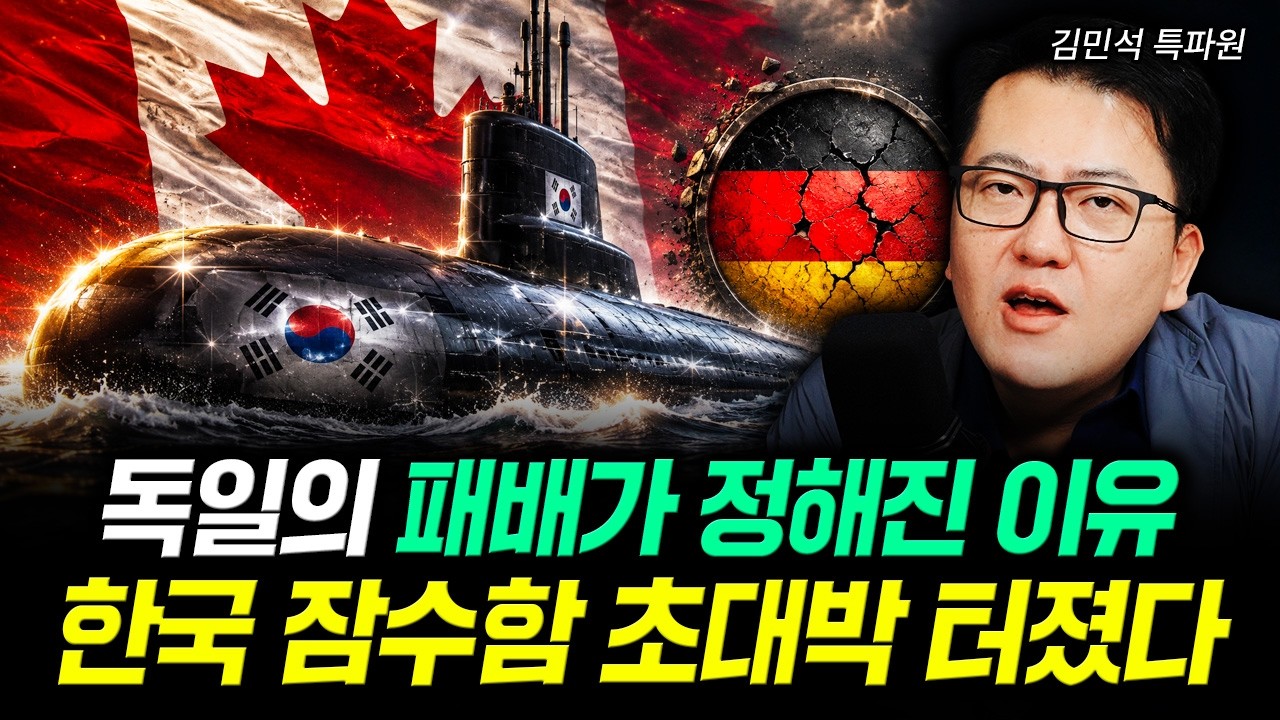
● Germany Submarine Shock-Korea Defense Boom-Russia Crisis-China Exit Signal
Germany Submarine Competitiveness at Risk, Expansion of South Korea’s Defense Exports, and Russia’s Economic Strain — Integrated Brief
This is not a standalone military headline. It connects: (i) potential erosion of Germany’s submarine edge, (ii) the probability of deeper entry by South Korean shipbuilding and defense contractors into Europe, (iii) structural stress in Russia’s wartime economy, and (iv) incentives for China to prefer conflict termination. The combined effect is a potential reshaping of Europe’s defense procurement market with implications for global supply chains and investment positioning.
1. Core Thesis: A Defense Story That Signals Industrial and Macro Repricing
Four linked developments define the current narrative:
1) Ukraine’s asymmetric operational model is inflicting disproportionate damage on Russia. Drones, unmanned systems, and robotics are altering force-exchange ratios.
2) Germany may not sustain historical dominance in the submarine segment. Competitive criteria now include delivery timelines, pricing, sustainment, and geopolitical reliability.
3) South Korean submarines and the broader “K-Defense” ecosystem are emerging as viable European alternatives. HD Hyundai Heavy Industries is increasingly cited as a potential beneficiary.
4) Russia’s economy is under rising strain from prolonged war, while indications suggest China increasingly prefers de-escalation. These dynamics intersect with oil markets, FX, inflation, and global growth expectations.
2. Operational Update: How Ukraine’s Asymmetric Toolkit Pressures Russia
Ukraine’s approach demonstrates that outcomes are not determined solely by high-cost legacy platforms. Low-cost drones, maritime unmanned craft, precision strike, and distributed attack methods are persistently targeting strategic assets and rear-area infrastructure.
The conflict also provides a live case study of fourth industrial revolution technologies in combat deployment: AI-enabled target recognition, real-time data integration, mass employment of low-cost unmanned systems, and accelerated adoption of network-centric concepts.
This matters because defense competitiveness is being redefined. The focus is shifting from “largest and most advanced platforms” to “faster production, higher volumes, lower unit costs, and superior integration and decision cycles.”
War increasingly becomes a function of industrial throughput and resilience. AI, robotics, semiconductors, communications, shipbuilding, energy, and cyber capabilities move as an integrated industrial package.
3. Why Concerns Are Rising About Germany’s Submarine Position
Germany has long been viewed as a submarine technology leader. However, Europe’s fast-changing security environment is reducing the value of legacy reputation as procurement priorities shift.
3-1. Delivery Schedules and Production Capacity Are Now Decisive
Post-war European rearmament emphasizes near-term deliverability. High performance is insufficient if lead times are extended or production capacity is constrained.
South Korea’s commercial shipbuilding track record demonstrates high productivity and schedule control. If translated into naval programs, this becomes a material advantage for European buyers.
3-2. Cost-Effectiveness and Lifecycle Support Are Increasingly Central
Defense acquisition is evaluated on total lifecycle cost: operations, maintenance, upgrade pathways, spares availability, supply-chain stability, and technology-transfer scope.
Even incumbent suppliers face scrutiny when buyers model multi-decade ownership costs. South Korean firms may gain share if they demonstrate competitive pricing and tailored industrial proposals.
3-3. Geopolitical Reliability and Political Flexibility Are Procurement Variables
European buyers increasingly assess crisis-time support reliability, political flexibility, and willingness to engage in industrial cooperation.
South Korea is not a core NATO power, which may allow more pragmatic partnership structures in technology cooperation, co-production, and industrial offsets.
4. Why Greece Is Being Discussed in Connection With South Korean Submarines
Greece is a maritime-focused country with strong commercial shipping expertise and a strategic need for naval capability. Symbolic references to early Greek support for South Korean shipbuilding are best interpreted as an indicator of trust in Korea’s shipbuilding credibility.
If Greece becomes less committed to German submarine negotiations and more open to alternatives, it could signal a broader shift in European procurement preferences.
Market commentary suggesting high probability of HD Hyundai Heavy Industries supplying the Hellenic Navy remains unconfirmed; however, it is relevant as an indicator of changing market sentiment. South Korean submarine offerings are gaining recognition on capability, cost efficiency, and build capacity.
5. Structural Strength of K-Defense: Selling an Integrated Industrial Package
A key differentiator is the ability to bundle platforms with broader industrial and support ecosystems rather than selling a single system.
5-1. Shipbuilding, Electronics, Semiconductors, Batteries, and AI Move Together
Submarines require integrated systems: sensors, communications, power systems, software, propulsion, and sustainment platforms. Defense exports therefore function as advanced manufacturing exports.
South Korea’s advantage extends beyond hull construction to digital manufacturing, AI-enabled maintenance, smart yards, supply-chain management, and combat-system integration.
5-2. Rapid Production and Iterative Improvement
Some legacy European defense primes face complex procurement structures and slower iteration cycles. South Korea is perceived as capable of faster specification adjustment, production execution, and delivery adherence.
In an era of heightened geopolitical and supply-chain risk, operational speed and flexibility translate into competitive advantage.
5-3. From “Low-Cost Option” to “Operationally Credible Supplier”
Following the Poland procurement precedent, South Korea is increasingly viewed as a supplier with rapid response capacity, scalable production, and sustainment competence—not merely a value alternative.
This positioning may extend to submarines as Europe prioritizes near-term rearmament and industrial cooperation.
6. Why Russian Ministry of Finance Concerns Are Market-Relevant
Reported concerns at the Russian fiscal authority level are material signals, not rhetoric. Prolonged conflict can degrade both national finances and industrial structure.
6-1. Wartime Output Can Create a Growth Illusion
Russia may appear resilient in the near term due to higher defense production and state spending. However, this resembles mobilization-driven activity rather than productivity-led growth.
Over time, this structure can amplify inflationary pressure, labor shortages, technological isolation, weaker investment, and fiscal deterioration.
6-2. Energy Exports Alone May Not Stabilize the System
As a resource exporter, Russia benefits from energy revenue, but discounts, sanctions-evasion costs, logistics restructuring, and financial constraints can compress real profitability.
These dynamics transmit to global oil pricing, commodity inflation, and broader macro expectations.
7. Why the View That China Prefers Conflict Termination Is Plausible
While China has provided diplomatic and economic support, it has avoided direct provision of troops and weapons. This suggests a balance: preventing Russian collapse while limiting escalation and duration.
7-1. China Benefits From Global Macro Stability
China’s economy remains sensitive to exports, manufacturing utilization, maritime logistics, commodity inputs, and FX stability. Prolonged war increases volatility across these variables.
With domestic headwinds such as property-sector stress and weaker consumption, sustained external shocks are adverse for China’s manufacturing and trade objectives.
7-2. China Seeks to Avoid Secondary Sanctions Exposure
Overt military support would raise the probability of secondary sanctions from Western jurisdictions, representing a high-cost risk.
Accordingly, China may prefer a managed outcome in which Russia avoids decisive defeat but the conflict is contained and eventually concluded.
8. Key Economic Takeaways
8-1. European Rearmament Creates Multi-Year Industrial Demand
Europe is likely to sustain elevated defense spending for years. Demand extends beyond platforms (ships, submarines, ammunition, missiles) into electronics, communications, AI, and sensor industries.
For South Korean firms, the opportunity set may include long-duration contracts and recurring sustainment revenue, with spillovers into domestic capex, employment, and technology upgrading.
8-2. Defense Has Defensive Characteristics Across Cycles
Security expenditure tends to be less cyclical than discretionary civilian capex. In high-rate, high-uncertainty environments, contracted backlog and visibility can support relative sector valuation resilience.
This dynamic may keep attention on South Korean defense and shipbuilding equities, subject to execution and policy risks.
8-3. AI Adoption Often Commercializes Faster in Defense and Industry
AI commercialization is not limited to consumer applications. Defense and industrial contexts are among the fastest to operationalize AI: ISR, target recognition, predictive maintenance, unmanned teaming, and battlefield analytics.
This implies that AI growth exposure may extend meaningfully into industrial AI, defense AI, and manufacturing AI supply chains.
9. The Underappreciated Point: War Is Reshaping Industrial Order
The central issue is not a single submarine contract. It is a preference shift in Europe from legacy “premium” procurement toward systems that can be delivered quickly, scaled, supported, and integrated under wartime urgency.
This shift is broader than submarines: MBTs, artillery, missiles, drones, logistics, sustainment, and extensions into energy, shipbuilding, and semiconductor cooperation.
If executed effectively, South Korea’s role could evolve from exporter to long-term partner within Europe’s security-industrial base, with implications for national branding, export composition, and industrial competitiveness.
10. Monitoring Framework
1) Procurement decisions by Greece and other European states regarding submarine acquisition paths.
2) Partnership structures proposed by HD Hyundai Heavy Industries and Hanwha Ocean in Europe (co-production, offsets, MRO).
3) Russia’s fiscal trajectory and energy export profitability under sanctions and discount dynamics.
4) Strength and consistency of China’s diplomatic signaling toward de-escalation.
5) The degree to which AI and unmanned systems become primary evaluation criteria in defense tenders.
11. Consolidated Conclusion
The current environment is less about whether South Korean submarines can outperform Germany on technology alone, and more about which suppliers can deliver rapidly, flexibly, and at scale with credible sustainment and industrial cooperation.
Given strengths in shipbuilding productivity, manufacturing depth, digital transformation capability, and supply-chain execution, South Korea is positioned competitively as Europe accelerates rearmament.
Russia’s increasing economic strain, China’s preference for macro stability, and Europe’s urgency to rearm together create a potential multi-year opportunity window for South Korean defense and adjacent future-industry value chains.
< Summary >
- The Ukraine war is accelerating drone- and AI-enabled warfare.
- Germany’s traditional submarine advantage may weaken on delivery time, cost, sustainment, and political flexibility.
- South Korean defense suppliers, including HD Hyundai Heavy Industries, are emerging as credible European alternatives.
- Russia faces growing structural economic burdens as the war persists.
- China likely prefers conflict termination to stabilize global trade and supply chains and to reduce sanctions risk.
- The primary takeaway is structural: the war is reshaping Europe’s defense market and broader industrial order.
[Related Articles…]
- K-Defense export expansion and European rearmament beneficiary sectors: https://NextGenInsight.net?s=defense
- AI trends, defense technology innovation, and future-industry investment themes: https://NextGenInsight.net?s=AI
*Source: [ 달란트투자 ]
– 캐나다 언론은 쉬쉬하고 있다 도산안창호함 충격 소문 | 김민석 특파원 3부