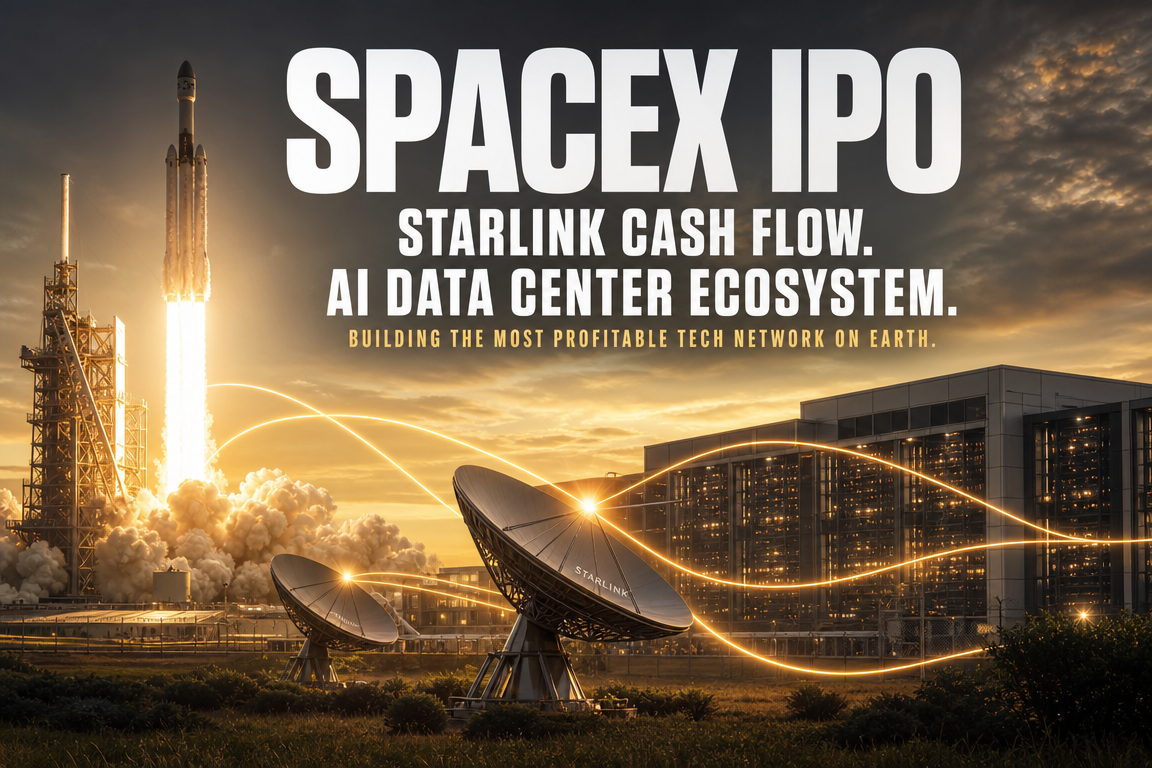
● Musk’s SpaceX Mega IPO, AI, Starlink, xAI, and Space Data Center Shockwave
The More Material Issue Than a SpaceX Listing: Musk’s Integrated Strategy Across IPO, Starlink, xAI, Space Data Centers, and Physical AI
The core issue is not simply the arrival of a mega-scale SpaceX IPO.
The more material point is the potential consolidation of space, AI infrastructure, satellite communications, data centers, and ultimately physical AI into a single ecosystem.
This report prioritizes structural and strategic implications over headline valuation figures.
It summarizes, in a news-style format, why SpaceX’s prospective market capitalization could influence global equity markets; why Starlink functions as a cash-generation engine rather than only a satellite internet product; why xAI losses may signal investment-led optionality rather than structural weakness; and why the market focus should be on ecosystem integration and rule-setting power rather than IPO execution alone.
It also addresses topics less emphasized in mainstream coverage: space-based data centers and AI monetization timing, potential strategic linkage with Tesla, and liquidity and allocation impacts on capital markets.
1. Why a SpaceX IPO Would Be a Market-Defining Event
1-1. Scale supports the “mega IPO” characterization
A frequently cited framing is “KRW 3,000 trillion scale,” reflecting perceived magnitude rather than rhetoric.
Indicative IPO valuation discussions reference a market capitalization around USD 1.75 trillion, which would place SpaceX immediately among the highest-value global listed companies.
Depending on market conditions and price discovery, a range of USD 1.5–2.0 trillion is often discussed, implying direct comparability with large-cap technology platforms.
1-2. Capital market impact could exceed historical benchmarks
Comparisons to Saudi Aramco highlight that the likely liquidity absorption could be substantial.
A large offering may redirect global risk capital toward SpaceX, creating reallocation pressure across growth equities, technology, and potentially defensive sectors.
Accordingly, the listing should be viewed as both a space-industry milestone and a global capital market supply-demand event.
2. Why Interpreting SpaceX as “Only a Space Company” Misprices the Thesis
2-1. The operating model extends beyond launch services
SpaceX is increasingly a cross-industry platform, defined by integration across verticals rather than a single product line:
- Launch services and space transportation
- Starlink-based satellite communications services
- Space infrastructure and potential space data center initiatives
- AI services and compute business centered on xAI
- Long-term pathway toward a physical AI ecosystem linked to Tesla
Under this framing, SpaceX is simultaneously a space operator, communications provider, AI infrastructure participant, and a hub within the broader Musk platform strategy.
2-2. Valuation remains difficult due to limited category precedent
Unlike semiconductors or autos, global valuation frameworks for space-industry conglomerates are not yet standardized.
Adding AI exposure (xAI) increases uncertainty, as AI comparables are often priced on expectations and strategic positioning rather than mature earnings.
As a result, institutional views diverge materially on appropriate multiples.
3. Do Losses Indicate Weakness, or Investment-Led Optionality?
3-1. The primary driver of losses is AI investment, not core space economics
A key interpretation is that the space segment may be more economically durable than commonly assumed, while reported losses are more closely linked to xAI and data center expansion.
Markets typically distinguish between:
- Losses driven by uncompetitive core operations, and
- Losses driven by front-loaded investment to secure future control points
This distinction can materially affect valuation treatment.
3-2. Starlink functions as a cash-generation engine
Starlink is characterized not only by subscriber growth, but by a high revenue contribution, rapid growth, and strong margins.
Margin references in the discussion are approximately ~40%, positioning Starlink as a funding engine supporting aggressive AI and infrastructure investment.
The operating model can be summarized as: Starlink cash flows funding xAI and compute build-out.
3-3. xAI revenue may scale faster as contracted compute converts to recognized revenue
While xAI currently incurs high costs and remains early in monetization, already-signed compute contracts may begin contributing more meaningfully from the second half of the year.
Markets often re-rate companies not on current losses, but on improving visibility into monetization and breakeven trajectories.
If Starlink stability and xAI revenue visibility improve concurrently, the probability of a faster valuation reassessment increases, subject to execution.
4. The Strategic Objective: IPO as a Step Toward Industrial Hegemony
4-1. The pattern emphasizes reshaping industry structure
The strategic interpretation is that the priority is not fundraising via listing, but re-architecting industry order—similar to how EVs were integrated with batteries, software, charging, and autonomy.
The emerging target system links:space + communications + AI + data centers + robotics/autonomy.
4-2. In AI, the bottleneck is infrastructure rather than models
A recurring thesis is that AI progress will be constrained by infrastructure: power, chips, networking, compute, and data centers.
Under this view, SpaceX is not only a launch company; it is a potential mechanism to secure new infrastructure domains, including non-terrestrial options.
4-3. Space-based data centers as a strategic extension
Space data centers are often treated as speculative, but the strategic logic ties directly to constraints in terrestrial data centers: power, cooling, land, and network density.
If long-term plans include off-planet compute and data processing, SpaceX launch capacity and Starlink connectivity become enabling infrastructure rather than standalone businesses.
In that framing, rockets are not only transport services; they are the logistics layer for deploying future AI infrastructure.
5. Why Tesla Combination Narratives Persist
5-1. Not a pure financial event; an ecosystem completion thesis
While frequently framed as rumor, the strategic roles are internally consistent:
- SpaceX: space infrastructure, launch, satellite networks, data center base layer
- Starlink: global communications network
- xAI: models and AI services
- Tesla: hardware platform, autonomy, robotics, physical AI deployment
If combined operationally, the stack spans infrastructure, network, models, and real-world execution platforms.
5-2. Tesla’s role in physical AI monetization
The most durable value capture for AI may occur in real-world applications: autonomous vehicles, humanoid robots, factory automation, and logistics.
Tesla provides a hardware and deployment pathway. In functional terms:
- xAI as the “cognition layer”
- Tesla as the “actuation layer”
- SpaceX/Starlink as the “connectivity and infrastructure layer”
This supports an “industrial operating system” interpretation rather than a collection of independent listed entities.
6. Key Market Monitoring Variables
6-1. Post-IPO category definition matters more than day-one pricing
The primary market question is how SpaceX will be categorized:
- Space industrial
- Communications infrastructure
- AI infrastructure
- Multi-vertical platform
Category classification drives multiple selection and investor base composition.
Early quarterly reporting, forward guidance, and the pace of Starlink and xAI revenue recognition are likely to be more material than first-day volatility.
6-2. Breakeven timing may be earlier than consensus narratives imply
If cost growth remains controllable, earnings improvement could emerge sooner.
In U.S. equities, a clear shift from “investment phase” to “monetization phase” often triggers rapid reframing.
6-3. Second-order impacts across incumbents
A successful listing would also pressure broader market narratives around AI infrastructure ownership.
Potentially affected segments include telecom operators, cloud providers, data center REITs, semiconductor suppliers, and aerospace/defense exposure.
In this sense, the IPO may set a new benchmark for what constitutes “AI infrastructure.”
7. News-Format Key Takeaways
7-1. Market reaction drivers
- SpaceX is viewed as a potential mega IPO with immediate entry into the top tier of global market capitalization.
- The offering could absorb significant liquidity, influencing allocations across growth and technology equities.
- The central debate is less “cheap vs. expensive” and more “which sector framework should price it.”
7-2. Business and financial structure
- Losses are interpreted as primarily driven by xAI and data center expansion rather than the core space segment.
- Starlink is positioned as a high-growth, high-margin cash generator.
- xAI could accelerate monetization as contracted compute begins to flow through revenue recognition.
7-3. Long-horizon strategy
- The central strategy is ecosystem integration across space, communications, AI, data centers, and hardware platforms.
- Tesla is a plausible execution platform for physical AI via autonomy and robotics.
- Space data centers remain early-stage, but align with long-term infrastructure bottleneck mitigation.
8. Under-Discussed Points with High Relevance
8-1. The material issue is cash-flow routing inside the ecosystem
The key structural feature is internal capital allocation: Starlink cash flows funding xAI and compute/data center investment.
A robust internal funding loop can reduce external financing dependence and increase resilience to market stress.
8-2. Space data centers link to power, cooling, and network constraints
As AI scales, the binding constraints are increasingly physical.
This supports a framework where SpaceX launch capability, Starlink networks, and xAI demand are components of a single bottleneck-resolution strategy.
8-3. SpaceX may redefine the next definition of AI infrastructure
AI infrastructure may expand beyond GPUs, cloud, and terrestrial data centers to include power systems, network layers, satellite connectivity, logistics, and physical deployment platforms.
A SpaceX listing could serve as the symbolic trigger for this broader redefinition.
9. Consolidated Interpretation
The primary lens is not “how expensive SpaceX is,” but “which industrial structure is being preemptively secured.”
- Starlink: current cash-flow engine
- xAI: future cognition and service layer
- Space data centers: long-duration infrastructure option
- Tesla: real-world execution platform
Under this framework, a SpaceX IPO is an initial step toward the market recognizing an integrated platform with potential to influence AI-era infrastructure standards.
< Summary >
The core of the SpaceX listing narrative is not the IPO mechanics, but the integration of space, satellite communications, AI, data centers, and physical AI into a single ecosystem.
Starlink is positioned as a strong cash-generation business, while xAI may enter a faster monetization phase as contracts convert into recognized revenue, potentially shifting the “loss-making” framing.
Incorporating space data center optionality and strategic linkage with Tesla, SpaceX can be evaluated as an AI-era infrastructure platform rather than a standalone space enterprise.
[Related Articles…]
- SpaceX IPO: Liquidity Absorption and Global Allocation Effects
- AI Data Centers: Power, Cooling, and Network Constraints
*Source: [ 경제 읽어주는 남자(김광석TV) ]
– 상장보다 무서운 일론 머스크의 ‘진짜 큰 그림’ | 경읽남과 토론합시다 | 정의훈 선임연구원 [1편]
● Middle East Oil, Energy Shock, Korea Security
Why the Middle East Has an Exceptional Oil Endowment, and Why Korea’s Energy Security Has Become More Critical
This report moves beyond the simple statement that “the Middle East has abundant oil.” It outlines: (i) why countries such as Saudi Arabia, Qatar, and Kuwait retained petroleum systems over hundreds of millions of years; (ii) how the United States re-established energy leverage through the shale revolution; (iii) why Korea has generated value as a refining hub despite lacking large upstream resources; and (iv) why issues such as East Sea gas fields and deepwater exploration themes should be assessed through an energy-security lens rather than short-term market narratives.
A central point is not merely the conditions for hydrocarbon generation, but why some regions lose hydrocarbons after generation while the Middle East preserved them. The discussion is framed to connect macro outlooks, oil and gas pricing, energy security, commodities, and the rising power demand associated with AI.
1. Key Takeaways (News Summary)
The Middle East became the world’s premier oil province not only because it generated large volumes of hydrocarbons, but because multiple elements aligned: organic-rich marine source rocks, appropriate thermal maturity, effective reservoir rocks, and—most importantly—tectonic stability that preserved the system over geologic time.
Northern parts of the Arabian Plate retained petroleum systems for more than 400 million years with limited volcanic activity and without severe tectonic disruption. Later collision with the Eurasian Plate contributed to structural traps (including dome-like folds) that concentrated hydrocarbons into super-giant fields.
By contrast, southern areas of the Arabian Peninsula experienced crustal rifting and volcanism associated with the formation of the Red Sea, which damaged or dispersed petroleum systems.
Korea is not entirely devoid of resources. The East Sea 1 and 2 gas fields reportedly produced approximately 5 million tons of natural gas through around 2022, with reported net profit of approximately KRW 1.4 trillion. While immaterial versus Middle Eastern scale, this indicates that offshore development has not been uniformly uneconomic.
Energy should be treated as a strategic asset affecting FX, inflation, the trade balance, industrial competitiveness, and national security—not only as an input cost.
2. Why the Middle East Has Exceptional Oil Endowment: A Geological Framework
2-1. Oil Does Not Form Everywhere
Commercial petroleum accumulation generally requires:
- a source rock (organic-rich sediment capable of generating hydrocarbons), and
- a reservoir rock (porous/permeable rock that can store and transmit hydrocarbons for production).
Both are required for economically recoverable fields.
2-2. What a Source Rock Is
Source rocks are typically organic-rich shale (fine-grained mudstone). The primary feedstock is not large animals; it is predominantly plankton and microscopic organic matter.
High biological productivity in marine or lacustrine basins, combined with additional organic input from major river systems, supports thick organic-rich sediment accumulation.
2-3. Organic Matter Must Be Preserved (Not Fully Decomposed)
Abundant organic input is insufficient if oxygenated conditions allow decomposition. Anoxic environments—such as deep marine settings or oxygen-poor lake bottoms—promote preservation and enable future hydrocarbon generation.
2-4. Burial and Thermal Maturity (“Cooking”)
After deposition, continued sedimentation buries organic matter. Temperature and pressure rise with depth; hydrocarbons form within characteristic maturity ranges (commonly described as “oil window” and “gas window”). If too cold, generation is limited; if too hot, hydrocarbons can crack or degrade.
2-5. Generation Is Not Enough; Accumulation and Storage Matter
Hydrocarbons generated within tight shale may not be economically producible unless they migrate into reservoir rocks (e.g., porous sandstone). A viable trap and seal are required to concentrate hydrocarbons into producible accumulations.
3. The Middle East’s Differentiator: Preservation Was More Important Than Generation
3-1. The Arabian Plate Was a Long-Lived Marine Basin
Regions that are now desert were formerly extensive marine environments. Northern areas of the Arabian Plate experienced prolonged marine deposition from Paleozoic times, allowing thick accumulation of organic-rich strata.
3-2. Why Other Former Marine Regions Did Not Become the Middle East
Many areas that were once marine basins later experienced major tectonism (plate collisions, faulting, volcanism, mountain building). These processes can:
- breach traps and allow hydrocarbons to escape,
- expose systems to excessive heat and degrade hydrocarbons,
- destroy reservoir/trap integrity.
In many basins, hydrocarbons were generated but not preserved.
3-3. Northern Middle East Maintained an Intact Petroleum System for Hundreds of Millions of Years
A corridor spanning Saudi Arabia, Qatar, Kuwait, northern Oman, and southern Iran retained an unusually durable petroleum system: generation, migration, reservoir charge, and long-term trap integrity remained broadly intact.
3-4. A Late-Stage Collision Helped Create Super-Giant Fields
Collision between the Arabian and Eurasian plates formed fold-and-thrust structures around the Zagros region. Folding created effective structural traps (including dome-like closures), concentrating oil and gas.
Timing was critical: overly early or prolonged disruptive tectonism could have compromised trap integrity or accelerated leakage. In this case, hydrocarbon maturation broadly preceded trap formation, and subsequent deformation enhanced accumulation rather than destroying it.
4. Why the Southern Arabian Peninsula Is Less Prolific
The Arabian Peninsula is not uniformly oil-rich. Southern areas were affected by Red Sea rifting and associated volcanism, which disrupted petroleum systems. This explains the concentration of major hydrocarbon provinces in northern and Gulf-adjacent regions rather than across the entire peninsula.
5. Why the United States Is a Second Pillar in Global Hydrocarbons
5-1. Continental Scale and Basin Diversity
The United States benefits from large, geologically diverse territory. While the western margin is tectonically active, much of the interior is comparatively stable. Large areas that were formerly marine environments are now accessible onshore basins, supporting extensive development.
5-2. Texas and the Shale Revolution: Technology Expanded the Resource Base
Historically, shale-hosted hydrocarbons were not considered commercially recoverable due to low permeability. Horizontal drilling and hydraulic fracturing shifted the recoverability frontier by enabling production directly from source rock.
This effectively changed the operational definition of reserves by converting previously uneconomic resources into producible supply.
6. Light vs. Heavy Crude: Why Quality Differentials Matter
6-1. Oil Is Not a Single Substance
Crude oil is a mixture of hydrocarbons, ranging from light molecules (methane, ethane, propane, butane) to heavier fractions. Composition determines key quality attributes.
6-2. Why Light Crude Typically Trades at a Premium
Higher light-fraction content generally reduces refining complexity and supports higher yields of high-value products such as gasoline, jet fuel, and naphtha. Many shale oils exhibit relatively light characteristics.
6-3. Why Heavy Crude Is Often Discounted but Strategically Valuable
Heavy crude has higher viscosity and a greater share of heavy fractions, requiring more complex upgrading and higher processing costs. However, refineries with advanced conversion capacity can capture margin by processing discounted feedstock into higher-value products.
6-4. How Heavy Crude Forms
Crude can become heavier through processes such as water washing, oxygen exposure, or biodegradation, in which microorganisms consume lighter hydrocarbons, leaving a heavier residual mix.
7. Why Korea Became a Refining Power Without Being a Major Producer
7-1. Strategy: Process Discounted Feedstock Efficiently
Korea’s advantage has been downstream capability rather than upstream resource ownership. Investment in complex refining and petrochemical infrastructure enabled large-scale imports of relatively discounted crude (including heavier Middle Eastern grades), conversion into higher-value products, and export monetization.
7-2. Energy as Both Cost and Industry
Korea is sensitive to higher crude prices as a net importer, yet it also operates integrated industrial ecosystems spanning refining, petrochemicals, shipping, and shipbuilding. Oil price moves can affect input costs, export pricing, inventory valuation, refining margins, and the trade balance in non-linear ways.
8. Korea Has Had Economically Viable Offshore Gas Production
8-1. East Sea 1 and 2: Demonstrated Profitability
Through around 2022, the East Sea 1 and 2 fields reportedly produced approximately 5 million tons of natural gas and generated reported net profit of approximately KRW 1.4 trillion. This indicates that domestic offshore development can be commercially viable under specific conditions.
8-2. Deepwater Exploration Requires Conservative Assessment
Deepwater prospects may carry substantial upside but should be evaluated against exploration success probability, development capex, production timelines, commodity price sensitivity, and technical complexity. The strategic relevance extends beyond short-term market reactions: exploration builds data, operational capability, and negotiating leverage.
9. The Core Issue Is Energy Security, Not Only Project IRR
9-1. Import Dependence Increases Exposure to External Shocks
Korea is highly sensitive to crude prices, USD/KRW, maritime shipping risks, and geopolitical disruptions. Escalation around critical chokepoints (e.g., Strait of Hormuz) can simultaneously impact supply availability, freight costs, FX, and inflation. Without domestic supply options, policy flexibility is limited.
9-2. Even Small Domestic Production Can Function as a Buffer
Domestic production is unlikely to meet total demand, but it can provide partial supply defense during disruptions and dampen shock transmission. Beyond volumes, licenses, subsurface data, and infrastructure experience constitute strategic assets.
9-3. Energy Policy Is National Security and Industrial Policy
As technology security (semiconductors), supply-chain security (batteries), and AI competitiveness rise, energy remains the foundational input for power, logistics, and manufacturing costs. Policy credibility and long-horizon planning influence investment decisions and competitiveness.
10. Renewables, Nuclear, and Oil & Gas: Portfolio Construction, Not Binary Choice
Energy policy should not be framed as either nuclear vs. renewables or upstream development vs. decarbonization. Practical strategy is an energy mix:
- Oil and gas remain necessary for industry and logistics in the near-to-medium term.
- Nuclear supports baseload stability and decarbonization.
- Renewables require long-term scaling.
Politicized swings can weaken industrial planning and capital allocation. For investors, relevant coverage extends beyond one segment to include nuclear, LNG, refining, grids, storage, and AI-related power demand.
11. Why Energy Matters More in the AI Era
11-1. AI Drives Structural Growth in Power Demand
AI expansion is increasingly constrained by power supply, cooling capacity, and data-center infrastructure rather than only by chips or model capability. Larger models and higher utilization translate into structurally higher electricity demand.
11-2. Energy Prices Influence AI and Manufacturing Economics
Rising power costs increase data-center opex and raise grid investment requirements. Manufacturing margins are similarly exposed. Monitoring oil, LNG, power policy, nuclear investment, and transmission infrastructure is increasingly relevant for sector analysis.
12. Under-Emphasized Points
12-1. The Middle East Advantage Is Preservation, Not Only Generation
The differentiator is the long-term integrity of petroleum systems. This explains why many former marine basins did not become super-giant hydrocarbon provinces.
12-2. Exploration Creates Strategic Options Regardless of Outcome
Exploration can fail geologically, but it still creates option value through data acquisition, resource assessment, international bargaining leverage, and emergency preparedness capacity.
12-3. Korea’s Vulnerability May Be Policy Inconsistency
If nuclear, renewables, and upstream development priorities shift materially by political cycle, long-term investment planning becomes difficult for industry. Energy strategy typically requires 10–20 year continuity.
13. Monitoring Checklist for Investors and Operators
13-1. Joint Movement in Oil Prices and USD/KRW
Korea’s macro sensitivity increases when oil prices and USD/KRW rise simultaneously, tightening import costs and pressuring corporate margins.
13-2. Linkages Across Refining, Petrochemicals, Shipping, and Shipbuilding
Oil price direction alone is insufficient. Refining margins, inventory effects, product spreads, and global demand cycles should be assessed together.
13-3. Nuclear, LNG, Grid Capex, and Data-Center Buildout
With AI-driven power demand growth, attention should extend beyond semiconductors to transformers, transmission/distribution, nuclear, and gas-fired generation.
13-4. Resource Development as Strategy, Not a Short-Term Theme
Offshore basins and contested zones should be evaluated primarily through self-reliance and geopolitical resilience, which can materially alter interpretation of headlines.
14. Conclusion: Middle Eastern Oil Is the Product of Geology and Time
The Middle East’s oil dominance reflects the alignment of: organic-rich marine deposition, sufficient maturation time, effective reservoirs, durable seals and traps, and tectonic events that ultimately concentrated hydrocarbons into super-giant fields.
Korea is not a resource superpower, but it has demonstrated downstream competitiveness and has evidence of economically viable offshore production. The primary decision variable is the consistency and quality of long-term energy strategy.
In an era where energy, AI, manufacturing, and security interact more tightly, energy analysis remains a practical starting point for interpreting macro and sector dynamics.
< Summary >
Middle Eastern hydrocarbon dominance is not only a matter of generation; it reflects the convergence of organic-rich ancient seas, appropriate thermal maturation, reservoir development, and multi-hundred-million-year preservation of petroleum systems. Northern Arabian geology remained intact, and later plate collision created structures that concentrated hydrocarbons into super-giant fields.
Korea is not fully resource-free; the East Sea gas fields reportedly generated economic returns. The primary relevance of exploration is energy security and strategic option value rather than near-term profitability. Investors should track oil, FX, refining dynamics, nuclear, renewables, LNG, grid investment, and AI data-center power demand as an integrated system.
[Related Articles…]
- Oil Price Outlook: Key Variables for 2026 Allocation Decisions
- AI Data Centers and Power Demand: Infrastructure Bottlenecks to Watch
*Source: [ Jun’s economy lab ]
– 중동은 왜 석유가 넘쳐날까?(김기범 교수 2부)