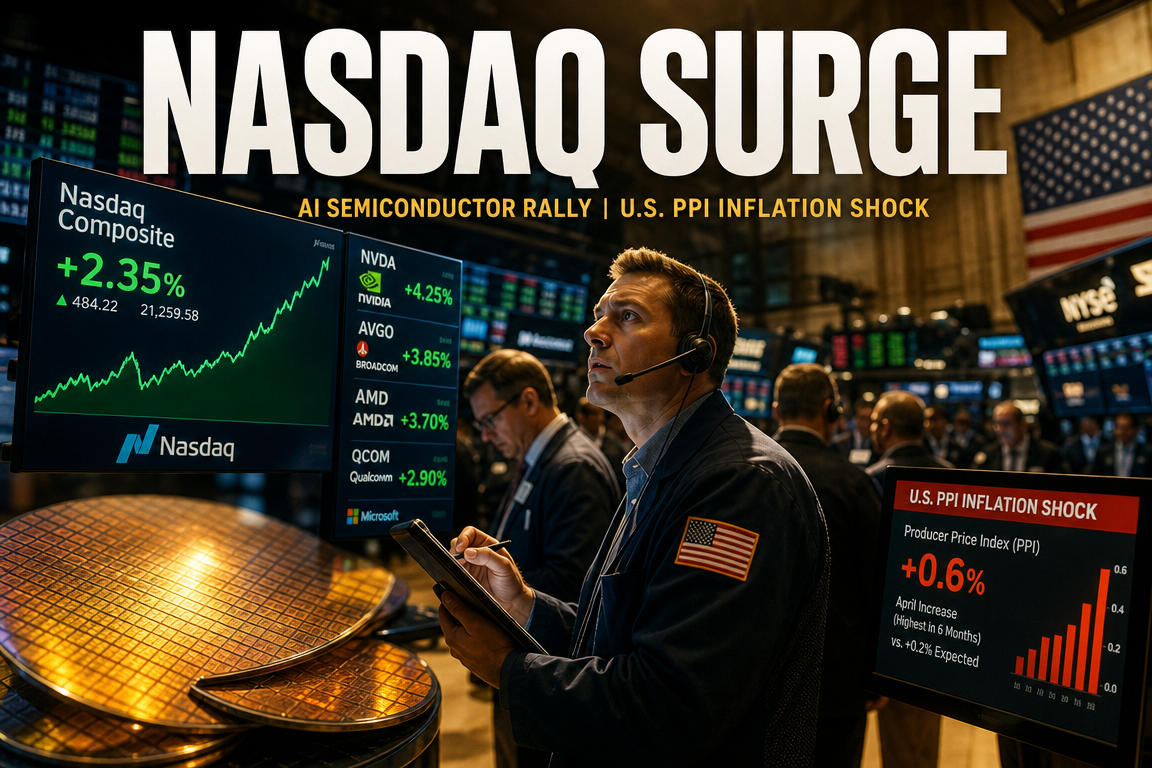
● Nasdaq Soars, Samsung, Hynix Rally, Trump Cancels Iran Strike, AI Chip Boom
Nasdaq Surge; Rising Probability of Concurrent Strength in Samsung Electronics and SK Hynix
Trump’s cancellation of a strike on Iran, semiconductor target-price upgrades, and the AI semiconductor rally—key takeaways
The market’s key variables can be summarized in three points:
First, the backdrop for a strong Nasdaq move includes a meaningful easing of geopolitical risk.
Second, U.S. AI semiconductor equities were already leading, and broad semiconductor-sector target-price upgrades have added incremental support.
Third, given Korea’s structurally high semiconductor index weighting, U.S. equity tailwinds can translate into index-level momentum led by Samsung Electronics and SK Hynix.
This report goes beyond a “why the market is up today” framing and outlines: (i) why U.S. and Korean equities can strengthen concurrently, (ii) how geopolitical events are transmitted into asset prices, and (iii) the core factors to monitor for semiconductor exposure.
1. Why the Nasdaq is strong today: reduced uncertainty, the market’s primary risk factor
Trump’s announcement canceling a strike on Iran is material for risk assets.
Equities do not respond solely to whether conflict occurs; they reprice most sharply to changes in uncertainty.
An elevated probability of military escalation involving Iran typically lifts crude oil, logistics costs, USD strength, demand for safe havens, and concerns about renewed inflation pressure.
A cancellation coupled with references to negotiations lowers the probability of worst-case scenarios, supporting risk appetite. This is a primary driver behind today’s improvement in sentiment.
1-1. Why easing geopolitical risk is particularly supportive for technology equities
Technology stocks, particularly large-cap Nasdaq constituents, are sensitive to rates and investor risk appetite.
Geopolitical stress can push oil higher, which feeds inflation expectations.
Higher inflation expectations weaken the outlook for Federal Reserve easing and pressure growth-stock valuations.
Conversely, easing geopolitical risk can reduce oil-spike risk and help stabilize market rates—conditions typically supportive for the Nasdaq and broader technology leadership.
Accordingly, this development should be viewed not as a standalone political headline, but as a factor that can reduce the equity risk premium.
2. Why semiconductors are outperforming: positive fundamentals reinforced by incremental catalysts
A key point is that the move is not explained by geopolitical risk alone.
U.S. AI semiconductor-related names had already been constructive.
Subsequent target-price upgrades across semiconductor coverage have further strengthened sector-level expectations.
Markets often react more forcefully when multiple catalysts align in the same direction; current conditions fit that pattern.
2-1. Structural reasons the AI semiconductor rally persists
AI semiconductors are increasingly treated as core infrastructure rather than a short-term theme.
Generative AI, cloud, data centers, on-device AI, autonomous driving, and robotics continue to expand demand for high-performance compute and memory.
In particular, HBM, advanced packaging, GPUs, and AI server supply chains are widely viewed as remaining in a demand-favorable regime.
As a result, U.S. strength in AI semiconductor equities tends to transmit directly into Korean equities via Samsung Electronics and SK Hynix, reflecting industrial linkages rather than flows alone.
2-2. Why target-price upgrades matter
Target-price increases are not merely headline changes; they typically reflect a combination of:
- upward earnings revisions
- improved demand expectations
- a more constructive industry-cycle assessment
- valuation re-rating assumptions
For semiconductors—an industry combining cyclical sensitivity with secular growth—such upgrades can materially influence positioning and risk appetite.
As investors shift from “valuation is stretched” toward “earnings estimates can move higher,” incremental buying interest can increase.
3. Why Korean equities can benefit disproportionately: index leverage to semiconductors
Korea’s equity market has an outsized semiconductor influence.
Samsung Electronics and SK Hynix represent a substantial share of the KOSPI, and their moves materially affect index performance.
Therefore, a combination of Nasdaq strength, U.S. semiconductor leadership, and easing geopolitical risk can drive a comparatively strong response in Korean equities.
In simplified terms: the U.S. market advances on technology leadership; Korea can respond more directly because its index is more concentrated in semiconductors.
3-1. Positive factors for Samsung Electronics
Samsung Electronics can reflect multiple supportive narratives: memory-cycle normalization, AI-driven demand growth, and optionality in foundry and advanced packaging.
Recent market behavior suggests a shift from treating the stock as a legacy IT large-cap toward a renewed AI-ecosystem valuation framing.
If U.S. semiconductor strength persists, Samsung Electronics may benefit from improved sentiment and positioning.
3-2. Positive factors for SK Hynix
SK Hynix is more explicitly positioned as a primary beneficiary of AI memory demand.
Given its HBM competitiveness and associated market premium, continued U.S. AI semiconductor momentum may translate into greater equity torque for SK Hynix.
Global investors are increasingly viewing memory not only as a cycle recovery trade, but as a leveraged exposure to AI infrastructure capex.
4. Key market points in a news-style format
4-1. U.S. equities
Trump’s cancellation of a strike on Iran and references to negotiations supported risk appetite.
Lower geopolitical tension reduces concerns around oil and inflation, which is generally positive for Nasdaq-led growth exposure.
At the same time, AI semiconductor equities maintained strength, and sector-wide target-price upgrades provided additional support.
4-2. Korean equities
Korean equities are positioned to be direct beneficiaries of the U.S. semiconductor rally.
Strength in Samsung Electronics and SK Hynix can improve broader KOSPI sentiment.
Foreign flows typically incorporate FX, U.S. equity direction, and semiconductor cycle expectations; the current mix is comparatively supportive.
4-3. Investor sentiment
Markets are simultaneously pricing (i) reduced conflict risk and (ii) sustained AI semiconductor optimism.
This is not only the removal of a downside tail risk, but also a reinforcement of existing positive drivers.
In this context, the dominant consideration is the larger macro/industry trend alignment rather than single headlines.
5. Core points often missed in mainstream coverage
The principal takeaway is not “markets rose because of a Trump headline.”
The key is that the market’s rationale is becoming more aligned in one direction.
5-1. Geopolitical easing + AI growth + earnings expectations are converging
Single-catalyst rallies often fade quickly.
Here, easing geopolitical risk, semiconductor target-price upgrades, and AI infrastructure investment expectations are pointing in the same direction.
This combination can be more durable than a standalone headline.
In equity markets, the removal of negative headlines can be as powerful as incremental positive news.
5-2. Korea has higher semiconductor leverage than the U.S.
U.S. semiconductor gains do not only benefit U.S. indices.
Korea can react more directly because index sensitivity to semiconductors is materially higher.
As AI semiconductor optimism builds, Korea’s market can exhibit higher beta to the same theme.
5-3. The key is trend persistence, not a one-day headline
Political events can drive short-term volatility; persistence must be validated.
Key confirmations include: tangible negotiation progress, sustained oil stability, confirmation that U.S. semiconductor strength is not solely short covering, and continued foreign buying into Korean semiconductors.
Today’s catalysts are constructive, but larger upside requires supportive follow-through in subsequent data and positioning.
6. Key indicators to monitor going forward
6-1. U.S. semiconductor indices and Nvidia leadership
AI semiconductor sentiment remains anchored by U.S. mega-cap semiconductor performance.
Sustained strength in core names, including Nvidia, is likely to support spillover sentiment toward Samsung Electronics and SK Hynix.
6-2. Crude oil and bond yields
For geopolitical easing to translate into broader market stability, oil and rates should remain contained.
A renewed spike in oil would be a headwind to technology leadership.
6-3. Foreign flows and USD/KRW
A durable Korean semiconductor rally typically requires foreign inflows.
If USD/KRW stabilizes and foreign investors continue net buying in Samsung Electronics and SK Hynix, KOSPI momentum can increase.
6-4. Semiconductor earnings revisions
Ultimately, price performance converges to earnings.
The key is whether AI demand translates into improved memory pricing, shipment volume, and profitability.
If sell-side earnings estimates continue to rise, the current move may extend beyond a short-term headline reaction into a medium-term trend.
7. One-sentence summary
The potential for a Nasdaq surge and concurrent strength in Korean equities reflects easing geopolitical risk following the cancellation of a strike on Iran, alongside reinforced semiconductor optimism driven by the AI semiconductor rally and target-price upgrades; Korea’s high index concentration in Samsung Electronics and SK Hynix can amplify the transmission.
< Summary >
- Nasdaq strength is supported by easing Iran-related geopolitical risk.
- AI semiconductor leadership and semiconductor target-price upgrades have reinforced the upside narrative.
- Korea’s market is positioned to benefit directly due to high index concentration in Samsung Electronics and SK Hynix.
- The critical check is follow-through: oil stability, sustained U.S. semiconductor strength, and continued foreign inflows.
[Related Articles…]
- Nasdaq Drivers: Rates, Risk Premium, and Tech Leadership
- Semiconductor Outlook: AI Supply Chain, Memory Pricing, and Earnings Revisions
*Source: [ 내일은 투자왕 – 김단테 ]
– 나스닥 떡상과 국장이 더블로 좋은 이유
● PPI Shock, Inflation Reignites, Fed Hints Hawkish, Markets Jolt
US May PPI Shock at 6.5%: The Key Market Risk Lies Elsewhere
The latest US May PPI release is more than a marginal beat versus consensus. It signals renewed inflation persistence and raises the probability that markets must reprice for a longer period of restrictive policy.
This report consolidates the implications of the 6.5% PPI increase, potential changes in the Federal Reserve’s rate path, US Treasury yield and USD dynamics, renewed upside pressure in oil driven by Middle East risk, and an underappreciated source of inflation: AI infrastructure investment.
This is not solely an inflation headline. It links to the next 2–3 months of CPI and PCE trends, interpretation of the FOMC dot plot, spillovers to the Bank of Korea’s policy constraints, and the risk of higher volatility across global equities.
In summary, the PPI acceleration is consistent with a “not yet over” inflation regime, increasing the likelihood of markets repricing renewed inflation risk and a less dovish policy outlook.
1. Key Takeaways from the US May PPI Release
US May Producer Price Index (PPI) rose 6.5% year-over-year.
This was above the market consensus of 6.4% and the highest reading since November 2022.
Core PPI printed 4.9%, unchanged from the prior revised figure.
While the beat is modest in magnitude (+0.1pp), inflation-sensitive positioning amplifies market impact. The recent trajectory indicates re-acceleration from the 3% range to 4%, then 5%, and now 6%.
2. Why PPI Matters: A Leading Signal for CPI
PPI reflects upstream cost pressures for firms, including raw materials, intermediate inputs, components, energy, and logistics.
If CPI represents end-consumer pricing, PPI is closer to wholesale prices and cost-of-goods pressures.
PPI increases typically transmit to CPI with a lag, often around 2–3 months.
If PPI remains firm across March, April, and May, it can add upward pressure to June–August CPI and PCE prints.
This increases the probability of repeated volatility around inflation releases: pre-release de-risking, post-release drawdowns on upside surprises, and short-lived rebounds on downside surprises.
3. US Inflation Dynamics: Supply-Side Pressures Are Increasingly Material
Current inflation appears less driven by demand overheating and more influenced by renewed supply-side constraints, which markets may be underweighting.
Key drivers include:
3-1. Middle East Risk and Rising Oil Prices
Geopolitical tensions can raise energy prices and transportation costs.
Higher oil prices transmit beyond gasoline into chemicals, plastics, logistics, aviation, shipping, and broad manufacturing cost structures.
This lifts producer-level inflation and can pass through to consumer prices.
3-2. Re-Intensifying Supply Chain Uncertainty
Global supply chains that stabilized post-pandemic show signs of renewed stress.
Delays in raw material procurement, component shortages, and higher ocean freight costs are typical drivers of higher PPI.
The current move appears consistent with a renewed supply-shock component rather than a purely statistical rebound.
3-3. AI Infrastructure Investment as a Near-Term Inflation Catalyst
This is an underappreciated factor. While AI may lift productivity over the long run, the current phase is predominantly infrastructure build-out.
In early adoption, large-scale investment and materials demand often precede measurable productivity gains, creating near-term cost-push inflation risk.
4. Why AI Can Raise Prices in the Near Term
AI diffusion generates substantial real-economy costs, particularly through:
4-1. Semiconductor Price Upside
AI servers and data centers require high-performance GPUs, HBM, DRAM, NAND, power semiconductors, and networking equipment.
A demand surge can lift semiconductor pricing.
Given semiconductors’ broad penetration across electronics and industrial equipment, higher chip prices can transmit into pricing pressure for PCs, servers, industrial machinery, automotive electronics, and consumer appliances.
4-2. Data Center Power Demand Surge
AI data centers are power-intensive.
This drives investment in generation capacity, transmission and distribution networks, transformers, and cooling systems.
It also increases demand for copper, aluminum, steel, power equipment, and cooling-related materials.
If power supply expansion lags demand, electricity pricing pressures may intensify.
4-3. Broad-Based Capex Expansion
AI is not solely a software theme.
It requires telecom networks, cloud infrastructure, data center construction, server racks, cooling systems, grid upgrades, and industrial automation equipment.
As a result, AI represents both a digital transformation and a physical investment cycle. In the early phase, it may be more inflationary than disinflationary.
5. The Market Message: Not Immediate Cuts, but Prolonged Restriction and Residual Hike Risk
The key implication is less about an immediate rate hike and more about increased justification for maintaining restrictive policy for longer.
The base case remains policy on hold. However, the statement language, press conference tone, and the dot plot may preserve optionality for additional tightening.
Markets typically respond more to forward guidance than to the current policy rate level.
5-1. Three FOMC Items to Monitor
First, changes in statement language and how hawkish the guidance becomes, rather than the hold decision itself.
Second, whether the dot plot shifts upward for the year-ahead rate path.
Third, whether the Chair frames inflation as transitory or emphasizes the potential need for additional restraint.
If the Fed treats renewed inflation as more material, equities may face valuation pressure while US Treasury yields reprice higher.
6. Expected Market Reaction: Prioritize Bonds and the USD Over Equities
In inflation-shock regimes, focusing only on equity indices can obscure the underlying transmission mechanism. US Treasury yields and the USD index are key indicators.
6-1. US 10-Year Treasury Yield
A higher-than-expected PPI increases the probability that the Fed cannot pivot dovishly.
Long-end yields may rise as a first-order response.
Higher 10-year yields pressure duration-sensitive assets, including technology, growth, and high-multiple equities. AI-linked equities may be particularly sensitive given their reliance on discount-rate assumptions.
6-2. USD Strength Risk
If inflation concerns rise and the duration of peak policy rates extends, the USD may strengthen.
A stronger USD can tighten financial conditions for emerging markets and is consistent with KRW depreciation risk, higher import prices, and increased volatility in Korean financial markets.
6-3. Higher Equity Volatility
Over the coming months, equity markets may repeatedly reprice around inflation releases.
If rate-cut expectations were partially embedded, the unwind could amplify downside volatility.
7. US Macro Outlook: Stagflation Risk Has Become More Difficult to Dismiss
Stagflation risk warrants closer monitoring.
If inflation re-accelerates while growth momentum softens and policy remains restrictive, pressures increase for corporates and households.
Supply-shock-driven inflation is particularly challenging for central banks. Unlike demand-driven inflation, it is less responsive to rate hikes when driven by energy, supply chains, commodities, geopolitics, and AI infrastructure-related costs.
This raises the probability of a “slower growth + renewed inflation pressure” configuration.
8. Implications for Korea and the Bank of Korea
A stronger US inflation backdrop complicates Korea’s policy environment due to sensitivity to FX, import prices, energy costs, external rate differentials, and exports.
8-1. KRW Depreciation and Import-Price Pressures
Sustained USD strength can pressure the KRW.
KRW weakness raises local-currency costs for crude oil, gas, commodities, and intermediate goods, adding to producer and consumer inflation pressure.
8-2. Increased Constraints on the Bank of Korea
If the Fed holds rates higher for longer, the Bank of Korea has less flexibility to ease.
Policy communication may become more hawkish to manage FX and inflation risks, even if domestic growth conditions argue for accommodation.
8-3. Are Exporters and Semiconductors Unambiguously Positive?
AI demand is supportive for Korea’s semiconductor cycle.
However, if semiconductor upturns contribute to broader inflation and rate pressures, index-level valuations can face headwinds.
Sector outperformance can coexist with macro-driven valuation compression.
9. The Under-Covered Core Point
Many summaries stop at “PPI beat expectations; the Fed could hike.” The more material issue is the nature of the inflation impulse.
9-1. This Is Not a Simple Overheating Cycle
The current inflation pressure is not primarily a classic demand-overheat regime.
It reflects a composite of geopolitics, supply-chain instability, energy pricing, and AI infrastructure build-out costs.
Such inflation can be more persistent and more difficult to address through policy alone.
9-2. AI May Be Disinflationary Long-Term but Inflationary Short-Term
Productivity gains may arrive later.
Before that, demand rises for semiconductors, power, data centers, networks, commodities, and capex—creating near-term inflation pressure.
This implies an early-stage regime with simultaneous “productivity optimism” and “inflation constraints.”
9-3. Markets May Trade More on Inflation and Rates Than on Earnings
In an AI-optimistic market, earnings can remain supportive, but discount rates may dominate performance.
If inflation re-accelerates, rate-cut expectations retreat and growth equity valuations can reprice quickly.
The distinction between “attractive industries” and an “attractive macro market” becomes more important.
10. Forward Calendar: Key Items to Watch
- FOMC decision and changes in statement language
- Dot plot revisions to the expected rate path
- Press conference tone from the Chair and key Fed officials
- Next CPI and PCE releases for confirmation of re-acceleration
- Direction of the US 10-year Treasury yield
- USD index and USD/KRW trajectory
- Oil prices and escalation/de-escalation of Middle East risk
- AI infrastructure indicators: semiconductor, power equipment, and commodity pricing
11. Investor Summary
This is not a “higher inflation print” in isolation.
A re-accelerating PPI increases the probability of renewed inflation concerns over the next several months, with potential spillovers into reduced rate-cut expectations, higher US Treasury yields, USD strength, and elevated equity volatility.
Even within AI beneficiaries, earnings momentum should be assessed alongside the sector’s impact on broader inflation and rate dynamics.
A more macro-driven regime is plausible, requiring integrated monitoring of inflation, central bank guidance, FX, yields, and energy.
12. One-Line Conclusion
US May PPI at 6.5% should be interpreted as a signal that “inflation re-acceleration -> prolonged peak rates -> higher market volatility” remains a credible pathway, with AI infrastructure investment emerging as an additional inflation-sensitive channel alongside geopolitical energy risks.
< Summary >
US May PPI rose 6.5%, above expectations and the highest since November 2022.
Given PPI’s leading properties, the next 2–3 months of CPI and PCE prints may face additional upward pressure.
The inflation impulse appears more supply-driven than demand-driven, shaped by supply-chain instability, Middle East tensions, oil prices, and AI infrastructure capex.
The Fed is more likely to hold than to hike immediately, but statement language, the dot plot, and press conference tone may skew more hawkish.
Markets should monitor the risk of higher Treasury yields, a stronger USD, and increased equity volatility.
AI may be disinflationary over the long run, but in the near term it can be inflationary via increased demand for semiconductors, power, and commodities.
Korea may face heightened FX and import-price pressures, and the Bank of Korea may face tighter policy constraints.
[Related Articles…]
- PPI and Inflation Re-Acceleration: Implications for Rates and Risk Assets
- AI Infrastructure Capex Cycle: Semiconductors, Power Demand, and Macro Spillovers
*Source: [ 경제 읽어주는 남자(김광석TV) ]
– [속보] 미국 5월 PPI 6.5% 상승…2022년 11월 이후 최고 인플레 쇼크 [즉시분석]