● Trump-Iran Deal, Oil Crash, Risk Assets Rally
Is Trump’s “Great Settlement” With Iran a Genuine Signal of War Termination?
Key Investor Takeaways: Crude Oil Sell-Off, Rebound in KOSPI and Bitcoin, and Implications for Inflation and Rates
This development is not merely diplomatic. It directly links to potential de-escalation in Middle East risk, further downside in global crude prices, the path of US Federal Reserve policy, and near-term risk-on performance in assets such as the KOSPI and Bitcoin.
This report focuses not only on “ceasefire optimism,” but also on (i) why Trump is pushing for an accelerated agreement now, (ii) why Iran is maintaining strategic ambiguity, and (iii) which market-relevant scenarios matter most. It also highlights an under-discussed point: the agreement may function as an interim political and market-stabilization framework rather than a fully implemented end-state settlement.
1. Key Headlines (Today)
Donald Trump stated on June 11 (local time) that negotiations related to the Iran conflict have entered a final-stage document coordination process.
He said he had just reached a “great settlement” with Iran and indicated a signing ceremony could be held in Europe as early as this weekend.
He added that he may not attend, but that Vice President JD Vance would.
Trump also said that the Strait of Hormuz would reopen immediately upon signing and that the US maritime blockade on Iran would be lifted.
He emphasized that Iran agreed it would never possess nuclear weapons.
Iran’s foreign ministry, however, said no final decision has been made.
In practice, the US is signaling “near agreement,” while Iran is maintaining an “unconfirmed” posture.
2. Why Markets Reacted Immediately
The remarks triggered a standard “reduced Middle East risk” repricing across global markets.
2-1. Global Crude Oil Decline
Crude is typically the first asset to reprice on Middle East escalation risk.
Because the Strait of Hormuz is a critical route for global oil flows, even incremental blockade concerns can lift prices sharply.
This time, references to potential reopening pressured WTI and Brent lower.
Markets interpreted this as a near-term reduction in the probability of severe supply disruption.
2-2. Expectations of Reduced Rate Pressure
Lower crude prices can ease energy-driven inflation pressure.
Inflation remains a dominant macro sensitivity in the US; sustained oil shocks can push the Fed toward a more hawkish stance.
Conversely, oil stabilization supports expectations of renewed disinflation.
2-3. Risk Asset Rebound (KOSPI, Bitcoin)
When war risk declines, markets often rotate from safe havens toward risk assets.
Equity indices such as the KOSPI and major crypto assets such as Bitcoin can respond positively via improved risk sentiment.
Accordingly, this is a macro-sensitive event with direct implications for financial conditions, not a standalone geopolitical headline.
3. Why It Is Premature to Treat This as a Definitive War-End Signal
The key issue is the gap between the strength of Trump’s messaging and Iran’s restrained response.
3-1. Strong Rhetoric, Potentially Incomplete Documentation
Trump described the memorandum of understanding (MOU) as “somewhat conceptual.”
This suggests a broad framework rather than a fully specified final settlement, leaving room for later disputes over interpretation and implementation.
3-2. Iran May Seek Additional Concessions Until the End
A rapid “yes” could reduce Iran’s bargaining leverage.
Iran may attempt to maximize outcomes on sanctions relief scope, maritime restrictions, and nuclear-language interpretation before final approval.
Strategic ambiguity is consistent with negotiation leverage rather than simple internal disorganization.
3-3. The Core Objective May Be “De-escalation First,” Not “Full Resolution”
Current signals are more consistent with halting escalation and stabilizing market conditions than resolving all core issues.
Sensitive items may be deferred: uranium disposition, verification mechanisms, snapback conditions, and triggers for renewed military action.
A “war-ending” label may overstate what is structurally an “immediate de-escalation plus follow-on negotiation” framework.
4. Why Trump Appears to Be Pivoting Abruptly
For markets, the motivation matters as much as the headline.
4-1. Limited Capacity to Absorb Additional Inflation Pressure
US inflation dynamics have re-entered a sensitive range.
Rising PPI can transmit into CPI with a lag.
If Middle East tension lifts crude further, the probability of inflation re-acceleration increases.
Prolonged tension therefore raises economic and market costs for the US administration.
4-2. Incentive to Influence the Rate Narrative
Oil shocks and supply disruptions reduce the Fed’s flexibility to ease.
Even expectations of delayed cuts can pressure equities via higher discount rates.
De-escalation allows policymakers and markets to frame energy-driven inflation as more transient.
While the White House cannot directly set Fed policy, it can influence the external conditions that shape rate expectations.
4-3. Political Costs of Prolonged Conflict
War can deliver short-term “strength” optics, but prolonged conflict typically elevates inflation visibility and domestic fatigue.
At moments when major diplomatic events and domestic approval management are critical, extended Middle East instability can be politically and operationally costly.
This pivot is therefore consistent with minimizing economic and political downside rather than pursuing extended military outcomes.
5. Most Important Macro Linkages (Market Transmission)
This story should be monitored through the following chain:
5-1. Reduced Middle East Tension -> Oil Price Stabilization
The first-order effect is the removal of “Hormuz disruption premium.”
5-2. Oil Stabilization -> Inflation Expectations Ease
Energy prices affect logistics, input costs, and medium-term inflation psychology.
5-3. Easing Inflation Expectations -> Reduced Rate Pressure
Even without an immediate dovish pivot, markets can price less tightening risk.
This can lower US Treasury yields, ease USD strength pressure, and reduce valuation headwinds for growth assets.
5-4. Reduced Rate Pressure -> Improved Risk Appetite (Equities, Crypto)
Risk assets typically benefit from the combined mix of reduced war risk, stable oil, and less restrictive rate expectations.
This supports co-movement potential across the KOSPI, Nasdaq-sensitive assets, and Bitcoin.
6. Key Items for Korea-Based Investors
6-1. KOSPI Is Generally Supported by Lower Oil
Korea is highly dependent on energy imports; oil stability is broadly constructive.
Lower input costs can support trade balance dynamics and corporate margins.
Sectors with notable sensitivity include airlines, chemicals, transport/logistics, and parts of manufacturing.
6-2. Risk of a “False Relief Rally” Remains
If issues are not fully resolved, markets can rise first and reprice lower later.
A weekend shift in Iran’s tone, signing delays, or disputes over nuclear wording could increase Monday volatility.
6-3. Monitor FX Alongside Risk Sentiment
Reduced geopolitical risk can moderate USD strength and support KRW stability.
A more stable KRW can improve foreign flows, with secondary effects on KOSPI momentum.
7. Scenario Framework
7-1. Bull Case: Confirmation of Progress by Weekend or Early Next Week
Markets may further price “war-end” expectations.
Crude may extend declines or remain stable; risk-on behavior in global equities may persist.
Bitcoin may continue to benefit from improved liquidity expectations and risk sentiment.
7-2. Base/Neutral Case: Signing Delayed, Negotiations Continue
Markets may partially retrace the initial move while avoiding a full risk-off reversal.
Price action may shift toward higher volatility within a range.
7-3. Bear Case: Effective Rejection by Iran or Renewed Military Tension
Crude could rebound sharply, reintroducing inflation risk.
Rate expectations would likely shift more restrictive, pressuring risk assets.
KOSPI and Bitcoin would face higher short-term drawdown risk.
8. Under-Discussed Point With High Market Relevance
The key variable is not only whether an agreement is reached.
The agreement may function as a political and market-stabilization device for Trump rather than a comprehensive peace framework.
Markets are currently trading “war termination,” but the operational substance may be “halt escalation and restore inflation/rate stability expectations.”
More important than the ceremony: whether the Strait of Hormuz remains reliably open, whether oil export normalization and sanctions relief are implemented, and how specific nuclear verification language becomes.
9. One-Line Investment Framing
Markets are buying “war-end expectations” now, but will increasingly price “implementation credibility” next; supportive near-term risk sentiment is possible, but weak details would keep volatility elevated.
10. Investor Checklist (Blog-to-Report Format)
1) Do not treat Trump’s remarks as confirmation.
2) Iran’s final approval remains the primary swing factor.
3) Markets are currently more sensitive to crude and inflation trajectory than to diplomatic optics.
4) KOSPI and Bitcoin can extend rebounds, but weekend headline risk can trigger fast retracements.
5) Base case should assume an interim stabilization framework rather than a fully specified end-state settlement.
< Summary >
Trump said an Iran-related agreement is in final coordination and markets interpreted it as rising probability of de-escalation.
Crude fell and risk assets such as the KOSPI and Bitcoin reflected improved sentiment.
Iran has not confirmed final approval, and the document may be closer to a conceptual MOU than a fully specified peace settlement.
The primary macro question is whether reduced Middle East risk can stabilize crude, ease inflation expectations, and reduce rate pressure.
If progress is confirmed over the weekend, markets may extend risk-on positioning; if expectations break, volatility is likely to rise.
[Related Articles…]
- Oil Volatility: Key Transmission to Korea’s Equities and Inflation
- Bitcoin and Interest Rates: What Investors Need to Monitor
*Source: [ 경제 읽어주는 남자(김광석TV) ]
– [속보] “이란과 방금 훌륭한 합의”…이란 “최종결정 안내려” [즉시분석]
● Alphabet,AI Powerhouse,Not Search,15Trillion Bet
Berkshire’s KRW 15 Trillion Bet on Alphabet: Why the Market Should Reframe It from a “Search Company” to an “AI Infrastructure Conglomerate”
Viewing Alphabet only as a Google Search company risks missing the core investment thesis.
This report summarizes Alphabet’s revenue structure; how AI Overviews may reshape the advertising model; the embedded value of YouTube, Cloud, Waymo, and DeepMind; realistic implications of US antitrust litigation; and why Berkshire Hathaway increased exposure at this stage.
A central issue is the transition from a “click-driven advertising economy” to an “answer-driven advertising economy,” and the implications for equity markets and the global macro cycle.
1. One-line summary: Alphabet is no longer a search company; it is a bundled digital infrastructure platform for the AI era
The investment case is not the persistence of ~90% search share by itself.
The core point is the integrated ecosystem spanning Search, YouTube, Cloud, autonomous driving, and AI R&D.
Alphabet functions simultaneously as an advertising company, a cloud platform, and an AI infrastructure operator.
This structure is relatively uncommon in US listed markets: multiple scalable assets are housed inside a single equity rather than being separately listed and independently valued.
2. Key recent issue: Why Alphabet’s planned USD 80 billion capital raise matters
In early June 2026, Alphabet indicated it would raise USD 80 billion via equity issuance to fund AI infrastructure investment.
This is not a routine financing headline; it is a strategic signal to the market.
2-1. The numbers clarify the point
- 2025 operating cash flow: USD 164.7 billion
- 2026 capex guidance: up to ~USD 190 billion
Capital spending is projected to exceed internally generated operating cash flow.
2-2. Implications
1) AI competition is more capital-intensive than many investors expected.
2) The competitive frontier is shifting from software alone to physical infrastructure: data centers, custom silicon, power, and network capacity.
3) Alphabet is signaling intent to remain a top-tier spender in this cycle.
This matters for macro positioning: AI-driven capex expansion can propagate across semiconductors, power equipment, cooling systems, cloud servers, optical networking, and grid investment. Alphabet’s capex posture functions as a reference point for the broader AI investment cycle.
3. Alphabet’s underlying structure: effectively five businesses under one ticker
3-1. Google Search: still the core cash-generation engine
- 2025 Search revenue: USD 224.5 billion (~56% of total revenue)
- Search market share: ~90%
Search remains the primary cash engine supporting AI-related reinvestment.
3-2. YouTube: a scaled media asset embedded within Alphabet
- 2025 YouTube advertising + subscription revenue: ~USD 60 billion
- Subscribers: ~325 million
If valued as a stand-alone entity, market perception and implied multiples could differ materially. Relative comparisons often reference Netflix (revenue ~USD 43 billion with sustained valuation premium). YouTube’s value may be under-reflected due to conglomerate structure.
Key valuation sensitivity: whether the market prices YouTube as a pure advertising platform or as media infrastructure combining ads, subscriptions, creator monetization, and AI-driven discovery.
3-3. Google Cloud: a likely underappreciated growth driver
- Annual revenue run-rate referenced: ~USD 70 billion
- 2026 Q1 growth rate cited: 63%
In the AI era, cloud is not simply compute rental; it is an integrated platform for model training, enterprise data processing, inference, security, and developer tooling. If Search cash flows scale Cloud capacity and Cloud becomes a primary channel for AI demand, valuation framing may shift toward an AI infrastructure platform multiple.
3-4. Waymo: option value not fully reflected in the consolidated price
Waymo’s February 2026 funding round reportedly implied a USD 126 billion valuation, suggesting the market increasingly treats it as more than an experimental program.
Two drivers:
- Accumulating real-world operational data and deployment experience
- Long-run platform optionality across mobility, logistics, and robotaxi ecosystems
Key constraints remain regulation, unit economics, and geographic scaling; however, the implied valuation is large enough that continued market discounting may be less sustainable.
3-5. DeepMind: less about near-term earnings, more about technological control
DeepMind may not be a near-term earnings lever, but it is central to Alphabet’s strategic positioning. Breakthroughs such as protein structure prediction illustrate the potential for AI to reshape science-driven industries.
This extends Alphabet’s addressable domain beyond consumer AI into industrial and scientific AI, with potential long-term linkages to drug discovery, materials science, and healthcare platforms.
4. The core battleground: AI is disrupting search, but Google is reasserting control over the transition
A common concern is whether generative AI erodes Google’s search advertising model. The premise is structurally valid: AI changes search behavior.
4-1. Click-through is structurally pressured
Historically: search -> link -> website visit. Google’s advertising model monetized this click flow.
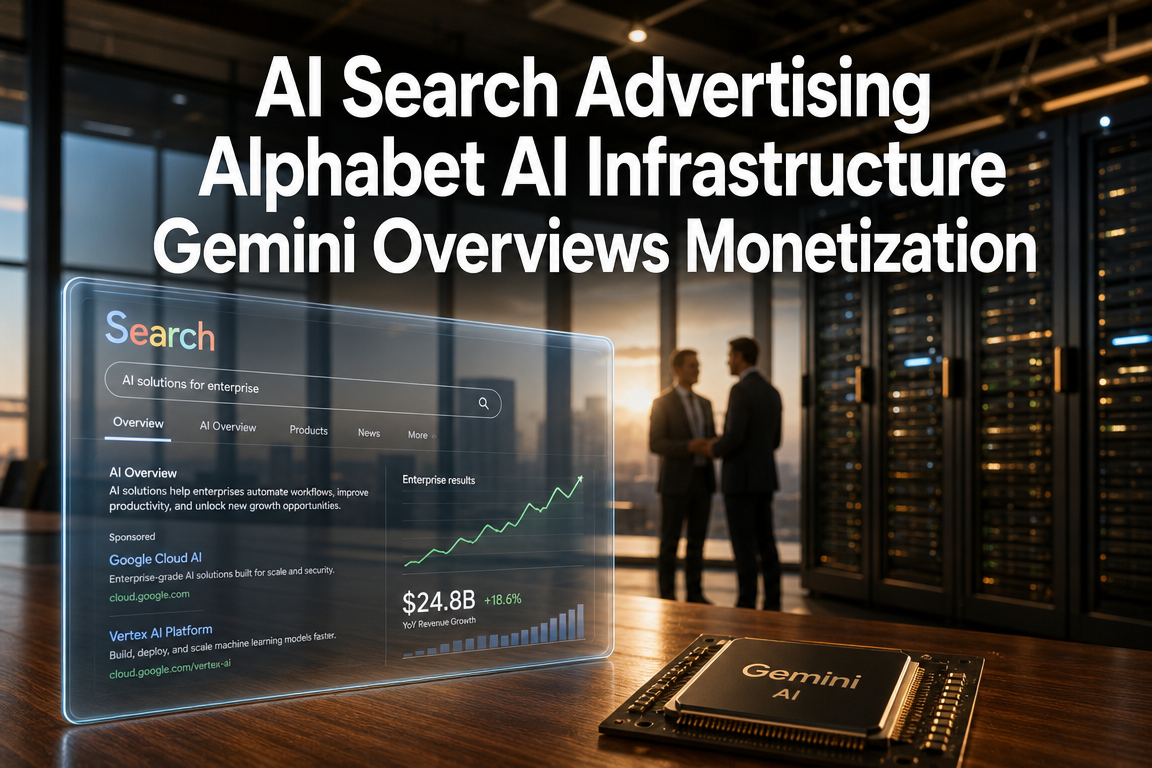
With AI Overviews, users may receive answers without clicking through. If AI Overviews materially reduce click-through rates, legacy search advertising dynamics face direct pressure.
4-2. The inflection: Gemini is embedded inside the dominant distribution surface
The competitive issue is less about standalone app usage and more about distribution scale. When AI is integrated into the default search workflow, switching costs for users remain low and engagement can be captured without requiring separate products.
4-3. Alphabet’s strategic pivot: from “click-based ads” to “answer-based ads”
Alphabet is attempting to migrate monetization from link-ad adjacency to advertising integrated within or around AI-generated answers.
If successful, Alphabet’s position could strengthen because few competitors combine:
- search traffic at scale
- advertiser network depth
- user data signals
- frontier AI models
- hyperscale cloud infrastructure
If unsuccessful, the core profit pool of digital advertising could be structurally impaired.
Accordingly, the critical variable is not only model quality, but whether Alphabet can sustain or expand monetization within AI answer surfaces.
5. Why Berkshire Hathaway increased exposure now
Berkshire’s additional investment is a signal event.
5-1. Not a pure “tech growth” bet; a cash-flow-validated platform
Alphabet remains a large operating cash flow generator funding internal reinvestment. The thesis aligns with a “current earnings plus reinvestment optionality” framework rather than narrative-only growth.
5-2. Multiple business lines under one entity
Search/ads, YouTube, Cloud, Waymo, and DeepMind provide diversification within a single platform. Weakness in one segment may be partially offset by strength in another.
5-3. A late entry framed as a higher-conviction platform choice
The purchase can be interpreted as selecting a platform perceived to have higher survival probability through the AI transition, rather than momentum-chasing. It also indicates broader mandate flexibility beyond traditional sectors.
6. Two realistic risks: often underweighted, but not negligible
6-1. US search antitrust litigation
US courts have questioned certain practices supporting search dominance. Market consensus often assumes limited direct earnings impact due to entrenched user preference and product strength, even if default distribution agreements change.
Headline risk is high; near-term operational impact may be more contained, but remains case-dependent.
6-2. US ad-tech antitrust litigation
This is more directly tied to Alphabet’s monetization stack. If regulators impose structural remedies affecting the integrated ad-tech value chain (execution, measurement, and marketplace), margin profile and pricing power could change. Equity sensitivity is likely higher than for search remedies.
7. Valuation framing: why “embedded value” remains a recurring theme
A forward P/E around ~26x may not appear “cheap” on a pure search-company basis, but may look less demanding when considering the portfolio of scalable assets.
Key questions embedded in current valuation:
- What would YouTube be worth as a stand-alone public company?
- Would Google Cloud receive a higher premium if independently listed?
- Would Waymo be re-rated as a mobility growth platform if separated?
If multiple answers are directionally positive, conglomerate discount dynamics may be present. The counterpoint is that the market may still be anchoring too heavily on search advertising.
8. Three investor checkpoints
8-1. Can AI Overviews sustain advertising revenue despite fewer clicks?
Primary KPI: whether ad revenue holds or grows even as click-through declines. Successful monetization migration would reduce the market’s core concern.
8-2. Severity of remedies in the US DOJ ad-tech case
Key distinction: fines and behavioral constraints versus structural separation or forced divestitures. Strong remedies would likely expand valuation discounts.
8-3. Durability of Google Cloud’s high growth rate
Sustained cloud outperformance would support the narrative of Alphabet transitioning from a search-centric model toward AI infrastructure exposure, potentially shifting the valuation framework.
9. Macro perspective: why Alphabet matters beyond a single equity
Alphabet’s investment cycle is a proxy for broader capital allocation and industrial restructuring.
9-1. AI is increasingly a capex cycle, not only a software cycle
AI leadership requires GPUs/accelerators, data centers, power delivery, cooling, and high-bandwidth networking. This links Alphabet’s strategy to a wider industrial supply chain.
9-2. Structural changes in digital advertising reshape the platform economy
Answer-driven search can alter web traffic patterns, publisher economics, and e-commerce acquisition flows. Google’s product experiments function as an ecosystem-level stress test for the internet business model.
9-3. Productivity upside and regulatory risk rise in parallel
AI can expand productivity, but may amplify market power concerns. Regulatory execution becomes a material determinant of risk-adjusted returns for large platforms.
10. News-style recap: the current Alphabet issue in brief
10-1. What happened
Alphabet moved to raise USD 80 billion to expand AI infrastructure.
10-2. Why it matters
Capex plans exceeding operating cash flow signal that AI competition has entered a capital-intensive phase.
10-3. What the market is focused on
Whether the search advertising model remains durable in an AI-first user experience.
10-4. Upside drivers
Potential re-rating of embedded assets: YouTube, Cloud, Waymo, and DeepMind.
10-5. Downside risks
US antitrust outcomes, particularly ad-tech remedies.
11. The most critical point often missed in short-form coverage
Many commentaries stop at: “Berkshire bought,” “Alphabet is undervalued,” or “AI threatens search.”
The key issue is the next step.
11-1. The core transition is not only model competition; it is a redesign of the internet monetization model
A relevant investment question is not merely whether Gemini outperforms competing models.
The central question is:Can Google monetize the answer surface even as links lose prominence?
If the answer is affirmative, Alphabet is not disrupted by AI; it consolidates industry control through AI-driven format change.
11-2. Alphabet’s competitive set is broader than any single AI lab
Competition increasingly includes new user behaviors and new distribution patterns: how people obtain answers, how ads are consumed, how content is routed, and how enterprises acquire customers. Alphabet sits in a position that can be both exposed to disruption and positioned to capture the transition.
12. Bottom line: how to frame Alphabet now
Alphabet presents simultaneous opportunity and risk in the near term, driven by two parallel transitions:
- regulatory pressure
- advertising format migration under AI-driven search
Over the medium to long term, Alphabet holds a rare breadth of AI-era infrastructure assets: search and advertising distribution, hyperscale cloud, autonomous driving optionality, and frontier AI research capability.
The valuation question is whether the market continues to price Alphabet primarily as “legacy Google,” while strategic buyers treat it as a durable AI platform with multiple embedded growth assets.
< Summary >
- Alphabet should be analyzed as an AI infrastructure conglomerate bundling Search, YouTube, Cloud, Waymo, and DeepMind.
- The USD 80 billion capital raise indicates AI competition is entering a capex-intensive phase.
- The key variable is whether advertising monetization can succeed within AI Overview answer experiences.
- Upside stems from potential re-rating of YouTube, Cloud, and Waymo embedded value.
- The principal risk is US ad-tech antitrust remedies.
- Berkshire’s sizable purchase can be interpreted as viewing Alphabet less as a “search company” and more as a long-duration AI platform.
[Related Articles…]
- Alphabet: AI Infrastructure Capex and Platform Monetization
- Gemini: Answer-Led Search and the New Advertising Stack
*Source: [ Maeil Business Newspaper ]
– “검색회사 아니다” 버크셔가 15조원 투입한 구글 진짜 정체 | 매일뉴욕 스페셜 | 홍성용 특파원