● AI-Infra Boom, Wall Street’s New Winners
Large-Scale Investment Wave Driven by Samsung Electronics and SK hynix Gains Momentum: A Comprehensive Review of AI Infrastructure Beneficiaries Now Drawing Fresh Attention on Wall Street
This move is not a simple technical rebound.
To identify the market’s core driver, investors should assess the expected memory capacity expansion led by Samsung Electronics and SK hynix, the mega-scale fundraising by big tech (Oracle, Amazon, Google), and the downstream allocation of that capital.
This report goes beyond widely discussed memory and CPU beneficiaries to consolidate, in a news-style format, why Wall Street is increasingly treating semiconductor equipment as a new key pillar, why the AI infrastructure cycle could last longer than consensus expectations, and which U.S.-listed names and ETFs warrant monitoring.
A critical under-discussed point is also addressed: big tech is increasingly functioning as a liquidity provider, at times more influential than central banks, via accelerated capex and external financing.
1. Weekly market focus: Volatility remained elevated, but AI infrastructure again led index performance
Equities fluctuated materially during the week, yet ended with a strong rebound.
The key observation is that AI infrastructure-related equities remained the principal driver of the rebound.
The Nasdaq and semiconductors outperformed, with buying expanding across the AI ecosystem: memory, CPUs, data centers, networking, and equipment.
This suggests the AI infrastructure complex continues to act as both a volatility source and the primary leadership group during rebounds, supported by capital deployment and earnings expectations rather than headline-driven trading alone.
2. A stronger force than macro: The market is prioritizing AI capex scale over rates
Recent macro narratives have centered on stabilizing oil prices, easing geopolitical risk, recurring rate concerns, and the growth debate.
Despite this, flows and leadership have been consistently concentrated in AI infrastructure.
This indicates that realized and planned corporate investment is exerting greater influence on prices than traditional macro variables.
The current regime resembles a period where big tech capex and financing activity acts as a practical liquidity engine, rather than interest rates being the sole determinant.
3. The Oracle “shock”: Negative for the stock near term, but a major positive signal for AI infrastructure demand
A key event was Oracle’s earnings release.
While the stock sold off sharply post-results, the underlying content was constructive for AI infrastructure.
3-1. Oracle’s AI investment plans materially exceeded expectations
The market had expected Oracle’s AI investment this year at approximately $60bn; commentary suggested it could exceed $90bn.
This implies potential AI infrastructure spending more than 50% above prior expectations.
For Oracle shareholders, such spending can pressure near-term cash flow and margins.
From a supply-chain perspective, the scale implies more aggressive-than-expected data center demand and infrastructure competition.
3-2. Use of external financing and equity issuance indicates the investment race is accelerating
Oracle indicated it would not rely solely on internal cash generation and would use external funding.
This includes share issuance (equity financing).
While dilution can be a near-term negative for the issuer, it reinforces that AI infrastructure investment is sufficiently large to require incremental funding beyond operating cash flow.
This capital ultimately flows into servers, memory, CPUs, GPUs, networking, cooling, power, semiconductor equipment, and foundry capacity.
Accordingly, Oracle’s stock reaction can diverge from implications for the broader AI hardware and infrastructure value chain.
4. Expansion to Google, Amazon, and Meta: Big tech financing competition can extend the AI capex cycle
This dynamic is not limited to Oracle.
Google has also drawn attention around large-scale funding, and Amazon has exhibited aggressive financing activity including bond issuance and lending. Meta is frequently cited as a likely follower.
The strategic driver is competition to secure AI infrastructure capacity faster and at greater scale.
Where prior equity upcycles were often driven by central-bank liquidity, the current cycle increasingly reflects big tech capex as a primary liquidity source.
4-1. Funding volumes in 1H already exceed the prior two years combined in some interpretations
Wall Street analysis suggests aggregate big tech bond issuance and financing in the first half of the year may already exceed the combined total of the prior two years.
Given this is only the first half, the pace is notable.
The implication is that AI capex could persist “longer and larger” than baseline expectations.
5. Primary beneficiaries to date: Memory and CPUs
Market leadership has been clear.
First: memory.
Samsung Electronics, SK hynix, Micron, and SanDisk have been cited as core beneficiaries of data center expansion, supported by surging demand for high-performance memory including HBM and consequent earnings and valuation re-rating.
Second: CPUs and compute semiconductors.
Intel, AMD, and ARM have been positioned as beneficiaries of expanding compute demand and the evolution toward AI-agent use cases.
To date, big tech capex has primarily been absorbed by memory and compute.
6. New focus on Wall Street: A semiconductor equipment supercycle thesis
A newly emphasized theme is semiconductor equipment.
Multiple global institutions published constructive equipment outlooks, with some framing the current setup as the start of a “once-in-decades” supercycle.
6-1. Why equipment is receiving attention now
The sequencing framework is straightforward:
1) Big tech builds AI data centers, lifting demand for memory and compute semiconductors.
2) Memory producers (Samsung Electronics, SK hynix, Micron) gain confidence demand is not transient.
3) Producers expand capacity via fab buildouts and equipment purchases.
Capital may therefore be flowing from big tech to memory producers and then to equipment suppliers.
6-2. Core support: Order visibility is extending
A major reason for the shift is that customer demand visibility is reportedly longer than in past cycles.
Equipment suppliers typically receive demand guidance spanning several months to roughly a year.
Current channel checks suggest visibility extending toward approximately two years, improving revenue line-of-sight and increasing the probability of a structurally longer expansion cycle.
6-3. Why “next year may be stronger than this year” matters
For growth assets, the key issue is not only direction but whether growth is accelerating or decelerating.
While high growth is expected this year, some forecasts argue growth could accelerate next year, which can prompt rotation from already re-rated memory names toward equipment names with perceived remaining upside.
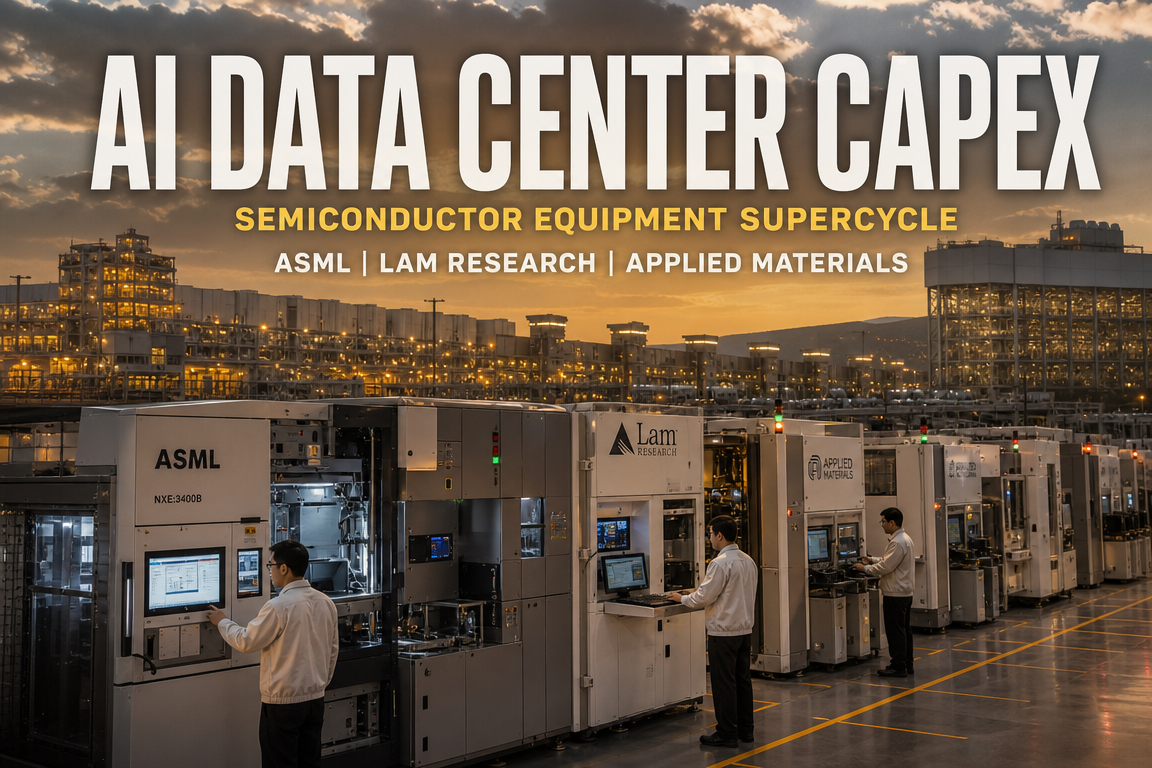
7. Key semiconductor equipment beneficiaries: ASML, Lam Research, Applied Materials, KLA
The core global equipment names are:
- ASML
- Lam Research
- Applied Materials
- KLA
These companies lead critical process steps including lithography, etch, deposition, and inspection/metrology.
A key feature is the industry’s high barriers to entry and oligopolistic structure, which can concentrate incremental demand among incumbents.
7-1. Why ASML is viewed as particularly strategic
ASML holds a dominant position in advanced lithography.
Leading-edge producers including Samsung Electronics, TSMC, SK hynix, and Micron must secure ASML tools to maintain competitiveness.
As AI semiconductor competition intensifies, ASML’s strategic relevance increases.
8. Additional signal from Musk and SpaceX: Interpreted more as AI data center demand than a pure space theme
SpaceX-related expectations are also notable.
While superficially a space-industry narrative, market interpretation increasingly links it to AI infrastructure and data center demand.
The rationale is that Musk repeatedly emphasizes large-scale compute capacity, AI chip scarcity, and the importance of securing semiconductor equipment.
8-1. Why Musk repeatedly references ASML
Musk has repeatedly highlighted semiconductor equipment, particularly ASML.
Large-scale AI compute infrastructure and longer-horizon concepts such as space-based data centers would require leading-edge semiconductor production capacity.
These comments are increasingly interpreted as signals that AI infrastructure competition is extending into equipment procurement.
8-2. SpaceX fundraising is also framed through an AI compute lens
In aggregate, investor sensitivity appears more tied to incremental AI compute demand and data center buildout than to launch activity alone.
This supports a constructive read-through for semiconductors, memory, equipment, power, and networking.
9. Intel re-rating framework: Foundry “backup” demand in addition to CPUs
Intel is being reconsidered.
Beyond CPU competitiveness and AI positioning, increased focus is placed on foundry diversification.
As demand concentrates at TSMC, large customers such as Google and Nvidia may consider alternative capacity to diversify supply chains, which could raise the strategic value of secondary and tertiary suppliers.
This is not solely an Intel-specific issue; it reflects broader supply tightness in AI semiconductors.
10. G7 summit watch items: AI has become a national-level agenda
A key upcoming event is the G7 summit.
A primary focus is the participation of major AI leaders.
Participation by leaders from OpenAI, Google DeepMind, Anthropic, and Meta would underscore AI as a national-level agenda spanning security, supply chains, productivity, regulation, and technology leadership.
From a market perspective, investors should monitor potential announcements related to international coordination, AI infrastructure investment, and energy/semiconductor supply-chain initiatives.
11. More important than FOMC and Japan rates: No clear deceleration signal in AI capex yet
Next week includes traditional drivers such as the FOMC, Japan’s rate decision, options expiration, and holiday effects, which can elevate near-term volatility.
However, the core trend is increasingly linked to big tech capex rather than central-bank messaging.
Even if Europe and Japan lean more restrictive or the Federal Reserve remains hawkish, sustained AI investment could keep earnings expectations across the value chain resilient.
Macro shocks may trigger pullbacks without necessarily ending the AI infrastructure cycle.
12. ETFs provide a clearer lens: Capital is spreading across the AI semiconductor ecosystem
For investors who prefer diversified exposure, ETF behavior can be informative.
SOX-linked semiconductor ETFs typically include memory, CPUs, GPUs, foundries, and equipment, offering broad coverage of the cycle’s beneficiaries.
The current advance is increasingly interpreted as an ecosystem-wide expansion from memory to equipment to foundries to networking and data centers, rather than a single-stock phenomenon.
13. News-style key takeaways
- Oracle announced AI investment plans materially above expectations.
- Google, Amazon, and Meta are moving into more aggressive financing competition.
- Big tech capital initially flowed to memory producers and may now extend to equipment suppliers.
- Wall Street is increasingly positioning semiconductor equipment as a supercycle candidate.
- ASML, Lam Research, Applied Materials, and KLA are being highlighted as primary beneficiaries.
- Intel may be re-rated on foundry diversification demand in addition to CPUs.
- The G7 summit may elevate AI-related coordination and infrastructure initiatives.
- AI capex momentum, more than rates and macro, remains central to the current market narrative.
14. Key under-discussed point: Big tech as a liquidity provider
The central issue is less “which stock rises” and more “why the cycle may be longer than expected.”
The core thesis:
Market liquidity is no longer driven only by central banks; big tech is increasingly a liquidity provider through capex and external financing.
Historically, rate cuts, quantitative easing, and fiscal stimulus were primary fuels for growth rallies.
In the current cycle, companies such as Oracle, Google, Amazon, and Meta are deploying internal cash and raising funds via bonds, loans, and equity issuance to accelerate AI infrastructure investment.
From a system-level perspective, this functions as a new channel of liquidity injection.
Key leading indicators may therefore include big tech capex guidance, bond issuance, equity financing, long-term supply agreements, and equipment order growth, potentially more than individual CPI prints or single FOMC statements.
15. Investment monitoring priorities
An efficient monitoring sequence:
- Whether big tech continues to raise AI capex guidance
- Whether the top memory producers sustain capacity expansion plans
- Whether equipment orders convert into reported results
- Whether foundry “backup” demand expands toward alternatives such as Intel
- Whether G7/FOMC and related events materially disrupt these trends
At present, items 1–3 remain comparatively robust, supporting continued attention to AI infrastructure-driven industrial realignment.
16. Conclusion: The market is pricing AI investment diffusion more than AI investment contraction
The current regime is better assessed through capital flow mapping than through the “AI bubble” debate.
Observed dynamics are:
Big tech is increasing, not reducing, investment pace; memory producers are reinforcing expansion expectations; and Wall Street is shifting attention toward equipment as the next beneficiary group.
The cycle is increasingly framed as a broad semiconductor ecosystem expansion spanning memory, CPUs, foundries, equipment, and data centers.
This is likely to remain a key axis for U.S. equities and AI-related exposure.
< Summary >
As big tech expands AI infrastructure investment using bonds, loans, and equity issuance, market liquidity is increasingly diffusing from memory and data centers into semiconductor equipment.
Oracle’s outsized investment plan pressured its stock near term but signaled a potentially longer AI capex cycle, supportive for the broader hardware value chain.
Following the memory beneficiaries (Samsung Electronics, SK hynix, Micron), equipment names such as ASML, Lam Research, Applied Materials, and KLA are increasingly positioned as potential next-phase leaders.
The principal variable is the persistence of big tech capex expansion rather than rates or macro alone.
[Related Articles…]
- AI Infrastructure: Key Beneficiaries Across Data Centers, Networking, and Semiconductors
- Semiconductor Equipment: Supercycle Signals and Order Visibility Indicators
*Source: [ 소수몽키 ]
– 삼전닉스발 대규모 투자 시작, 월가에서 새롭게 주목 받는 수혜주들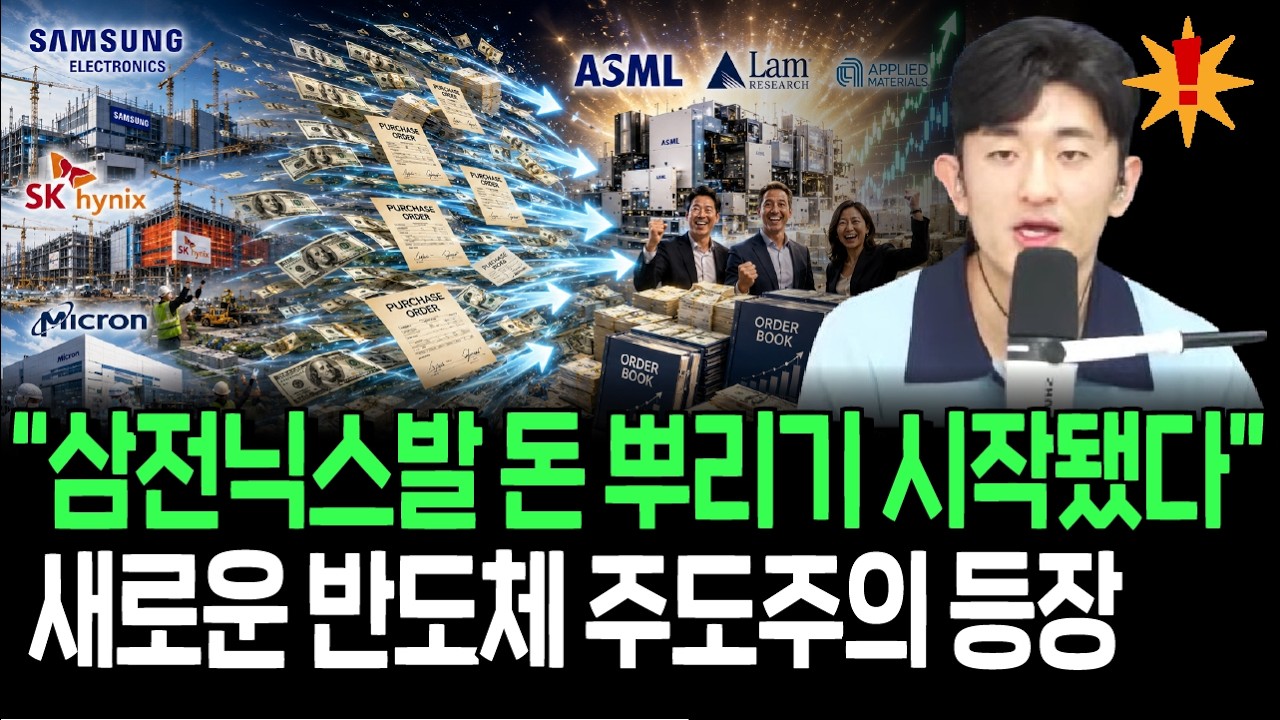
● Trump-iran-Deal-Spurs-AI-Rally-Goldilocks-Bullishness
The Real Reason Trump Moved Quickly on an Iran Deal: Not Merely De-Risking the Middle East
The strategic implications extend beyond a bilateral agreement, a pullback in crude oil, and a rebound in US equities. The narrative links Federal Reserve leadership transition, the rates path, inflation interpretation, and the AI-led equity rally.
This report focuses on (i) why the deal was pushed at this timing, (ii) why markets re-accelerated into semiconductors and AI, and (iii) why the upcoming FOMC may set market direction over the next six weeks. It also highlights the under-discussed risk of a shift in Fed communications under a Chair Wash framework and potential valuation effects.
1. Market Reaction: Valuation Pressure Eased More Than Geopolitical Risk
Following headlines suggesting a US–Iran understanding, risk assets responded rapidly. The immediate leadership came from AI and semiconductor bellwethers, indicating a re-focus on earnings momentum rather than a simple geopolitical relief rally.
Micron surged, and large-cap technology broadly strengthened (Alphabet, Meta, Amazon, Nvidia, Microsoft, Oracle).
2. Why AI and Semiconductors Reasserted Leadership
The dominant market logic has been consistent:
Even with elevated prices, equities may not be expensive if earnings are rising faster.
Semiconductors and AI infrastructure remain central because data-center capex, cloud build-outs, generative AI diffusion, and enterprise adoption continue to drive results that are, in several cases, stronger than consensus.
Market positioning largely reflects:
- AI infrastructure investment is not at the end of its cycle
- Semiconductor demand is structural rather than thematic
- Big Tech capex increases visibility for suppliers across the stack
- Nasdaq leadership remains concentrated in AI beneficiaries
The key headwind had been:
Higher oil → higher inflation risk → higher yields → higher valuation pressure on long-duration growth assets.
3. The Deal Mattered Because It Pressured Both Oil and Rates
During the escalation phase, the primary market concern was the Strait of Hormuz. Disruption risk implied rapid upside in crude.
After the agreement headlines, oil eased. The significance is not limited to cheaper energy:
Lower energy-driven inflation pressure can reduce long-end yields and ease valuation constraints on growth equities.
Markets reflected this sequence:
- Crude oil down
- US 10-year yields down
- High-multiple tech rebound
- AI/semiconductor leadership strengthened
Current market sensitivity remains more tied to rates and liquidity conditions than to recession risk.
4. Not Fully Resolved: Interpretation Gaps Remain
Despite an apparent agreement, key implementation risks persist.
4-1. Strait of Hormuz Transit Fee
Reports suggest a 60-day fee-free arrangement for Hormuz transit. The risk is what follows.
The US side appears to expect a longer-term low-burden framework, while Iran has signaled it may re-impose fees after 60 days, with reports of administrative preparation.
This implies divergent interpretations that could reintroduce headline risk.
4-2. Nuclear Materials Disposition
The nuclear track remains incomplete. The US position emphasizes dismantlement/removal after technical talks. Iran has not provided an equally explicit public commitment.
This suggests near-term political containment, but non-trivial operational and technical friction risk.
5. Why Wall Street’s Baseline Turned More Constructive
Consensus framing is that the situation moved away from worst-case outcomes rather than being fully resolved:
- Immediate escalation risk diminished
- Hormuz risk reduced at least near-term
- The probability of an oil-led inflation re-acceleration fell for now
- The Fed’s rationale for a more aggressive hawkish stance weakened marginally
Markets reacted more to a reduction in tail risk than to complete uncertainty removal.
6. Why the Deal Was Accelerated: The FOMC Timing
The key market hypothesis is that the push for an accelerated agreement was influenced by the near-term FOMC and the new Fed Chair regime.
From a market perspective, the critical issue is the policy tone communicated at the meeting.
7. Why This FOMC Matters: Chair Wash’s First Messaging Test
This meeting is less about the hold/cut decision and more about the first signal under the new Chair.
Markets see a plausible split:
- Inflation is re-accelerating; policy should remain tighter for longer
- The recent inflation impulse is energy-driven and may fade
Recent CPI/PPI were elevated, but core measures were marginally softer than feared, with headline strength disproportionately influenced by energy.
If the oil shock was driven by geopolitical risk, then a de-escalation provides a stronger basis to frame the inflation impulse as potentially temporary.
This is where the political-economy logic emerges:
Resolving the Iran risk pre-FOMC can reduce the need for a hawkish communications posture.
8. Under a Wash Regime, the Variable May Be “How Much the Fed Talks,” Not Only Rates
A key under-covered issue is a potential shift in the Fed’s communications framework.
Wash has previously criticized excessive signaling, arguing that forecasts, dot plots, press conferences, frequent member remarks, and ongoing speeches can reduce flexibility.
Core logic:
- Once guidance is published, it becomes harder to reverse without credibility cost
- Frequent member remarks fragment the message
- Real-time over-communication can make policy appear performative
- “Words” can become a larger market variable than policy itself
In practice, this implies a bias toward a framework closer to the 1990s: more internal debate, fewer external signals.
9. Market Implication: FOMC Messaging Could Carry Longer
If communication frequency declines, the first FOMC message may dominate pricing longer into the inter-meeting window.
With fewer intervening remarks to recalibrate expectations, the Chair’s initial tone could exert outsized influence on:
rate-cut expectations and broader asset-price dynamics over the next ~6 weeks.
Had Middle East risk remained elevated into the meeting, the Chair may have been more conservative. With oil easing and yields stabilizing, the range of interpretations widens:
- oil cooling
- yields drifting lower
- energy-led inflation framed as temporary
- dot plot/SEP potentially read as less hawkish at the margin
This makes the pre-FOMC timing potentially advantageous from both political and market-stability perspectives.
10. Four Remaining Market Variables
10-1. Whether Oil Re-Spikes
A renewed rise in crude would likely revive inflation concerns and pressure long-end yields, re-tightening valuation constraints on AI/semiconductor leadership.
10-2. Wash’s Tone at the FOMC: Dovish vs. Hawkish
This meeting is primarily about language. The key is not an immediate cut, but how credible the path to easing appears.
10-3. Dot Plot and Summary of Economic Projections
A modestly less hawkish dot plot could materially support risk assets. Watch revisions to growth, inflation, and unemployment projections.
10-4. Continuation of AI Earnings Momentum
Equity leadership ultimately depends on earnings delivery. If Nvidia, Micron, Microsoft, Alphabet, and Amazon maintain AI capex and translate it into revenue and profit, the rally thesis may persist longer than expected.
11. One-Page News-Style Summary
(1) US–Iran agreement headlines supported US equities
Risk sentiment improved; tech led the rebound.
(2) Oil declined; US Treasury yields stabilized
Energy-led inflation risk eased; growth valuations benefited.
(3) AI and semiconductors reasserted leadership
AI beneficiaries including major semis and mega-cap platforms outperformed.
(4) The agreement leaves unresolved implementation issues
Hormuz transit fees and nuclear-materials disposition remain key uncertainty points.
(5) The key point is the pre-FOMC timing
The acceleration may reflect an intent to reduce external inflation pressure ahead of the Fed’s first major communications event under the new Chair.
(6) A lower-frequency Fed communications regime is plausible
If adopted, a single FOMC message could dominate pricing for longer periods.
12. Most Material Under-Discussed Point
The primary relevance is not “war risk relief” but the possibility that an external inflation catalyst was neutralized immediately before a Fed communications transition.
Markets are currently more sensitive to the direction of rate expectations than to the level of rates. The FOMC remains the most powerful event for shaping those expectations.
Reduced Fed “message volume” would also likely increase the market impact of any single phrasing change, dot-plot shift, or press-conference nuance, potentially raising episodic volatility.
13. Practical Investor Takeaways
This is not a regime for unilateral optimism or pessimism. The appropriate posture is conditional on the interaction of the key drivers:
- Near-term: oil stabilization and lower yields are supportive for US equities
- AI, semiconductors, and cloud-linked growth remain best positioned to benefit
- Agreement details still carry medium-term headline risk
- A hawkish interpretation of the FOMC could trigger near-term drawdowns
- A dovish interpretation could extend an AI-led Nasdaq rally
The market is currently driven by three concurrent pillars:
geopolitical risk easing + Fed tone expectations + AI earnings momentum.
If all three align, upside risk increases; if any deteriorates, volatility likely rises.
< Summary >
The accelerated US–Iran agreement can be interpreted not only as a diplomatic event but also as a pre-FOMC effort to reduce oil-driven inflation pressure, enabling a less hawkish initial stance under the new Fed Chair. The immediate market response reflected lower oil and yields and a renewed rally in AI and semiconductor leadership. However, unresolved issues around Hormuz transit fees and nuclear-materials disposition leave room for renewed volatility. Key forward drivers are oil, FOMC messaging, dot-plot/SEP revisions, and the durability of AI earnings momentum.
[Related Articles…]
- Federal Reserve: Policy Signaling and Market Pricing
- AI: Semiconductor Infrastructure and Earnings Momentum
*Source: [ Maeil Business Newspaper ]
– [홍장원의 불앤베어] 트럼프 이란 합의 서두른 진짜 이유. 워시 새 의장을 위한 새 판이 열렸다