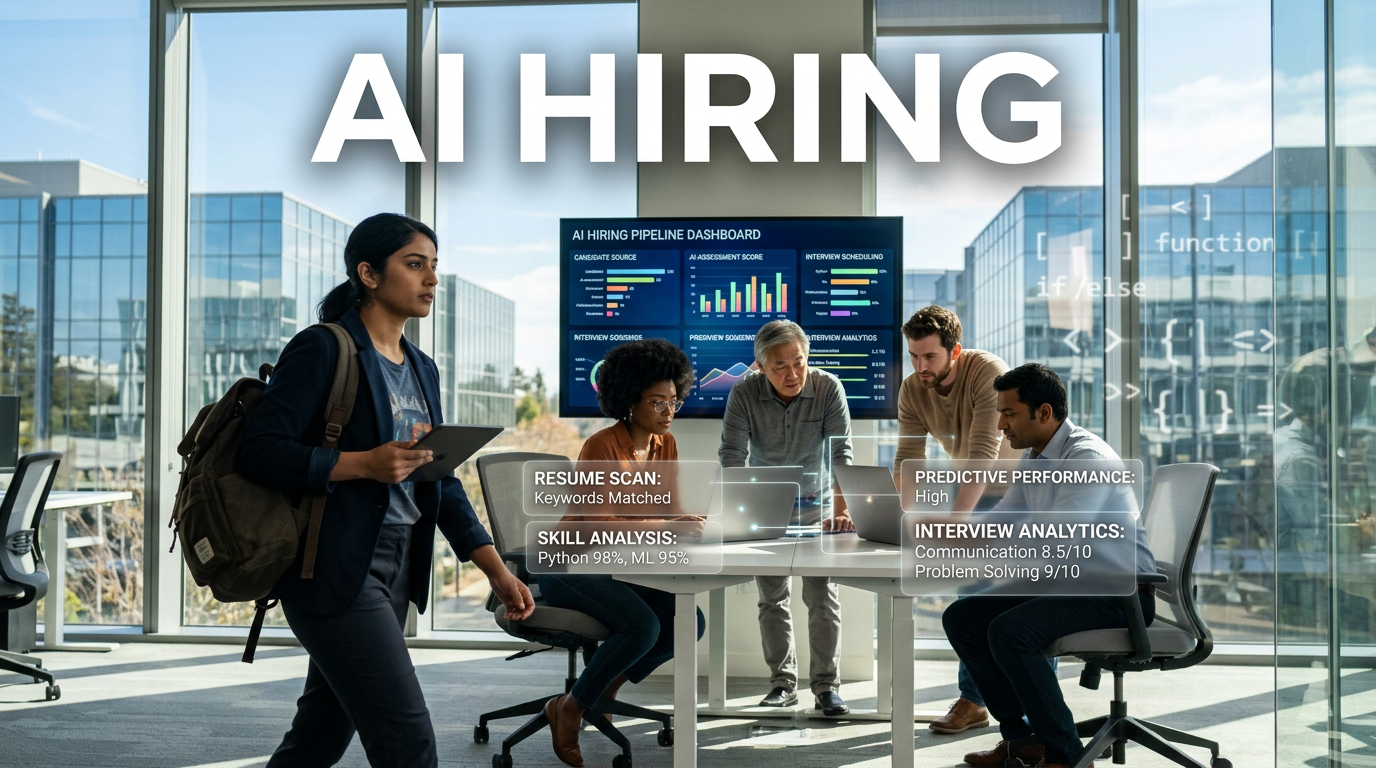
● AI Hires Rewrite Everything
“Hiring changed” How AI coding in Silicon Valley is reshaping hiring, organizations, and the way we work Core News
Key Highlights (The 5 things you must take from this article)
- With AI, the gap between ‘engineers who are good vs engineers who are not’ isn’t widening by 2~3 times—it’s being observed to widen by 10x~20x
- What matters is moving from job boundaries (backend/iOS/ML, etc.) to the ability to identify problems and see them through to the end
- In hiring, coding tests expand from “can you solve problems?” to also include “can you solve complex problems when given AI”
- An organizational learning process that reverses the focus of productivity metrics from “how much AI you used” back to “business value output”
- A practical argument for why executives and leaders ‘personally’ write code: to understand bottlenecks and guardrails
News 1) The ‘talent gap’ created by AI coding structurally gets even wider
The core message from DoorDash Engineering Team Lead Shin Sangmin is this. In the past, even if there were differences in skill levels, the gap was somewhat limited by physical time and the scope of work, but once AI came in, the “speed at which the better performer gets picked” grew exponentially.
That’s why they say the concept of ‘talent density’ in Silicon Valley feels even more real. Even if the total size of the same team (e.g., number of team members × production capability) looks the same, in the AI era, observations show that differences in the density of deliverables widen even more—so team performance diverges noticeably.
The reason this matters is because it means organizations must design with the assumption that a “structure where top productivity talent produces results faster” will matter more than a strategy that simply “raises the average.”
News 2) Engineers who cross the ‘boundary’ are more successful
The old way was relatively clear. Backend was backend, iOS was iOS, ML/recommendations was ML, and collaboration was the structure that made projects run.
But as AI coding becomes common, they say scenes where backend developers think, “Should I try iOS too?” and then move directly are increasing.
In other words, the criteria for important abilities has changed. It’s not the tech stack—it’s an attitude that takes the lead in understanding problems and brings them to resolution that creates performance.
This shift is explained as weakening the old layout of “product planners come up with ideas, and engineers just implement,” and moving toward a flow where engineers carry ideas/verification/implementation more broadly as well.
News 3) Hiring approach: coding tests + “ability to solve with AI” is added
The most practical change shows up in hiring. In the past, coding tests (time limit, one problem) were the core, but now they also look at whether you can “solve more complex problems with AI provided, over a longer period of time.”
Hiring at the team-lead level is also expanded with the same logic. They ask about experience improving factors that reduce productivity across the entire team using AI, and focus on cases where you tried automating/cleaning up wasted time processes and inefficiencies with AI.
This part is very intuitive from a company standpoint. Because adopting AI doesn’t automatically raise productivity, they’re hiring people who “use AI to reduce the organization’s real bottlenecks.”
News 4) Productivity measurement shifts back from ‘AI usage amount’ to ‘output value’
They say many organizations go through trial and error at the beginning. Instead of “how much coding you did,” there were companies that put “how much/how diligently you used AI” on a leaderboard, and
that is disappearing over time. It’s not just “productivity doesn’t rise even if we use AI, so we change the metrics”— it’s explained with the logic that organizational change creates learning only when you push through the transition period aggressively.
So first, you make people use it a lot to build habits and learn how to use it; then, in the next phase, you reset the evaluation metrics around business value output rather than “AI usage amount.”
Since this is the “metrics design problem” each company will inevitably face when adopting AI, it reads as a message to readers: don’t just follow “trend metrics,” manage it step by step.
News 5) Will code reviews get harder? The conclusion converges on ‘output quality’
There’s a question that comes up. If you use AI a lot, won’t code reviews become even harder to do?
But the answer is pretty clear in direction. Code reviews will likely get more help from AI too, but ultimately, the standard that matters remains: “whether engineers produce proper deliverables (quality/value) using AI.”
That’s why organizations end up reorganizing their systems around the quality of deliverables and the validation framework, not the code itself.
News 6) Executives also code: the purpose is to understand bottlenecks and guardrails
Here comes the most realistic detail. They say Shin Sangmin’s direct superior (Senior Director/executive) writes code to review it and send it back, and even that there’s a culture of “you can’t just assign code reviews to you—so you have to write it yourself too.”
The reason executives code directly is that they need to touch the code themselves so they can see “what the bottleneck is” and “what risks AI has created.”
What’s needed then is guardrails (safety mechanisms). You have to build a guideline/verification framework to structurally prevent, in advance, “the bottleneck that happens when a smart new hire comes in and tries to tear everything apart and fix it with AI” and “the damage that occurs when, on the other hand, a careless person wants to block dangerous changes made with AI.”
Once the organization understands this, it’s summarized as: engineers can run fast in a much safer environment.
News 7) Product development costs and options shrink, and the ROI of recommendations/automation changes
The point comes up that “because of AI, costs go down, and you can try more complex solutions even with products on a smaller scale.”
In particular, ML-based functions like recommendation systems used to have high costs because companies needed to set up ML engineer teams, so it was centered on large big-tech firms. But with improved AI coding/development efficiency, the entry barrier has dropped.
Also from a team-lead perspective, they explain that it’s not just that engineers code— AI can help improve productivity’s “time efficiency” by supporting more tasks such as bug fixes and test generation/automation.
In the end, from a company standpoint, they re-calculate how the ROI changes after adopting AI, and that can lead to changes in the roadmap and product priorities as well.
News 8) It’s not that humans become ‘useless’—learning increases so they can use AI better
There’s a common concern. “If we use AI, won’t human capability eventually weaken?”
But Shin Sangmin says the opposite. It’s become a stronger direction that to use it better, you need to work harder, study more, and research more.
Plus, in a company environment where you must create revenue and profit, the learning pressure increases because “what you did better with AI” becomes more important than “we introduced AI.”
News 9) Data and infrastructure in the broad U.S. market: search and agents are key pillars
Even the background early in the interview is important. Shin Sangmin says that at DoorDash, he oversees search and the agents side.
Search isn’t just about results from a simple search box; personalization is the key. Even for the same “breakfast,” what gets shown should differ depending on regional and user context, so learning personalized models is essential.
He also says DoorDash has expanded beyond food delivery into local commerce overall, and that the core is scale issues—from the database to infrastructure that runs without downtime.
This reads as a signal that you shouldn’t view AI trends only as “development tools,” but you should also look at the service operation capability where search/recommendations/automation are actually attached.
Reader-ready perspective: only the ‘most important takeaways’ you should pull from this interview
- Problem-solving scope over tech stack: engineers who cross boundaries create bigger impact
- Hiring shifts to ‘problem-solving ability with AI provided’
- Metrics are rearranged from ‘AI usage amount → business output’ (after the transition period)
- Executive coding is an action to design guardrails based on experience
- The essence of adopting AI is recalculating ROI: recommendations/automation become possible even for small teams
And the SEO keywords that naturally connect through this article are “AI coding,” “search personalization,” “recommendation systems,” “AI hiring,” and “organizational guardrails.” All those keywords converge into the same message: AI changes not only tools, but the work style and organization design itself.
< Summary >
As AI coding spreads, the engineer gap widens by 10~20x, and performance is determined more by problem-solving scope than by job boundaries. Hiring expands to include the ability to solve complex problems when given AI, as well as experience improving bottlenecks and processes that harm team productivity using AI. Metrics first gathered around AI usage amount, then after the transition period they are rearranged around business value output. Also, the reason executives code is to directly experience bottlenecks and risks in order to design guardrails, and AI works by increasing the direction of learning and research so humans can use it better rather than replacing them.
[Related Articles…]
*Source: [ 티타임즈TV ]
– “채용때 묻는 질문부터 달라졌어요” (신상민 도어대시 엔지니어링 팀장)