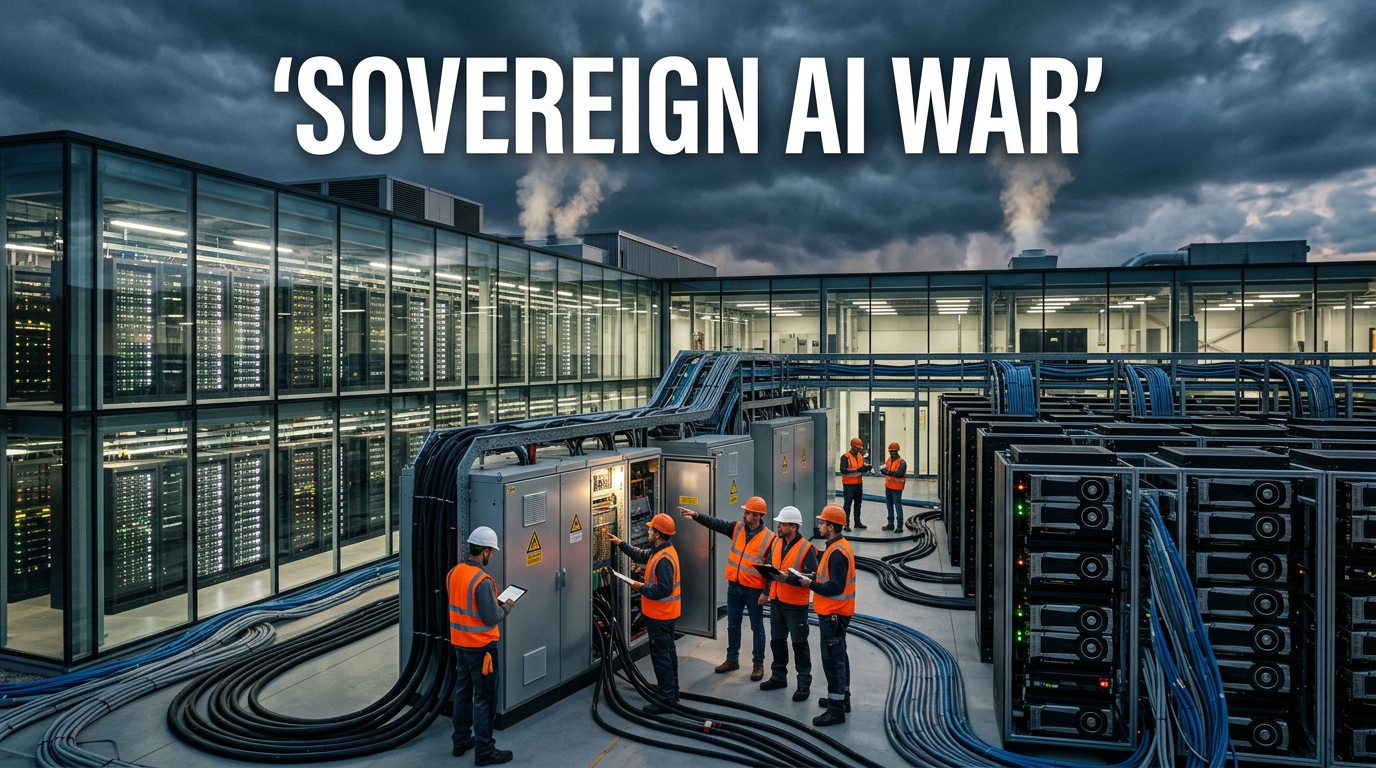
● Sovereign AI Infrastructure War
“The Real Board” that Fable 5 Has Opened — The AI Model War Is Shifting Into a “Sovereign AI Infrastructure” War
Key Takeaway First: Three Most Dangerous Changes Right Now
- Top-tier AI access is effectively becoming more favorable to a specific tier/country, which could cause the AI gap (inequality) to widen even faster.
- The race for model performance is not ending—it’s shifting the weight of the competition to where and with what infrastructure you deploy the model.
- “Nation-controlled AI infrastructure” such as GPUs, data centers, power, and networking has risen as a new strategic asset.
Why This Story Became “Important News” Now
- As Anthropic’s high-performance model Fable 5 became strong enough, an interpretation emerged that governments started moving from the standpoint of export/access restrictions, much like semiconductors.
- In this process, the logic that had emphasized “safety” met a backlash; from a user perspective, sudden access restrictions + a surge in costs occurred at the same time.
1) The Arrival of Anthropic’s “Fable 5”: Performance Up, Access Down
Fable 5 Marked in the “Top Performance Tier”
- Reports say it scored 65 points on a comprehensive benchmark, comfortably surpassing existing top-tier models (e.g., Claude-family models, GPT-family models, etc.).
- The point isn’t just “it’s good at coding”; it’s that it does a wide range of tasks very well.
User Reactions Deteriorated Rapidly Right After Access Was Restricted
- At one time, it delivered astonishing results and users were highly satisfied, but once restrictions kicked in, complaints grew that “what we used to do well has been taken away.”
- Here’s the important message: the user experience (UX) doesn’t end with performance alone.
2) Switching from Subscriptions to “API-Based Billing” — Cost Gaps Explode
The Change People Felt: “In the End, It Costs More”
- Fable 5 is known for a usage-based API billing structure rather than a subscription model, and calculations circulated that token consumption could become so large that costs could spike sharply.
- Talk spread that hourly costs could reach the tens of thousands to hundreds of thousands of won (as perceived), depending on usage.
Why This Matters Economically
- AI is solidifying into a structure where it’s not “use a good model and you’re done,” but rather that organizations that can afford the costs run more experiments, production, and iteration.
- As a result, it’s highly likely to lead to performance gap → usage gap → productivity gap → market gap.
3) What the “One-Shot Prompt” Demo Showed: AI Is Now a System Builder, Not Just a Production Tool
From 3D games to interaction to time/situation changes — “All at Once”
- The demo mentioned creating a World of Warcraft–style game using a one-shot prompt.
- The flow emphasized implementing not only object interactions (pressing, triggering, motion) but also time progression (for example, faction recovery after sleeping for 8 hours), along with the UI/physics “feel.”
- The core takeaway is that it evolved beyond “just drawing graphics” toward designing the game’s systems (objectives, rewards, interfaces).
Google Maps-Linked Drone Racing: Real-World Data + Game Logic Combined
- Implementing drone racing that connects to a destination in real time by linking to Google Maps.
- It’s read as a signal that a combination (map data + interaction + simulation) that used to feel unimaginably hard has become possible.
Here’s the “Real Point” I See
- Beyond whether a model is “smart,” the speed at which AI actually builds services/products is becoming the center of industrial competition.
- And speed competition quickly becomes competition over infrastructure (server/computing/network/data) accessibility.
4) Conclusion: The Focus Shifts from “AI Model War” to “Sovereign AI Infrastructure War”
Why “Where You Run It” Becomes the Core Issue, Not the Model Itself
- Right now, AI looks like software sold globally once it’s on the cloud, but this perspective strengthens that it can increasingly be treated like a strategic asset controlled by the state.
- In this view, metaphors like “AI has ripple effects as large as nuclear weapons” appear.
Sovereign AI Ultimately Connects to Infrastructure Sovereignty
- Required resources: the entire data-center value chain including power, GPUs, memory, networking equipment, security classification, and more
- In other words, it’s not just “build AI models by country”; it moves toward securing an AI supply chain that countries can operate and control.
The Signal From Jensen’s Announcement: Demand Spreads Beyond Hyperscalers
- During the earnings season, reports say data-center-related revenue was disclosed not as a single line item but split into hyperscalers and ACI (department/track).
- It’s interpreted that demand for NeoCloud/state-level sovereign AI is entering the ACI side.
- Numerically, the two axes appear to be almost the same size, and there were remarks suggesting that “demand for NeoCloud/sovereign AI could be higher.”
5) Economically: The “Risks and Opportunities” We Should See in Advance
Risk: The AI Access Gap Becomes a Productivity Gap
- When expensive API costs combine with access restrictions, organizations that do more experiments and automation move ahead faster.
- As a result, AI polarization (top companies/countries vs everyone else) could become even more real.
Opportunity: Growth Across Data Centers, Semiconductors, Power, and Networks
- The spread of sovereign AI doesn’t just grow the AI model industry—it stimulates the entire data-center infrastructure.
- In particular, it’s likely that investments will come along in power infrastructure, GPU/memory supply, and high-speed networking.
6) Only the “Most Important Conclusion” That Others Don’t Usually Summarize Elsewhere
Key Takeaway:
“Going forward, the essence of competition in AI won’t be model performance, but who can secure sovereign-grade infrastructure (power, GPUs, data centers, networking) and how quickly they can do it.”
“Going forward, the essence of competition in AI won’t be model performance, but who can secure sovereign-grade infrastructure (power, GPUs, data centers, networking) and how quickly they can do it.”
In other words, from an investment/business/policy perspective, the first indicator to look at isn’t which model you used, but what computing environment you can run it in.
Main Content to Convey (One-Line Message)
- AI is now expanding beyond “smart models” into a nation-level competition for sovereign AI infrastructure.
- Access restrictions and usage-based billing can accelerate AI gaps.
- Therefore, from a corporate/investor perspective, you should look more closely at the AI supply chain like data centers, power, GPUs, and networking.
SEO Keywords (Key Messages Naturally Included)
- Latest AI models
- API cost structure
- GPU data center investment
- Sovereign AI (sovereign-grade AI) strategy
- Power infrastructure
< Summary >
- While Fable 5 showed top-tier performance on benchmarks, access restrictions and an API billing structure increased cost burdens, causing a surge in user dissatisfaction.
- As AI quickly reached the level of making products like games/simulations with one shot, “turning into a production tool” became fully underway.
- As a result, the center of competition is shifting from model performance to sovereign AI infrastructure (data centers, GPUs, memory, networking, power).
- Jensen’s direction in earnings disclosure also suggests that demand for national-level buyers (NeoCloud, sovereign AI) could expand.
- AI gaps can grow further through access rights and cost structures; for investment and business, AI supply-chain infrastructure is key.
[Related Articles…]
- Sovereign AI Outlook: Why the State-Level Computing Competition Is Changing
- GPU Data Center Investment Checkpoints: Why You Need to Look Into Power and Networking Too
*Source: [ 월텍남 – 월스트리트 테크남 ]
– 이제 최고 AI모델은 “부자와 미국인”에게만 접근이 허락됩니다.