● SpaceX-IPO-AI-Shock
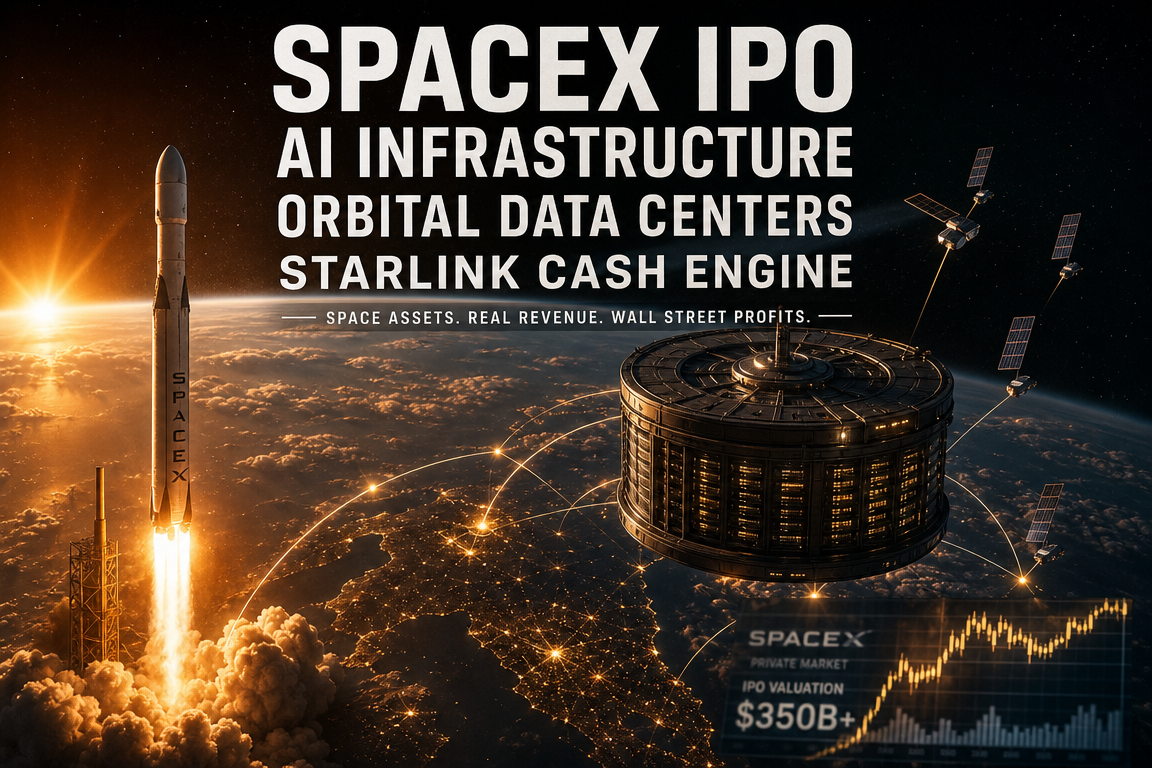
The Core Issue After a SpaceX IPO: “AI Infrastructure Reconfiguration” and the Strategic Case for Orbital Data Centers Beyond a $2.2 Trillion Market Cap
Viewing a SpaceX listing solely as a mega-IPO risks missing the central implications.
The key issues are:
1) SpaceX should be analyzed not only as a launch provider, but as an AI infrastructure platform.
2) Starlink’s cash generation can be recycled into xAI and orbital data-center initiatives, potentially reshaping expectations for semiconductors and the data-center industry.
3) This listing signals a structural shift affecting global capital allocation, macro conditions, and equity-market positioning.
1. SpaceX IPO: Key Figures
SpaceX completed one of the largest IPOs on record and immediately became a central equity-market component.
- Offering size: $75 billion
- Post-listing market capitalization: approximately $2.2 trillion
- U.S. market cap ranking: approximately within the top 6
- First-day performance: approximately +19% vs. offering price
At this scale, the IPO functions as a major liquidity absorber. If index inclusion (e.g., S&P 500, Nasdaq-100) follows, passive flows and large institutional rebalancing may mechanically shift allocations.
2. Why This Should Not Be Framed Only as a “Space Company Listing”
While the listing is of a space company in form, the valuation logic extends beyond rockets.
Core business pillars:
- Space: launch services, satellite deployment, space infrastructure
- Connectivity: Starlink satellite broadband
- AI: xAI, Grok, data centers, AI services
Key interpretation: Starlink is the primary current cash engine, while AI-related initiatives drive the valuation premium. The structure resembles “cash flow from space connectivity, reinvested into AI infrastructure and services.”
3. Strategic Blueprint: AI Value Chain + Physical AI Value Chain
The strategic design implies vertical integration from infrastructure to models to services and end products.
3-1. Infrastructure Layer
- Communications infrastructure: Starlink
- Power infrastructure: Megapack, solar, energy storage
- AI infrastructure: GPU/HBM-based data-center expansion
- Space infrastructure: reusable rockets, launch vehicles, space transport
This matters because AI-era constraints increasingly center on power, connectivity, data centers, and semiconductors.
3-2. Model Layer
- Grok (xAI)
- Large-scale training infrastructure investment
- Expansion into enterprise AI services
Even with limited share today, bundled demand may be created via integration with Starlink, data centers, and the Tesla ecosystem.
3-3. Services and Product Layer
- AI services on X
- Generative AI expansion via Grok
- Tesla vehicles
- Optimus robotics
- Potential future physical-AI device connectivity
Compared with NVIDIA: NVIDIA dominates chips/platforms but is not a mass-scale end-product manufacturer. The Musk ecosystem spans vehicles, robots, satellite connectivity, social distribution, and models, supporting an end-to-end stack.
4. Why Starlink Is the Primary Cash Engine
Starlink is not only a satellite internet product; it is positioned as the group’s main cash-flow source.
4-1. Structural Strengths
- Many geographies cannot economically densify terrestrial base stations (remote regions; maritime; aviation; defense).
- Low Earth orbit systems offer lower latency, relevant for autonomy, robotics, drones, defense operations, and real-time transmission.
- Control of connectivity enables bundling and distribution of AI services (connectivity plan + AI subscription).
4-2. Scale Indicators
- Share of global rocket launches: >50%
- Share of global satellite deployment: ~70–80%
- Long-term satellite count target: >42,000
This implies standards-setting scale rather than conventional competition.
5. Orbital Data Centers: Why They Are Considered Despite Apparent Risk
The key question is not feasibility in isolation, but why the concept is being evaluated now.
5-1. Constraints of Terrestrial Data Centers
- Power shortages
- Rising cooling costs
- Land-use and permitting friction
- Community opposition
- Upward pressure on electricity pricing
Data centers increasingly require both grid capacity and social/political approval.
5-2. Potential Advantages of Orbital Data Centers
- Potential solar power utilization
- Possibility of power-autonomous architectures
- Reduced exposure to terrestrial permitting risk
- Potential cooling-design innovation
Current economics remain unproven; near-term cost parity with terrestrial facilities is unlikely. The relevant framing is relative cost curves: terrestrial costs are rising while launch and space-infrastructure costs may decline via reusability and heavy-lift progress. If and when curves intersect, orbital data centers become an industrial-economic proposition rather than a speculative concept.
6. The Interpretation That “90% of SpaceX Revenue Could Come From AI Data Centers”: Why It Matters
A central market interpretation is that the long-term monetization target may be AI data centers and enterprise AI infrastructure, not launch narratives.
6-1. Drivers Behind This Interpretation
- Starlink generates cash flow
- Cash flow is reinvested into xAI and data centers
- AI infrastructure TAM exceeds connectivity TAM
- Enterprise and government AI markets may open faster than consumer markets
Launch is the enabling capability, Starlink is the funding mechanism, and AI infrastructure may be the platform-level objective.
7. Defense and SpaceX: Potentially Larger Than Conventional Space-Market Framing
Defense demand is increasingly defined by networked, data-centric operations.
7-1. Why Defense Becomes a Core Customer
Recent conflict dynamics emphasize asymmetry: defending against low-cost drones with high-cost missiles is not sustainable. Defense procurement priorities increasingly shift toward:
- Satellite communications
- Real-time ISR
- Drone control
- AI-enabled operational decision support
- Low-latency networks
SpaceX can potentially deliver launch, satellite networks, communications, data infrastructure, and AI as an integrated stack, creating a positioning adjacent to (and in some areas overlapping with) defense data platforms.
8. Valuation Debate: The Relevant Analytical Focus
A valuation premium is structurally likely; price-to-sales levels may exceed those of legacy mega-cap technology peers. The relevant question is the basis for the premium.
8-1. Factors Supporting Premium Valuation
- Dominant launch capability
- Starlink cash-generation potential
- Option value of orbital data centers
- Integration premium with xAI
- Expansion pathway into physical AI
This is a forward-scenario valuation, implying elevated volatility.
8-2. Investment Implication
Large first-day gains and subsequent drawdowns can both be plausible. The primary characteristic is path volatility rather than linear trend behavior.
9. Capital-Market Impact: Why Other Growth Equities May Experience Volatility
Mega-IPOs typically create:
- Anticipatory inflows
- Rebalancing-driven sales elsewhere
At this scale, rebalancing effects may be material. Institutions typically fund new allocations by trimming existing holdings across equities, credit, and alternatives, raising near-term volatility in growth, AI, semiconductors, and related ETFs.
10. Implications for Korean Equities
10-1. Direct Theme Linkages
- Aerospace value chain
- Satellite-communications equipment
- Specialty alloys and high-performance materials
- Space/aerospace ETFs
10-2. Indirect but Core Linkages
- Samsung Electronics
- SK hynix
- AI server and memory supply chain
- Data-center power and cooling ecosystem
If SpaceX evolves toward AI infrastructure, demand extends beyond GPUs to HBM, memory, power delivery, storage, and networking. For Korean large-cap semiconductors, this is more plausibly an indirect demand linkage than a direct beneficiary relationship.
11. News-Style Executive Summary
- Listing: SpaceX entered U.S. public markets via a mega-IPO, immediately becoming a core index-relevant equity.
- Business: Current cash is primarily generated by Starlink; longer-term valuation premium is tied to AI and orbital data centers.
- Technology: Reusability and LEO networks are largely de-risked; the next focal point is data centers and AI services.
- Industry: The “space” category is converging with communications, defense, and AI infrastructure into a standalone industrial segment.
- Markets: The IPO is a capital reallocation event capable of increasing volatility across existing growth and large-cap technology exposures.
12. Under-Emphasized Points in Mainstream Coverage
12-1. SpaceX Resembles an “Infrastructure Control” Business More Than a Pure Space Manufacturer
A more investor-relevant framing is “space-scale infrastructure + network + AI infrastructure,” analogous to a space-enabled hyperscaler stack.
12-2. Starlink May Function as an AI Distribution Network, Not Only Internet Access
Connectivity control enables packaged distribution of AI services globally and can become a delivery channel for subscriptions and enterprise deployments.
12-3. Orbital Data Centers Are Primarily an Economic-Curve Question
The key variable is “when relative economics shift,” not only “whether it is technically possible.”
12-4. Defense AI Demand May Scale Earlier Than Consumer AI Demand
Government and defense procurement may accelerate integrated communications, ISR, and AI decision infrastructure sooner than broad consumer monetization.
12-5. The IPO Has Indirect Implications for Semiconductor Expectations
A broader AI infrastructure arms race expands demand beyond GPUs into HBM, storage, servers, networking, and power infrastructure, reinforcing linkages to the semiconductor and data-center capex cycle.
13. Practical Investor Framework
- The company presents a long-duration strategic narrative.
- Post-listing price discovery is likely to be highly volatile.
- Mega-IPO mechanics combine capital inflow with forced rebalancing.
- Position sizing and risk control are central considerations.
14. Closing Points
This is not only a space-sector event. It combines AI infrastructure, satellite connectivity, defense technology, data centers, semiconductors, and index-driven capital reallocation.
Market pricing may reflect not current earnings power, but perceived control over future infrastructure layers.
< Summary >
The SpaceX IPO should be interpreted as a structural event linking AI infrastructure, satellite communications, orbital data centers, and defense AI.
Starlink supports near-term cash generation, while xAI and orbital data-center optionality may underpin longer-term valuation.
Near-term market impact may be significant, but the longer-term implication is the re-rating of the space category into an infrastructure-and-AI-aligned investment domain.
The core issue is infrastructure, with AI and data centers as the terminal layer.
[Related Articles…]
- AI Infrastructure: Capital Allocation and the Next Data Center Cycle
- Semiconductors: HBM and Memory as the Critical AI Bottleneck
*Source: [ 경제 읽어주는 남자(김광석TV) ]
– [모아보기] 상장 직후 시총 2조 2000억 달러, 미국 증시 6위. 스페이스X의 큰 그림
● SpaceX, Starlink, AI, Power, Empire
SpaceX: Why Missing the Current Window Matters — Key Takeaways on Starlink, xAI, and the Space Economy
This report does not focus on headline-driven commentary around Elon Musk.
It outlines why SpaceX warrants attention now, why markets increasingly view the company not merely as a private space launch provider but as core infrastructure for the next phase of the space economy, and how this trajectory links to U.S. equities, the global macro environment, semiconductors, and the AI industry.
It also consolidates under-discussed points often reduced to brief mentions in mainstream news and short-form media: Starlink’s state-level leverage, SpaceX’s moat being driven more by organizational systems and talent architecture than patents, and the potential for SpaceX, Tesla, xAI, data centers, and energy to converge into an integrated ecosystem.
In summary, this is not a narrative of “SpaceX is impressive,” but a structured, news-style framework for why SpaceX could become a central axis for asset allocation and technology competition beyond 2026.
1. Core Development: Why Market Perception of SpaceX Has Shifted
Market interpretation of SpaceX has changed materially.
Previously framed as a “private launch company,” SpaceX is increasingly evaluated as space infrastructure + global connectivity + AI ecosystem optionality + a strategic national asset.
This matters because valuation frameworks are expanding beyond near-term revenue growth toward strategic positioning in U.S. competitiveness and critical technology supply chains.
SpaceX is best analyzed via two pillars:
- Starlink: space-based global connectivity infrastructure
- xAI and superintelligence adjacency: expansion into AI, data centers, energy, and robotics
Combined, these pillars increasingly position SpaceX as a future platform-like company rather than a single-industry aerospace contractor.
2. Pillar 1: Why Starlink Is Viewed as the Leading Asset in the Space Economy
2-1. The Key Variable Is Control, Not Satellite Count
A central point is Starlink’s dominant position in the low-Earth-orbit ecosystem.
The strategic relevance is not simply the number of satellites, but the ability to influence communications availability, battlefield connectivity, military decision cycles, and remote operational continuity.
Starlink functions less like a consumer internet service and more like foundational infrastructure for national resilience, security, and industrial connectivity.
2-2. Structural Advantage from Launch Cost Differentials
SpaceX’s most durable advantage is economic efficiency.
Significantly lower launch cost per kilogram versus competitors enables more frequent, higher-volume, lower-cost deployment of orbital assets, reshaping industry-wide cost structures.
Competitors cannot close this gap through technology replication alone; the full stack must be rebuilt: manufacturing systems, engine design, launch operations, and reuse execution. This creates a high barrier to entry and a defensible moat.
2-3. A Private Network with State-Level Influence
Starlink increasingly impacts domains such as war, diplomacy, emergency communications, and infrastructure restoration, producing a structure where a private company can exercise quasi-sovereign connectivity leverage.
In this framework, global power increasingly depends not only on energy and semiconductors but also on who controls connectivity.
3. Pillar 2: AI, Superintelligence, and Potential Linkage to xAI
3-1. Why Some Markets Now View SpaceX Through an AI Lens
SpaceX is often viewed narrowly through rockets and satellites. However, a growing subset of observers connects SpaceX with xAI, data centers, robotics, and communications networks.
This matters because AI development simultaneously requires:
- large-scale compute
- power infrastructure
- data transmission networks
- execution hardware (robots)
SpaceX is directly adjacent to at least two of these: transmission networks via Starlink and potential remote/edge infrastructure pathways relevant to data center expansion.
3-2. Are Space-Based Data Centers Unrealistic?
The market focus is less on near-term feasibility and more on whether Musk-style execution embeds long-horizon concepts into real contract structures, incentives, and operational roadmaps.
The distinction is that some organizations articulate visions without operational alignment, while Musk-led organizations often translate visions into incentive-linked objectives.
3-3. AI, Robotics, and Satellite Networks as an Integrated Stack
A notable thesis is potential ecosystem convergence across SpaceX and Tesla.
AI is unlikely to be fully productized by software alone. Autonomous driving, humanoid robots, remote connectivity, real-time data transfer, energy storage, and large-scale intelligence systems may need to operate as a unified industrial stack.
Within this model: Starlink can serve as connectivity, Tesla as execution hardware, and xAI as the intelligence layer.
4. The Primary Moat: Organizational Systems, Not Patents
4-1. Why People and Culture Can Matter More Than Rocket IP
Moat discussions often prioritize patents, share, and capital. For SpaceX, a more persuasive moat is the accumulated engineering organization and problem-solving system built through repeated iteration.
Rocket development is not reproducible from schematics alone. Core advantage rests in tacit knowledge across manufacturing, testing, failure analysis, redesign, scaling, and launch operations. This knowledge is retained operationally through culture and process, not spreadsheets.
4-2. Why “Fail Fast” Is a Competitive Advantage
A core characteristic is engineered learning via rapid failure.
Where many large organizations treat failure as a liability, SpaceX treats it as a mechanism for accelerating learning velocity. In domains without settled answers, the organization that learns fastest is positioned to widen the gap.
This logic also aligns with AI development, where experimentation-feedback-iteration speed is a primary source of differentiation.
4-3. Equity Incentives and Mission-Driven Retention
Retention is reinforced by both a mission narrative and equity-based compensation.
The structure can convert employees from labor inputs into long-duration stakeholders. Competitors can recruit individuals, but replicating a coherent mission plus incentive system is materially harder.
5. Why Some Argue SpaceX’s Moat May Be Deeper Than Tesla’s
5-1. EV Competition vs. Space Market Structure
Tesla competes in an increasingly crowded EV landscape against Chinese entrants and incumbent OEMs.
By contrast, SpaceX’s launch and LEO operations face fewer credible competitors, with larger performance and experience gaps.
5-2. The Key Variable Is Time Advantage
Even with competitors, the dominant factor is time.
Space capabilities depend on accumulated launch cadence, engine reliability, reuse execution, and operational history. These are path-dependent and cannot be rapidly duplicated by capacity expansion alone. Markets therefore emphasize time-based compounding of capability, not only current share.
6. U.S. Strategic Context: SpaceX as a Macro-Relevant Asset
6-1. A Private Company Operating as Strategic Infrastructure
In the context of U.S.-China technology competition, policy focus increasingly bundles semiconductors, AI, energy, space, and connectivity.
SpaceX occupies a distinctive position because its commercial activities overlap with national priorities: lunar programs, military communications, space logistics, and next-generation internet.
6-2. Interpretation: A Return of Entrepreneurial Power
One interpretation is that strategic necessity may drive greater institutional support for innovation-critical private firms.
For companies aligned with national objectives, policy outcomes may tilt more toward enablement than constraint. This lens is also relevant for interpreting broader U.S. equity dynamics where state strategy and private capital formation may increasingly interact.
7. Relevance for Korean Investors: Semiconductors, Equipment, and Supply Chains
7-1. Korea as a Critical Supplier to the Musk Ecosystem
As SpaceX, AI, robotics, and data centers scale, demand concentrates on compute resources, and compute is anchored in semiconductors.
This suggests Korea may capture structural upside via memory, advanced packaging, equipment, and materials. This is less a thematic trade than a supply-chain constraint reality.
7-2. Look Beyond Mega-Caps Toward the Next Capex Cycle
If semiconductor mega-caps have already re-rated, a broader approach is to monitor the next order and capex cycle that flows into equipment and component suppliers.
If AI and space-linked infrastructure continue expanding, capacity additions and process upgrades become necessary, supporting downstream industrial beneficiaries.
8. Valuation: Why Markets Continue to Focus Despite Apparent Expensiveness
8-1. Traditional Multiples Provide Limited Explanatory Power
Companies like SpaceX are difficult to assess via standard earnings multiples. Markets often apply a sum-of-the-parts lens:
- launch services value
- Starlink value
- future government/defense contract value
- AI/ecosystem option value
Strategic platform positioning can dominate near-term profitability in the valuation narrative.
8-2. Characteristics of “Expensive but Ownable” Assets
The purchase rationale is less “cheap valuation” and more “structural centrality,” often expressed as a small allocation within a diversified portfolio and evaluated over long horizons.
This aligns with asset allocation discipline rather than short-term trading.
9. Most Material Under-Discussed Points
9-1. The Core Is Not Rockets, but the Structuring of Private Power
Coverage often emphasizes launches, satellite counts, and IPO speculation. A more consequential element is the consolidation of private control across communications, security-adjacent services, space logistics, and national-scale projects.
This is relevant for interpreting potential shifts in global order.
9-2. The Asset Is a System That Converts Failure into Learning
Over time, the most difficult element to replicate is not hardware but an operating model that rewards controlled failure and converts it into learning velocity.
9-3. SpaceX, Tesla, and xAI Should Not Be Analyzed in Isolation
An integrated view may be required: connectivity, robotics, autonomy, data centers, energy storage, and advanced intelligence can converge into a unified platform, altering how enterprise value is framed.
10. Investment Framework: How to Interpret SpaceX Now
10-1. Not Explained by Short-Term Hype Alone
SpaceX is not readily analyzed as a traditional value asset, but it also does not fit a pure “theme” classification, given its operational infrastructure footprint and government project exposure.
10-2. Four Ongoing Monitoring Indicators
- Starlink subscriber growth and service expansion rate
- durability of reusable launch economics
- trajectory of U.S. government and defense-related contract expansion
- ecosystem linkage with xAI, Tesla, and data-center infrastructure
Tracking these indicators supports deeper interpretation beyond headline cycles.
10-3. For Korean Investors, Indirect Beneficiaries Also Matter
Regardless of direct exposure, potential beneficiaries may include semiconductors, equipment, power infrastructure, AI server supply chains, and aerospace components.
SpaceX may function less as a single-company story and more as a proxy “order book” for technology competition over the next decade.
11. Conclusion: SpaceX as an Operating System for Future Industry
The current focus on SpaceX reflects multiple converging drivers: Starlink as global connectivity infrastructure, launch cost leadership that widens competitive gaps, an organizational model that resists replication, and optionality from convergence with AI, robotics, energy, and data centers.
Accordingly, SpaceX can be framed as a composite symbol of U.S. strategic posture, the space economy, AI infrastructure, and evolving private power structures.
This framework can also sharpen how investors identify relevant U.S. equities and technology exposures going forward.
< Summary >
SpaceX is best framed not as a rocket company, but as a combination of Starlink-led global connectivity infrastructure, structurally advantaged launch economics, a rapid-learning organizational system, and a potentially integrated ecosystem spanning AI, robotics, data centers, and energy.
Investors should evaluate SpaceX within the context of U.S. strategic priorities and future platform infrastructure.
For Korean investors, the relevant exposure may include indirect beneficiaries across semiconductors, equipment, power, and AI supply chains.
[Related Articles…]
- Space Economy: Investment Implications and Infrastructure Winners
- Semiconductors: AI Infrastructure Demand and the Next Supply-Chain Cycle
*Source: [ Jun’s economy lab ]
– 스페이스X는 엄청난 기업입니다. 놓치지 마세요(ft.정주용 의장 1부)