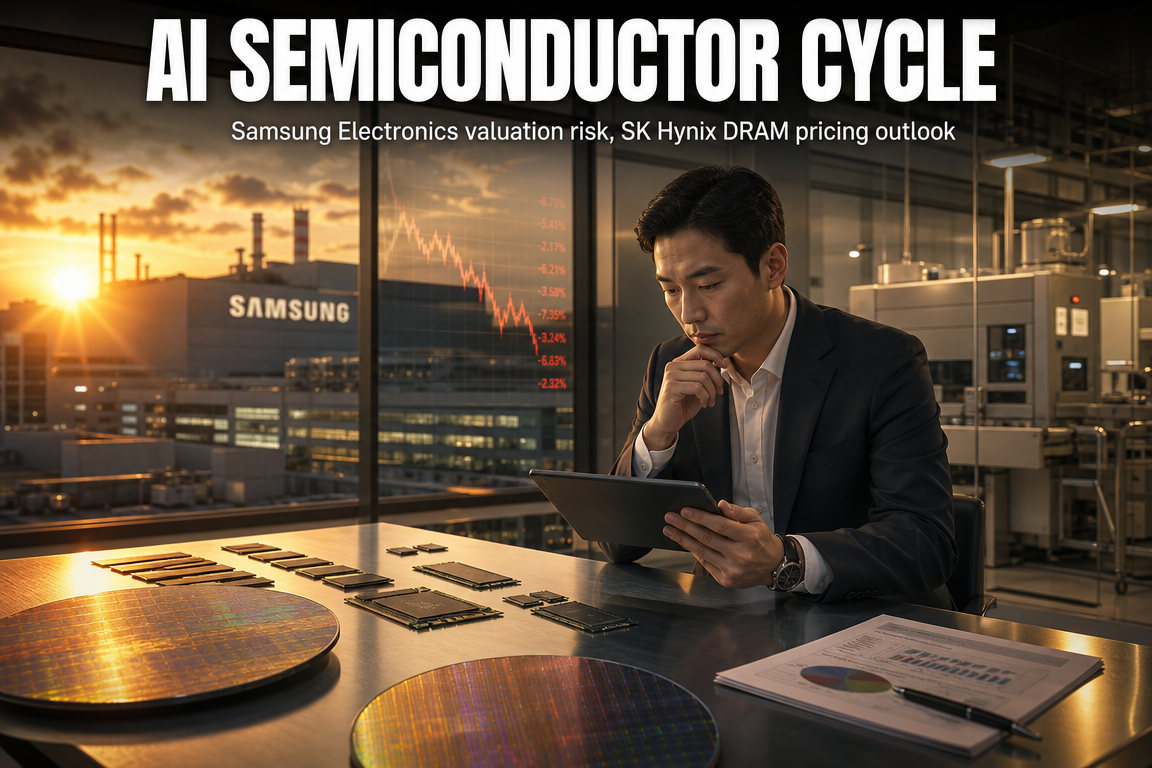
● AI-Rally, Chip-FOMO, Valuation-Risk
“A Good Company Is Not Necessarily a Good Stock”
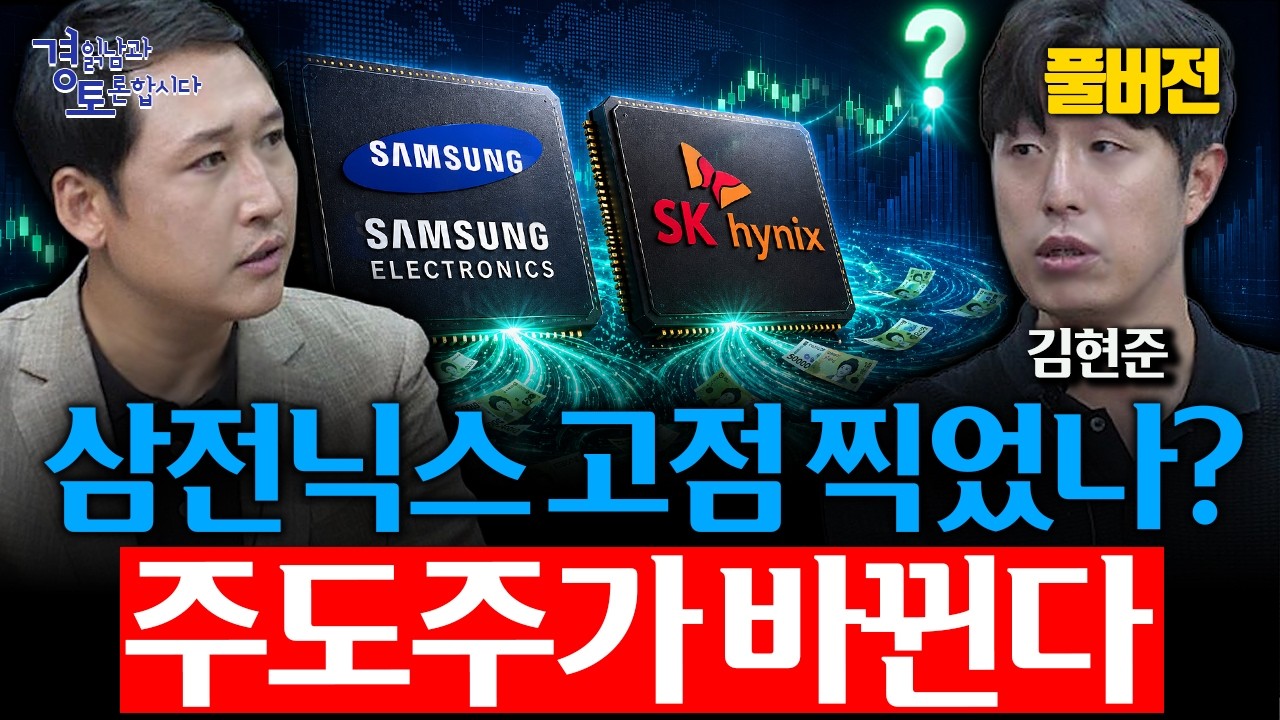
Samsung Electronics and SK Hynix: Is It Attractive to Buy Now? Key Takeaways on the Semiconductor Cycle, Valuation, and Real AI Upside
The market’s central question is straightforward: Samsung Electronics and SK Hynix are widely recognized as high-quality companies, but are they attractive stocks at current prices? This report links the semiconductor outlook, equity-market positioning, the Korean equity index backdrop, AI-driven demand, and the implications of expected rate cuts. It focuses on what is often under-addressed: how much optimism is already priced in, the risk of valuation compression if DRAM pricing turns down, the concentration effects driven by FOMO-type flows, and the typical rotation pathway into the next leadership cohort. The core issue is not only “buy or not,” but why the current decision point is structurally difficult.
1. Core conclusion: Samsung Electronics and SK Hynix are strong businesses, but not automatically strong stocks at current levels
A key principle applies: a good company is not necessarily a good stock.
Samsung Electronics and SK Hynix have scale, technology, and global competitiveness in memory. They are also direct beneficiaries of AI infrastructure build-outs. However, equity returns are not determined by business quality alone. Investors must assess:
- How much expectation is already embedded in the price
- Whether the stock has moved faster than earnings capacity
- The remaining incremental upside versus embedded consensus
At this stage, the primary question is not “the companies are good,” but whether the current price already discounts the expected tailwinds.
2. Why decision-making is harder now: fundamentals are improving, but expectations have expanded
The positive setup is broadly known: DRAM pricing recovery, HBM demand, AI server capex, and a cyclical upturn in memory. The issue is that widely known positives are often already reflected in valuations.
Equities respond less to absolute improvement than to whether results exceed expectations. Strong reported results can coincide with weak price action if they do not represent upside to consensus. The key question becomes:
- Can earnings growth keep pace with the price and multiple expansion already realized?
3. The primary near-term trigger: whether DRAM pricing rolls over
Short-term direction is heavily influenced by DRAM pricing.
Semiconductor profitability improves via (1) higher volumes or (2) higher prices. Volume expansion requires capacity build and time. Price increases can translate more directly into operating leverage given relatively stable cost structures.
Therefore, the market’s immediate focus is:
- Does DRAM pricing continue rising, or does it turn down?
If DRAM pricing weakens, sentiment may deteriorate faster than near-term earnings, because the market has begun to treat memory not only as a cycle but as a more structural AI-driven growth exposure. A pricing downturn can quickly shift the interpretation back toward “cycle dynamics,” increasing the probability of multiple compression ahead of earnings revisions.
4. The dominant risk is not earnings weakness, but expectation reset
In practice, expectation reset can be more destabilizing than modest earnings declines.
Current positioning reflects a narrative beyond a normal recovery: sustained AI demand, structurally tighter supply, and an extended period of improved profitability. If DRAM pricing softens even marginally, market interpretation can swing toward:
- Peak-cycle concerns
- Post-HBM growth deceleration
- Renewed oversupply risk
In such scenarios, the critical downside mechanism is often valuation regime change rather than near-term profit variance.
5. FOMO-type flows are amplifying concentration and fragility
A meaningful share of inflows may be driven less by valuation work and more by fear of missing performance. This can occur across retail, private wealth, and institutional allocations.
When widely owned, highly liquid mega-cap leaders rally, FOMO pressures can intensify. The practical consequence is that decision-making deteriorates into performance-chasing, and marginal demand can disappear quickly on relatively small negative signals.
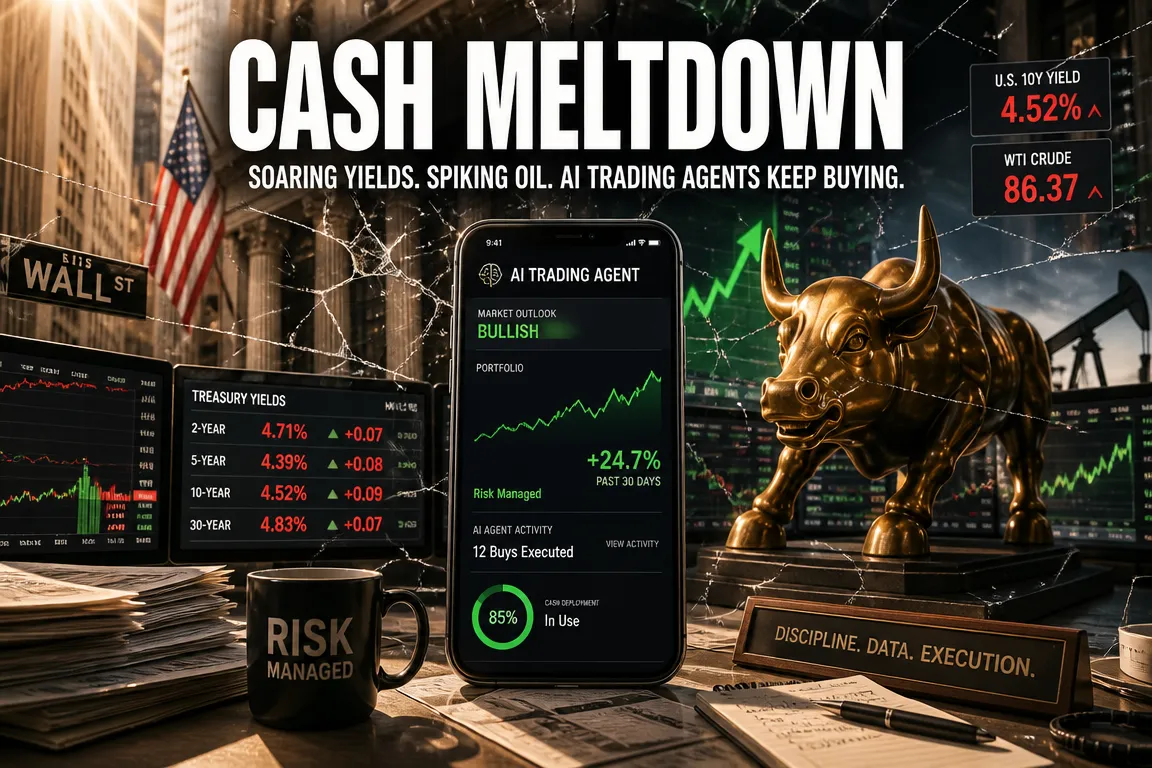
6. Why equities can rise despite elevated sovereign yields: the market is paying for observable performance
Higher rates typically raise discount rates and compete with risk assets. Recent price action has diverged, particularly for AI and semiconductor exposures. This can be framed in three points:
6-1. Higher rates are being treated as a new baseline
Once elevated rates persist, markets often adapt and stop treating the level itself as incremental negative information.
6-2. Increased sovereign issuance can coincide with demand support via fiscal channels
Large issuance often reflects fiscal spending on defense, energy, infrastructure, and industrial policy. While yields can be a headwind, fiscal outlays can also support corporate revenues, creating an offsetting mechanism.
6-3. Equities retain an advantage versus gold or crypto due to earnings visibility
Gold and crypto lack periodic operating results. Public equities provide recurring metrics (revenue, operating profit, guidance). In uncertain environments, capital can rotate toward segments with verifiable earnings momentum, including AI-linked large-cap technology and semiconductor leaders.
7. A structural issue in Korea: excessive index dependence on two names
Strength in Samsung Electronics and SK Hynix is positive for the market, but concentration risk is rising.
If these two companies dominate index performance, overall market direction becomes disproportionately sensitive to:
- Memory pricing
- AI narrative stability
- Semiconductor sentiment
This can widen the gap versus other sectors and increase index volatility when leadership weakens.
8. Even with an upcycle, caution is warranted: global peers are also benefiting
The recovery may be broadly shared across the global memory ecosystem:
- Micron’s cycle participation
- Aggressive positioning by Chinese suppliers supported by policy
- Strengthening semiconductor ecosystems in Taiwan and the United States
Profit expansion may reflect industry-wide pricing power rather than durable share gains by Korean incumbents. Investors should differentiate cyclical uplift from competitive gains by monitoring share shifts, customer mix, yields, and contracting structures.
9. Portfolio implication: prioritize staying invested over perfect timing
Attempting to precisely time peaks and troughs is typically unrealistic. A more robust approach is to remain invested while gradually reallocating toward better risk-adjusted opportunities.
In inflationary environments, holding cash for extended periods can imply real purchasing-power erosion. The key decision is the form of asset exposure, not binary in-or-out timing.
10. Potential next leadership: rotation from hardware toward software, platforms, and monetization
Early AI phases reward hardware and infrastructure:
- GPUs, HBM, servers
- Power, data centers
- Networking equipment
Over time, profit pools often migrate toward:
- Platforms
- Software layers
- AI-enabled services with pricing power and monetization
This suggests investors should not treat semiconductors as the only AI expression. Portfolio construction may benefit from preparing for leadership rotation toward entities that monetize AI, not only those that supply inputs.
11. Practical checklist for current positioning
11-1. To what extent is the earnings recovery already priced in?
Focus on upside versus consensus, not absolute improvement.
11-2. Are there early signs of DRAM pricing inflection?
Track spot and contract trends, customer inventories, and capacity plans.
11-3. Is the purchase thesis analytical or performance-chasing?
If the motivation is primarily “not to miss,” the investment case may be weak.
11-4. Is semiconductor exposure disproportionately large?
Higher conviction often leads to concentration; concentration increases drawdown sensitivity.
11-5. Are potential next leaders being monitored?
Leadership rotates within semiconductors and across the AI value chain.
12. Market points to monitor (current framing)
First. Samsung Electronics and SK Hynix remain high-quality operators, but current prices likely discount a meaningful portion of AI expectations and memory recovery.
Second. The key variable is DRAM pricing; a downturn may pressure sentiment and valuation before earnings revisions.
Third. Despite elevated yields, flows have favored AI-linked large-cap equities with observable earnings momentum.
Fourth. The Korean index is increasingly concentrated in these two names, increasing systemic sensitivity.
Fifth. Leadership may migrate from hardware toward platforms, software, and services as AI monetization expands.
13. Under-addressed but decision-critical points
13-1. The market is buying narrative as much as earnings
Pricing reflects a belief in a structurally improved memory regime. Narrative breaks can be more harmful than small earnings misses.
13-2. The principal downside is valuation reset
The risk is not only lower profits, but reduced willingness to pay a premium multiple.
13-3. Current strength may not imply durable share gains
If competitors benefit similarly, the upside may be more cyclical than structural.
13-4. The next opportunity set may be “AI monetizers,” not “AI builders”
Profit pools may shift toward those with pricing and distribution advantages in AI services.
14. Bottom-line view: should investors buy Samsung Electronics or SK Hynix now?
Both companies remain strategically important in an AI-driven cycle. However, the current setup is not well-suited to indiscriminate momentum entry given elevated expectations, concentrated flows, and sensitivity to DRAM pricing signals.
A more disciplined approach emphasizes:
- Position sizing and concentration control
- Active monitoring of DRAM inflection risk
- Incremental preparation for leadership rotation toward AI software, platforms, and services
The key distinction remains: buying a strong business is not the same as buying at an attractive price.
< Summary >
Samsung Electronics and SK Hynix are high-quality companies, but current prices likely reflect substantial AI and memory-cycle optimism. DRAM pricing is the primary near-term driver; an inflection could trigger expectation reset and multiple compression risk. Equity strength amid high yields is supported by preference for visible earnings performance in AI-linked large caps. Korea’s index concentration in two semiconductor leaders increases systemic volatility. Over time, AI leadership may rotate from hardware toward software, platforms, and services.
[Related Articles…]
- Semiconductor Cycle: What Drives Memory Valuations Across the Next Turn
- AI Monetization: Platform Economics and the Next Leadership Rotation
*Source: [ 경제 읽어주는 남자(김광석TV) ]
– [풀버전] “좋은 기업이 좋은 주식은 아니다” 삼성전자·SK하이닉스 지금 사야 할까? | 경읽남과 토론합시다 | 김현준 대표님