● KOSPI-10000, Liquidity-Driven, AI-Fueled, Rate-Hike-Risk
Will the KOSPI Reach 10,000? A Consolidated View of Rate Policy, the National Pension Service, and US Equity Liquidity from July
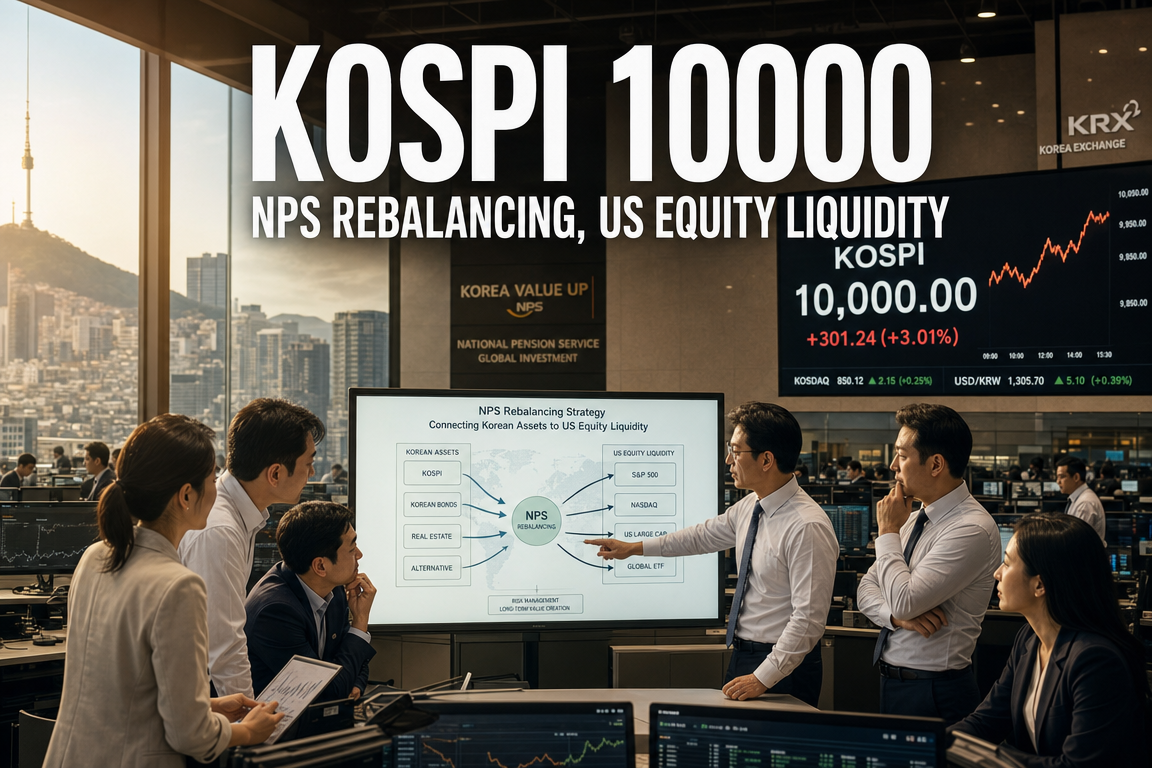
The core issue is not whether the KOSPI outlook is simply “positive” or “negative.” The relevant question is how liquidity, policy constraints, and global capital allocation could plausibly align to support a move toward 10,000—and why, from July onward, US equities may show relative strength versus Korean equities. This note also connects the National Pension Service (NPS) rebalancing channel, Federal Reserve dynamics, oil and Middle East risk premia, and the AI semiconductor-to-physical AI transition.
1. Key Conclusion: The 10,000 Scenario Remains Open
The 10,000 thesis is framed primarily as a liquidity-driven outcome rather than a pure earnings-driven outcome.
- The market is characterized less by “prices rising because earnings improved,” and more by “capital concentration into semiconductors and large-cap equities under a liquidity regime.”
- From a level perspective, a move from 9,000 to 10,000 implies a ~10% increase, which is mechanically less demanding than earlier-stage index reratings.
- The critical variables are timing, marginal buyers/sellers, and sector leadership rather than the index level itself.
2. Why Prices Rise: Liquidity Dominates Earnings in the Current Regime
The dominant driver is interpreted as liquidity and risk appetite, with earnings influencing allocation within the market rather than setting the market’s direction.
- Liquidity lifts the aggregate market.
- Earnings determine where liquidity concentrates (sectors and individual names).
- Markets often react immediately to changes in rate expectations even when corporate fundamentals are unchanged, consistent with liquidity sensitivity.
Even if rate-cut expectations soften intermittently, fiscal outlays, policy-linked funding, and recovering global risk appetite may continue to support asset prices.
3. Why the US May Outperform Korea from July
The constructive stance on equities does not necessarily imply Korea will lead. From July, the relative setup may favor US equities due to the following factors.
3-1. NPS Rebalancing: Potential Headwind for Domestic Equity Flows
- The NPS operates with target weights for domestic equities.
- After recent market gains, realized domestic equity exposure may exceed targets, potentially prompting gradual selling to rebalance.
- Even absent forced selling, this can create incremental supply near index highs.
3-2. Korea’s Residual Tightening Pressure
Korea faces a different constraint set than the US, largely due to:
- FX stabilization considerations
- Inflation persistence risks
The environment is described as an era of “divergent tightening,” where rate policy is less synchronized globally and more country-specific. Under such conditions, Korea cannot fully rule out renewed tightening pressure.
3-3. Stronger US Fiscal Liquidity Tailwinds
- In the second half, US election dynamics may amplify fiscal impulse and policy-driven liquidity.
- Equity support can persist even when monetary easing expectations moderate, particularly where fiscal channels remain active.
3-4. Mega IPOs and Global Capital Attraction
Large listings and capital market events may absorb global liquidity and reinforce US market gravity, including:
- SpaceX
- Anthropic
- OpenAI
- CXMT (China memory)
This can reduce marginal capital available for smaller or less liquid markets.
4. The NPS as a Systemically Relevant Domestic Market Participant
The NPS is treated as a critical, often underweighted variable relative to foreign flows.
- Its scale can materially affect Korean market clearing conditions.
- Going forward, monitoring whether the NPS is accumulating or rebalancing may be as important as tracking foreign net flows.
5. FX, Oil, and Middle East Risk: Framework for Interpretation
Oil and geopolitical risk remain key uncertainty sources, but the base case assigns some probability to partial easing of uncertainty around July.
-
Markets typically reprice risk premia when “worst-case escalation probability” declines, even if risks remain.
-
FX implications are not one-directional and should be assessed through multiple channels:
-
Foreign equity inflows are supportive for KRW.
-
Tightening or hawkish shifts in Japan and the euro area can weaken broad USD strength.
-
Korea retaining a tightening option can support FX defense.
A near-term pause in Korean equities does not mechanically imply sustained KRW depreciation.
6. The Fed and Kevin Warsh: Why the “Hawk in Dovish Clothing” Interpretation Emerged
The discussion positions Warsh less as a pure hawk and more as an advocate of structural change in Fed communication and framework.
6-1. Skepticism Toward Dot Plots and Forward Guidance
- Concern that excessive pre-commitment and granular projections increase market volatility and confusion.
6-2. Openness to Alternative Inflation Metrics
- Greater emphasis on measures such as trimmed-mean PCE is interpreted as a framework-level adjustment rather than immediate tightening intent.
6-3. Policy Significance
- The key variable may be how the Fed communicates and structures its framework, not only the binary question of hikes versus cuts.
7. July Earnings Season: Samsung Electronics and SK Hynix Risk Assessment
The focal point is expectations management rather than absolute earnings direction.
- Near-term fundamentals are not assumed to deteriorate sharply given demand, orders, and supply plans.
- The primary risk is that expectations are elevated; results that are “good but not good enough” can still trigger pullbacks.
- This should be distinguished from a structural downturn in the cycle.
Key lens:
- Expectations heat, not earnings collapse
- Potential for tactical drawdowns without invalidating a constructive medium-term cycle view
8. Does “AI Investment Retrenchment” Break the Semiconductor Cycle?
Concerns include AI pricing pressure, enterprise cost optimization, and potential Big Tech CAPEX moderation. The counterpoint emphasizes elasticity effects:
- Lower AI service pricing does not necessarily reduce total demand.
- Price declines can expand adoption, increasing aggregate compute usage and sustaining demand for:
- Data centers
- Power infrastructure
- AI hardware and networking
Assessment should focus on usage growth and infrastructure intensity, not pricing headlines alone.
9. Physical AI as the Next Demand Layer
Physical AI is framed broadly beyond humanoid robotics, extending AI into hardware products and real-world systems:
- AI refrigerators
- AI washing machines
- AI TVs
- AI PCs
- AI smartphones
- AI robot vacuums
- AI vehicles
This implies a shift from:
- AI infrastructure → AI models → AI services
to: - AI infrastructure → AI models → AI products
Korean manufacturers may be structurally advantaged if AI diffusion accelerates across consumer electronics, mobility, communications, batteries, robotics, and grid infrastructure.
10. Semiconductor Strength as a Distortion in Korea Macro Interpretation
Headline macro aggregates may appear resilient, but may be disproportionately supported by semiconductors.
- Exports, GDP, current account, industrial output, and equities can look strong due to semiconductor contribution.
- Non-semiconductor sectors may remain weak, limiting broad-based recovery in household and SME sentiment.
Implication:
- Monitor both aggregate indicators and semiconductor-excluded metrics to avoid policy and investment misreads.
11. Long-Term Semiconductor Risk: US and China Moving Toward Self-Sufficiency
While near-term strength can persist, structural change is underway.
- The US is reshoring and rebuilding AI-to-memory supply chains.
- China continues moving toward domestic sourcing.
This increases the strategic importance of choke-point technologies that are difficult to replicate, rather than reliance on scale in commoditized segments.
12. Stablecoins and “Post-AI” Capital Rotation Candidates
Stablecoins are treated as a long-horizon structural theme with potential to reshape payment rails, distribution economics, and data linkage.
- If institutional adoption accelerates, multiple forms may emerge (corporate, retail, platform-linked), with broader implications across finance and commerce.
Potential “next” capital rotation candidates mentioned:
- Quantum
- Space
These are not assumed to be near-term mainstream but are relevant for thematic horizon scanning.
13. News-Style Key Points
- The KOSPI 10,000 pathway remains feasible under a liquidity-driven regime.
- Liquidity is the primary market driver; earnings guide sector allocation.
- From July, US equities may show relative strength versus Korea.
- NPS domestic equity rebalancing may create a supply overhang.
- Korea retains tightening pressure due to FX and inflation constraints.
- US fiscal liquidity may support markets in the second half.
- Mega IPOs can attract global capital toward the US.
- Semiconductor earnings may remain strong, but expectation risk is elevated.
- AI pricing declines can expand adoption and sustain infrastructure demand.
- Physical AI expands AI demand into real-world products and manufacturing.
- Semiconductor outperformance can distort Korea’s macro signals.
- US/China semiconductor self-sufficiency is a medium-to-long-term structural risk for Korea.
14. Under-Discussed Core Messages
14-1. Flow-of-Funds Matters More Than the Index Level
- Returns are driven by marginal flow changes.
- Regimes differ materially depending on whether the NPS is accumulating or rebalancing, and whether foreign investors are re-entering or reducing exposure.
14-2. Semiconductors Support Korea While Masking Weakness Elsewhere
- Semiconductor strength can hide broader industrial fragility.
- A key strategic priority is rebuilding non-semiconductor sector resilience during upcycles.
14-3. AI Is Moving from Chat Interfaces to Real-World Industrial Integration
- The larger inflection is AI embedded into products and systems.
- Korea’s opportunity set is stronger where manufacturing ecosystems can integrate chips, devices, communications, energy, and mobility.
15. Investor Checklist
- Treat the 10,000 scenario as plausible, but monitor July flow shifts closely.
- Track NPS rebalancing signals and domestic equity target-weight commentary.
- Watch Bank of Korea posture changes alongside FX dynamics.
- Monitor US mega IPO calendars and Big Tech AI CAPEX guidance.
- For Samsung Electronics and SK Hynix, evaluate expectation clearance rather than absolute earnings.
- Map the Physical AI value chain for longer-horizon exposure.
< Summary >
The KOSPI 10,000 scenario remains viable under a liquidity-driven framework. From July onward, Korea may face relative headwinds from NPS rebalancing, residual domestic tightening pressure, and global capital attraction toward US AI ecosystems and mega IPOs. Semiconductor earnings may remain constructive, but elevated expectations increase the probability of tactical volatility. Medium-term analysis should separate semiconductor-driven headline strength from broader Korea macro conditions, while monitoring the transition from AI services to Physical AI as a potential structural demand expansion.
[Related Articles…]
*Source: [ 경제 읽어주는 남자(김광석TV) ]
– [LIVE] 코스피 1만시대 진입할까? 케빈워시 금리인상 단행할까? 매의 탈을 쓴 비둘기 [즉시분석]