● AI-Driven, Surge, Hynix, Boom
KOSPI and SK Hynix Surge: Why the Rally Feels Constructive Yet Fragile
The market is currently driven by two concurrent forces: expectations that a stronger memory cycle can extend semiconductor upside, and concerns that SK Hynix has risen too far, too fast.
This move should be assessed through five lenses: the strength of memory export data; the sentiment impact of US-Iran talks; how DRAM price expectations are lifting earnings assumptions for SK Hynix and Samsung Electronics; why the KOSPI is moving primarily on semiconductors; and the key risk of concentration and leveraged flows.
While headline performance resembles a broad risk-on rally, underlying signals point to structural fragility in the Korean equity market and near-term overheating risks.
1. Why the KOSPI and SK Hynix rose today
Three primary drivers explain today’s strength in the KOSPI and SK Hynix.
1-1. Korea’s memory export data materially exceeded expectations
The market’s first reaction was to memory export data that was not merely “better than expected,” but strong enough to meaningfully reinforce confidence in a semiconductor upcycle.
Memory exports are a key variable for both Korea’s macro export trend and KOSPI direction. Strong export data typically reflects not only volumes, but also pricing, shipments, customer inventory normalization, and expectations for server investment recovery.
This improves earnings expectations for large-cap semiconductor names such as SK Hynix and Samsung Electronics and often attracts incremental foreign flows, making the data relevant beyond the headline figure.
1-2. US-Iran talks in Switzerland supported a de-risking impulse
A second driver was perceived easing of Middle East geopolitical risk following news of senior-level US-Iran talks in Switzerland, which reduced near-term tail-risk concerns.
In global markets, heightened conflict risk tends to strengthen oil, the US dollar, and demand for safe-haven assets, while pressuring equities. Any credible diplomatic channel can improve risk sentiment quickly.
Korea’s market is particularly sensitive to external variables such as global growth, exports, FX, and geopolitics; reduced uncertainty can therefore support short-term equity performance.
1-3. Jefferies’ DRAM price outlook further lifted earnings expectations
The third catalyst was an investment bank forecast. Jefferies projected DRAM prices could rise by 30% in 3Q and 40% in 4Q, reinforcing the view that the profit cycle for memory suppliers could be larger than previously priced.
In memory, pricing has strong operating leverage due to a high fixed-cost base; ASP increases can translate into disproportionate earnings expansion.
Accordingly, higher DRAM price assumptions can drive upward revisions to operating profit forecasts for SK Hynix and Samsung Electronics, and accelerate valuation re-rating, with share prices often moving ahead of realized results.
2. Why the market still feels unstable: key sources of fragility
The issue is less the quality of the news and more the way the market is responding to it.
2-1. The KOSPI is being driven by concentrated semiconductor exposure
Market breadth appears narrow, with index strength driven disproportionately by a small set of semiconductor-related leaders rather than broad participation.
In such regimes, the index can look strong while many stocks lag. Narrow breadth typically reduces durability; if leadership weakens, index-level volatility can rise quickly.
2-2. SK Hynix market cap has approached 98% of Samsung Electronics common shares
On a common-share basis (excluding preferred shares), SK Hynix’s market capitalization approaching 98% of Samsung Electronics’ common-share market cap is a high-visibility signal of how strongly expectations are concentrated in SK Hynix.
The market prices future earnings and growth, and SK Hynix’s premium linked to HBM and AI memory exposure is understandable to a degree.
However, when considering absolute production scale, portfolio diversification, customer breadth, and cash-flow stability, the pace of re-pricing raises questions about whether the market is assuming near-perfect execution.
2-3. A 50% gain in one month indicates excessive speed
The most immediate concern is the speed of appreciation. A roughly 50% rise over one month is consistent with momentum conditions that can become technically crowded.
In rapid rallies, price action can be amplified by upgraded expectations, flows, chase buying, and leverage, potentially pushing valuations ahead of fundamentals.
The primary risk is asymmetry: when momentum reverses, profit-taking can accelerate and drawdowns can be sharp.
2-4. Leveraged ETF inflows can amplify volatility
A critical area to monitor is concentration into leveraged ETFs, which often attract flows when leadership is strong.
While leverage magnifies gains in up moves, it also increases realized losses during pullbacks. Concentrated leverage can exaggerate both upside and downside, increasing the probability of overshoot and forced de-risking.
3. The core rationale behind SK Hynix outperformance
3-1. In the AI cycle, memory is a central constraint
The AI theme extends beyond GPUs. As AI workloads scale, demand increases for high-bandwidth memory, server DRAM, and high-performance NAND. Memory therefore functions as infrastructure rather than a secondary component.
SK Hynix is positioned at the center of this theme, with HBM viewed as a direct beneficiary of AI capex expansion. Global investors increasingly frame SK Hynix as an AI infrastructure exposure rather than a conventional memory supplier.
3-2. Simultaneous expectations of cyclical recovery and earnings inflection
Memory remains highly cyclical. The current narrative is not only recovery, but a combination of pricing rebound and AI-driven demand acceleration.
This is supported by the view that supply discipline may persist while the mix shifts toward higher-value products, potentially strengthening the cycle relative to prior recoveries.
4. Why Samsung Electronics has lagged
A common question is why Samsung Electronics has not rallied to the same extent. While semiconductor improvement should be supportive, the market is currently rewarding clearer, more concentrated exposure.
4-1. SK Hynix is perceived as a more direct AI memory proxy
Samsung Electronics has a diversified portfolio across devices, consumer electronics, and foundry, which can dilute the purity of memory-cycle sensitivity in equity pricing.
SK Hynix, with a more memory-focused structure, provides more direct beta to DRAM pricing and HBM momentum, and is therefore favored in current positioning.
4-2. The market is paying for future narrative more than present stability
Equities discount forward expectations. Samsung’s strengths include scale, stability, and cash generation, but the market is emphasizing growth narratives over defensiveness.
AI, HBM, DRAM price upside, and operating leverage are more tightly associated with SK Hynix in current market framing, reinforcing flow concentration.
5. Under-discussed but critical points
5-1. The primary issue is market structure, not the cycle itself
Most coverage emphasizes exports, DRAM pricing, and AI demand. The more material risk is how narrowly these expectations are being expressed in Korean equities.
A healthier KOSPI typically requires sector rotation across autos, batteries, biotech, consumer, and financials. The current semiconductor-heavy structure increases index fragility if leadership breaks.
5-2. The risk is not that SK Hynix is “wrong,” but that expectations are too high
This is not a definitive claim of overvaluation; fundamentals may remain strong.
However, equity performance is highly sensitive to results relative to expectations. When expectations are elevated, upside reactions to good news can diminish, while minor disappointments can drive outsized drawdowns.
5-3. The key KOSPI indicator is whether laggards begin to catch up
For the rally to become more stable, lagging sectors and stocks need to participate (a catch-up phase).
If only SK Hynix and a small cluster of semiconductor names continue to rise while the broader market lags, the index may hold but underlying conditions would remain weak.
If rotation broadens, KOSPI gains are more likely to be sustained and less dependent on a single theme.
6. Investor scenarios to monitor
6-1. Most constructive scenario
DRAM price increases are confirmed in reported earnings; geopolitical risk continues to ease; and flows broaden beyond SK Hynix and Samsung Electronics into other large caps and lagging sectors.
In this case, the KOSPI could transition from a single-sector rally to a broader risk-on regime, alongside improved macro and export expectations.
6-2. Key downside scenario
With expectations heavily front-loaded, DRAM pricing or earnings revisions fail to meet consensus optimism, while geopolitics re-escalate or US equity volatility rises.
In that environment, leveraged and momentum-driven flows could reverse quickly, producing a sharp leadership-led correction that transmits to the broader KOSPI due to narrow breadth.
6-3. Base case / neutral scenario
The cycle remains supportive, but the stock consolidates after rapid gains.
A period of time-based consolidation combined with catch-up in Samsung Electronics or other sectors could improve market balance and create a more stable upward structure.
7. Key points (news-style summary)
- Korea’s memory export data came in materially strong, reinforcing expectations for a semiconductor upcycle.
- News of US-Iran talks in Switzerland supported risk sentiment via reduced geopolitical tail-risk perception.
- Jefferies projected DRAM prices could rise by 30% in 3Q and 40% in 4Q.
- The outlook lifted expectations for upward earnings revisions for SK Hynix and Samsung Electronics, supporting the KOSPI.
- Risks remain elevated due to heavy semiconductor concentration and narrow market breadth.
- SK Hynix’s market cap approaching 98% of Samsung Electronics common shares signals exceptionally elevated expectations.
- A roughly 50% one-month rally and increased leveraged ETF activity raise near-term volatility risk.
- A healthier KOSPI path requires catch-up participation from lagging sectors and broader market breadth.
8. Conclusion
SK Hynix’s rally is supported by identifiable drivers: improved memory exports, AI-driven demand, rising DRAM price expectations, and improved geopolitical sentiment.
The key risk is not the company’s fundamentals but the pace and magnitude with which expectations have been priced in. Investors should monitor breadth expansion, catch-up dynamics in lagging sectors, and the intensity of leveraged positioning.
The central question is not whether SK Hynix can extend gains alone, but whether leadership can broaden into a more balanced KOSPI advance.
< Summary >
The rise in SK Hynix and the KOSPI reflects strong memory export momentum, improved geopolitical sentiment linked to US-Iran talks, and expectations for substantial DRAM price increases. Key risks include semiconductor concentration, rapid expansion in SK Hynix’s relative market cap, a roughly 50% one-month gain, and leveraged ETF crowding. The core issue is market concentration. The main confirmation signal is whether lagging sectors begin to participate and market breadth improves.
[Related Articles…]
*Source: [ 내일은 투자왕 – 김단테 ]
– 코스피 하이닉스의 상승이 불안한 이유
● AI Power Bottleneck, Chip Surge, Grid Shock
Is Power Truly the Next Bottleneck After Semiconductors? The “Real Constraint” Created by AI Data Centers Reveals the Next Market محور
The key issue is not a simple comparison of semiconductors vs. power.
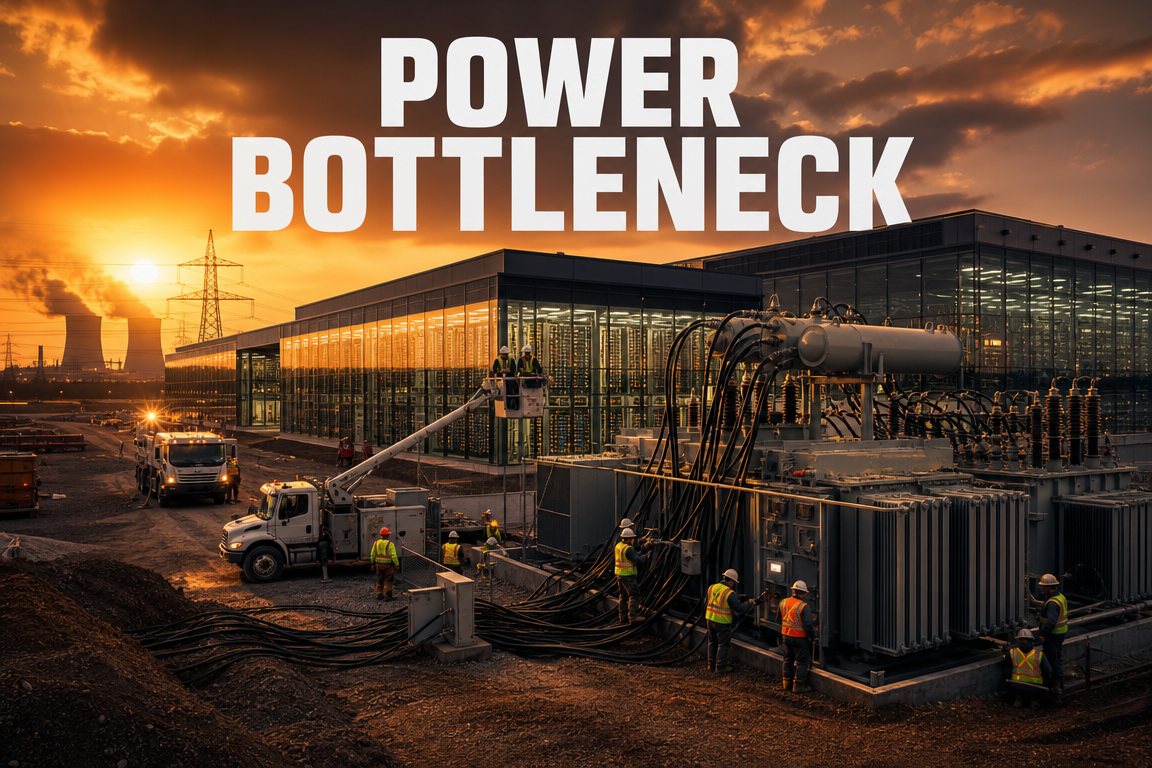
As AI data center investment scales, the bottleneck is shifting beyond GPUs toward power infrastructure: the grid, transformers, interconnection capacity, and related equipment constraints.
As a result, the next multi-year cycle may extend beyond the semiconductor rally to include power equipment, utilities, energy transition capex, nuclear, and renewable grid integration.
This report summarizes, in a news-style format:
- Why AI data centers are structurally power-intensive
- Why the power equipment supercycle is discussed not only through 2030 but potentially into 2035
- Why equities can remain volatile even with strong earnings
- What investors should monitor now
1. Key Takeaway: In the AI Era, the Bottleneck Is No Longer Only Semiconductors
Equity flows have recently re-centered on semiconductors.
Capital has concentrated in names linked to memory (including HBM) and GPU ecosystems, while power equipment equities have consolidated.
The primary risk of missing the broader picture is that, across the AI value chain, the limiting factor is increasingly the ability to deliver reliable power to data centers.
In practice:
- GPUs can be procured, but data centers cannot be built if power availability is insufficient.
- Data centers can be constructed, but commissioning is delayed if grid interconnection is constrained.
- Delays in commissioning slow AI service scaling.
Consequently, markets are increasingly treating power constraints within AI infrastructure as a central variable.
2. Why a Power Equipment Supercycle Emerged: It Began With Aging Infrastructure Replacement
Power equipment outperformance is often framed as an AI data center trade, but the cycle began earlier.
The supercycle accelerated from 2023, initially driven more by replacement of aging power infrastructure and reshoring-related industrial policy than by AI.
In the US in particular, replacement demand for legacy grid assets increased materially. This was reinforced by:
- manufacturing relocation,
- higher industrial power demand,
- electrification trends.
From 2024 onward, AI data center demand added incremental load, expanding the cycle beyond a standard replacement phase.
The current cycle is best viewed as a composite of:
- legacy grid replacement demand
- renewable grid-connection demand
- incremental AI data center power demand
- electrification and manufacturing reshoring
3. Why the Cycle May Be Longer: Rationale for a 2035 Discussion, Not Just 2030
Semiconductor cycles typically exhibit higher volatility.
Power infrastructure differs structurally:
- long lead times to permit and build,
- multi-year project execution once initiated,
- long-lived assets (transformers, switchgear, substations) rather than short-cycle products.
If legacy replacement alone supported an approximately 6-year cycle historically, the addition of renewable integration and AI-driven demand creates conditions for a longer expansion phase.
Hence, while many forecasts reference backlog visibility through 2030, the cycle is increasingly discussed as potentially extending toward 2035, supported by the view that power demand growth is outpacing the speed of infrastructure expansion.
4. Why AI Data Centers Intensify Power Constraints
AI data centers require significantly higher power density than conventional server facilities.
They involve large-scale GPU deployments, enhanced cooling, and stricter requirements for power quality and reliability.
The core issue is not merely generation capacity, but whether the system can deliver power to the required location, with required quality, on schedule.
Bottlenecks typically emerge across three layers:
- generation constraints: insufficient supply expansion
- transmission and distribution constraints: insufficient lines and capacity to deliver power
- equipment constraints: transformer, breaker, switchgear supply and installation delays
The third layer is frequently underestimated. Operationally, transformer availability and interconnection delays can be the binding constraint, and are also implicated in permitting and commissioning timelines.
5. Why “Power Constraints Arrived Before GPU Constraints” Matters
A key observation is that power infrastructure shortages may have surfaced earlier than GPU bottlenecks.
Markets often focus on areas where prices have already surged, which in 2024–2026 has been concentrated in GPUs and memory supply dynamics.
However, power equipment manufacturing has long lead times and limited short-term capacity expansion, implying that effective shortages may have started earlier in the physical economy than reflected in market attention.
This gap helps explain why capital market narratives and real-economy constraints can diverge.
6. How Geopolitical Risk and Energy Transition Reinforced Grid Investment
This theme is not fully explained by AI alone.
Following elevated geopolitical risk in the Middle East, energy security has regained priority, increasing pressure on governments to stabilize energy supply structures.
Fiscal expansion has increasingly supported not only defense but also:
- energy transition capex,
- supply chain restructuring,
- grid reinforcement.
Energy transition in this context reflects:
- energy mix transition: reducing fossil dependence, expanding nuclear and renewables
- diversification of supply: lowering reliance on specific regions and resources
These shifts are structurally associated with higher grid investment because changes in generation require corresponding grid and interconnection buildout.
Renewables, in particular, are more sensitive to interconnection and grid stability, sustaining demand for transformers, switchgear, and transmission-related capex.
7. Nuclear, Renewables, and Utilities: Better Framed as an Integrated System
The market often frames nuclear versus renewables as a binary trade-off. In a scenario of simultaneous AI expansion and electrification, both may be required.
- nuclear: large-scale stable baseload capacity
- renewables: long-term cost and security-driven expansion
- utilities and power equipment suppliers: entities enabling system-level integration and reliability
For investment analysis, separating layers improves precision:
- generation: nuclear, gas, renewables
- delivery: transmission, distribution, substations
- equipment: transformers, breakers, protection systems
- operations: utilities, grid stabilization solutions
8. Why Power Equipment Earnings Are Strong: A Supplier-Favorable Market Structure
The sector has been supported not only by expectations but by realized earnings.
Since 2023, operating profit has increased materially across power equipment companies, with some reporting triple-digit annual growth rates.
Growth rates may decelerate, but earnings expansion is still expected to remain elevated near term.
The mechanism is straightforward:
- demand exceeds supply
- production lead times are long
- capacity cannot be expanded quickly
- customers face urgency to secure equipment
This structure shifts pricing power to suppliers, supporting higher ASPs, margin expansion, and EPS growth.
With backlog converting into revenue over time, earnings visibility is often higher than in typical cyclical rebound industries.
9. Why Equities Can Be Volatile Despite Strong Earnings: Earnings Growth Is Not the Same as Stock Performance
This is critical for investors.
In real-economy terms, a 60% increase in operating profit is substantial. Capital markets, however, can react more to the direction of the growth rate than to absolute profit levels.
Example dynamic:
- earnings continue to rise
- but increase less than expected
- valuation multiples compress
- the equity corrects
In growth segments, elevated expectations can turn strong results into catalysts for profit-taking if growth deceleration is perceived.
10. Is the Power Theme Still Early? More Consistent With “Early Mid-Cycle”
Many investors focus on entry timing.
A conservative framing is that the power equipment upcycle is no longer in the earliest stage; the theme is broadly recognized and earnings strength has been partially demonstrated.
However, it is not necessarily a peak-out scenario. The base case is better described as:
- not an “undiscovered, deeply discounted” phase
- but a “mid-cycle with continued earnings runway” phase
Positioning depends on return objectives:
- near-term expectations of 100% upside: higher risk
- medium-term 30–50% upside: case-dependent
- 3–5 year durability focus: still relevant
Accordingly, investors may prioritize earnings visibility, backlog, valuation, and company-specific capacity expansion potential rather than momentum-based allocation.
11. Semiconductors vs. Power: The Key Variable Is the Time Horizon
Semiconductors may lead in the short term, especially in AI chips, HBM, and memory where earnings growth can be sharper.
Power equipment is typically characterized by steadier growth, often with recurring 30–50% style expansion rather than extreme spikes.
The relationship is less competitive than complementary: both are structural components of the AI ecosystem, operating on different time scales.
12. Indicators Investors Should Monitor
To assess AI data center expansion and power infrastructure constraints, key indicators include:
- global data center CAPEX growth rates
- upward revisions to power demand forecasts in the US and other major markets
- lead time trends for transformers, breakers, and related equipment
- transmission permitting progress and interconnection queue size
- order backlog and ASP trends for power equipment suppliers
- approval velocity for nuclear and renewable projects
- sovereign yield levels and growth-equity valuation sensitivity
These variables interact. Higher yields can pressure multiples, but sectors with durable backlog and earnings delivery may show relative resilience.
13. Underemphasized Points in Typical Coverage
Three core points are often underweighted:
1) The binding constraint is not generation volume; it is interconnection capacity
Power shortages are not purely aggregate supply issues. The decisive factor is whether interconnection, substation capacity, and T&D equipment can connect supply to load centers.
2) The power equipment supercycle is not an AI-only theme; it is an industrial restructuring theme
AI is a major catalyst, but the foundational drivers include aging grid replacement, reshoring, energy security, electrification, and renewable interconnection. A moderation in AI capex does not automatically imply a collapse in total infrastructure demand.
3) The primary market risk is expectation overheating, not immediate end-of-cycle
Even with strong earnings, growth-rate deceleration can trigger valuation compression. Differentiation by company fundamentals and valuation is likely to increase.
14. Investor-Oriented Summary
Short term
- semiconductor positioning may remain more crowded
- power equities may consolidate
- growth-rate deceleration concerns can increase volatility
Medium term
- continued AI data center buildout can further highlight grid bottlenecks
- backlog and ASP expansion can continue to support power equipment earnings
- energy transition and utility CAPEX may reinforce the cycle
Long term
- potential for a structural upcycle extending into 2030–2035
- tighter coupling of nuclear, renewables, transmission/distribution, and data centers
- power infrastructure may increasingly be treated as a strategic asset class within global economic restructuring
15. Conclusion: The More Precise Thesis Than “Power After Semiconductors”
The more accurate framing is:
As AI scales, semiconductor value rises while power infrastructure scarcity becomes increasingly explicit.
This scarcity is supported by observable factors: backlog, supplier-favorable pricing, energy transition capex, and grid expansion constraints.
Market focus may broaden from semiconductors alone to include the grid and power equipment required to operationalize AI at scale.
< Summary >
AI data center expansion is shifting the primary constraint from semiconductors toward power infrastructure.
The power equipment supercycle began not only from AI demand but from overlapping drivers: aging grid replacement, reshoring, energy transition, and renewable interconnection.
The cycle is increasingly discussed as potentially extending beyond 2030 and into 2035.
The key bottleneck is less about generation volume and more about transformers, transmission/distribution capacity, and interconnection capability.
Power equipment fundamentals can remain strong under supplier-favorable conditions, but equities may react sensitively to earnings growth-rate deceleration.
Semiconductors may lead near term, while power infrastructure may gain greater strategic relevance over the medium to long term as a core enabler of AI scaling.
[Related Articles…]
- Data Center Power Demand and Grid Interconnection Constraints
- Transformer Lead Times and the Power Equipment Supercycle
*Source: [ 경제 읽어주는 남자(김광석TV) ]
– 반도체 다음은 전력? AI 데이터센터가 만드는 진짜 병목 | 경읽남과 토론합시다 | 손현정 연구원 [1편]