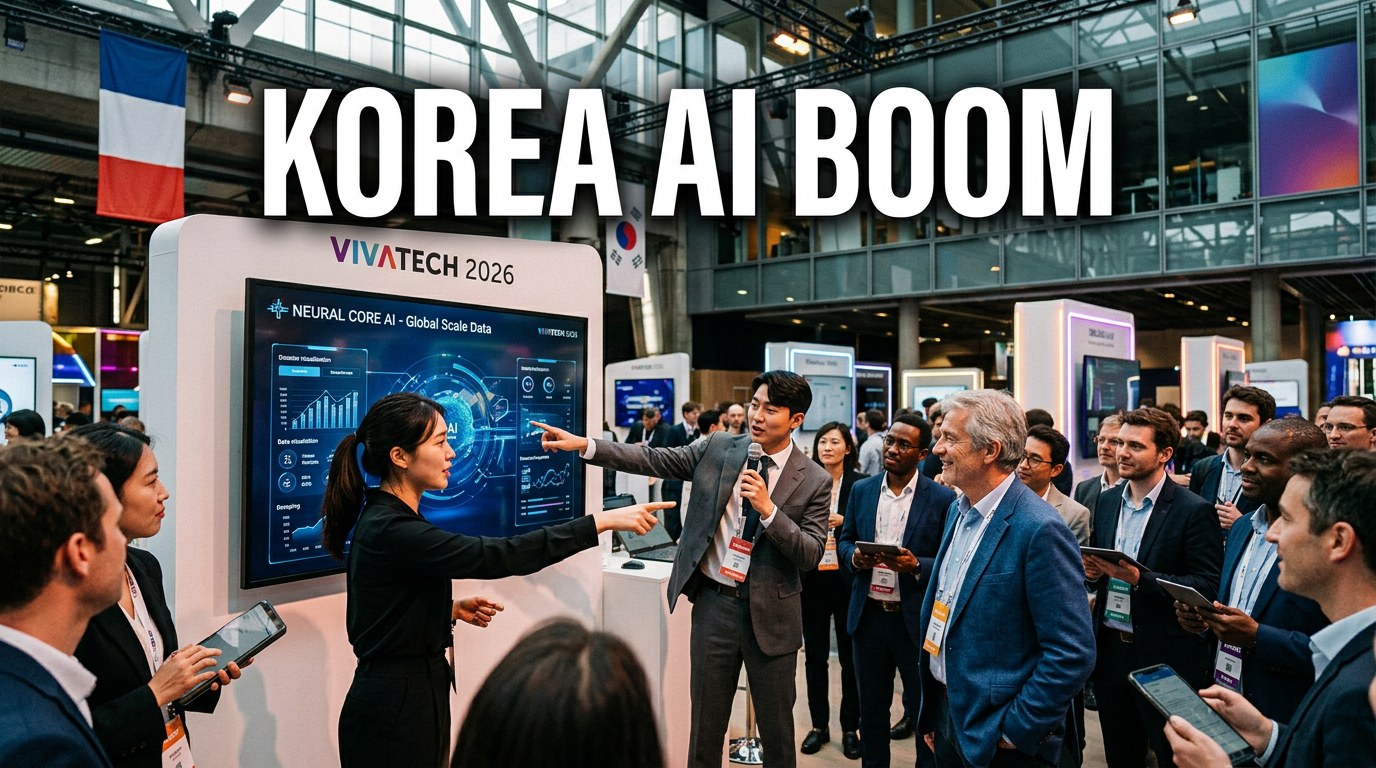
● Europe Embraces Korean AI That Passes GDPR and Delivers Real ROI
The Real Reason French Visitors Flocked to Korean AI Startups at VivaTech 2026
What stood out at VivaTech 2026 was not “how stylishly AI was presented.”
What French investors and buyers obsessively checked was whether it actually worked in real customer settings, whether it could withstand European regulations, and whether it solved a problem clearly enough to justify paying for it.
The six Korean AI startup teams that participated in the integrated K-Startup pavilion brought “field-ready AI” into completely different areas: offices, manufacturing plants, digital twins, perfume, K-beauty, and real-time interpretation.
In particular, the European market is not easy to break into with technical strength alone.
Companies must be vetted simultaneously on data security, GDPR, sustainability, local references, and industry-specific adoption potential.
For that reason, this case is not just a simple trade show appearance; it is an important scene showing how Korean AI startups can seek investment and business expansion amid the global economic outlook.
1. The Core Message of VivaTech 2026: Real Impact, Not AI Fantasy
This year’s keyword at VivaTech was closer to “impact” than flashy AI demos.
In other words, the atmosphere had moved past the stage where generative AI is merely impressive and into the stage where it must solve real-world problems in cost, time, productivity, and customer experience on the industrial front line.
Many startups at the venue positioned AI as their core technology, but French local investors were not satisfied with a simple explanation of “we use AI.”
Instead, they focused more on the following questions.
- Is this AI already operating at real customer companies?
- Where is the data stored, and how is it protected?
- Can it comply with Europe’s GDPR and industry-specific regulations?
- Is there a chance it will convert from PoC to a paid contract?
- Does it meet the purchasing criteria of the European market, which differs from those of the U.S. and China?
This is the important point.
The axis of competition in the AI industry is shifting from model performance to field applicability, regulatory responsiveness, and data infrastructure capabilities.
For companies pushing digital transformation, “AI adoption” itself is no longer the goal; the key takeaway is whether it connects to actual business processes.
2. The K-Startup Integrated Pavilion by the Korea Institute of Startup & Entrepreneurship Development: A Stage Aimed at Deals, Not Exhibits
The six Korean AI startup teams did not go to Paris independently.
The Korea Institute of Startup & Entrepreneurship Development formed the K-Startup integrated pavilion with seven organizations and connected pre-departure capability-building training, local investor matchmaking, K-Startup Night, and IR pitching.
The goal was not simple promotion, but local investment, PoC, partnerships, and contract conversion.
The institute views Europe as a core market within the world’s top three economic regions, following the U.S. and China.
However, Europe is not a market that looks only at product completion.
It evaluates market fit, sustainability, data security, and regulatory responsiveness together.
That is why Korean startups entering Europe must build trust that says “European companies can adopt this safely” rather than merely “the technology is good.”
3. StepHau: Connecting Scattered Office Data with an AI Agent
The first company is StepHau, which develops an in-house AI agent service.
StepHau’s service is “Whisly AI.”
It integrates documents, ERP, groupware, and SaaS data scattered across a company through RAG technology, helping employees search, analyze, and generate information easily.
Many companies already have enormous amounts of data.
But when they actually need it, they cannot find the information they want.
That is because reports, contracts, meeting minutes, inventory data, ERP materials, and customer support records are scattered across different systems.
StepHau is solving this problem with an AI agent.
- Main target: legacy industries such as manufacturing, logistics, and energy
- Main customer departments: IT teams, informatization teams, AX teams
- Core technology: in-house data integration and search based on RAG
- European expansion point: PoC reference with Tallinn City Hall in Estonia
- Regulatory response: ISO certification, GDPR compliance, security standard adherence
What stood out in particular was that it began a PoC with Tallinn City Hall in Estonia.
Estonia is a country known for digital government and e-administration.
A public-sector reference from there can be a meaningful trust asset for entering the European market.
Starting with Estonia, StepHau is laying out a strategy to expand into France, Germany, and eventually the entire European Union.
What European investors asked most often was ultimately data security and regulatory compliance.
This is likely to become one of the most important purchasing criteria in the enterprise AI agent market going forward.
4. Ingkle: The Starting Point of the AI Factory Era Is Manufacturing Data Collection
The second company is Ingkle, which creates an AI data platform for manufacturing sites.
Ingkle provides solutions that collect and analyze data generated by factory facilities and equipment to improve quality, productivity, cost, and time.
Manufacturing sites are places with very high demand for AI adoption.
But when companies actually try to apply AI, they first run into a problem.
That problem is that the data simply is not collected properly.
Factory equipment pours out data in 1ms increments, but due to capacity issues, security concerns, and cost issues, it is often left in a state where AI cannot use it effectively.
- Main target: manufacturing companies, smart factories, industrial automation sites
- Core function: equipment data collection, analysis, and control
- Problems solved: quality issues, productivity declines, predictive maintenance, cost reduction
- Technical differentiation: onsite data processing that keeps factory data from being exported outside
- VivaTech demo: robot data collection and robot control demonstration
The point Ingkle emphasized was that “AI factories are no longer optional; they are essential.”
Whereas smart factories in the past were centered on automation and monitoring, AI factories extend to prediction, judgment, and control based on collected data.
But the starting point of an AI factory is not a grand model; it is the data infrastructure.
European manufacturers were interested in Ingkle for exactly this reason.
Europe is a market highly sensitive to manufacturing data security.
Ingkle proposed a direction in which data does not leave the factory but can still be collected, turned into big data, and analyzed with AI inside the plant.
For companies considering manufacturing innovation, the ability to adopt AI without the burden of moving to the cloud is attractive.
5. Greeneta: The Bottleneck in Digital Twins Is 3D Data Volume
The third company is Greeneta, which has digital twin 3D data compression technology.
Greeneta solves the massive data volume problem that occurs when digital twin data is reconstructed in 3D.
It explained that data can be compressed by up to 99.6% without loss.
Digital twins are becoming increasingly important in the energy, shipbuilding, construction, manufacturing, and robotics industries.
That is because real-world facilities and spaces can be replicated in 3D for monitoring, inspection, simulation, and robot training.
The problem is that 3D scan data is too heavy.
It lags when opened on the web, is difficult to use for real-time monitoring, and is not easy to connect to precise simulations.
- Main product: Optimizer 2.0
- Core technology: lossless compression of 3D data by up to 99.6%
- Product form: expanding from SaaS to on-premises and Windows-installed versions
- Main applications: energy facilities, shipbuilding, manufacturing, digital twins, robot training
- Companies of interest: discussions related to Siemens, PwC, and Hyundai Heavy Industries PoC
Many European energy facilities are old, and some have no blueprints.
To digitize such facilities, 3D scanning is necessary.
But after scanning, the data volume becomes so large that management and use become difficult.
Greeneta is a deep-tech company trying to solve exactly this bottleneck.
What was interesting on site was the reaction from investors.
Greeneta said that after its investor pitch, it received such a positive response that it was mentioned as having an investment intention worth around 15 billion won.
This case can also be seen as a sign that not only AI startups but also digital twins, industrial data, and infrastructure software are being rewatched in the investment market.
6. Bonjak: Can AI Recommendations Work in the French Perfume Market?
The fourth company is Bonjak, which unveiled an AI-based perfume recommendation service.
Bonjak operates the niche perfume brand “Selvatico” and the perfume recommendation services “Centpedia” and “Cent ID.”
The concept is “Made in France, Engineered in Korea.”
The perfume market is relatively slow to shift online.
Its online purchase share is lower than that of fashion or interior goods.
The reason is simple.
There is a strong perception that scent must be experienced directly.
But Gen Z and millennials are already consuming fragrance through language and imagery.
They explain scent notes in communities, share the perfumes they use, and receive taste-based recommendations.
Bonjak’s strategy is to combine this trend with quantified fragrance data and AI recommendations.
- Main services: Centpedia, Cent ID
- Core method: analysis based on photos of owned perfumes and personalized taste matching
- Market problem: low conversion rate for online perfume purchases
- Differentiation: highly structured perfume and fragrance ingredient data
- Main achievements: PoC with L’Oréal Korea, participation by global fragrance company shareholders, meetings with L’Oréal France headquarters and Estée Lauder
France is the birthplace of perfume.
So a Korean startup bringing AI perfume recommendations to France is a fairly ambitious attempt.
But Bonjak sees new opportunities in combining France’s upstream fragrance industry with Korea’s digital recommendation technology.
This case shows the direction of consumer AI well.
AI is evolving beyond a chatbot that simply provides consultation into commerce infrastructure that links taste data and purchase conversion.
7. WooDang Network: Turning K-Beauty Popularity into AI Recommendations
The fifth company is WooDang Network, which develops an AI-based K-beauty recommendation service.
WooDang Network’s service “Hapic” diagnoses a user’s skin condition and recommends Korean cosmetics products based on the result.
At the venue in France, there was a line of visitors at WooDang Network’s booth.
This is not just interest in AI technology.
It means K-beauty’s popularity is expanding into a need for actual purchase information.
- Main service: Hapic
- Core functions: skin diagnosis, product scanning, ingredient analysis, personalized suitability score
- Differentiation: Korean cosmetics DB and an expertly designed full-ingredient filter
- AI usage: product recognition, matching customer skin condition with product suitability
- Goal: contracts with offline K-beauty stores in France and Europe
The core of Hapic is answering the question, “Is this product right for me?”
For overseas consumers, even if Korean cosmetics are popular, it is hard to know the ingredients, usage, and skin compatibility.
WooDang Network aims to solve this problem with skin diagnosis and a product database.
It especially emphasized that its recommendation logic was designed with researchers and PhD-level experts who know Korean cosmetics best.
This shows the possibility that K-beauty will evolve beyond a simple export product into data-driven personalized commerce.
In the European market going forward, if K-beauty distributors and offline stores attach such recommendation solutions, they can raise both purchase conversion and customer satisfaction.
8. SconAI: Field Response Created by 1.2-Second Ultra-Low-Latency AI Interpretation
The final company is SconAI, which created the AI simultaneous interpretation service “Scon.”
SconAI emphasized ultra-low-latency AI translation, providing interpretation results within 1.2 seconds from the moment a person begins speaking.
Typical interpretation services often take around 5 to 7 seconds after speech ends before producing results.
By contrast, SconAI aims for a delay short enough not to interrupt the flow of conversation.
This difference is significant in global events, IR pitching, international conferences, and business meetings.
- Main service: Scon AI simultaneous interpretation
- Core performance: interpretation within 1.2 seconds after speech starts
- Differentiation: contextual understanding, automatic language detection, continuous interpretation
- Technical base: self-developed LLM
- Use cases: interpreting global leaders such as Jensen Huang at APEC 2025, supporting specialized conversations such as fusion and semiconductor supply chains
Another point SconAI emphasized was contextual understanding.
For example, the word “hot” can mean warm, spicy, or heated depending on context.
SconAI identifies whether the conversation is about weather, food, or coffee by understanding the broader context and interprets accordingly.
Automatic language detection is also important.
Even if users speak Japanese, English, French, Arabic, or other languages, it can interpret without manually changing the input language.
It was also used at the K-Startup Night IR pitching event held before the opening of VivaTech and received a strong response from local attendees.
This technology can go beyond convenience and become infrastructure that lowers barriers to global business.
For startups, SMEs, and export companies, language barriers are the most practical cost of entering overseas markets.
9. Core Comparison of the Six Korean AI Startups
| Company | Field | Core Technology | Reason It Drew Attention in Europe |
|---|---|---|---|
| StepHau | Enterprise AI agent | In-house data integration based on RAG | GDPR, security, and public-sector PoC references |
| Ingkle | Manufacturing AI data platform | Equipment data collection, analysis, and control | Applying AI without exporting factory data outside |
| Greeneta | Digital twin | Lossless compression of 3D data by 99.6% | Solving data bottlenecks in energy, shipbuilding, and manufacturing sites |
| Bonjak | AI perfume recommendation | Taste recommendations based on perfume and fragrance data | Combining the French perfume industry with Korean AI recommendation technology |
| WooDang Network | AI K-beauty recommendation | Skin diagnosis, ingredient analysis, product suitability | Connecting K-beauty demand to personalized purchasing |
| SconAI | AI simultaneous interpretation | 1.2-second ultra-low-latency translation | Removing language barriers in global events and business meetings |
10. The Most Important Point Other News Often Misses
The most important thing in this VivaTech case is not that “Korean AI startups became popular in Europe.”
The real key takeaway is that Europe’s AI purchasing criteria have already changed.
First, Europe looks at data sovereignty before AI model intelligence.
The reason StepHau and Ingkle drew attention is not simply that they are good at AI.
It is because they proposed a structure for safely handling internal company data and factory data.
In the future B2B AI market, “our model is better” may be less persuasive than “we do not send your data anywhere dangerous.”
Second, PoC references are becoming the currency of European expansion.
Actual verification examples with institutions and companies, such as the Tallinn City Hall PoC, the L’Oréal Korea PoC, and discussions related to Hyundai Heavy Industries, are needed before the next meeting opens.
European companies are interested in new technology, but they are cautious about adoption.
Therefore, small proof-of-concept cases with local or global companies become key assets for investment attraction and contract conversion.
Third, the competitiveness of AI startups depends on the depth of industrial data.
Each company handles very different data, such as perfume data, cosmetic ingredient data, manufacturing equipment data, 3D scan data, and in-house work data.
In the AI market going forward, the battle will likely not be about general-purpose AI alone, but about how deeply a company understands and structures the data of a specific industry.
Fourth, the strength of Korean startups lies in fast productization and field adaptability.
Europe is strong on regulation and trust, while Korea is fast in execution and in reflecting customer feedback.
If that combination clicks, Korean AI startups can build strong positions in niche industries without confronting U.S. big tech head-on.
11. Implications from the Global Economic Outlook Perspective
Looking at the global economic outlook, companies are still under pressure to cut costs and improve productivity.
After the era of high interest rates, investment decisions have become more difficult, and AI investment is also shifting from “experimentation” to “ROI” centric decisions.
The Korean AI startups highlighted at VivaTech were all aligned with this trend.
- StepHau improves office productivity.
- Ingkle solves cost and quality issues on manufacturing sites.
- Greeneta reduces the cost and speed issues of digital twin infrastructure.
- Bonjak raises online perfume purchase conversion rates.
- WooDang Network lowers the failure rate of K-beauty purchases.
- SconAI reduces global communication costs.
Ultimately, what they have in common is connecting AI to cost reduction, revenue growth, and improved customer experience.
Going forward, this practical type of AI is likely to receive higher evaluations in the investment attraction market as well.
12. What to Watch Next
The first thing to watch is whether PoCs convert into paid contracts.
Being noticed at a trade show and actually closing a deal are completely different matters.
It is important whether companies like StepHau, Bonjak, and Greeneta, which are already in PoC or partner discussions, can turn that into actual revenue.
The second is securing local partners in Europe.
The European market differs by country in language, regulation, and purchasing culture.
Positive reactions in France do not automatically mean the same structure will work in Germany, Italy, or Spain.
Connections with local distributors, SI companies, industrial partners, and investment firms are essential.
The third is demand for on-premises and security-focused AI.
Manufacturing, energy, and public institutions are extremely cautious about sending data to external clouds.
So in the future B2B AI market, on-premises, private AI, and security-focused AI agents may become even more prominent.
The fourth is the sophistication of industry-specific AI.
The general chatbot market is fiercely competitive, but AI that goes deep into a specific industry—such as manufacturing data, 3D data, cosmetic ingredients, fragrance, and real-time interpretation—has strong differentiation potential.
< Summary >
At VivaTech 2026, six Korean AI startup teams drew major attention from local French investors and buyers.
StepHau presented an AI agent that connects in-house data, Ingkle presented a manufacturing AI data platform, and Greeneta unveiled 3D data compression technology for digital twins.
Bonjak drew attention for AI perfume recommendations, WooDang Network for AI K-beauty recommendations, and SconAI for 1.2-second ultra-low-latency AI interpretation.
The core point was not AI technology itself, but actual field applicability, data security, GDPR response, PoC references, and the possibility of paid contracts.
For Korean AI startups to grow in the European market going forward, they must prove not only technical strength but also regulatory responsiveness and industry-specific data competitiveness.
[Related Articles…]
- European AI market growth strategies attracting attention from startups
- Analysis of global investment attraction trends for K-startups
*Source: [ 티타임즈TV ]
– 프랑스 관람객이 한국 AI 스타트업에 몰린 이유