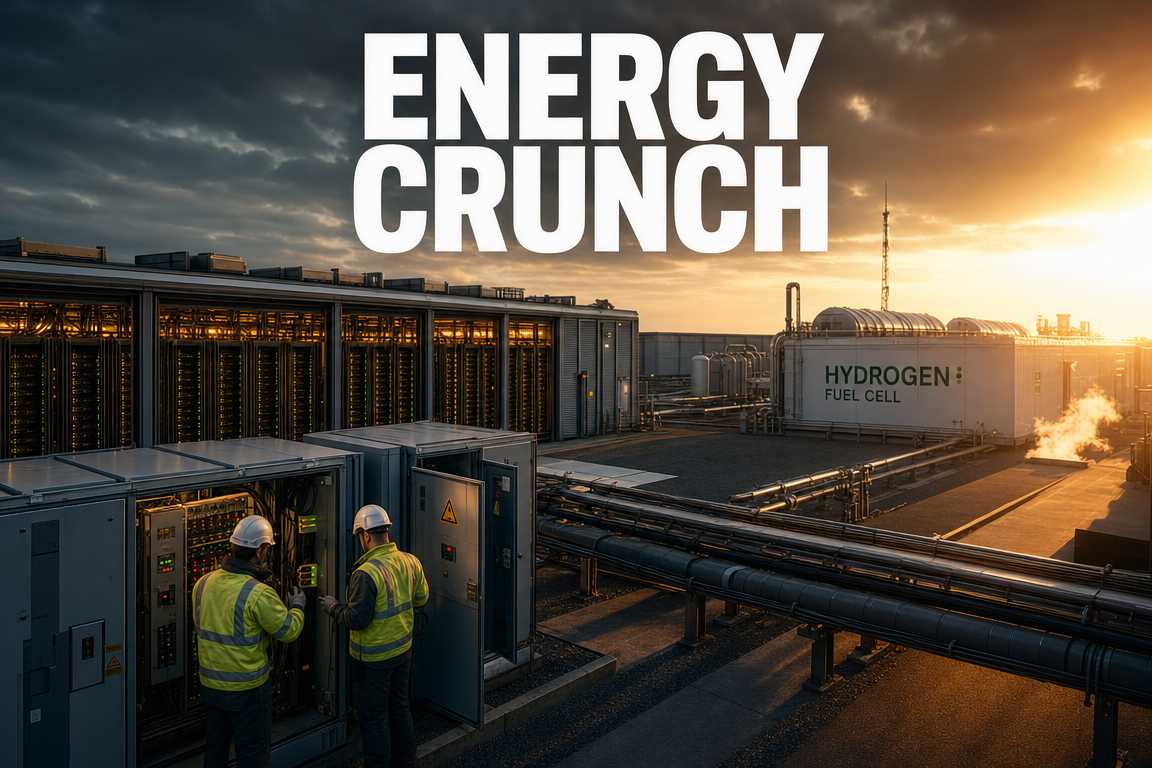
● AI Power Boom, Jensen Huang Sparks Infrastructure Surge
Is Power More Important Than AI Semiconductors? AI Power Infrastructure Beneficiaries to Watch After Jensen Huang’s Remarks
The core of this issue is straightforward.
Even if AI semiconductors improve, AI services cannot operate without electricity reaching the data center.
This is the point Jensen Huang at Nvidia has continued to emphasize.
The bottleneck in AI competition is shifting from GPUs to power.
This report summarizes U.S. regulatory easing in the power sector, data center power shortages, the Bloom Energy report, Jensen Huang’s five-layer cake theory, and AI power infrastructure beneficiaries in the U.S. equity market.
The key point often overlooked in other coverage is that future returns in AI infrastructure may increasingly depend on how cheaply, quickly, and with how little local opposition electricity can be delivered.
1. The United States Has Moved: Easing Rules for AI Data Center Power Interconnection
The main driver behind the recent rally in power-related stocks is a move by U.S. energy regulators.
The key issue is that AI data centers in the United States are growing rapidly, but outdated grid interconnection rules are delaying actual power delivery.
In practical terms, data centers are being built, but electricity cannot be connected in time, pushing back operations.
This reflects a broader shift in the AI infrastructure bottleneck from semiconductor shortages to power grid constraints.
- U.S. grid interconnection standards have been criticized as remaining tied to a decades-old system.
- AI data center power demand is rising rapidly, but approval processes and regulations are not keeping pace.
- Bipartisan support has reportedly emerged among energy commissioners for regulatory reform.
- Authorities are seeking to move quickly, with a 30-day review and 60-day reform proposal timetable mentioned.
The key point is that, regardless of political affiliation, there is growing consensus that power infrastructure expansion is necessary for U.S. AI leadership.
In the U.S. equity market, policy support is a powerful catalyst.
For power infrastructure industries that require long-duration capital investment, regulatory easing can directly affect earnings and valuation.
2. Why Is Power Interconnection So Urgent?
AI data centers operate on a completely different scale of power consumption from ordinary buildings.
Large-scale GPU servers, cooling systems, network equipment, and backup power systems operate 24/7.
Power usage becomes even more intensive as AI agents and inference services expand.
In the past, AI training consumed large amounts of electricity over concentrated periods.
Inference, however, requires real-time model execution every time a user submits a query.
As a result, power demand is shifting from episodic to persistent.
- AI training uses large amounts of electricity in concentrated bursts.
- AI inference consumes power continuously around the clock.
- In the AI agent era, user request volume may further accelerate data center power demand.
- Delays in grid interconnection lead to delays in data center commissioning.
- Data center delays can affect cloud services, AI applications, and semiconductor demand more broadly.
Accordingly, securing power for data centers is not merely a utility issue.
It is a core infrastructure issue that determines the pace of AI industry growth.
3. Key Ideas Emerging From U.S. Regulatory Easing Discussions
A notable point in the original material is how to reduce grid interconnection waiting queues.
There are many companies seeking electricity, and if all must wait in sequence, the process can take years.
Accordingly, U.S. discussions appear to have focused on prioritizing companies that meet certain conditions.
3-1. Prioritizing Companies With Self-Secured Power Sources
The first idea is to prioritize companies that can secure their own power supply.
For example, this would include companies that install generation facilities next to a data center or deploy on-site power supply systems.
Although this proposal was not ultimately adopted, the policy direction itself is significant.
It signals how urgently the United States is viewing the power challenge for data centers.
3-2. Prioritizing Companies That Can Manage Peak-Time Power Demand
The second idea is to give priority to companies that can reduce power consumption during peak demand periods.
If data centers can respond flexibly during periods of high electricity demand, such as summer cooling peaks, grid stress can be reduced.
Prioritizing such companies would help support both grid stability and AI infrastructure expansion.
3-3. Prioritizing Companies That Do Not Pass Grid Costs to Households
The third point is politically important.
If data centers increase the need for grid investment and those costs are passed on to households through higher electricity bills, public resistance may intensify.
For that reason, discussions have reportedly centered on giving preference to companies that do not excessively transfer grid costs to consumers.
This may become a critical criterion for future data center investment.
Companies that can reduce cost conflict with local communities may be valued more highly than those that simply secure large amounts of electricity.
4. AI Power Infrastructure Beneficiaries Highlighted by the Issue
As this power infrastructure theme gained attention, related companies rallied in the U.S. equity market.
The move extended across power generation, generators, gas turbines, cooling, power management, and grid construction companies.
The trend indicates that AI infrastructure investment is expanding beyond GPUs into the broader power infrastructure stack.
4-1. Bloom Energy: A Leading Beneficiary of On-Site Power Supply
The company most prominently referenced in the original material is Bloom Energy.
Bloom Energy provides on-site power supply solutions based on hydrogen fuel cells.
The key appeal is its ability to deliver electricity directly next to the data center.
Market attention has increased because it can supply power near the facility without relying on complex long-distance transmission interconnection.
- It has emerged as a direct beneficiary of AI data center power shortages.
- Its model is based on hydrogen fuel cell power generation.
- On-site power supply can help reduce grid interconnection bottlenecks.
- It may also reduce local opposition and transmission construction burdens.
That said, Bloom Energy’s report also emphasizes the advantages of its own business model.
From an investment perspective, growth potential should therefore be assessed alongside earnings stability, profitability, and policy dependence.
4-2. Caterpillar: Demand for Backup Generators at Data Centers
Caterpillar is widely known as a construction equipment company, but it is also an important player in large generator markets.
Data centers cannot tolerate power interruptions.
As a result, backup generators and emergency power systems are essential.
As AI data centers expand, demand for large generators may increase as well.
4-3. GE Vernova: Gas Turbines and Power Generation Equipment
GE Vernova is drawing attention in power generation and electrical equipment.
In particular, gas turbines are a key area tied to rising data center power demand.
Even amid the transition to renewable energy, gas-fired power remains important for reliable electricity supply.
Because AI data centers require stable 24/7 power, gas turbine-related companies are regaining attention.
4-4. Vertiv: A Critical Company in Cooling and Power Management
Vertiv provides data center power management and cooling solutions.
AI servers generate substantially more heat than conventional servers.
As GPU density increases, the importance of cooling systems rises accordingly.
Beyond electricity supply, efficient power usage and thermal management are becoming core competitive factors for data centers.
4-5. Eaton and Quanta Services: Direct Beneficiaries of Grid Infrastructure Expansion
Eaton provides power management equipment and efficiency solutions.
Quanta Services has strengths in power grids, transmission, and infrastructure construction.
As AI data centers expand, generating electricity alone is not sufficient.
Investment is also required in systems that transmit, transform, manage, and connect power reliably.
For this reason, power grid equipment and construction companies are also moving in step with the AI infrastructure cycle.
5. The Bloom Energy Report’s Core Message: Power Demand Has Accelerated by Five Years
The market reaction to the Bloom Energy report was driven by the upward revision in power demand forecasts.
In particular, the report emphasized that AI inference and the expansion of AI agents have brought forward expected power demand by roughly five years.
This suggests that AI power demand is becoming structural rather than temporary.
- Major Wall Street institutions have continued raising forecasts for data center power demand.
- The AI infrastructure cycle may be in an early phase rather than at a peak.
- AI inference expansion could drive sustained growth in data center electricity usage.
- Survey responses from customers indicate that power availability is the biggest bottleneck in AI infrastructure.
The original material also noted that 51% of AI infrastructure respondents identified power availability as the single biggest issue.
A majority identifying power as the top bottleneck is highly significant.
Semiconductor supply, construction costs, and local opposition matter, but electricity remains the first constraint that must be resolved.
6. Jensen Huang’s Five-Layer Cake Theory: AI Is a Physical Industry, Not Just Software
One of Jensen Huang’s recurring themes is the five-layer structure of AI.
The point is that AI should not be viewed as a purely software-based service.
AI is a large physical industry built on power, semiconductors, data centers, models, and services.
- Layer 1 is energy and power.
- Layer 2 is semiconductors and GPUs.
- Layer 3 is data centers and computing infrastructure.
- Layer 4 is AI models.
- Layer 5 is services and applications.
If Layer 1, power, is constrained, the upper layers cannot function effectively.
No matter how many GPUs are secured, servers cannot run without electricity.
No matter how many data centers are built, delayed grid connections postpone monetization.
This is why Jensen Huang continues to emphasize the power issue.
7. What the United States Is Really Worried About: China’s Cheap Electricity
The most important geopolitical point in this issue is China’s electricity cost advantage.
Jensen Huang has warned that China may have an advantage over the United States in power generation and electricity pricing.
Even if the United States restricts exports of advanced AI semiconductors, China may be able to use relatively inexpensive electricity to run lower-performance chips more extensively and for longer periods.
This point is important.
AI competition is no longer only about who owns the best GPUs, but about who can lower total computational cost.
- The United States has an advantage in high-end semiconductors.
- China may have advantages in electricity cost and state support.
- Cheap power allows lower-performance chips to run longer while maintaining cost competitiveness.
- Ultimately, AI leadership is a competition combining semiconductor performance and electricity pricing.
This is the key issue that is often less emphasized in other coverage.
U.S. semiconductor restrictions alone may not be enough to slow China’s AI progress.
Overall competitiveness in power infrastructure, power costs, and approval speed is becoming critical.
8. This Also Aligns With Larry Fink’s Warning
The original material also referenced comments by BlackRock CEO Larry Fink.
Fink has said that the United States faces shortages in core resources.
Among the areas highlighted were power, computing, chips, and memory.
This structure closely matches Jensen Huang’s five-layer model.
- Power is the foundational infrastructure of the AI industry.
- Chips and memory are the core components of AI computation.
- Computing refers to the data center’s overall processing capacity.
- Models and services are the final output built on this infrastructure.
The fact that leading figures in finance and AI are making similar points is not a trivial observation.
Although concerns about an AI bubble persist, infrastructure demand remains substantial, and bottlenecks are still evident.
Accordingly, semiconductor cycles, memory markets, power infrastructure, and data center investment should be viewed as part of one larger trend.
9. Where the Money Is Moving Now: AI Infrastructure Leaders
The market tone described in the original material is clear.
Capital is not being distributed evenly across stocks; it is concentrating in AI infrastructure leaders.
Memory, semiconductors, data centers, power infrastructure, and related ETFs have shown strong momentum.
By contrast, space-related names, thematic growth stocks, and non-leading sectors have seen relative underperformance.
In such an environment, it is easy to feel left behind.
However, when capital flows concentrate in a specific leading industry, the reason should be assessed rationally.
- The AI infrastructure investment cycle has become a central market theme.
- Semiconductors, memory, data centers, and power infrastructure are moving together.
- Power-related stocks can be seen as an extension of the AI semiconductor theme.
- Short-term volatility may increase after sharp gains, but structural demand should still be monitored.
From an investment perspective, it is important to distinguish between companies with real earnings support and those driven primarily by expectations.
AI infrastructure is a long-term growth theme, but not every related company will benefit equally.
10. ETF Approaches to AI Infrastructure Investing
If individual stocks are difficult to evaluate, ETFs provide an alternative approach.
The original material referred to power infrastructure ETFs, data center-related ETFs, semiconductor ETFs, and memory ETFs.
Exact product names and holdings should be verified before investing.
At a high level, the structure can be summarized as follows.
- Power infrastructure ETFs may include companies such as Bloom Energy, GE Vernova, Vertiv, Eaton, and Quanta Services.
- Data center ETFs may provide diversified exposure to cloud, REITs, cooling, power management, and server infrastructure companies.
- Semiconductor ETFs offer exposure to the AI semiconductor value chain, including Nvidia, Broadcom, AMD, and TSMC.
- Memory ETFs focus on demand growth in DRAM and HBM.
Individual stock investing may offer higher upside, but it also brings greater volatility.
ETFs may provide more moderate returns, but they reduce company-specific risk.
For a sector with a long value chain such as AI infrastructure, ETFs can be a practical option.
11. The Main Point Often Missed in Other Coverage
The most important takeaway from this issue is not simply that power-related stocks rallied.
The real point is that AI competitiveness is expanding beyond semiconductor performance to include power access capability.
11-1. Grid Interconnection Queues May Become a New Barrier to Entry
Future data center operators will need more than land and servers.
They will also need grid interconnection approvals, local community consent, and an acceptable power cost structure.
Companies that can move through this process quickly may gain a significant competitive advantage.
11-2. Electricity Cost Pass-Through May Become a Political Risk
If data centers increase local grid costs, household electricity bills may rise.
In that case, public resistance and political pressure may increase.
Going forward, the key question may shift from who consumes the most power to who places the least social burden on the power system.
11-3. On-Site Power Providers May Receive a Premium
Models such as Bloom Energy, which can supply electricity directly near data centers, may help bypass grid bottlenecks.
These companies may be evaluated not merely as power generators, but as bottleneck-solvers within AI infrastructure.
11-4. China’s Cheap Electricity Is a Hidden Risk to U.S. AI Leadership
The United States leads in AI semiconductors, but if China holds an electricity cost advantage, the long-term competition becomes more complex.
Ultimately, AI competition is a total contest involving GPU performance, power prices, data center efficiency, and government support.
12. Key Points to Monitor Going Forward
- Whether U.S. grid interconnection regulatory easing translates quickly into actual legislation or administrative action.
- Order trends and earnings guidance for Bloom Energy, GE Vernova, Vertiv, Caterpillar, Eaton, and Quanta Services.
- Whether data center power contracts and on-site generation adoption continue to increase.
- Whether growth in AI inference demand translates into actual capital spending by cloud providers.
- Whether memory, HBM, GPUs, and power infrastructure continue to move in the same direction.
- Macro events such as Micron earnings and Qualcomm’s investor day, which may affect AI semiconductor volatility.
At this stage, AI infrastructure should be viewed as one integrated industrial chain.
Semiconductors alone are not enough, and power stocks alone are not enough.
The broader market signal becomes clearer when power, semiconductors, memory, data centers, cooling, and grid construction are analyzed together.
< Summary >
The expansion of AI data centers has made power shortages a central issue in the United States.
U.S. regulators are moving toward easing outdated grid interconnection rules.
Jensen Huang describes AI as a physical industry built on layers of power, semiconductors, data centers, models, and services.
If the bottom layer, power, is constrained, the broader AI industry may face delays.
Bloom Energy is drawing attention for its on-site power supply model, and Caterpillar, GE Vernova, Vertiv, Eaton, and Quanta Services are also being cited as AI power infrastructure beneficiaries.
As AI inference and AI agents scale faster, data center power demand may rise more quickly than previously expected.
Future AI investment analysis should incorporate not only semiconductors, but also data center power, power infrastructure, cooling, and the speed of grid interconnection.
This report is for information purposes and does not constitute a buy or sell recommendation for any specific stock.
[Related Articles…]
- AI Data Center Power Infrastructure Investment Cycle Review
- U.S. Semiconductor Cycle and AI Infrastructure Beneficiaries Analysis
*Source: [ 소수몽키 ]
– AI 반도체보다 더 중요한 건 전력? 젠슨 황 폭탄 발언의 수혜주들
● Tsunami, Surge, Breakout
SK Hynix’s July Nasdaq Listing Issue, KRW/USD Near 1,550, and Meta’s Entry-Level Smart Glasses
The key issue is not simply that “SK Hynix is going to Nasdaq.”
The market is also focusing on SK Hynix’s potential access to a broader global investor base, the impact of the KRW/USD exchange rate approaching 1,550 on domestic equities and inflation, and whether Meta’s entry-level smart glasses can accelerate mass adoption of AI devices.
These developments are also linked to Nvidia, HBM, data centers, AI investment, and U.S. equity market trends, forming an important inflection point for the next cycle in semiconductors and artificial intelligence.
1. Today’s Key News Summary
First, the market is paying attention to the July Nasdaq listing issue for SK Hynix.
In the original report, the main point was that SK Hynix had confirmed a July Nasdaq listing.
However, investors should verify the official filing to determine whether the listing is a direct listing, an ADR structure, or a structure involving a separate entity or business unit.
The key point is that SK Hynix may move into a position where it is compared more directly with Nvidia, Micron, and TSMC in global capital markets.
Second, the KRW/USD exchange rate has risen to around the 1,550 level.
A KRW/USD level near 1,550 is not just a number; it increases pressure on the broader Korean economy.
It can affect import prices, energy costs, corporate input costs, foreign investor flows, and the Bank of Korea’s policy decisions.
If dollar strength continues, demand for U.S. equities, dollar assets, and global ETFs may strengthen again relative to domestic equities.
Third, Meta has unveiled entry-level smart glasses.
Meta’s smart glasses are more than a wearable device; they represent an early attempt to expand AI services beyond smartphones.
If the price barrier is lowered, smart glasses could move from an early-adopter product to a mainstream AI device.
2. Why the SK Hynix Nasdaq Listing Issue Matters
SK Hynix is already recognized as a core HBM company in the global semiconductor market.
With surging demand for Nvidia AI accelerators, HBM has become a more strategic product than conventional memory.
In the past, memory semiconductors were viewed as a highly cyclical industry subject to sharp price swings.
Today, HBM is directly tied to data centers, generative AI, and cloud infrastructure investment.
A Nasdaq listing or expanded access to U.S. investors could support a valuation re-rating.
U.S. equity markets tend to assign higher premiums to AI semiconductor companies.
Nvidia is the clearest example, while Micron has also attracted investor attention on AI memory expectations.
If SK Hynix enters the Nasdaq investor universe more directly, its HBM competitiveness may be reflected more clearly in valuation.
However, the structure matters more than the short-term price reaction.
A listing alone does not guarantee a share price increase.
Investors should assess the listing structure, number of shares issued, dilution for existing shareholders, dollar funding purpose, U.S. institutional demand, and the durability of HBM supply contracts.
In a market increasingly concerned about an AI bubble, even positive news can be used as a profit-taking trigger.
3. KRW/USD Near 1,550: What It Means for the Korean Market
A KRW/USD rate near 1,550 signals strong pressure on the Korean economy.
Higher exchange rates can benefit exporters in the short term.
Dollar-denominated revenue can translate into higher earnings when converted into won.
However, the effect is not positive for all companies.
Companies with high import dependence face higher cost burdens.
Energy, food, airlines, retail, and parts of manufacturing may see immediate input cost pressure from a weaker won.
Rising costs can feed through to consumer prices and revive inflationary pressure.
In that case, the Bank of Korea will find it more difficult to cut interest rates.
For foreign investors, currency losses become a greater risk.
Even if Korean equities rise, a weaker won can reduce returns in dollar terms.
As a result, in periods of sharp currency depreciation, foreign investors may reduce exposure to Korean equities or remain on the sidelines.
Conversely, if the market views the exchange rate as near a peak, foreign capital may return in search of currency upside.
4. U.S. Equities and AI Investment: The Real Focus Is Data Centers
When evaluating the current AI investment trend, focusing only on Nvidia misses the broader picture.
The real core is the data center investment cycle.
As generative AI models grow larger, demand rises for GPUs, HBM, servers, power, cooling, and networking equipment.
In this structure, SK Hynix is a key part of the HBM supply chain.
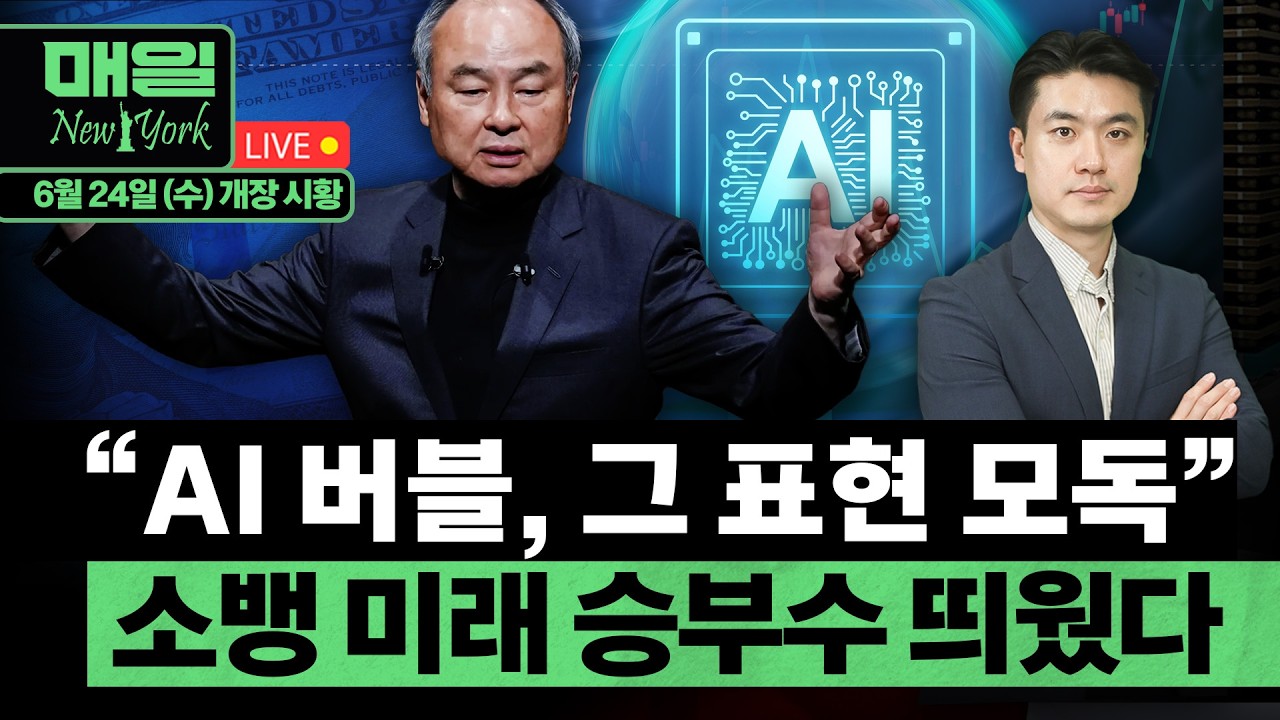
SoftBank Chairman Masayoshi Son’s AI investment strategy should also be viewed in this context.
SoftBank has historically made large-scale bets on the internet, mobile, and platform sectors.
It is now shifting its focus toward AI infrastructure, semiconductors, robotics, and data centers.
Even amid concerns about an AI bubble, global capital remains focused on who will control AI infrastructure.
The main issue for U.S. equities ahead is earnings, not only rates.
The Federal Reserve’s policy stance and inflation data remain important.
But for AI-related companies, revenue growth, margins, capital expenditures, and supply chain stability are more direct valuation drivers.
If Nvidia delivers strong earnings but the market still weakens, investors may be questioning the pace at which AI investment is being converted into profits.
5. Meta’s Entry-Level Smart Glasses and Why They Matter for AI
Meta’s entry-level smart glasses point to the next interface competition beyond smartphones.
So far, AI services have mostly been used through smartphone apps or PC screens.
Smart glasses, however, can combine the user’s field of view, voice, camera, and location data to make AI a more integrated daily assistant.
The fact that the product is entry-level is especially important.
High-priced AR and VR devices have been slow to reach mass adoption.
In contrast, lower-priced smart glasses could spread more quickly through use cases such as content consumption, photography, real-time translation, navigation, work assistance, and shopping recommendations.
If Meta succeeds in popularizing smart glasses, Apple, Google, and Samsung Electronics may respond more aggressively.
The real monetization model may not be hardware sales.
Smart glasses can be linked to advertising, commerce, AI subscriptions, and data-driven services.
For Meta, this is a strategy to secure a new advertising surface and AI platform beyond Facebook and Instagram.
In other words, Meta’s smart glasses are not just a device but a starting point for the next platform competition.
6. Key Risks Investors Should Watch
First, concerns about an AI bubble may continue to grow.
If AI-related stocks have already risen significantly, even minor disappointments can lead to sharp volatility.
In particular, semiconductor, data center, and power infrastructure companies face higher execution pressure when expectations are elevated.
Second, a sharp rise in the exchange rate can weigh on domestic investor sentiment.
If the KRW/USD rate remains elevated for an extended period, foreign flows, inflation, interest rates, and corporate earnings outlooks may all come under pressure.
Exporters may appear to benefit, but if the main driver of currency weakness is global risk aversion, the broader equity market may still be under strain.
Third, the Nasdaq listing issue must be confirmed through official disclosures.
Rather than making an investment decision based only on headlines, investors should verify the listing structure and filing details.
It is especially important to determine whether the structure benefits existing shareholders and whether the funds are intended for growth investment or balance-sheet improvement.
Fourth, smart glasses may take longer to reach mass adoption than expected.
Privacy concerns, battery life, comfort, price, and the app ecosystem must all be addressed.
Even if Meta unveils an entry-level product, actual market response should be judged through sales and usage data.
7. The Real Point Missed by Many Reports and Videos
The core issue is that the AI industry is moving from a stock-market theme to a capital-market structure shift.
SK Hynix’s Nasdaq listing issue should be viewed not as a simple overseas listing, but as an event in which a major Korean AI semiconductor company is evaluated directly in global capital markets.
This also connects to the issue of Korea’s valuation discount.
The second key point is that exchange rates can influence AI investment flows.
If the won remains weak, Korean investors may continue moving toward U.S. equities and dollar assets.
At the same time, Korean semiconductor companies may benefit from dollar-denominated sales and increased global investor attention.
In other words, the exchange rate is not just an economic indicator; it is also a switch that can redirect capital flows.
The third key point is that Meta Glasses could create the next stage of AI demand.
Until now, AI demand has been centered on data centers.
Going forward, it may expand into on-device AI across smart glasses, smartphones, PCs, automobiles, and robots.
If that shift accelerates, semiconductor demand may broaden beyond GPUs and HBM to include sensors, low-power chips, communication chips, and memory in general.
The fourth key point is that investors should not focus only on “the next Nvidia.”
AI is not a market that ends with Nvidia alone.
It includes HBM, packaging, servers, power grids, cooling, cloud services, security, AI software, and wearable devices.
Accordingly, it is more important to view the entire industry value chain than to chase a single stock.
8. Investment Checklist from a Strategy Perspective
Semiconductor investors should track HBM supply contracts and pricing trends.
For SK Hynix, the key variables are HBM market share and profitability.
Investors should monitor supply stability to Nvidia, competitiveness in next-generation HBM, and the pace of catch-up by Samsung Electronics and Micron.
Currency investors should watch policy responses after the 1,550 level.
It is important to monitor foreign-exchange authorities’ verbal intervention, actual stabilization measures, the U.S. dollar index, and Fed policy expectations.
If the exchange rate stabilizes after a short-term spike, it may support a recovery in domestic equities.
U.S. equity investors should track AI earnings and rate expectations together.
U.S. equities may remain strong in AI growth names, but inflation reacceleration and persistent high rates could pressure valuations.
High-P/E stocks, in particular, tend to show greater volatility around earnings releases.
AI device investors should evaluate the platform strategies of Meta, Apple, Google, and Samsung Electronics.
If the smart glasses market develops, opportunities may extend beyond hardware makers to camera modules, displays, batteries, voice recognition, and AI service companies.
However, in the early stage, expectations often rise faster than actual revenue.
9. Response Points for Domestic and Overseas Investors
Domestic equity investors should track semiconductors and the exchange rate together.
SK Hynix and Samsung Electronics may benefit from AI semiconductor demand.
However, if a sharp rise in the KRW/USD rate triggers foreign selling, the broader index may face pressure.
Accordingly, investors should monitor both company fundamentals and foreign flow data.
Overseas equity investors should distinguish between AI infrastructure and platforms.
Nvidia, Micron, and Broadcom belong to the AI infrastructure segment.
Meta, Microsoft, Google, and Amazon belong to the AI platform and cloud segment.
Smart glasses represent an important experiment as Meta expands from a platform company into a device company.
ETF investors should review the holdings of AI and semiconductor ETFs.
An ETF labeled as AI may still have a heavy weighting toward large-cap tech stocks.
Conversely, a semiconductor ETF may have excessive exposure to Nvidia.
When investing in ETFs or funds, fees, top holdings, and currency hedge status should be reviewed carefully.
10. Key Variables That Will Drive the Market Ahead
The first variable is SK Hynix’s official announcement and the detailed listing structure.
The timing, structure, capital raise size, and use of proceeds will help determine the stock’s direction.
The second variable is whether the KRW/USD rate rises further.
Whether the exchange rate stabilizes near 1,550 or moves toward 1,600 could significantly affect sentiment in Korean financial markets.
The third variable is the Federal Reserve’s rate signal.
If inflation does not ease quickly, rate-cut expectations may weaken and weigh on growth-stock valuations.
The fourth variable is the market response to Meta’s smart glasses.
What matters more than the product launch itself is whether consumers adopt the device as part of daily life.
Early reviews, preorders, app ecosystem development, and developer interest will be important.
The fifth variable is the sustainability of AI data center investment.
If large technology companies continue to increase capital spending, it will be positive for semiconductor and power infrastructure companies.
If investment slows, AI-related stocks could face a deeper correction.
< Summary >
SK Hynix’s July Nasdaq listing issue increases the possibility of a valuation re-rating for HBM and AI semiconductors.
The KRW/USD exchange rate approaching 1,550 may put pressure on domestic equities, inflation, interest rates, and foreign flows.
Meta’s entry-level smart glasses signal the next stage of platform competition as AI moves beyond the smartphone.
The key takeaway is that the market is not being driven by Nvidia alone, but by data centers, HBM, exchange rates, and AI devices moving simultaneously.
Investors should monitor official filings, exchange-rate trends, Fed policy signals, AI earnings, and smart glasses adoption data together.
[Related Articles…]
- HBM Semiconductor Investment Cycle and AI Data Center Beneficiaries
- Impact of KRW/USD Surges on U.S. Equities and Korean Stocks
*Source: [ Maeil Business Newspaper ]
– SK하이닉스 7월에 나스닥 상장 확정ㅣ원·달러환율 1550원 언저리까지 상승ㅣ메타, 보급형 스마트글래스 공개ㅣ홍키자의 매일뉴욕