● K-Greentech in Europe Cuts Hidden Costs With Invisible Carbon Savings
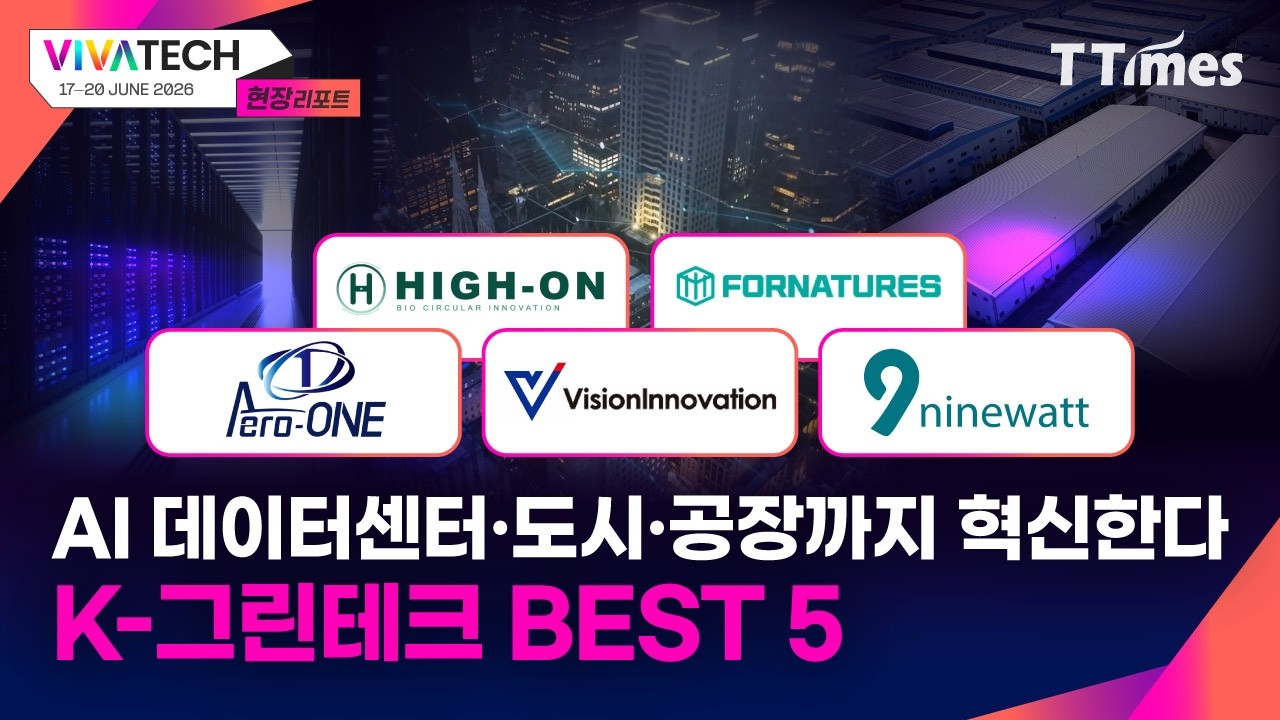
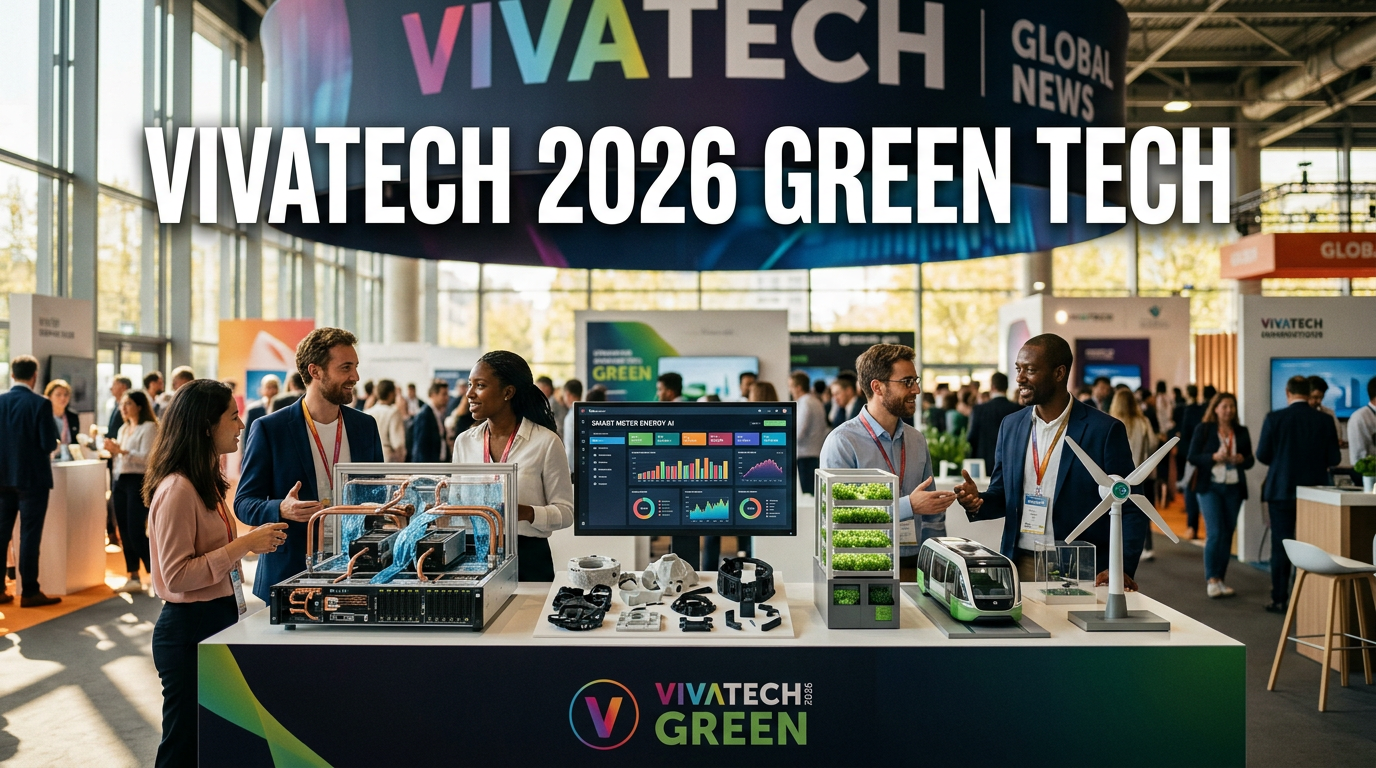
5 K-Greentech Companies Seen at VivaTech 2026: What Europe Paid Attention To Was “Invisible Infrastructure Carbon Reduction”
The most striking point at this VivaTech 2026 was not simply that they “made eco-friendly products.”
Korean greentech startups brought technologies that reduce both carbon and costs at the bottom of industry, such as data centers, plastic factories, hydrogen storage infrastructure, urban spaces, and building energy management.
In particular, Europe is a market where carbon-neutral regulations, mandatory recycled materials, building energy compliance, and data center power demand are all growing rapidly.
So the solutions from these Korean startups should not be seen as mere exhibition technologies, but as infrastructure technologies that can actually change industrial costs amid global economic outlook and AI trends.
The key takeaway comes in five parts.
Vision Innovation introduced an injection nozzle that increases the use of recycled plastic.
Hiyon made biodegradable immersion-cooling oil for AI data centers using oil extracted from insects raised on food waste.
AeroOne presented a safe hydrogen storage module that adsorbs and stores hydrogen in a solid without high-pressure compression.
ForNatures showed an approach of “planting a forest in a space” with a microalgae-based carbon capture device.
NineWatt unveiled a platform that uses only smart meter power data to diagnose building energy usage patterns with AI, without installing separate equipment.
1. The core issue at VivaTech 2026: greentech is no longer an “eco-friendly image” but an “industrial cost reduction technology”
The direction of greentech that drew attention at VivaTech 2026 was quite clear.
Compared with eco-friendly tumblers or recycled products that consumers can directly hold, technologies that increase energy efficiency and reduce carbon emissions inside factories, data centers, buildings, and urban infrastructure drew far more attention.
This trend is tied to the characteristics of the European market.
Europe is rapidly strengthening mandatory use of recycled plastics, carbon emission regulations, building energy performance standards, and environmental standards for industrial processes.
For companies, it is changing from “it would be nice to be eco-friendly” to “if we fail to meet regulations, costs rise and market entry becomes difficult.”
Ultimately, greentech is becoming not a phrase for ESG reports, but a practical technology that determines cost competitiveness and export competitiveness.
At this point, the strength shown by Korean startups was solutions that could be attached directly to on-site processes.
This is also why European companies showed interest.
No matter how good the technology is, if a factory line has to stop, large-scale equipment investment is needed, or certification risk is too high, adoption slows down.
On the other hand, if it can be attached to existing infrastructure to reduce defect rates, lower power consumption, and cut waste costs, the case for adoption becomes much stronger.
2. Vision Innovation: a degassing nozzle that increases recycled plastic usage
The first company is Vision Innovation, which developed a solution to improve plastic injection molding processes.
Vision Innovation’s core product is the “Vision Nozzle,” which removes moisture and gas during plastic injection molding.
When making plastic products, an injection process is needed to melt raw materials and put them into a mold.
The problem is that the higher the share of PCR, or Post-Consumer Recycled material, the more moisture and gas increase, and the higher the defect rate becomes.
Europe is moving quickly toward mandatory use of recycled materials in plastic products.
Companies need to increase the PCR ratio, but if quality drops and productivity falls, practical implementation is not easy.
Vision Innovation solves this bottleneck in the molten section right before injection.
The Vision Nozzle removes moisture and gas in a short time right before the raw material enters the mold.
This structure increases the possibility of applying 25% or more PCR without a separate process, optimizes the drying process, and reduces defect rates.
The industrial significance of Vision Innovation
This technology is not just about making plastic more eco-friendly.
In manufacturing, defect rates directly translate into costs.
When defects go down, waste goes down, rework costs go down, and power consumption also decreases.
In other words, carbon neutrality and cost reduction happen at the same time.
In industries with high quality standards such as automotive, home appliances, and medical devices, increasing the use of recycled materials is not easy.
Vision Innovation has already signed a business agreement with the European Borealis Group and is pursuing applications in the automotive sector.
It is also showing a strategy to expand into home appliances and the automotive aftermarket.
The Turkish market, which is linked to European production bases, was also mentioned as a major target.
This part is quite important.
That is because it is a strategy that directly targets European regulations while also aiming at Turkey, a real production base, and the automotive aftermarket.
3. Hiyon: immersion-cooling oil that cools AI data centers with food waste and insects
The second company is Hiyon, which targets the cooling problem of AI data centers.
As AI trends spread explosively, data center power consumption and cooling costs have become a key variable that cannot be left out of the global economic outlook.
In particular, as generative AI, high-performance GPUs, and large server clusters increase, the limits of conventional air cooling are becoming clear.
Hiyon is making cooling oil needed for immersion cooling, a next-generation data center cooling method, in an eco-friendly way.
The differentiator is the raw material.
Conventional immersion-cooling oil is mainly made from petrochemical sources.
Hiyon extracts high-purity lipids from insects such as black soldier flies that grow by eating food waste.
It then turns this oil into biodegradable immersion-cooling oil that meets insulating oil standards through first and second esterification processes.
Hiyon’s core competitiveness
Hiyon’s approach addresses three costs at once.
First, it turns the environmental problem of food waste disposal into a resource.
Second, it replaces petroleum-based cooling oil to reduce carbon emissions and disposal burdens.
Third, it offers the possibility of lowering total cost of ownership, or TCO, for data center operators.
Data center operators do not look only at the initial purchase price.
They consider cooling efficiency, maintenance costs, disposal costs, and regulatory response costs as well.
Hiyon emphasized that its biodegradable feature can reduce the burden of disposal costs.
Although it is an early-stage startup not even a year old, Hiyon participated in VivaTech with the goal of POCs and investment discussions with global data center operators.
The on-site reaction could be described as closer to “Is this really possible?”
It is unfamiliar, but if successful, it is a technology that could create a significant ripple effect in the data center cooling market.
4. AeroOne: storing hydrogen through solid adsorption instead of high-pressure compression
The third company is AeroOne, which develops hydrogen storage technology.
Hydrogen continues to attract attention as a future energy source, but the biggest bottleneck is storage and transportation.
Conventional hydrogen storage methods usually require high-pressure compression around 700 bar.
High-pressure storage consumes a lot of energy for compression, has a high explosion risk, and also incurs high costs for storage tanks and transportation infrastructure.
AeroOne aims to solve this problem with a solid adsorption method.
The core is a material-based module that improves hydrogen storage performance by doping graphene with B, N, and S elements.
In simple terms, instead of forcibly squeezing hydrogen under high pressure, it is stored by adsorbing it onto a specific solid material.
Why AeroOne’s technology matters
The most important keywords in the hydrogen economy are safety and cost.
No matter how cleanly hydrogen is produced, if storage and transportation are dangerous and expensive, industrial expansion becomes difficult.
AeroOne’s method can be an alternative to existing high-pressure hydrogen storage systems because it enables low-pressure storage and transport.
It can reduce the energy needed for compression and lower explosion risk.
The reason this technology is drawing attention in the European market is also clear.
Europe is a market where evaluation of green hydrogen and sustainability moves more strictly and quickly than in Korea.
The standards are high, but if you pass them, the market opportunity is also large.
AeroOne is in discussions with companies that directly use, transport, or sell hydrogen, and it was also mentioned that it received investment firm and venture cluster occupancy proposals.
However, this field is still a rare technological area worldwide.
So rather than securing a large number of customers quickly, meeting one or two proper strategic partners is more important.
5. ForNatures: a carbon capture device that plants a forest in a space with microalgae
The fourth company is ForNatures, which develops microalgae-based carbon capture technology.
Under the slogan “planting a forest in a space,” ForNatures is creating devices that capture carbon dioxide and purify air by using the photosynthesis of microalgae.
Existing carbon capture and storage technology, or CCS, has limitations because it requires large-scale facilities, enormous cost, and wide spaces.
It can be applied to power plants or large industrial facilities, but it is not easy to apply to everyday spaces or medium-sized buildings.
ForNatures has changed this approach.
It presented a carbon reduction technology in the form of a device that can be placed in everyday spaces, rather than carbon capture centered on large facilities.
Why ForNatures drew attention in Europe
ForNatures won innovation awards in two categories at CES earlier this year.
At VivaTech, it also attracted the attention of investors and partners, and some contract discussions were reportedly underway.
In particular, what surprised local observers was the point that “climate tech is an area where it is difficult to generate results, yet there are already sales records to power plants, manufacturing facilities, and construction companies.”
This is a quite important point.
Climate tech startups often have many technology demos but struggle to secure real references.
ForNatures emphasized that even though only about six to seven months had passed since the device launch, it was already creating real carbon reduction cases in various spaces.
Europe is a market with a high sense of urgency regarding climate change.
The original video also mentioned the on-site feeling that Paris was so hot the temperature was close to 40 degrees Celsius.
It also introduced Europe as a market pouring massive amounts of money into climate tech.
What ForNatures is targeting is not a giant carbon capture plant, but carbon reduction that can be felt immediately in spaces where people stay.
6. NineWatt: AI diagnosis of building energy usage patterns using smart meter data
The fifth company is NineWatt, which provides an AI solution for building energy management.
NineWatt’s main solution is “Opti.”
Opti analyzes a building’s energy usage patterns based on 15-minute interval power data from already installed smart meters.
The important point is that there is no need to install additional hardware.
Building owners can use only power usage data to check which time periods are wasting energy and which equipment or operating patterns have problems.
In addition, users can ask questions in a chat format, and hardware installation simulations for solar power or ESS are also possible.
It is a platform that allows individuals or corporate staff without an engineering background to receive reports on energy improvement directions.
Why NineWatt is targeting the European market
Europe is a market with very high building energy compliance risk.
As regulations on the energy and carbon emissions of buildings become stricter, building owners must set improvement plans based on data.
NineWatt’s customer base is mainly factories and industrial buildings in Korea, but overseas it expands to airports, office buildings, and commercial buildings as well.
At VivaTech, energy suppliers such as France’s EDF, Engie, and TotalEnergies, as well as ESCO operators like Schneider Electric, showed interest.
This has meaning beyond simple interest.
Energy suppliers and ESCO operators have channels through which they can directly supply solutions to building owners or run energy-saving projects.
For startups, entering the market through such large partners is much faster than persuading individual building owners one by one.
NineWatt said it is participating in VivaTech for the third time, and that in Europe, repeated exposure is a strategy that builds trust.
The message is that, as much as technical capability, becoming a “company that keeps being seen” in the local market is important.
7. Local reaction in Paris: the strengths of K-greentech were “friendly explanations” and “specific problem solving”
Visitors in Paris who toured the K-startup joint pavilion at VivaTech reacted that Korean companies’ technology explanations were specific and highly complete.
In particular, there was strong interest in companies that directly solve environmental problems connected to pollution, food, soil, and water.
Local visitors mentioned pollution issues such as PFAS and evaluated technologies that solve environmental issues linked to soil, agriculture, and food safety as important.
They also positively noted that the Korean booth companies explained things kindly and were active in interaction.
This reaction shows that market communication is just as important as the technology itself.
Because the European market has strong environmental regulations, technology verification and explanation responsibility are also strong.
Rather than packaging technology nicely, the ability to explain exactly what problem it solves and how accurately it solves it matters more.
8. The real core point that can be missed in other news: K-greentech is reducing “invisible costs”
The most important point in this case is not simply that “Korean startups drew attention in Europe.”
The real key takeaway is that all of them are technologies that reduce invisible costs.
First, they reduce compliance costs.
Europe’s mandatory recycled material use, building energy standards, and carbon emission regulations directly translate into costs for companies.
Vision Innovation and NineWatt are trying to solve this compliance burden through process improvement and data analysis.
Second, they reduce energy costs.
Data center cooling, hydrogen compression, plastic drying processes, and building power usage are all directly linked to energy costs.
Hiyon, AeroOne, Vision Innovation, and NineWatt each improve energy efficiency in different ways.
Third, they reduce disposal costs.
Biodegradable immersion-cooling oil, expanded use of recycled plastics, and microalgae-based carbon capture are all directions that lower disposal and environmental burdens.
This is connected not to ESG image, but to actual operating costs.
Fourth, they are technologies that attach to existing infrastructure.
Rather than building entirely new industries from scratch, all five companies presented solutions that can be applied to already existing data centers, factories, buildings, hydrogen infrastructure, and urban spaces.
This is attractive from the perspective of European companies.
That is because it allows them to improve efficiency without discarding existing assets.
Fifth, the decisive factor for entering Europe is the “partner structure,” not the technology itself.
Vision Innovation is connecting with materials and automotive companies.
For Hiyon, POCs with data center operators are important.
AeroOne needs strategic partnerships with hydrogen transport and sales companies.
ForNatures has the advantage of references from power plants, manufacturing facilities, and construction companies.
NineWatt is likely to spread through energy suppliers and ESCO operators.
In the end, global expansion in greentech is not a game that ends with technical skill alone; it is a game of entering the local distribution networks and regulatory response systems of major companies.
9. Investment points for K-greentech from an economic perspective
This VivaTech 2026 case also shows which direction Korea’s startup ecosystem should move in.
As the AI industry grows, data center power and cooling demand will continue to increase.
As carbon-neutral regulations strengthen, manufacturing will be required to improve both recycled material use and process efficiency.
As the hydrogen economy becomes fully established, storage and transportation safety will become a key bottleneck.
As climate change worsens, carbon capture is likely to move down from large plants to living spaces and urban infrastructure.
Building energy management can become a core data industry linked to electricity bills, carbon credits, and real estate value.
In other words, the five companies introduced here may look like they belong to different fields, but they are all part of one big trend.
That trend is energy efficiency, carbon neutrality, data-driven infrastructure management, and industrial cost reduction.
Going forward, in the global economic outlook, climate tech and AI infrastructure are likely not to move separately.
As AI expands, power and cooling problems grow, and the value of greentech that solves those problems grows along with them.
10. Key summary by company
Vision Innovation
It developed the Vision Nozzle, which removes moisture and gas during plastic injection molding.
It is expanding into the automotive, home appliance, and medical device sectors while increasing the use ratio of PCR recycled materials and reducing defect rates and waste.
Hiyon
It makes biodegradable immersion-cooling oil with oil extracted from insects that eat food waste.
Its goal is to replace petroleum-based cooling oil in the AI data center cooling market and lower disposal costs and total cost of ownership.
AeroOne
It is developing a module that stores hydrogen at low pressure using a graphene-based solid adsorption method.
It is an approach to solve the bottleneck of hydrogen infrastructure by reducing the risk and cost of high-pressure compressed hydrogen storage.
ForNatures
It develops devices that capture carbon and purify air in indoor and outdoor spaces using microalgae photosynthesis.
The differentiating point is expanding carbon capture from large facilities into everyday spaces.
NineWatt
It uses AI to analyze 15-minute interval power data from smart meters and diagnose building energy usage patterns.
It is a platform that provides energy-saving reports, solar and ESS installation simulations, and chat-based Q&A without separate equipment.
< Summary >
At VivaTech 2026, Korean greentech startups drew attention amid Europe’s strong carbon regulations and pressure from energy costs.
Vision Innovation introduced an injection nozzle that increases recycled plastic usage, while Hiyon unveiled biodegradable immersion-cooling oil derived from insects.
AeroOne presented hydrogen storage technology without high-pressure compression, ForNatures a microalgae carbon capture device, and NineWatt a building energy AI diagnosis platform.
The commonality among the five companies is that they do not offer consumer-facing eco-friendly products, but instead reduce the costs and carbon of invisible industrial foundations such as data centers, factories, buildings, cities, and hydrogen infrastructure.
As AI trends and carbon-neutral regulations intensify at the same time, the economic value of this kind of infrastructure-based greentech is likely to grow even more.
[Related Articles…]
Europe’s Carbon Rules and Greentech Investment Opportunities
AI Data Centers, Power Demand, and Cooling Technology Shifts
*Source: [ 티타임즈TV ]
– 자원을 효율적으로 안전하게! 유럽서 주목하는 K-스타트업