● Meta AI Compute Sales Fuel Stocks Drop
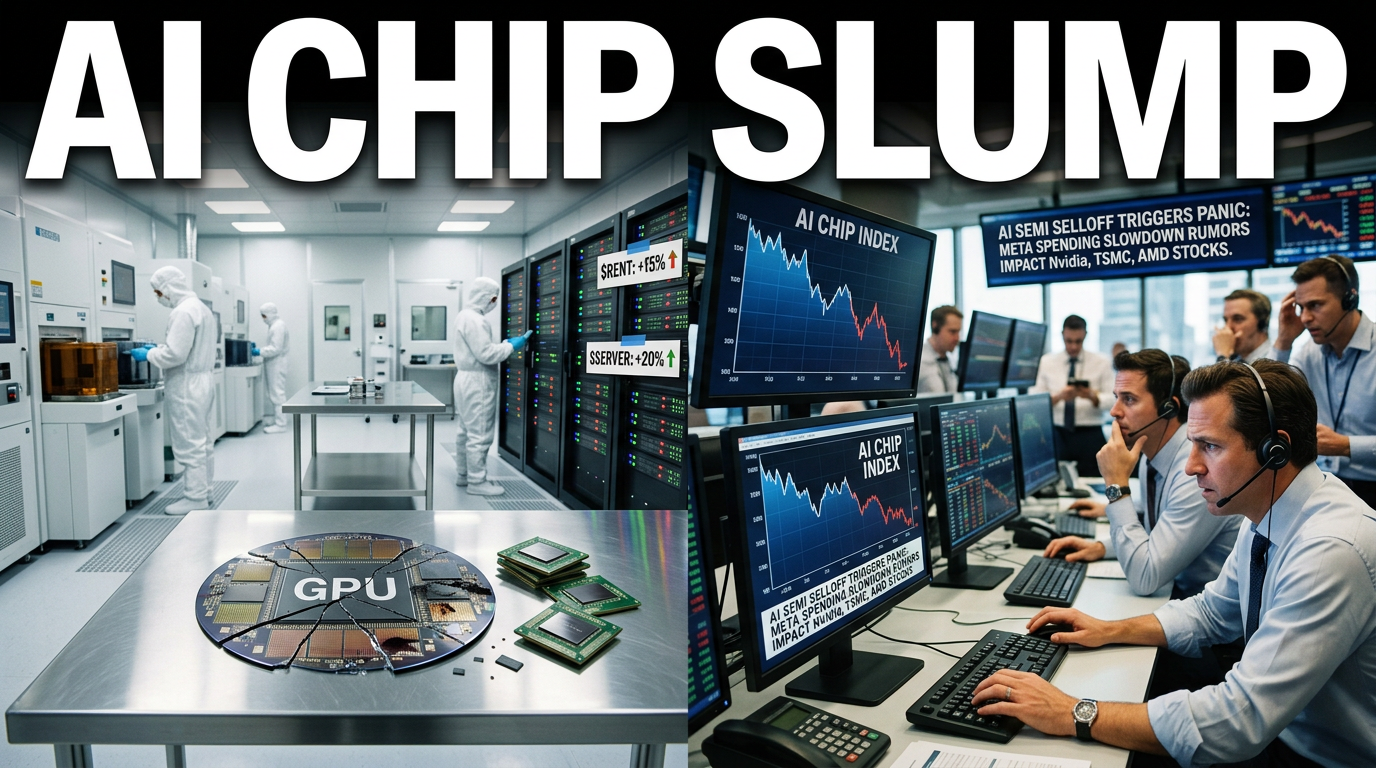
Did semiconductor stocks plunge on rumors that Meta is cutting AI investment? The core point is “a shortage of computing power.”
The core point of this issue is simple.
Meta made remarks to the effect that “if there is excess computing, it can be sold externally,” and the market overinterpreted this as a signal that “AI investment will be reduced.”
As a result, stocks related to AI semiconductors, memory semiconductors, and the data center value chain were shaken, while Meta’s stock rebounded.
But this interpretation is quite dangerous.
In the current global economic outlook, the most important pillar is still AI infrastructure investment, and the actual bottlenecks remain across GPUs, HBM, power, data centers, and cloud computing.
In this article, we will organize the true meaning of Meta’s remarks, the direction of hyperscaler capital expenditures, the profitability of AI data center investment, memory semiconductor fundamentals, and the core risks the market is missing in a news-style format.
1. Why the market wavered: Meta’s remarks were interpreted as “cutting AI investment”
The most widely discussed recent topic in the market is Meta’s remarks about AI infrastructure.
Mark Zuckerberg’s past comments at a shareholder meeting or in an official statement to the effect that “when the time comes that infrastructure is overbuilt, external sales are on the table” drew renewed attention.
Some in the market interpreted this to mean that “Meta may slow the pace of AI investment.”
Investors then immediately raised concerns about AI semiconductor stocks, especially the GPU and memory semiconductor value chain.
Conversely, Meta’s stock rose on expectations that reducing capital expenditures could improve cash flow in the short term.
But there is an important point here.
Zuckerberg’s remarks do not mean that “computing is currently in excess.”
More precisely, they are closer to a general statement that “at some point in the future, if infrastructure becomes overbuilt, any excess computing could be sold externally.”
In other words, it is not a direct message that current AI investment will be halted or reduced.
2. Why this interpretation is excessive: Meta still lacks computing power
The interpretation that Meta has excess computing power does not fit the current situation well.
Rather, Meta is closer to a position where it would be difficult to meet AI demand with its own data center buildout alone.
There have been continued reports that Meta is securing additional computing resources through neo-cloud providers such as CoreWeave and Nebius.
There is also talk of possible cooperation with competing cloud providers like Google Cloud and Oracle.
In simple terms, this means:
It is not at the stage of having excess computing and lending it out, but rather still at the stage of needing to borrow it.
Therefore, the interpretation that “Meta is so overbuilt in AI infrastructure that it can sell spare GPUs externally” does not align with the current data center investment trend.
In the AI industry, computing power is no longer just a cost item.
Computing power is, in effect, production equipment that creates revenue.
Just as a factory makes products in manufacturing, AI companies produce tokens, inference, and AI services through GPUs and data centers.
3. Core fact check: “selling excess computing” is not a sign of cutting investment, but a monetization strategy
Meta’s mention of the possibility of external sales can be seen not as a plan to reduce AI infrastructure investment, but rather as an intention to monetize computing assets more efficiently.
Big tech companies already know this approach well.
Amazon expanded internal infrastructure into an external cloud business through AWS.
Microsoft became a key player in the AI cloud market through Azure.
Google also grew Google Cloud based on infrastructure built for search and advertising.
Meta can make a similar choice.
After securing the computing needed for ad recommendation algorithms and AI inference engines, it can provide idle capacity externally in cloud form if spare resources emerge at some point.
This is not a cost-cutting move, but a strategy to improve asset returns.
In particular, Meta simultaneously operates AI recommendations, ad targeting, Reels algorithms, generative AI chatbots, and the open-source Llama ecosystem.
It is not realistic to think that a company running services at this scale would suddenly stop investing in AI infrastructure.
4. What the xAI case shows: once data centers are complete, cash generation can explode
An important comparison case mentioned in the original article is xAI’s large data center, or Colossus-scale AI infrastructure.
Elon Musk’s camp quickly built a massive GPU cluster, and the model of offering some computing resources to external customers drew market attention.
Google and Anthropic were mentioned as customers.
Here, the key point is not whether they are competitors.
The key point is the value of a completed AI data center.
A data center equipped with GPUs, power, cooling, networking, land, and operational capabilities is not just a facility; it is closer to the “oil production plant of the AI era.”
The original article mentioned an annual contract value of about $26 billion and construction costs of around 100 trillion won.
Those figures do not need to be taken at face value, but the message is clear.
If AI infrastructure is operated well, it can deliver such high ROI that investment can be recovered within 2 to 3 years.
That is why big tech companies find it difficult to easily reduce capital expenditures.
AI data centers may look like costs, but in reality they are capital investments that front-load future revenue.
5. The Anthropic case: the structure of “spend $1 on inference, generate $3 in revenue”
Anthropic CEO Dario Amodei once made a very important remark about the economics of AI inference.
The gist was that “if you put $1 into inference, you can generate $3 in revenue.”
This means that the economics of AI services are steadily improving.
In particular, as developer-focused AI services like Claude Code expand rapidly, Anthropic needs more computing power.
The original article used an expression suggesting that Anthropic’s annual revenue could rise 11-fold from around $4 in 2025 to around $44 in 2026, but contextually it is more appropriate to understand this as meaning that “the pace of revenue growth is extremely steep.”
The common challenge for AI companies is not lack of demand, but lack of computing.
As AI models improve, more users come in.
As users increase, inference requests rise.
As inference requests rise, demand for GPUs and data centers grows further.
Ultimately, demand for AI semiconductors and memory semiconductors moves on a far more structural trend than short-term news.
6. Rising GPU rental prices: this is not a market with excess supply, but one with shortages
The most direct signal currently visible in the AI computing market is GPU rental prices.
According to the original article, Nvidia GPU rental prices were said to have risen by 1.5x to nearly 2x compared with the start of the year.
In particular, Blackwell-series GPUs are widely described as something that is “so scarce they can’t be sold fast enough.”
Price increases are also being seen in contract renewals at some neo-cloud providers.
For example, there are reports that GPU usage fees previously at about $2.63 per hour could rise to nearly $5 per hour under new contracts.
Such price increases are unlikely in an oversupplied market.
In other words, rising GPU rental prices mean computing power remains scarce.
In the AI industry, the situation is not that demand is falling, but that supply is failing to keep up with demand.
7. Increasing neo-cloud backlog: AI infrastructure bottlenecks continue
This is also why companies like CoreWeave and Nebius are drawing attention.
They absorb GPU demand that big tech cannot directly handle and provide computing power to AI startups and large enterprises.
In earnings releases, an important metric is not only revenue but also backlog.
Increasing backlog means reservations for future computing power keep piling up.
In this structure, it is difficult for data center investment to slow down easily.
That is because customers are lining up before the GPUs even arrive.
Power contracts, cooling systems, network infrastructure, HBM supply, server assembly, and rack-level shipments are all bottlenecks.
In this situation, the interpretation that “AI investment is over” is based too much on short-term stock movements.
8. Meta’s real strategy: expansion from ad AI into cloud monetization is possible
Meta is fundamentally an advertising company.
It boosts ad efficiency based on massive user data from Facebook, Instagram, Reels, and Threads.
Here, AI inference engines are extremely important.
That is because AI decides which content to show users, which ads to place, and which recommendations lead to revenue.
But if AI inference efficiency improves, the situation changes.
The same GPU can handle more inference, and some computing capacity may become available.
At that point, Meta’s strategy is clear.
Instead of leaving spare computing idle, it can monetize it by offering cloud services or AI infrastructure leasing.
This is a model already proven by Amazon, Microsoft, and Google.
If Meta moves seriously into the AI cloud market, this would be closer to discovering a new revenue stream than cutting AI investment.
9. The dilemma of Meta’s own AI models: monetizing infrastructure may come before model competition
Through the Llama ecosystem, Meta has a major presence in the open-source AI market.
But in frontier model competition, it inevitably has to be compared directly with GPT, Claude, and Gemini.
The original article interpreted Meta’s own model competitiveness as still lagging behind GPT and Claude, while also facing pressure from some Chinese open-source models.
In that case, Meta’s options become more complex.
It must continue improving its own models, but what may be immediately more profitable is offering its computing infrastructure to external users.
xAI is also growing its own model, Grok, while potentially combining that with a strategy of providing some infrastructure externally to generate cash flow.
The key point here is not “abandoning AI models.”
The core point is “pursuing model development and infrastructure monetization at the same time.”
Because AI competition is so expensive, the ability to turn data centers into cash-generating assets is becoming increasingly important.
10. GPU utilization issue: it may be not excess computing, but “computing that is not being used well”
There is another important variable in AI data centers.
That is GPU utilization.
The original article mentioned that the GPU utilization rate at a certain large data center was only around 11%.
In such cases, computing may appear to be in excess on the surface.
But in essence, it is more likely an architecture and operational optimization issue than a demand issue.
In AI training, even one slow GPU can become a bottleneck for the entire cluster.
If just one of network connectivity, data pipelines, storage, cooling, power stability, or software scheduling goes wrong, overall utilization drops.
In other words, it may not be that computing is excess, but that computing is not being fully utilized.
When that happens, companies have two choices.
First, improve internal optimization to raise utilization.
Second, lease out resources that are difficult to use internally right away and generate cash flow.
This too is not a reduction in AI investment, but an improvement in operational efficiency.
11. The decisive rebuttal: if Meta had excess computing, why would it raise capex guidance?
The most important rebuttal is capital expenditures.
If Meta truly had excess AI computing and intended to reduce investment, the normal move would be to lower capex plans.
But according to the original article, Meta reportedly raised its 2026 capex guidance by more than $10 billion in its recent earnings release.
This can be seen as a sign that Meta still needs more data centers and AI infrastructure.
Meta is pushing its own data center projects while also continuing contracts with external neo-cloud providers.
This combination is not the behavior of a company with oversupply.
Rather, it means AI computing demand is so strong that it must simultaneously build internally and lease externally.
Therefore, the assertion that “Meta is cutting AI investment” directly conflicts with the current capex trend.
12. The real risk the market should worry about: hyperscaler CEOs managing their messaging
The truly important risk in this issue is elsewhere.
If Meta’s stock rebounded merely on expectations that it “might reduce capital expenditures,” other hyperscaler CEOs could be tempted to make similar remarks.
If recent M7 stock performance has been weak, boards and shareholders may pressure companies to reduce the burden of capital expenditures.
Companies like Microsoft, Amazon, Google, and Meta cannot afford to fall behind in AI competition, so it is difficult for them to materially cut actual investment.
But in earnings calls, they can use language such as “we will moderate the pace of capex growth” or “we will improve efficiency at current levels.”
The market can immediately interpret such phrases as a slowdown in semiconductor demand.
In other words, the short-term variable more important than actual demand is CEO communication.
Even if the AI arms race continues, one sentence in an earnings release can move semiconductor stocks sharply in the short term.
13. Memory semiconductor fundamentals: SK Securities data and earnings power in 2027
The original article referenced SK Securities data to discuss the 2027 operating profit outlook for the three major memory companies.
The core point is that the earnings power of Micron, Samsung Electronics, and SK hynix could outweigh most big tech companies.
Excluding Nvidia, the three memory makers’ 2027 operating profits could be quite large, according to the analysis.
In particular, as HBM demand explodes, memory semiconductors are shifting from a simple cyclical industry to a core bottleneck industry of AI infrastructure.
AI servers do not only need GPUs.
They also require high-bandwidth memory, DRAM, NAND, packaging, interconnects, and power semiconductors.
The original article also cited very low forward P/E ratios based on 2027.
The interpretation was around 7x for Micron and around 5x for Samsung Electronics and SK hynix.
Of course, actual valuations keep changing depending on stock prices and earnings outlooks, but the market’s view of the memory semiconductor earnings cycle remains strong.
14. Why do semiconductor stocks swing sharply even on small negatives?
The reason semiconductor stocks reacted sensitively to this news is simple.
AI semiconductor and memory semiconductor stocks have risen a lot recently.
In a rally that has gone up a lot, even a small negative can be priced in heavily.
Especially when investors are sensitive to the phrase “AI bubble,” any sign of possible big tech capex slowdown can trigger selling pressure.
But stock corrections and deterioration in industrial fundamentals must be distinguished.
Stocks may correct in the short term to cool off overheating.
However, the industrial structure is still moving toward more AI data center investment, HBM supply shortages, rising GPU rental prices, and increased cloud computing demand.
Therefore, investors should avoid mistaking short-term volatility for a sign of AI industry collapse.
15. The most important point that other news and YouTube usually do not emphasize
First, computing power is now not a cost, but revenue-generating equipment.
AI companies rent GPUs, run models, and then sell the results as tokens and services to generate revenue.
In this structure, the more computing power they have, the more revenue opportunities they create.
Second, “selling excess computing” may be a signal of entering the cloud business, not of cutting AI investment.
Meta’s talk of external sales is likely a strategic option similar to Amazon AWS, Microsoft Azure, and Google Cloud.
Third, the real bottleneck is not a single GPU, but the entire data center.
HBM, power, cooling, networking, land, transformers, and operational software are all in short supply.
That is why AI infrastructure investment is hard to end quickly.
Fourth, the short-term stock risk is not demand slowdown, but CEO remarks.
If hyperscalers mention moderating capex in earnings releases, the market may immediately interpret it as bad news for semiconductors.
But the actual investment competition is close to an arms race and is not easy to stop.
Fifth, memory semiconductors now have much stronger structural demand than before.
In the past, memory was heavily shaken by the economic cycle, but now AI servers and HBM demand are becoming new growth drivers.
16. Investment perspective summary: what to watch now
Checkpoint 1. Big tech capex guidance
Check whether AI infrastructure investment plans are maintained in earnings releases from Microsoft, Amazon, Google, and Meta.
In particular, pay attention to how terms like “efficiency,” “moderating pace,” and “capex optimization” are used.
Checkpoint 2. GPU rental prices
If GPU rental prices keep rising, it means the AI computing supply shortage remains.
Conversely, if prices fall sharply, demand slowdown or oversupply should be examined.
Checkpoint 3. Neo-cloud backlog
Backlog at companies like CoreWeave and Nebius is a leading indicator of AI computing demand.
If backlog increases, the data center investment cycle is likely to continue.
Checkpoint 4. HBM supply contracts
Supply contracts and customer qualification status for HBM from Samsung Electronics, SK hynix, and Micron are central to memory semiconductor investment decisions.
Checkpoint 5. Power and data center permitting
AI infrastructure bottlenecks are no longer happening only inside semiconductor fabs.
Power grids, transformers, cooling equipment, and data center site acquisition have emerged as key variables in the global economic outlook.
17. Conclusion: the AI bottleneck is not over; it is expanding
This Meta remarks issue showed how sensitive the market has become to any sign of slowing AI investment.
But if you look at the substance, AI computing power is still in short supply.
Meta’s mention of external sales is closer to a strategic remark about monetizing computing assets like a cloud business over the long term than a signal of reduced investment.
AI semiconductor and memory semiconductor stocks may correct in the short term.
Given how much they have already risen recently, being shaken by small negatives is a natural process.
But if you look at data center investment, capital expenditures, GPU rental prices, HBM demand, and neo-cloud backlog together, it is hard to say the AI infrastructure cycle is over.
In the end, the important thing is to see the structure without being swayed by rumors.
The core resources of the AI era are data, power, semiconductors, and computing power.
As long as these four bottlenecks are not resolved, the AI investment cycle is likely to remain resilient.
< Summary >
It is reasonable to view Meta’s remark about the possibility of externally selling excess computing not as a cut in AI investment, but as a long-term monetization strategy.
At present, Meta is actually in a situation where it still needs to secure computing resources from external neo-cloud and cloud providers, which shows AI computing remains insufficient.
Rising GPU rental prices, increasing neo-cloud backlog, and expanding HBM demand show that AI infrastructure bottlenecks continue.
In the short term, capex-related remarks in hyperscaler earnings releases can increase semiconductor stock volatility.
But in the medium to long term, the fundamentals of AI semiconductors, data center investment, and the memory semiconductor cycle remain strong.
[Related Articles…]
Has the AI semiconductor cycle and memory supercycle ended?
The data center investment war and big tech capex outlook
*Source: [ 월텍남 – 월스트리트 테크남 ]
– “절대 속으시면 안됩니다”