● Meta Shock-Sparks Memory Rout
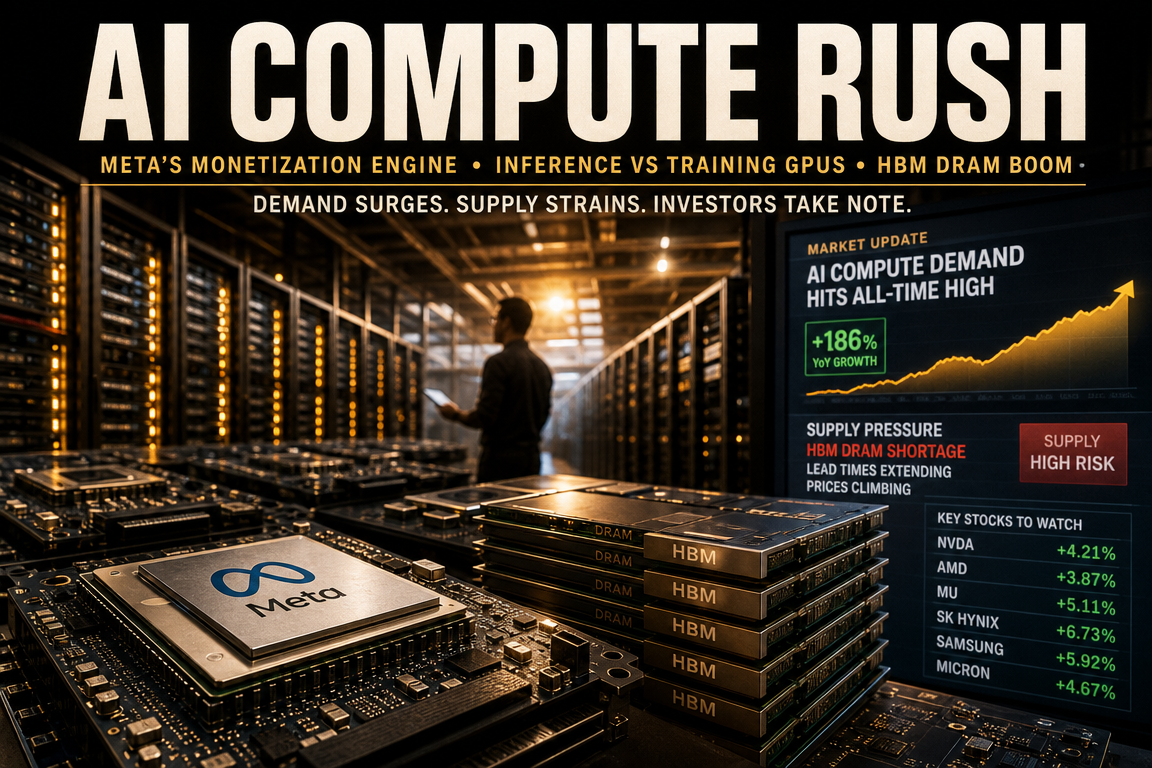
Micron and SanDisk Fall Sharply: Is the Memory Trade Over? The Key Issue Is the Real Meaning of Meta’s AI Compute Monetization
This selloff in memory stocks should not be interpreted simply as a sign that the AI bubble is bursting.
The key market trigger was the news that Meta may seek to sell excess AI computing capacity externally.
This report summarizes the declines in Micron, SanDisk, SK Hynix, and Samsung Electronics in a news format, and analyzes the core issue the market may be overlooking: the distinction between inference computing and training computing.
Many reports have framed the move as “Meta has excess compute → AI infrastructure investment will slow → memory stocks are at risk.” However, Meta may also be monetizing idle resources to preserve investment capacity.
In short, the decline appears less like a structural end to memory stocks and more like a market disagreement over the AI infrastructure investment cycle.
1. What Happened: Micron, SanDisk, SK Hynix, and Samsung Electronics Sold Off Together
In the U.S. market, Micron fell about 10% the previous day and then declined more than 2% intraday in the following session.
SanDisk was hit harder. After a double-digit drop the prior day, it fell more than 8% intraday in the next session, rapidly weakening sentiment across memory stocks.
South Korean equities were also affected. SK Hynix fell about 14% intraday, while Samsung Electronics dropped about 9%, reflecting broad concerns over the semiconductor cycle.
Such moves suggest more than simple profit-taking and indicate that the market is reassessing the outlook for AI infrastructure investment.
- Micron: additional decline after a sharp prior-day selloff
- SanDisk: two consecutive days of steep losses
- SK Hynix: sharp intraday decline from elevated levels
- Samsung Electronics: weaker on memory-cycle concerns
- Market interpretation: preemptive selling on concerns about slower AI investment
2. Why Meta Became the Center of Attention
The direct catalyst was reporting by Bloomberg and CNBC.
The key point in those reports was that Meta is considering a cloud business to sell excess AI computing power externally.
Meta has not formally confirmed the reports, and a spokesperson declined to comment.
Nevertheless, the market reacted immediately.
Investors interpreted the news as a sign that Meta’s AI computing demand may be weaker than expected.
Concerns over slower AI infrastructure investment then spilled over into selling across GPU, HBM, DRAM, NAND, and data center-related stocks.
Because memory stocks had risen sharply on expectations of expanding AI investment, even a small doubt was enough to trigger significant profit-taking.
3. The Market’s First Interpretation: Does “Excess Meta Compute” Mean AI Is Over?
The market’s simplified interpretation can be summarized as follows.
- Meta says it may sell excess compute.
- That suggests internal AI compute demand may be weaker than expected.
- If AI compute demand is weak, data center investment may slow.
- If data center investment slows, HBM and memory demand may weaken.
- Therefore, Micron, SK Hynix, Samsung Electronics, and other memory stocks should be sold.
This logic is understandable from a market perspective.
AI capital expenditure and semiconductor cycles have been among the key variables moving both U.S. and Korean markets.
As AI investment expectations rise, memory stocks tend to outperform; when AI spending concerns emerge, memory names are among the first to sell off.
However, one critical question is missing.
Is Meta’s AI compute really broadly excess?
4. The Core Issue: AI Compute Is Not One Category; It Splits Into Inference and Training
To understand this issue, AI computing must not be treated as a single bucket.
There are two major types of demand:
- Training computing: high-performance compute resources used to train AI models
- Inference computing: compute resources used to run trained models and respond to user queries
A simple analogy: training is the learning process, while inference is the actual test-taking process.
Training requires substantially more compute and more powerful GPUs.
Inference can often run on relatively lower-spec GPUs or existing infrastructure.
Therefore, when the market hears that Meta has excess compute, it must distinguish whether the surplus is in inference capacity or whether overall AI demand is actually weakening.
Without that distinction, investors can misread the implications for memory stocks and AI infrastructure.
5. Is Meta Really Sitting on Excess Compute? Recent Deals Suggest a Different Picture
Recent large AI compute contracts signed by Meta appear inconsistent with the interpretation that it has broad excess capacity.
- March: a roughly $27 billion AI compute contract with Nebius
- March onward: a roughly $21 billion contract with CoreWeave
- June 18: a large-scale 1.6GW compute contract with Crusoe
These agreements indicate that Meta is still securing substantial AI compute capacity.
A 1.6GW commitment is not a small-scale allocation.
This creates a clear inconsistency: one set of reports suggests Meta is selling excess compute, while another shows Meta continuing to lock in major compute contracts.
The most plausible explanation is that Meta may have excess inference compute while still lacking training compute.
6. Why Meta May Want to Sell Inference Compute
Meta operates Facebook, Instagram, WhatsApp, and other large platforms.
However, in AI services it does not yet appear to generate inference demand on the same scale as companies such as OpenAI, Anthropic, or Google.
That means Meta may be spending heavily on AI infrastructure without seeing equivalent end-user utilization of its own AI products.
In that case, some inference servers may be underutilized.
From Zuckerberg’s perspective, monetizing idle capacity through external cloud services would be economically rational.
Rising GPU rental prices are also important.
As AI demand increases, GPU leasing rates have risen, and some cloud providers have increased prices for high-end GPU rentals.
In that environment, selling surplus inference compute could be an attractive business model.
7. Meta’s Likely Objective May Be Capital Efficiency, Not an AI Pullback
Many investors interpreted the news as a sign of reduced AI investment.
An alternative interpretation is that Meta is selling excess inference compute to generate cash and redeploy that capital into stronger training infrastructure.
Meta has sharply increased AI capex in recent months.
The issue is that rising capex also increases pressure on free cash flow.
Shareholders may accept AI investment in principle, but they remain sensitive to a rapid deterioration in cash generation.
If Meta monetizes excess compute through cloud sales, it could achieve several objectives:
- Monetize idle AI infrastructure
- Reduce free cash flow pressure
- Make it easier to justify continued AI investment to shareholders
- Create additional room for training-related GPU spending
In other words, this may not be a signal that Meta is abandoning AI, but rather that it is trying to sustain the AI race more efficiently.
8. Why Zuckerberg Is Unlikely to Retreat Easily From the AI Race
Meta was previously hurt by Apple’s privacy policy changes.
When Apple changed iOS ad tracking rules, Meta’s advertising business came under pressure.
That experience reinforced the risk of depending on external platform owners.
As a result, Meta invested aggressively in VR and the metaverse as potential platform shifts.
AI is similar.
If AI becomes the next platform for search, advertising, content, commerce, and productivity, Meta cannot afford to fall behind.
Zuckerberg’s commitment to AI is therefore not simply a response to a trend, but a strategic effort to avoid being dependent on another platform controlled by others.
From this perspective, a sudden reduction in Meta’s AI spending appears less likely.
9. Why the Market Is Still Concerned
That said, the market’s reaction is understandable.
AI infrastructure and memory stocks had already risen sharply in recent months.
Expectations for HBM demand, data center expansion, cloud growth, and a semiconductor cycle recovery were all embedded in valuations.
In such conditions, even a modest negative headline can trigger large selling.
The situation would change materially if Meta were actually slowing the pace of AI capex.
If Meta and other major tech firms begin to adjust AI spending plans, memory stocks and semiconductor equipment names could face additional pressure.
For now, the market appears to be pricing not confirmed weakness, but concern that an AI spending peak may be forming.
10. The Most Important Point Other Reports Often Miss
The most important point is not whether Meta is selling compute.
The real issue is what kind of compute it is selling and what kind it continues to buy.
Excess inference capacity does not imply weaker demand for high-end training GPUs.
Conversely, monetizing inference compute to generate cash could support continued investment in training infrastructure.
The market reacted as if AI compute were one undifferentiated pool, but the industry structure is much more segmented.
Investors who understand this distinction may reach very different conclusions from the same news flow.
- Simple interpretation: Meta compute sale → weaker AI demand → memory stocks at risk
- Deeper interpretation: monetizing inference resources → improved cash flow → continued training investment
The key question is not whether AI investment is slowing, but how the composition of AI investment is changing.
11. Key Items to Watch Going Forward
The true direction of this issue will likely become clearer at Meta’s next earnings release.
Analysts are likely to ask about Meta’s AI capex plans, potential cloud sales, and utilization of compute resources.
Zuckerberg may also address the issue directly in a podcast or interview.
Investors should monitor the following points:
- Whether Meta maintains or raises its 2025 and later AI capex guidance
- Whether the cloud sales target is inference compute or training compute
- Whether GPU rental prices continue to rise
- Whether AI infrastructure spending plans at Microsoft, Google, and Amazon remain intact
- Whether HBM pricing and supply agreements remain consistent with prior expectations
- Whether memory demand expectations for SK Hynix and Samsung Electronics change
For memory stocks, changes in earnings consensus matter more than short-term price action.
If AI server demand holds up and HBM pricing remains firm, the current decline may prove to be a reset from overextended levels.
If big tech capex expectations are revised lower, however, the semiconductor cycle will need to be reassessed.
12. Investment View: Is the Memory Trade Over?
At this stage, it is premature to conclude that memory stocks are over.
This decline appears driven less by confirmed AI spending weakness and more by the market’s conservative interpretation of a single Meta headline.
That said, volatility is likely to remain elevated after the strong run in recent months and the buildup of leveraged positioning.
Memory stocks remain highly sensitive to AI infrastructure spending, HBM demand, data center expansion, and cloud competition.
Short term, that implies continued sharp swings driven by news flow.
Over the medium term, the key question is whether major technology firms are truly reducing AI capex or instead improving capital efficiency while continuing to invest.
This event appears less like the end of the memory cycle and more like a transition into a more differentiated phase of the AI investment cycle.
The focus should shift from “AI is good” to which parts of AI infrastructure are monetizing and which compute categories remain constrained.
Summary
The sharp declines in Micron, SanDisk, SK Hynix, and Samsung Electronics were triggered by reports that Meta may sell excess AI compute through cloud channels.
The market interpreted this as a sign of slowing AI infrastructure investment and sold memory stocks aggressively.
However, the key issue is whether Meta is monetizing excess inference compute while continuing to invest in training compute.
Meta’s recent large compute contracts suggest that it has not abandoned AI investment.
The decline may therefore reflect a market overreaction to a change in the composition of AI investment rather than a structural end to the memory cycle.
Going forward, investors should monitor Meta’s earnings, big tech capex guidance, GPU rental pricing, and HBM demand.
[Related Articles…]
*Source: [ 내일은 투자왕 – 김단테 ]
– 마이크론 샌디스크 연이틀 하락? 메모리 주식 이제 끝인가?
● Jobs Shock, Rate Pressure
U.S. June Employment Data Immediate Analysis: Labor Shock or Rate-Hike Pressure
The key issue in this U.S. June employment report is not a single number, but which number the market chooses to focus on.
The unemployment rate declined more than expected, signaling that the U.S. labor market remains resilient.
At the same time, nonfarm payroll gains fell well short of expectations, increasing concerns about labor-market slowdown.
Wage growth also remained elevated, complicating the outlook for inflation and the policy path for interest rates.
As a result, this release supports two competing interpretations: rising odds of a rate hike and increasing pressure for rate cuts due to economic slowdown.
This report connects U.S. employment data, the FOMC, policy rates, inflation, and semiconductor outlook in a single framework.
1. Key Numbers in the U.S. June Employment Report
The market focused primarily on three indicators.
First, the unemployment rate.
Second, nonfarm payrolls.
Third, average hourly earnings growth.
-
Unemployment rate: 4.2%, below the market expectation of 4.3%.
-
Nonfarm payroll gains: approximately 57,000 jobs, well below the consensus estimate of around 110,000.
-
Wage growth: 3.5%, in line with expectations and above the prior 3.4% reading.
On a headline basis, the report does not point in a single direction.
The unemployment rate suggests the labor market remains firm.
Nonfarm payrolls indicate a faster cooling trend.
Wage growth implies labor-market tightness and persistent inflation pressure have not fully eased.
2. Why the Unemployment Rate Signals Labor Strength
The decline in the unemployment rate to 4.2% may appear positive at first glance.
A lower unemployment rate means fewer people are losing jobs relative to the labor force.
In other words, the U.S. economy is still holding up on the employment side.
If the unemployment rate continues to move lower from 4.5% to 4.4%, 4.3%, and 4.2%, the Federal Reserve can argue that labor conditions remain manageable.
That weakens the case for an immediate rate cut.
If inflation reaccelerates, the Fed may even keep open the possibility of further tightening.
From this perspective, the unemployment rate does not point to a labor shock, but rather to continued labor resilience.
3. Why Nonfarm Payrolls Signal Labor Slowdown
The main issue is the payroll number.
Nonfarm payrolls are one of the most closely watched U.S. employment indicators.
They measure job creation across most industries excluding agriculture.
This report showed gains of about 57,000 versus expectations of roughly 110,000.
That suggests the labor market is cooling more quickly than expected.
Equity markets tend to react more strongly to payroll growth than to the unemployment rate.
As a result, the data may be interpreted as a labor-market shock in the near term.
However, from a monetary-policy perspective, payrolls must be assessed together with unemployment and wages.
4. Why 3.5% Wage Growth Matters
Average hourly earnings growth is a critical component of this report.
A 3.5% pace indicates that wage pressure remains intact.
Higher wage growth supports consumption.
Stronger consumption makes it harder for firms to lower prices.
This can keep service inflation and core inflation from easing meaningfully.
The Federal Reserve is generally most concerned when employment remains strong, wages stay elevated, and inflation begins to reaccelerate.
This report does not rule out that scenario.
Accordingly, it cannot be read as a simple case for rate cuts.
5. Why the Market Reacted with Mixed Signals
This employment report is difficult to interpret in a single direction.
The unemployment rate points to labor strength.
Payroll growth points to labor weakness.
Wage growth points to persistent inflation risk.
When these three signals arrive together, the market is likely to respond inconsistently in the short term.
-
Bond market view: weaker payrolls may be seen as reducing the probability of further rate hikes.
-
Equity market view: slower job growth may raise concerns about recession risk.
-
Fed view: lower unemployment and higher wages make it difficult to justify an early rate cut.
In other words, markets may price in easing expectations in the short term, while the Fed remains focused on inflation and labor resilience.
6. FOMC Rate Outlook: CPI Remains the Decisive Factor
This employment report alone does not determine the outcome of the July FOMC meeting.
The most important variable now is the U.S. CPI report due in mid-July.
A stronger-than-expected CPI print would keep the possibility of further tightening alive.
A softer reading would reinforce expectations for a policy hold.
At this stage, a rate pause appears more likely than a hike.
However, market volatility is likely to remain elevated until the CPI release.
The FOMC decision is scheduled for 3:00 a.m. Korea time on July 30.
For this meeting, inflation data is likely to matter more than employment data.
7. How the Fed Views the Relationship Between Inflation and Employment
The Federal Reserve focuses on two mandates.
One is price stability.
The other is maximum employment.
The challenge is that these objectives do not always move in the same direction.
Strong employment supports consumption, which can keep inflation elevated.
Conversely, tighter policy to fight inflation can slow investment and consumption, weakening employment.
This report, with low unemployment, elevated wages, and slowing payrolls, creates a difficult policy mix.
As a result, the July FOMC is likely to focus less on employment alone and more on the upcoming CPI data.
8. Is AI Disrupting U.S. Employment?
Many investors are concerned that AI is reducing labor demand.
The impact is visible in software development, office work, content production, translation, design, and data analysis.
In some areas, hiring has become more difficult and entry-level recruitment has tightened.
However, the broader labor market picture is more complex.
AI is displacing some jobs while creating new ones.
Labor demand is expanding in data center construction, power infrastructure, cooling systems, AI semiconductors, servers, networks, cloud operations, and AI service development.
In the near term, AI is better understood as reshaping labor demand than as reducing it outright.
Over the longer term, some roles may disappear, but at present AI is also supporting employment through infrastructure investment and semiconductor demand.
9. Is AI Deflationary or Inflationary?
AI can support long-term disinflation by improving productivity.
However, in the near term, it is working in the opposite direction.
As AI adoption expands, demand for data centers rises.
That increases demand for AI semiconductors, memory chips, electricity, and cooling equipment.
This can drive up chip prices, power costs, and cloud infrastructure expenses.
The result is a form of chip-led inflation.
That inflation can eventually be passed through to AI service pricing, hardware prices, cloud fees, and software subscriptions.
In that sense, AI may be deflationary over time, but inflationary in the near term.
10. Why Semiconductor Stocks Have Become More Volatile
Semiconductor stocks have shown sharp volatility recently.
Micron reported strong earnings and raised guidance.
Yet the stock still weakened.
The first reason is profit-taking after positive results.
Investors who had already priced in strong results sold into the announcement.
The second reason is concern about chip-led inflation.
Higher memory prices benefit chip manufacturers.
But they raise costs for big tech firms, smartphone makers, PC vendors, server operators, and cloud providers.
If those costs are passed through to end products and services, demand may soften.
That has led to a reassessment of how far semiconductor pricing can rise without hurting final demand.
The third reason is supply constraints.
Even if HBM and DRAM demand expands rapidly, limited supply capacity may prevent revenues from rising as much as expected.
The fourth reason is excessive options and leverage activity.
When call-option positioning becomes crowded, even small news flow can trigger sharp price swings.
11. The Meta Development and Its Impact on Semiconductors
One of the market’s key recent concerns involves Meta’s AI infrastructure strategy.
Reports suggested that Meta may use its large AI compute capacity to lease or provide infrastructure externally.
On the surface, this appears to be a business expansion.
However, the market interpreted it differently.
The concern is that Meta may have overbuilt AI infrastructure.
If internal AI demand were sufficient, external leasing would be less necessary.
As a result, investors began to view the announcement as a sign of potential overinvestment.
That fed concerns about a peak in AI semiconductor demand and helped trigger declines in the Philadelphia Semiconductor Index and major chip stocks.
12. Implications for the Korean Semiconductor Market
In Korea, Samsung Electronics and SK hynix are directly affected by U.S. semiconductor volatility.
HBM, DRAM, NAND, and AI server demand remain key variables for the Korean semiconductor outlook.
However, short-term share price action should be separated from fundamentals.
Stock prices are heavily influenced by sentiment, positioning, foreign flows, derivatives, and global news.
By contrast, earnings depend on actual exports, pricing, exchange rates, and demand.
Korean semiconductor exports have remained strong, and semiconductors now account for a very large share of total exports.
This suggests that earnings expectations for Samsung Electronics and SK hynix remain intact.
In other words, the recent pullback in share prices does not by itself indicate a deterioration in fundamentals.
13. July Semiconductor Earnings Calendar
July is a critical month for semiconductor investors.
The upcoming earnings releases are not only company events but also major macro signals for the AI infrastructure and semiconductor cycle.
-
July 7, around 8:40 a.m.: Samsung Electronics preliminary Q2 results.
-
Around July 10: SK hynix ADR-related Nasdaq schedule.
-
July 16, 3:00 p.m.: TSMC earnings release.
-
July 23, around 8:40 a.m.: Samsung Electronics final Q2 results.
-
July 29, morning: SK hynix earnings release.
These events may determine the near-term direction of semiconductor equities.
For Samsung Electronics and SK hynix, HBM revenue, DRAM pricing, NAND recovery, and operating margin trends will be the key metrics.
14. Bank of Korea and FOMC Schedule
July also includes major monetary-policy events in Korea and the United States.
The Bank of Korea Monetary Policy Board meeting is scheduled for July 16.
The FOMC decision is scheduled for 3:00 a.m. Korea time on July 30.
The Bank of Korea must consider domestic inflation, exchange rates, household debt, and growth conditions.
The Federal Reserve will assess CPI and employment data together in setting policy.
Both central banks are facing a complex policy environment rather than a one-dimensional growth or inflation backdrop.
Rising currency volatility may make the Bank of Korea’s policy decision more difficult.
15. The Main Point That Is Often Missed
The central issue in this employment report is not simply whether it is a labor shock.
The more important question is whether markets and the Fed are reacting to different indicators.
Markets are likely to focus more on weaker payroll growth.
That can support short-term expectations for easing, while also raising recession concerns.
The Fed, however, will look more broadly at unemployment, wage growth, and CPI.
If unemployment remains low and wages stay elevated, the Fed may conclude that it is too early to cut rates.
As a result, markets may price in easing while the Fed keeps a tightening bias.
That gap is the main source of July volatility.
Another important point is that it is too early to conclude that the AI semiconductor cycle has ended.
The market is currently pricing in concerns about overinvestment in AI infrastructure.
However, industry conditions still suggest strong demand across the semiconductor value chain.
The July earnings season will likely help distinguish between sentiment-driven fear and actual demand trends.
16. Key Checkpoints for Investors
The market is entering a difficult phase.
Employment data remains mixed, the FOMC depends on CPI, and semiconductors face both earnings support and valuation pressure.
Short-term investors should focus on volatility management.
Long-term investors should separate earnings trends from market sentiment.
-
First: monitor whether mid-July CPI comes in hotter than expected.
-
Second: track the U.S. 10-year Treasury yield.
-
Third: assess whether semiconductor earnings confirm sustained demand and margin stability.
-
Fourth: monitor whether big tech continues to expand AI infrastructure spending.
-
Fifth: watch whether foreign buying and domestic institutional selling pressure ease.
June and July may be best understood as a consolidation phase with elevated volatility.
Investors seeking lower volatility may need to maintain higher cash levels.
Investors willing to trade volatility may view post-earnings dislocations as opportunities.
< Summary >
The U.S. June employment report was a mixed release, with a lower unemployment rate, slower payroll growth, and sustained wage gains.
The unemployment rate suggests labor strength, while payrolls point to labor slowdown.
Wage growth remains elevated, leaving inflation risks in place.
The key driver for the July FOMC is likely to be CPI rather than employment.
The semiconductor market has been pressured by concerns about overinvestment in AI infrastructure, but actual demand and earnings still need confirmation.
July earnings releases from Samsung Electronics, TSMC, and SK hynix will be important indicators of the direction of the AI semiconductor cycle.
[Related Articles…]
*Source: [ 경제 읽어주는 남자(김광석TV) ]
– [LIVE] 미국 6월 고용지표(실업률, 비농업취업자), 고용쇼크 나올까? [즉시분석]