● Won-Won Crash, Structural Storm, Dollar Drain
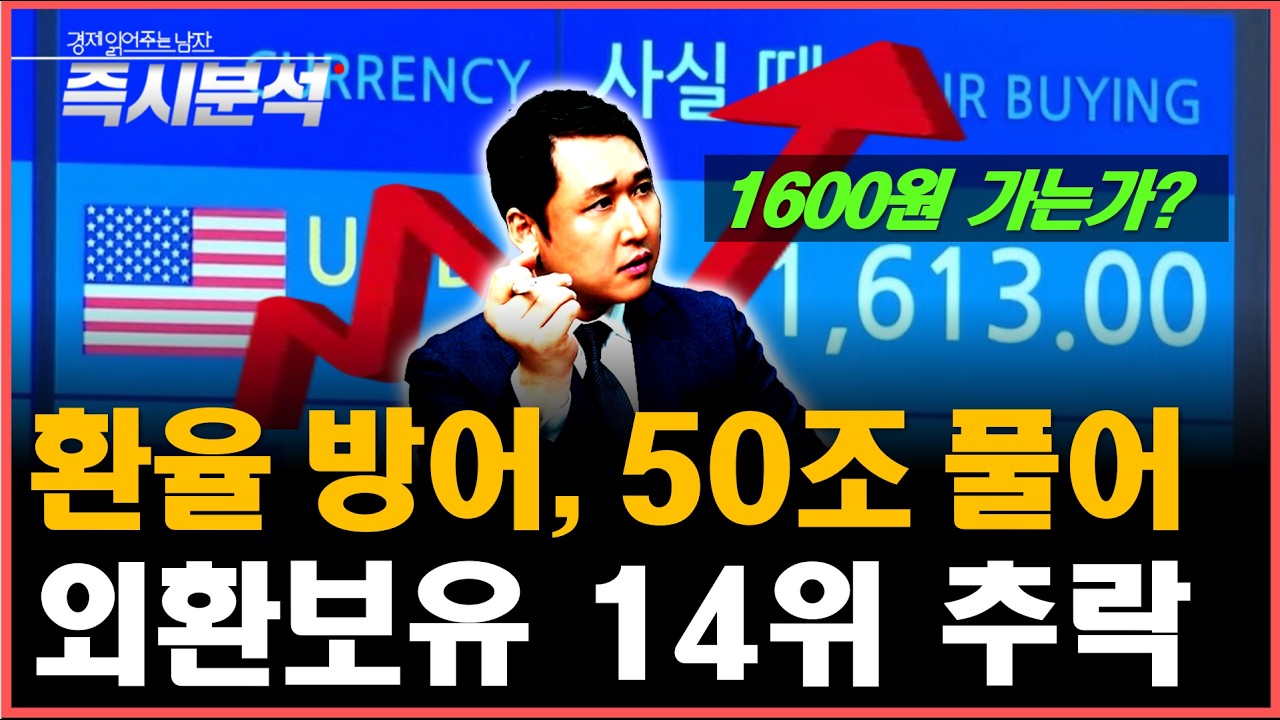
The Real Reason Behind the Sharp Decline in the Won: Structural Factors Behind Why the KRW/USD Rate Remains Elevated Even After a KRW 50 Trillion Intervention
The key issue is not simply that “the dollar is strong, so the KRW/USD exchange rate has risen.”
Even after the authorities supplied roughly KRW 50 trillion worth of dollars to the market, the exchange rate has remained elevated because the pressure is coming from outside the FX market itself.
This report reviews the potential for the KRW/USD rate to reach 1,600, the decline in foreign exchange reserves, foreign net selling, individual overseas investment, corporate dollar hoarding, the Korea-U.S. policy rate gap, rising liquidity, worsening fiscal soundness, and slowing potential growth.
It also addresses a structural issue often overlooked in other reports and videos: “A high exchange rate is effectively a bonus for large export conglomerates, but a cost shock for domestic demand firms and import-dependent SMEs.”
1. Current KRW/USD Conditions: The Numbers Already Signal Acute Stress
-
The KRW/USD rate has recently traded above the 1,560 level intraday, sustaining a strong uptrend.
-
Last month’s average KRW/USD rate was recorded at 1,527.9.
-
This is the highest monthly average since the IMF crisis, roughly 28 years and 4 months ago.
-
Because exchange spreads are added at airports and bank counters, the effective retail exchange rate may feel closer to the low 1,600 range.
The important point is that this is not a one- or two-day spike.
A high monthly average indicates that won weakness is becoming structurally entrenched rather than remaining a temporary shock.
2. The Authorities Have Already Injected a Large Amount of Dollars
-
The authorities reportedly sold a net US$22.4 billion in Q4 last year.
-
They also supplied about US$13.6 billion in Q1 this year.
-
Combined, this amounts to roughly US$36 billion, or around KRW 50 trillion.
-
This intervention is described as continuing for six consecutive quarters.
-
Significant market support may also have occurred in Q2.
The issue is that the exchange rate remained elevated despite these dollar sales.
This does not imply insufficient intervention, but rather that market supply operations alone cannot offset the underlying structural pressures.
3. Foreign Exchange Reserves Remain Adequate, but Defensive Capacity Is Increasingly Sensitive
-
South Korea’s foreign exchange reserves are estimated at about US$427 billion.
-
This is more than 10 times the level during the IMF crisis.
-
The Bank of Korea maintains that its response capacity remains sufficient, citing the current account surplus, improved trade balance, and reserve size.
-
However, reserve rankings have reportedly fallen to around 13th globally.
-
Falling behind Singapore is symbolically important for market sentiment.
Reserve ranking declines do not automatically imply an external crisis.
South Korea’s net external asset structure differs materially from 1997, so a direct comparison to the Asian financial crisis is inappropriate.
The real concern is not an outright crisis, but the inflationary effects, import cost increases, SME pressure, rate-hike expectations, and domestic demand weakness caused by a prolonged high exchange rate.
4. This Episode Differs from Previous Crisis Periods
During the IMF crisis, the global financial crisis, and the pandemic shock, crisis anxiety and demand for dollars rose simultaneously.
In those periods, safe-haven demand for the dollar surged, and emerging-market currencies such as the won were sold off rapidly.
However, the current environment does not resemble a conventional FX or financial crisis.
Even so, the KRW/USD rate remains elevated and has failed to normalize.
This suggests that the current won weakness reflects a combination of Korea’s economic fundamentals, liquidity, interest rates, fiscal conditions, growth prospects, and capital flows rather than a simple crisis-driven event.
5. Temporary Factor 1: Large-Scale Foreign Equity Selling
-
According to the source text, foreign investors sold about KRW 141 trillion worth of domestic equities in the first half of 2026.
-
Net selling was particularly strong in May and June.
-
When foreign investors sell Korean stocks, they convert won into dollars to repatriate funds.
-
This increases dollar demand and won supply, putting upward pressure on the exchange rate.
The key issue is that this flow is difficult for the government to control directly.
Authorities cannot force foreign investors to hold Korean equities.
However, if every episode of foreign selling is offset through reserve use, intervention costs continue to rise.
6. Temporary Factor 2: Rising Individual Overseas Investment
-
Retail investors in Korea continue to expand overseas investment in U.S. equities, ETFs, and AI-related semiconductors.
-
The source text notes that overseas equity selling was seen early in 2026, but buying resumed from June and July.
-
Purchasing foreign equities requires converting won into dollars.
-
This also increases dollar demand and weakens the won.
This is not a flow that policymakers can simply restrict.
Overseas investment by younger investors and retail participants is not a behavior that can be discouraged outright.
The issue is to build FX stability measures that assume this capital flow will continue.
7. Temporary Factor 3: Exporters’ Dollar Hoarding
-
Korean exports continue to show record-strength performance in semiconductors, automobiles, consumer electronics, and displays.
-
Trade balance conditions have improved, and large exporters are benefiting from the positive translation effect of a weaker won.
-
However, many exporters are no longer converting dollar proceeds into won immediately.
-
Corporate foreign-currency deposits are estimated at about US$97.4 billion.
-
The rise in dollar-denominated deposits is particularly notable.
If companies expect further dollar appreciation, they have little incentive to convert funds into won immediately.
When exporters retain dollars rather than release them into the market, domestic dollar supply tightens.
As a result, even strong export performance does not translate into meaningful exchange-rate stabilization.
8. Structural Factor 1: Korea-U.S. Policy Rate Differentials
-
The U.S. policy rate is cited at around 3.75%.
-
The Bank of Korea policy rate is cited at around 2.5%.
-
When Korea’s policy rate is below the U.S. rate, won-denominated assets become less attractive relative to dollar assets.
-
In theory, a Bank of Korea rate hike would support exchange-rate stability.
However, higher rates are not a universal solution.
Korea has experienced policy-rate inversion periods before.
Even then, the exchange rate did not remain structurally elevated in the same way.
If the rate gap has remained broadly similar for nearly a year but the exchange rate has still risen, the policy-rate differential alone cannot explain the current situation.
In short, rate hikes may help stabilize the won, but they are not the sole driver of the current depreciation.
Monetary policy alone therefore has clear limits.
9. Structural Factor 2: Korea’s Liquidity Expansion Is Faster
Exchange rates are ultimately relative prices of money.
If the won is being supplied faster than the dollar, the won is likely to weaken.
-
The source text points out that Korea’s M2 growth rate exceeds that of the U.S.
-
Although the U.S. is also supplying liquidity, Korea’s pace appears faster, adding pressure on the won.
-
Fast liquidity growth can support asset prices, but it is negative for the exchange rate.
This point is critical.
In FX markets, the issue may appear to be a shortage of dollars, but the more fundamental problem may be excess won liquidity.
Accordingly, managing the pace of won liquidity expansion should accompany reserve-based intervention.
10. Structural Factor 3: Deteriorating Fiscal Soundness
-
The source text states that Korea has recorded deficits for eight consecutive years.
-
Spending above revenue implies persistent fiscal expansion.
-
Accumulating deficits increase concerns about sovereign debt.
-
The OECD has reportedly recommended stronger fiscal discipline in its assessment of Korea.
Exchange rates reflect more than foreign exchange supply and demand.
They also incorporate confidence in the economy, fiscal stability, and long-term growth potential.
Weakening fiscal soundness can reduce confidence in won assets.
Fiscal policy is therefore also linked to KRW/USD stability.
11. Structural Factor 4: Slowing Potential Growth
-
The source text notes that Korea’s ranking in potential growth among OECD members has fallen from around the mid-teens to the low 30s.
-
Potential growth refers to the economy’s sustainable growth capacity without triggering inflation.
-
Long-term demand for a currency weakens when the economy’s growth outlook deteriorates.
The core driver of the won’s long-term value is Korea’s growth capacity.
Even during strong semiconductor cycles and solid export performance, a decline in potential growth can raise concerns about the economy’s long-term fundamentals.
This is a major structural source of won weakness.
12. Structural Factor 5: Net Outflow in Overseas Direct Investment
-
If Korean firms expand production overseas faster than foreign companies invest in Korea, dollar outflow pressure rises.
-
The source text argues that foreign direct investment inflows should rise from roughly US$20 billion to US$30 billion currently to about US$50 billion to US$70 billion.
-
To achieve this, attracting semiconductor mega-projects, global AI company R&D centers, and advanced manufacturing clusters is essential.
When global companies build factories and research centers in Korea, dollars flow into the country.
Foreign direct investment is therefore not only industrial policy, but also an exchange-rate stability policy.
This is why investment attraction in AI semiconductors, batteries, robotics, biotech, and cloud data centers has become increasingly important.
13. How Should the 1,600 Level Be Viewed?
In the short term, a test of 1,600 cannot be ruled out.
If foreign net selling, individual overseas investment, and corporate dollar hoarding occur simultaneously, dollar demand can rise sharply.
Combined with the Korea-U.S. policy rate gap, faster liquidity growth, fiscal concerns, and slower potential growth, the upper bound of the exchange rate may open further.
That does not mean an external crisis is imminent.
Korea still has substantial foreign exchange reserves, and its external asset structure differs from the past.
The greater risk is not an outright crisis, but the long-term widening of economic polarization caused by a prolonged high exchange rate.
14. The Real Damage from a High Exchange Rate: Exporters Benefit, Domestic and Import-Dependent Firms Suffer
A high exchange rate is favorable for large exporters.
When export revenues earned in dollars are converted into won, sales and profits increase.
Semiconductor, automobile, consumer electronics, and display exporters can therefore benefit from a weaker currency.
By contrast, SMEs that rely on imported raw materials, domestic demand businesses, small merchants, and consumers face higher costs.
Higher prices for crude oil, gas, food, raw materials, and components lift production costs and consumer inflation.
This can feed into higher interest-rate pressure from the Bank of Korea and increase household debt burdens.
In other words, a high exchange rate may support exports at the national level, but it deepens internal inequality across the economy.
15. The Most Important Point Often Missed in Other Coverage
First, the FX problem began outside the FX market.
The current instability is driven not just by dollar supply and demand, but by rates, liquidity, fiscal policy, growth prospects, and investment structure.
Second, reserve usage is a temporary stabilizer.
It can reduce volatility, but it does not resolve the structural causes of won weakness.
Third, a high exchange rate effectively creates a favorable environment for large exporters.
This may explain why the incentive for authorities to force the exchange rate lower could be weaker than market participants assume.
However, if the situation persists, import-dependent SMEs and domestic demand sectors will face greater pressure.
Fourth, the key issue in reserve-ranking declines is confidence, not the headline number itself.
US$427 billion is not a low level.
The problem is that prolonged intervention encourages markets to ask how long the defense can be sustained.
Fifth, stabilizing the won requires capital inflows into Korea.
Compared with simply raising rates, attracting global investment, strengthening the AI semiconductor ecosystem, restoring fiscal soundness, and raising potential growth are more durable solutions.
16. Policy Response: Structural Adjustment Matters More Than Reserve Consumption
-
Policy rates: The Korea-U.S. rate gap should be considered to improve the attractiveness of won assets.
-
Liquidity management: Korea’s M2 growth should not outpace the U.S. excessively.
-
Fiscal repair: A medium-term plan is needed to prevent prolonged deficits.
-
Growth strategy: Korea needs industrial policy, labor reform, education reform, and regulatory reform to raise potential growth.
-
FDI attraction: Korea should create conditions for global firms to invest in semiconductors, AI, data centers, biotech, and batteries.
-
Corporate dollar inflows: Tax and financial incentives should encourage exporters to bring dollars onshore and deploy them domestically.
17. Key Monitoring Points for Investors and Companies
-
Watch whether the KRW/USD rate remains above 1,550 for an extended period.
-
Monitor whether foreign net selling slows, especially in semiconductors and financials.
-
Track the Bank of Korea’s rate-hike probability alongside inflation expectations.
-
Check whether corporate foreign-currency deposits, especially dollar deposits, continue rising.
-
Assess fiscal policy plans, supplementary budgets, and government bond issuance as exchange-rate variables.
-
Monitor whether U.S. liquidity expansion is translating into dollar weakness.
Retail investors should assess exchange-rate risk alongside overseas equity returns.
Companies should reassess raw material costs, dollar liabilities, and hedging strategies.
< Summary >
The surge in the KRW/USD exchange rate cannot be explained by a strong dollar alone.
Although the authorities supplied roughly KRW 50 trillion in dollars, the exchange rate remains high.
Foreign net selling, individual overseas investment, and exporters’ dollar hoarding are short-term drivers.
The Korea-U.S. policy rate gap, rapid liquidity growth, weakening fiscal soundness, slowing potential growth, and net outbound direct investment are structural drivers.
The bigger risk than an external crisis is that a prolonged high exchange rate will deepen inflation, burden import-dependent SMEs, weaken domestic demand, and widen economic polarization.
The solution is not continued reserve depletion, but a coordinated adjustment in rates, liquidity, fiscal policy, growth strategy, and investment attraction.
[Related Articles…]
*Source: [ 경제 읽어주는 남자(김광석TV) ]
– 원화가치 급락의 ‘진짜 이유’. 50조 풀어도 잡히지 않는 원달러 환율. 1600원 가는가? [즉시분석]