● AI Dependency Risk
AI Cognitive Debt More Dangerous Than Technical Debt: Sovereign AI, the Big Tech AI Data Center War, and the Real Risks of Enterprise AX
The core point of this issue is not simply “let’s use a good AI model.”
We need to connect all at once the AI dependency risk revealed by the controversy over Anthropic’s latest model export controls, the rise of Chinese open-source AI models, the need for Korean-style Sovereign AI, and the AI cognitive debt quietly accumulating inside companies.
Especially what companies are missing right now is not how to use AI well, but how much humans can understand and control the outputs AI produces.
If this breaks down, decision-making, development productivity, data strategy, and cost structure can be destabilized much faster than with technical debt.
1. The message sent by Anthropic’s ‘Fable’ export control incident
Recently, Anthropic’s latest AI model, ‘Fable,’ was restricted outside U.S. territory, sending a major shock through the global AI market.
On the surface, it looked like a restriction on the overseas use of a specific model, but in reality it was closer to a sign that AI protectionism and AI sovereignty issues had entered a full-scale phase.
Anthropic has traditionally operated model lineups such as Haiku, Sonnet, and Opus.
Haiku is a fast, inexpensive model; Sonnet is a general-purpose model with broad versatility; and Opus is an expensive model known for high reasoning performance.
Above them was the Mythos family, known as an even more powerful model, and this model is described as having become subject to U.S. government-level management because of its potential for hacking, vulnerability analysis, and military use.
Fable is mentioned as a version of such a powerful model with guardrails added.
When dangerous questions are asked, it was designed to redirect them to a lower-performing safety model, but the problem is that these guardrails can also be bypassed.
Concerns were raised that prompt injection or AI jailbreak techniques could evade the model’s safety mechanisms.
In the end, the U.S. had no choice but to judge that “if this model goes abroad, it could create national security risks.”
As a result, access to the latest models was blocked in regions outside the U.S., including Korea.
2. AI dependence is no longer a cost issue; it is a management risk
For companies, the scariest thing is not model performance but dependence.
Let’s assume a company has deeply connected its workflows to a specific AI tool such as Claude Code, Copilot, ChatGPT, or Gemini.
But if one day that model’s price doubles, usage limits are imposed, or government policy blocks its use in a particular country, the company’s operations themselves can be shaken.
In actual vibe coding environments, when all AI model usage is exhausted, the development flow can stop for hours.
You may think it’s fine to work without AI, but if code writing, documentation, refactoring, testing, and design review have already been done together with AI, it becomes difficult for a person to suddenly take over alone.
This is not just a drop in productivity.
As digital transformation advances, AI tools are becoming like a company’s operating system for work, and if a company becomes overly dependent on a specific model, its fate can be determined by pricing policies and export regulations.
In the past, during the era of globalization, the strategy of buying technology cheaply and using it efficiently worked.
But now, as tariffs, export controls, AI semiconductor regulations, and data sovereignty issues grow, the strategy of “just buy the good thing and use it” is no longer enough.
3. Why Sovereign AI matters: data, not models, is national competitiveness
The keyword that has come back into focus after this incident is Sovereign AI.
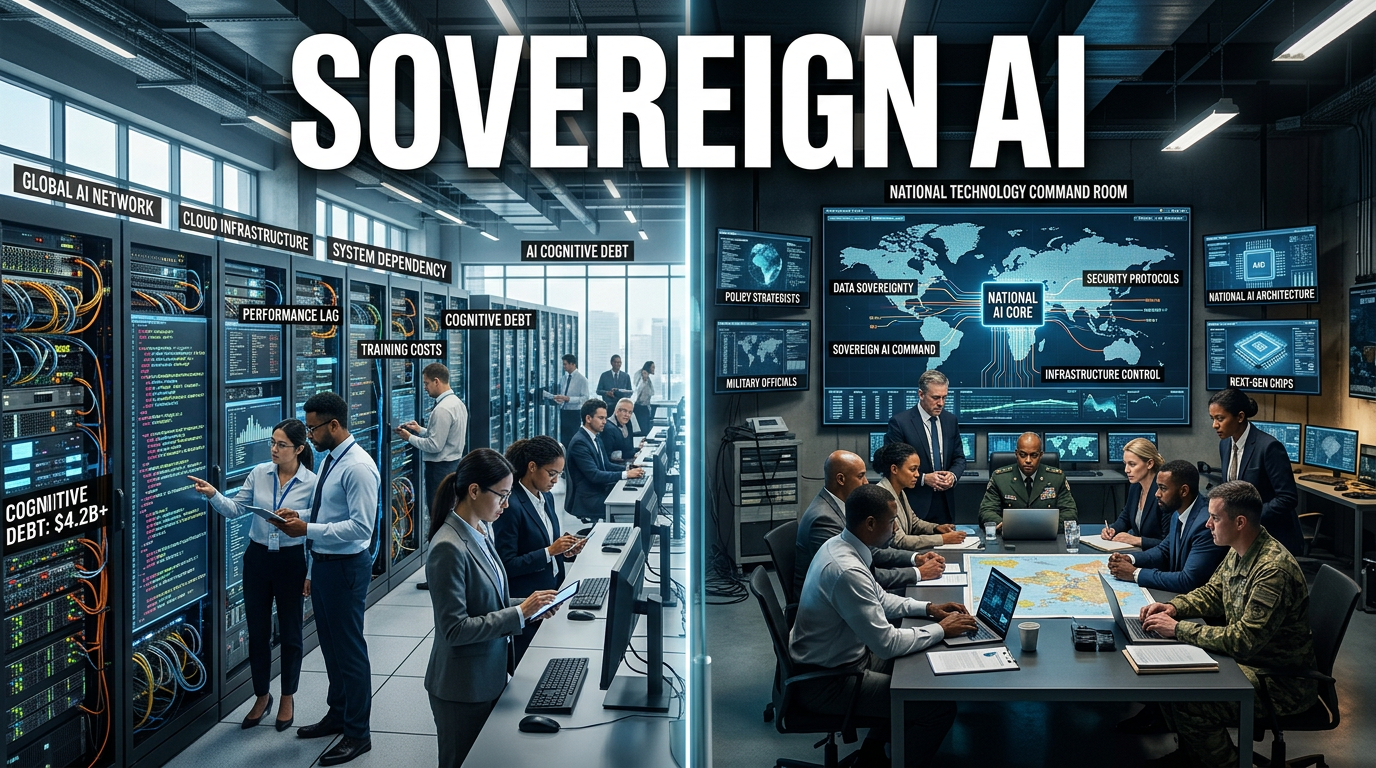
Sovereign AI is the concept of building an independent AI ecosystem based on a country’s own data and infrastructure, rather than being dependent on foreign big tech models.
What matters here is data more than the model itself.
Korea is mentioned as accounting for only about 0.06% of the world’s territory, but about 0.6% of the population and roughly 1.5% of GDP.
It is pointed out that compared with its economic scale, the share of internet data and publicly available digital data is still insufficient.
In the AI era, population matters more than territory, GDP matters more than population, and even more important than GDP is digital data.
If 10% of the world’s internet data were Korean-language data, global AI models would be much more likely to produce responses that are friendly to Korean language and Korean society.
But in reality, there is not enough Korean-language data available publicly.
Older news articles, public institution documents, research materials, industry data, classical literature, and non-confidential corporate materials all need to be digitized and made public in greater volume.
Opening public data, standardizing industrial data, and expanding Korean-language corpora ultimately become the core foundation of Korean AI competitiveness.
4. The rise of Chinese AI models: the two sides of open-source strategy and data regulation
As access to the latest U.S. models became restricted, Chinese AI models drew attention as alternatives.
What is interesting is that while in the past the U.S. was seen as leading open source and China as being closed, in the AI model market Chinese models are instead showing strong presence in the open-source camp.
China’s choice of an open-source AI strategy can be seen as a catch-up strategy by a late mover.
When model weights are released, developers and researchers around the world can join in and improve performance.
Chinese companies were able to catch up to U.S. models quickly through this approach.
However, it is not clear whether this trend will last forever.
After growing the market with open source, there is also a possibility that top-tier models will switch back to closed form.
What matters even more when looking at Chinese AI models is data regulation.
China is described as requiring that a certain proportion or more of training data for generative AI must be Chinese-language data.
The original text explains as a core takeaway that more than 50% of the training data must be in Chinese.
This regulation is both a strength and a weakness for Chinese models.
Chinese-language performance can become stronger, but if the share of English, Korean, Japanese, and Southeast Asian language data decreases, performance gaps can emerge in certain tasks.
U.S. models have an overwhelmingly high proportion of English data, so Korean companies often enter important prompts in English.
By contrast, Chinese models are strongly Chinese-centric, so verification is essential when applying them to Korean-language work.
5. The real barrier in AX is not technology but “datafying tacit knowledge”
The biggest barrier in enterprise AI transformation, or AX, is not model adoption.
The real difficulty is turning the tacit knowledge in employees’ heads and fingertips into data.
Work methods that are not written down, judgment criteria exchanged only during meetings, know-how passed verbally from senior staff to juniors, and exception-handling methods by department are all difficult for AI to learn.
For AI to replace or assist organizational work, such tacit knowledge must be transformed into digital data.
The case of Meta allegedly trying to install programs on employees’ computers to track keyboard and mouse usage data can also be understood in this context.
It is an attempt to turn how employees actually work into data and have AI learn from it.
However, this approach can raise issues such as privacy, surveillance concerns, employee resistance, and damage to collaboration culture.
AI transformation is not simply about collecting more data; it is about creating a structure in which people can collaborate with AI based on trust.
Something similar is happening in the humanoid robotics industry as well.
For robots to assemble, move, and judge like humans, first-person video data of tasks is needed.
That is why a market has emerged for large-scale collection of videos of workers in specific countries actually performing tasks.
The problem is that if a robot learns only a specific country’s, specific factory’s, or specific labor method’s patterns, that method can harden into the global standard.
AI data is not just raw material; it becomes the behavioral standard for future automation systems.
6. What is AI cognitive debt, and why is it more dangerous than technical debt
Technical debt is a concept long recognized as important in development organizations.
It refers to the phenomenon in which hastily built code, temporary workarounds, and undocumented systems increase maintenance costs over time.
But in the AI era, a debt even scarier than technical debt emerges.
That is AI cognitive debt.
AI cognitive debt refers to a state in which AI-generated outputs work, but people do not fully understand their principles or structure.
The code runs, but no one knows why it runs; the report looks convincing, but the basis is unclear; the strategy document is impressive, but the decision process is invisible.
In the past, there was a joke that code written while drunk has to be fixed while drunk.
It meant you have to be drunk to understand the code.
But with AI-generated code, a situation may arise where only AI can debug it.
The moment a person looks at the code and still does not know “why was it designed this way?”, cognitive debt accumulates.
This problem is especially visible in vibe coding.
AI creates terminal commands, modifies code, installs libraries, and connects databases.
The user simply presses Enter and gets the result, but later they may no longer know which services are connected, where data is stored, or how security settings are configured.
The same issue arises in work agents.
When AI capabilities are added to Microsoft Word, Excel, PowerPoint, and Google Workspace, document and report creation becomes faster.
But if people submit content without properly reviewing it, incorrect evidence and wrong numbers can enter decision-making.
In the end, the important question is not whether to use AI.
It is how quickly humans can learn, verify, and control the outputs AI produces.
7. How companies can reduce AI cognitive debt
Companies should design a way to learn with AI, not a way to block it.
First, source tracing for AI outputs must be mandatory.
For AI-generated code, reports, and strategy documents, the data and decision criteria used should be recorded.
Outputs without sources may be produced quickly, but they become organizational risks later.
Second, humans must be able to explain the work AI produces.
Developers should be able to review AI-generated code, and planners should be able to explain the assumptions behind AI-generated strategic options.
“AI said so” can no longer be an answer.
Third, companies should measure AI performance outcomes, not just AI usage volume.
Using many tokens does not mean the work was done well.
Conversely, saving tokens does not automatically create competitiveness.
What matters is how much actual revenue, development speed, quality, customer response, and decision density improve through AI use.
Fourth, a system should be created to evaluate AI-generated outputs with AI again.
AI can re-check whether AI-written code complies with standards, test coverage, security vulnerabilities, and business contribution.
However, final responsibility must remain with humans.
Fifth, key talent must be provided with sufficient AI usage environments.
Employees who use AI well often run out of tokens.
They need higher-tier plans or multiple accounts to maximize productivity.
8. The coding agent market: Claude Code is not the only number one
Many people think Claude Code dominates the coding agent market, but by revenue, GitHub Copilot has a strong presence.
Microsoft has powerful sales force based on GitHub, Office, and Azure.
That is why GitHub Copilot still holds a strong position in the developer tools market.
Cursor is also an important player.
Thanks to a developer-friendly interface and fast execution experience, many developers use it.
Coding agents are not just development tools; they can become a gateway to securing users’ workflow and behavioral data.
Claude Code is highly rated among developers in terms of performance.
However, in terms of broad adoption and enterprise sales power, Copilot and Cursor are formidable as well.
OpenAI’s Codex is considered very smart, but it comes with a heavy cost burden.
Even in subscription plans, usage can be depleted quickly, and if used via API, token costs can rise sharply.
In the U.S., there are even cases where companies spend more on AI tokens than on developer salaries.
This trend shows that AI productivity is not merely a matter of model performance; it is also a matter of cost structure, usage limits, workflow integration, and the organization’s level of training.
9. The Big Tech AI data center war: model competition is ultimately infrastructure competition
AI competition may look like a competition in model performance, but in reality it is competition in AI data centers and AI semiconductors.
The winner will be determined by who secures more GPUs, who gets stable power supply, and who can produce tokens more cheaply.
Microsoft is rapidly growing AI revenue based on OpenAI and Azure.
Through Office Copilot, GitHub Copilot, and Azure AI services, it is targeting both work agents and coding agents.
Amazon is moving around AWS and Anthropic.
Through Bedrock, it is offering various models while pursuing a strategy to reduce dependence on any single model.
Its own AI chips, Trainium and Inferentia, are also important cards.
Google is a player with both Gemini and TPU.
It is one of the few companies that possesses model, chip, and cloud infrastructure at the same time.
As AI costs surge, TPU competitiveness may become even more important going forward.
Oracle is also quietly securing GPU infrastructure and connecting with OpenAI.
Although it has been relatively less noticed in the cloud market, its presence is growing as AI infrastructure demand expands.
Elon Musk’s xAI and Colossus are also important variables.
Efforts continue to connect large-scale data centers with proprietary models, services, and a coding agent ecosystem.
10. The war after Nvidia’s dominance: TPU, Trainium, Tesla AI chips
At present, the center of the AI semiconductor market is Nvidia.
But big tech companies are accelerating development of their own chips to reduce dependence on Nvidia.
Google has been developing TPU for a long time and is focused on lowering AI training and inference costs.
Amazon is expanding in-house chip use within the AWS ecosystem through Trainium and Inferentia.
Tesla is also evolving beyond a car company into an AI chip company.
Tesla vehicles contain AI chips for autonomous driving, and if chips such as AI5 and AI6 are mass-produced in the future, the company could expand into robotics and data centers as well.
AI semiconductor companies such as Cerebras are also drawing attention after going public, but actual revenue growth and ecosystem expansion remain challenges.
Even if hardware performance is excellent, model porting, service operations, customer acquisition, and stable revenue generation are entirely different problems.
11. Why Meta looks ambiguous even though it has many GPUs
Meta is mentioned as one of the companies with many GPUs.
However, unlike Microsoft, Amazon, and Google, it is not a company that provides a powerful cloud platform to external users.
Meta tried to expand its influence in the AI ecosystem through the Llama open-source model, but it has a lot to consider in the top-model competition.
It is trying various directions such as VR, the metaverse, AI, and work agents, but it is still hard to say it has secured clear platform dominance.
Still, Meta is a company that has media inventory, user data, and an advertising system all at once.
As Apple and Google restricted mobile ad tracking, the power of companies like Meta that hold data within their own platforms has actually grown stronger.
Under the banner of privacy protection, external tracking is restricted, but in the end the hegemony of big tech companies that possess platforms, data, and ad inventory all at once grows even larger.
This is extremely important from the perspective of the global economic outlook.
In the AI era, wealth is likely to concentrate not only in companies that build models well, but also in companies that simultaneously possess data, inventory, and infrastructure.
12. The real core point that other news does not say clearly
The first core point is that AI export controls can directly stop a company’s operational productivity.
Until now, export controls have been understood mainly in terms of semiconductors, equipment, and military technology.
But now access to a specific AI model itself determines a company’s development speed and work efficiency.
The second core point is that the success or failure of Korean-style AI depends more on data disclosure than on model development.
It is important to build good models, but if Korea cannot secure enough Korean-language and Korean industry data, it may remain a peripheral user of U.S. or Chinese models in the long run.
The third core point is that cognitive debt is the process of handing organizational decision-making power over to AI.
If people approve, report, and deploy outputs without understanding what AI produced, humans will retain only responsibility while losing judgment.
The fourth core point is that AI costs may become a key line item on corporate income statements going forward.
Like cloud costs, AI token costs are highly likely to be directly reflected in cost of goods sold and operating expenses.
The more a company uses AI, the higher productivity may rise, but if cost control fails, profitability can wobble.
The fifth core point is that big tech’s AI competition is ultimately a battle to dominate data centers, power, chips, and workplace tools.
If you only look at model performance announcements, you miss the trend.
The real contest is who can produce tokens more cheaply and who can penetrate more deeply into corporate work tools.
13. What companies and individuals should do now
Companies should avoid a strategy that ties all work to a single AI model.
A multi-model strategy, data backup strategy, prompt asset management, and AI usage log management are necessary.
Individuals should reduce the habit of using AI outputs as-is.
Even if AI handles the draft, you must understand the final judgment criteria, evidence, and structure yourself.
Development teams should actively adopt vibe coding, but at the same time strengthen code review, architecture explanation, test automation, and security verification.
Work teams should use work agents, but standardize the source of reports and the process for verifying numbers.
Governments and public institutions should more actively disclose Korean-language data and public data.
If Korea does not become a data powerhouse in the AI era, Sovereign AI is likely to remain merely a slogan.
< Summary >
The Anthropic latest model export control incident was an event that showed the need for AI protectionism and Sovereign AI.
If companies become overly dependent on a specific AI model, they are exposed to risks from pricing, policy, and usage restrictions.
Chinese AI models grew rapidly through an open-source strategy, but because of Chinese-language-centric data regulations, their use requires verification.
Korean AI competitiveness depends more on Korean-language data and the disclosure of public data than on models.
What is more dangerous than technical debt is AI cognitive debt, where humans cannot understand the outputs AI creates.
The AI data center war is expanding into infrastructure competition among Microsoft, Amazon, Google, Oracle, xAI, and Meta.
Going forward, corporate competitiveness is likely to hinge more on the ability to understand and control AI than simply on the ability to use it.
[Related Articles…]
- Analysis of AI Industry Outlook and Big Tech Infrastructure Competition
- Summary of AI Chip and Data Center Investment Trends
*Source: [ 티타임즈TV ]
– 기술부채보다 위험한 AI 인지부채 (박종천 지란지교소프트 CAIO)