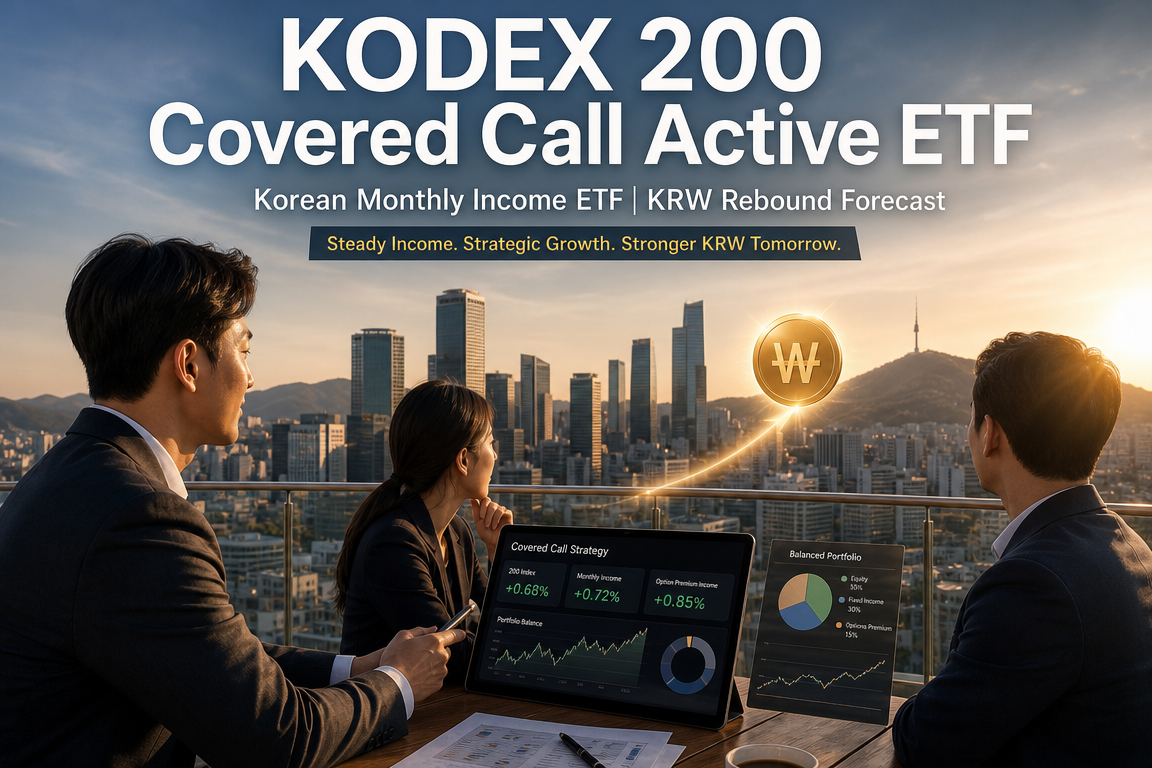
● KODEX 200 Covered Call Active ETF, Monthly Income, KOSPI200, Active Strategy, Volatility Shield
How to Position for KOSPI 200 Leadership While Capturing Monthly Cash Flow: KODEX 200 Covered Call Active ETF Key Summary
In market conditions where Korean equities have risen sharply and daily swings have widened, the key question is no longer only how much more can be earned, but how to protect gains already accumulated.
This report outlines the KODEX 200 Covered Call Active ETF in a news-style format, focusing on its KOSPI 200 exposure, monthly income objective, and active adjustment of weights in leading sectors such as semiconductors and shipbuilding.
It also covers the structure of covered call ETFs, active management features, potential tax advantages related to option premiums, a twice-monthly distribution framework, and the risks investors may overlook.
1. Market Context: Investor Focus Is Shifting from Return Maximization to Volatility Management
In the first half of the year, Korean equities showed a strong overall trend.
The KOSPI 200 and other benchmark domestic indices extended gains on the back of global equity momentum, policy expectations, semiconductor recovery, and strength in leading sectors such as shipbuilding and defense.
The issue now is post-rally volatility.
When share prices rise quickly over a short period, profit-taking is likely to emerge.
Additional pressure from U.S. market moves, changing rate-cut expectations, exchange-rate fluctuations, and foreign investor flows has also increased daily volatility in the Korean market.
In this environment, investors are increasingly asking:
- Should gains already made be held?
- How should a sudden correction be managed?
- Should equity exposure be reduced in favor of short-term bonds or deposits?
- Is there a way to remain invested in further market upside?
- Can monthly cash flow be generated beyond salary income?
KODEX 200 Covered Call Active ETF is designed to address these questions.
2. Product Overview: What Is the KODEX 200 Covered Call Active ETF?
KODEX 200 Covered Call Active ETF invests in the KOSPI 200 while seeking monthly distributions through a covered call strategy.
Three terms are central to the product name:
- 200: The fund invests on the basis of the KOSPI 200, Korea’s benchmark index.
- Covered Call: It holds equities while selling call options to generate option premiums.
- Active: It does not simply track the index passively, but adjusts sector weights and option exposure based on portfolio management judgment.
In other words, this ETF is neither a plain passive KOSPI 200 fund nor a mechanical covered call product.
It seeks exposure to the benchmark Korean market while dynamically managing leading sectors and option positioning depending on market conditions.
It can be viewed as a monthly distribution-oriented covered call ETF within Samsung Asset Management’s KODEX lineup.
3. First Key Point: Active Allocation Toward Leading Industries
A defining feature of the Korean market recently has been that gains have been driven by a few sectors rather than by broad-based participation.
Semiconductors, shipbuilding, defense, selected financials, and companies benefiting from shareholder-return expectations have led the market.
By contrast, many names within the index but outside those leaders have produced weaker returns or remained range-bound.
In such a market, a passive strategy that replicates the KOSPI 200 exactly may appear less efficient.
KODEX 200 Covered Call Active ETF seeks excess return by increasing exposure to leading sectors and industries based on portfolio manager judgment.
In practical terms, it allocates to the broader KOSPI 200 universe while placing somewhat greater emphasis on industries with stronger momentum.
This is the key difference from conventional passive covered call ETFs.
4. Second Key Point: Higher Shareholder Returns and the Potential for a Korea Premium
Shareholder return has become one of the most important themes in the Korean market.
Government and regulatory initiatives have emphasized corporate value enhancement, dividend expansion, treasury share cancellations, and governance reform as part of an effort to address long-standing valuation discounts.
Historically, the term “Korea discount” has often been used to describe the market.
More recently, companies active in dividends and share buybacks have increasingly been viewed as candidates for re-rating, supporting expectations of a “Korea premium.”
KODEX 200 Covered Call Active ETF does not simply hold KOSPI 200 constituents; it also monitors companies with strong shareholder-return profiles and may reflect them in the portfolio when appropriate.
The structure therefore combines benchmark exposure with policy momentum and shareholder-return themes.
5. Third Key Point: Flexible Use of Option Maturity
A covered call strategy involves holding equities and selling call options to receive premium income.
The main advantage is the potential for steady cash flow in flat or moderately rising markets.
The limitation is also clear.
In a strong rally, call option exposure can reduce participation in upside returns.
For this reason, the critical issue in a covered call ETF is when to sell options, which maturity to choose, and how much exposure to sell.
KODEX 200 Covered Call Active ETF manages this actively.
- It may use monthly options.
- It may use weekly options.
- It may use daily options.
- It can adjust the level of option selling according to market conditions.
- When premiums are attractive, it can prioritize cash-flow generation.
- When a strong uptrend is expected, it can increase market participation.
In effect, the strategy seeks to enhance downside defense through option premium in weak or range-bound markets, while maintaining greater participation in rising markets by adjusting call writing intensity.
6. Key Investor Appeal: Monthly Cash Flow
The most direct appeal of this ETF is its monthly distribution profile.
Investors may seek monthly distributions derived from option premiums and other sources while maintaining exposure to a KOSPI 200-based equity portfolio.
This may be especially relevant for retirees, pension accounts, and investors who prioritize recurring cash flow.
However, one point is essential.
Monthly distribution is not a guaranteed return.
Distributions depend on market conditions, option premium levels, dividends from holdings, and overall portfolio performance.
A distribution does not imply principal protection.
7. Tax Consideration: Option Premium Distributions May Be Treated Differently
One point emphasized in the original material is the tax treatment of option premiums.
In general, dividends received from the ETF’s underlying equity holdings are subject to dividend income taxation.
For domestic investors, the standard dividend income tax rate is 15.4%.
However, where option-sale premiums are used as part of the distribution base in a covered call strategy, that component may currently be excluded from taxation under existing rules.
This does not mean that the entire distribution is tax-free.
The distribution may include both taxable dividend income from stocks and option-premium-derived income.
While the stock-dividend portion may be taxable, the option-premium portion may currently receive tax-favorable treatment.
Because tax rules can change, investors should confirm the latest applicable regulations before investing.
8. Existing Product Pairing: A Twice-Monthly Distribution Framework
One notable use case in the original material is a cash-flow strategy combining two covered call ETFs.
The existing KODEX 200 Target Weekly Covered Call ETF follows a mid-month distribution structure.
The newly listed KODEX 200 Covered Call Active ETF seeks month-end distributions.
As a result, investors may consider a strategy that targets distributions twice a month by combining the two products.
- The KODEX 200 Target Weekly Covered Call ETF may be used from the start of the month through the middle of the month.
- After the mid-month distribution reference date, KODEX 200 Covered Call Active ETF may be considered.
- Holding the ETF through the final business day of the month may target month-end distribution.
- In this structure, investors may aim for cash flow twice a month.
However, investors should not assume that simply buying on a given day guarantees a distribution.
Distribution eligibility depends on the record date, ex-distribution date, settlement date, and business-day schedule.
Because of the settlement cycle in the Korean market, the purchase date and the actual entitlement date may differ.
Accordingly, investors should review the fund prospectus and the official KODEX website for monthly reference dates.
9. Why It Matters That Both Products Are Based on the Same KOSPI 200 Universe
A twice-monthly distribution strategy can also be built with other ETF combinations.
However, the underlying exposures may differ substantially.
For example, switching from a semiconductor ETF in mid-month to a dividend ETF at month-end could change both the investment objective and risk profile.
In that case, the portfolio may become unintentionally concentrated in a sector or misaligned with the market direction.
By contrast, both KODEX 200 Target Weekly Covered Call ETF and KODEX 200 Covered Call Active ETF are based on the KOSPI 200.
That means the core investment anchor remains Korea’s benchmark equity market even when a mid-month and month-end distribution framework is used.
This is an important advantage.
Without this consistency, investors may drift across strategies and unintentionally weaken portfolio structure. Using two KOSPI 200-based products helps maintain strategic coherence.
10. Manager Perspective: Samsung Asset Management and the KODEX Platform
Covered call ETFs may appear straightforward, but they are operationally demanding.
Option sale timing, maturity selection, premium assessment, distribution reserve management, and response to sharp market moves all matter.
The original material highlights Samsung Asset Management’s experience as a key strength.
Samsung Asset Management launched Korea’s first ETF business in 2002.
The existing KODEX 200 Target Weekly Covered Call ETF is also described as a large-scale covered call product in terms of assets and retail inflows.
Experience managing a large covered call ETF is an important competitive advantage.
For a strategy run at large scale, investment ideas alone are not sufficient; market liquidity management and operational systems are equally important.
11. The Most Important Points Often Understated in Media Coverage
First, twice-monthly distributions do not mean double the return.
Distributions are paid out of ETF net assets, and the share price may adjust after the ex-distribution date.
Investors should assess total return, not only cash received.
Second, the real performance driver in a covered call strategy is not simply the level of option premium, but how well upside participation is managed.
If call selling is too aggressive, the ETF may underperform sharply in strong rallies.
If it is too limited, distribution income may weaken.
The core of this ETF is the active management of that balance.
Third, any tax advantage may apply only to the option-premium-related portion of distributions, not to the entire payout.
Investors should not interpret this as a blanket tax exemption for monthly distributions.
Distribution composition should be reviewed to separate taxable and potentially tax-favored components.
Fourth, active ETFs can outperform when the manager makes correct calls, but they can also lag the index when those calls are wrong.
Increasing exposure to leading sectors can create an opportunity for outperformance, but it also creates risk when leadership rotates.
Fifth, this product is not a deposit substitute.
Although monthly distributions may make it appear conservative, the underlying asset is the KOSPI 200 and equity downside risk remains.
12. Suitable Investor Profiles
KODEX 200 Covered Call Active ETF may suit investors who:
- want to remain exposed to Korean equity upside while reducing volatility concerns,
- prefer monthly cash flow while maintaining KOSPI 200-based exposure,
- want a structure that combines benchmark investing with leading sectors and shareholder-return themes,
- already hold a mid-month covered call ETF and want to add a month-end distribution strategy,
- are building a cash-flow-oriented portfolio in pension or retirement accounts.
It may be particularly relevant for investors near or after retirement who prioritize recurring income.
At the same time, investors seeking aggressive long-term capital growth should understand the upside cap inherent in covered call strategies.
13. Key Risks to Review Before Investing
First, upside may be limited in a strong rally.
Because the strategy sells call options, part of the gain may be forfeited when the index rises sharply.
Second, capital loss is still possible in a down market.
Option premiums may soften losses, but a material decline in the KOSPI 200 can still reduce ETF value.
Third, distributions are not guaranteed.
A monthly distribution ETF does not mean the payout will be stable from month to month.
Fourth, there is active management risk.
Sector weights and option selling levels are adjusted based on manager judgment, and that judgment may not always be correct.
Fifth, tax rules may change.
Although option-premium-related distributions may currently receive favorable treatment, future tax policy could differ.
Sixth, switching strategies can create transaction costs and timing risk.
Moving between ETFs to capture mid-month and month-end distributions may involve trading costs, bid-ask spreads, ex-distribution timing, and settlement errors.
14. Core Investment View: A Defensive Growth-Participation Product
In one sentence, KODEX 200 Covered Call Active ETF can be described as an active covered call ETF that seeks to participate in KOSPI 200 upside while generating monthly cash flow and reducing volatility.
It is not designed to fully track the index in a strong bull market.
Instead, it uses option premiums to generate recurring cash flow and active management to adjust exposure to leading sectors and option strategy.
Accordingly, the ETF is better suited to investors seeking continued participation in Korea’s benchmark equity market with volatility control and monthly distributions, rather than those seeking short-term surge exposure.
The key issue is portfolio sizing.
Rather than allocating all capital at once, investors should define the ETF’s role within a broader portfolio that may include other KOSPI 200 funds, dividend ETFs, bond funds, and cash equivalents.
< Summary >
KODEX 200 Covered Call Active ETF is designed to invest in the KOSPI 200 while pursuing monthly distributions through a covered call strategy.
Unlike conventional passive covered call ETFs, it actively adjusts sector weights, shareholder-return exposure, and option maturity and selling intensity.
A month-end distribution structure may allow investors to combine it with KODEX 200 Target Weekly Covered Call ETF for a twice-monthly cash-flow framework.
However, monthly distributions are not guaranteed returns, and strong upside may be capped under the covered call structure.
Option-premium-related distributions may currently benefit from favorable tax treatment, but investors should confirm composition and remain aware that tax rules may change.
This product is an equity ETF based on the KOSPI 200 rather than a deposit substitute, so position sizing should reflect each investor’s objectives and risk tolerance.
[Related Articles…]
- Monthly Income Investing: Understanding Covered Call ETF Basics
- KOSPI 200 and the Dynamics of Korea’s Leading Sectors
*Source: [ 소수몽키 ]
– 주도주에 올라타며 월 현금도 챙긴다? 코스피 끝판왕 월배당 투자법
● Won-Rushed, Yuan-Faded, Korea-Soared
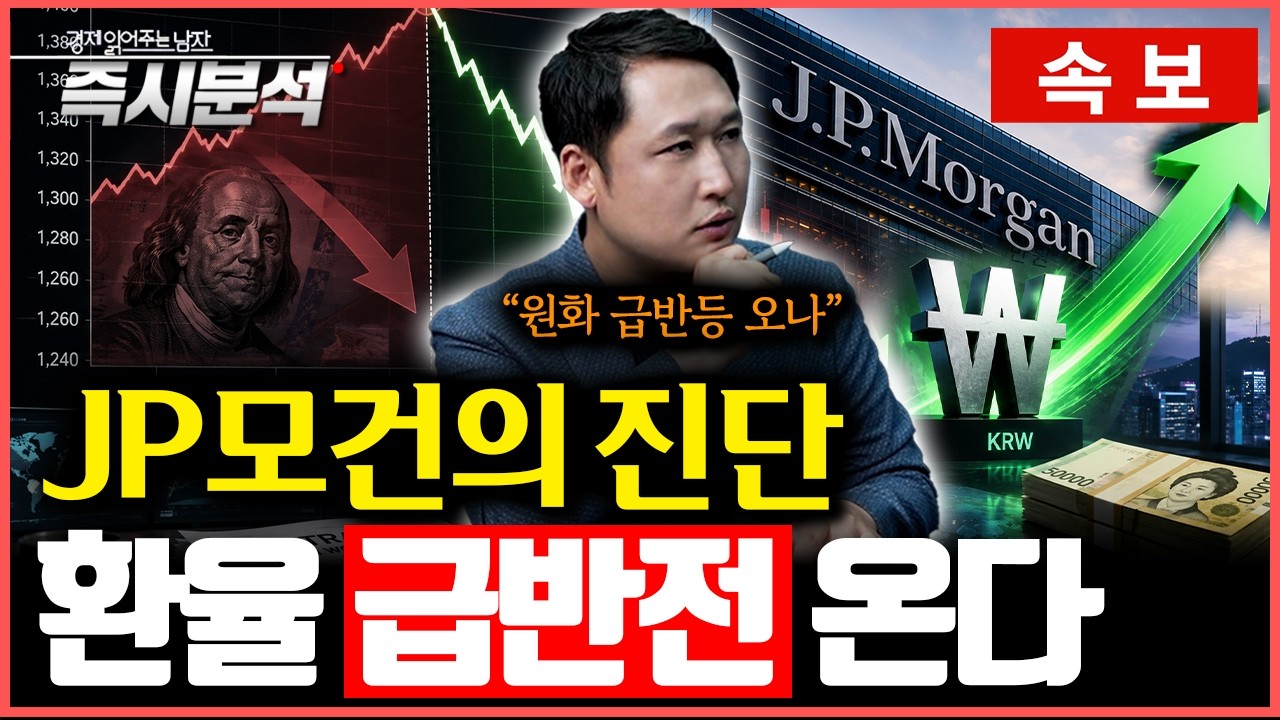
JP Morgan FX Outlook: A Potential Sharp Reversal in KRW, Renewed KRW Strength, and Repricing Across Emerging-Market Currencies
The key point in this development is not simply that the Korean won is expected to strengthen.
What matters more is that JP Morgan Asset Management is reducing exposure to the Chinese yuan and shifting attention toward the Korean won and high-yield emerging-market currencies.
This is a signal for where global capital may be rotating out of and into, and it should be assessed through the lens of USD/KRW, the Korean equity market, semiconductor exports, emerging-market currencies, and global liquidity flows.
In particular, the relevant issue is not only that JP Morgan has turned constructive on the won, but that this view is aligned with changes in money supply growth in the United States and Korea, the impact of FX market intervention, reduced yuan positioning, and foreign-currency funding dynamics tied to SK hynix ADR-related discussions.
In this context, the exchange rate is not just a number; it is a leading indicator of how Korea’s economic outlook may be repriced in a weaker-dollar environment.
1. JP Morgan’s core view: capital rotation from the yuan to KRW and high-yield currencies
JP Morgan Asset Management recently said it has been trimming long positions in the Chinese yuan in its Asia FX strategy.
A long position is a bet that a currency will appreciate.
JP Morgan is not arguing that the yuan’s fundamentals are weak.
Rather, it noted that if China’s trade and current account balances remain supportive and the dollar continues to weaken, the yuan could still strengthen toward around 6.5 per dollar.
However, much of the favorable yuan narrative appears to be already priced in.
In other words, the currency may still be constructive fundamentally, but its near-term upside looks less attractive from a valuation and positioning perspective.
Accordingly, JP Morgan is rotating toward currencies that have lagged, remain undervalued, or offer higher yield.
The currencies cited include the Korean won, the Philippine peso, and the Mexican peso.
This suggests that global capital is moving beyond a simple safety-driven stance and toward a phase in which yield and relative upside potential matter more.
2. Why the Korean won has been identified as a relative outperformer
Julio Callegari, head of Asia fixed income at JP Morgan Asset Management, said the Korean won could emerge as one of the most significant reversal stories in Asian FX.
He argued that if a Fed policy reassessment, a weaker dollar, and a possible correction in U.S. equities converge, undervalued Asian currencies could reprice quickly.
The won is viewed as having greater rebound potential because it has underperformed materially this year.
The weakness of the won is not solely a reflection of Korea’s domestic economy.
Even as the dollar index has declined, USD/KRW has remained elevated, indicating that the won may be excessively undervalued.
Normally, a weaker dollar should support a stronger won.
Yet recent market behavior has shown both a weaker dollar and a weaker won, which is an unusual FX pattern.
JP Morgan’s view is that this distortion may eventually normalize.
3. The USD/KRW anomaly: the dollar weakened, but the won also weakened
USD/KRW functions as a key barometer of both Korea’s economy and global financial conditions.
A higher exchange rate can support exporters, but it also raises costs for importers and puts upward pressure on consumer prices.
Conversely, a stronger won helps stabilize import prices, reduce foreign-currency input costs, and support foreign capital inflows.
The issue is that USD/KRW has remained near levels historically associated with major stress periods such as the Asian financial crisis and the global financial crisis.
However, those earlier episodes were typically characterized by sharp spikes followed by normalization.
By contrast, the recent elevated exchange rate has looked more persistent and structural.
That is why the market has described the situation as abnormal.
Since the dollar index has been falling while the won has also weakened, the explanation cannot rest on dollar strength alone.
The recent move likely reflects a combination of funding, sentiment, and policy-related factors specific to Korea.
4. Why FX intervention has had limited effectiveness
The original analysis emphasized that the authorities appear to have intervened substantially in the FX market.
To support the won, policymakers can sell dollars into the market and absorb won liquidity.
However, when foreign reserves and current account data are compared, it appears that even substantial intervention produced only limited stabilization.
This is an important signal.
If large-scale intervention does not bring the exchange rate down meaningfully, the underlying pressure is likely more structural than tactical.
Possible drivers include domestic liquidity growth, overseas investment outflows, foreign investor positioning, corporate dollar demand, and political or geopolitical risk.
Another issue is that net intervention data are published with a lag.
Because FX markets move quickly, delayed disclosure makes it harder for investors and corporates to assess the market in real time.
For FX stabilization, the speed of information disclosure matters alongside the scale of intervention.
5. SK hynix ADR-related flows and their impact on KRW supply and demand
The original text also highlighted the possibility that SK hynix ADR-related activity could affect won strength through foreign-currency funding flows.
An ADR is a depositary receipt that allows a foreign company’s shares to trade in the U.S. market.
If a large-scale ADR issuance or foreign-currency fundraising were to occur, the conversion of dollar proceeds into won could create upward pressure on the won.
Forward transactions could also cause FX markets to price in the effect in advance.
That said, this remains contingent on filings, listing schedules, and fundraising size.
Accordingly, it should be treated as a potential supply-and-demand variable rather than a confirmed outcome.
Even so, if capital raising by major semiconductor firms, foreign investor inflows, and higher Korea equity allocations occur together, they could reinforce KRW appreciation.
In particular, SK hynix and Samsung Electronics remain central to both Korea’s export performance and foreign investor flows.
An improvement in the semiconductor cycle could support both the won and the Korean equity market.
6. Why the yuan has become a target for position reduction
The Chinese yuan has been among the stronger Asian currencies recently.
According to JP Morgan, the yuan has risen about 3% against the dollar year to date, and the CFETS yuan index has also moved to elevated levels on a real effective basis.
The CFETS index measures the yuan against the currencies of China’s major trading partners, not just the dollar.
This means the yuan is already relatively expensive compared with earlier levels.
JP Morgan’s point is not that the yuan is unattractive, but that much of the favorable story is already reflected in prices.
In investment terms, it is not enough to identify strong assets; one must also identify assets whose upside has not yet been fully priced in.
From that perspective, the won, the yen, and certain emerging-market currencies may appear more attractive on a relative basis.
If the yuan enters a period of consolidation and global capital searches for the next leg of appreciation, the won could benefit.
7. The common theme for the yen and the won: both currencies have become very cheap
Like the won, the Japanese yen has also experienced prolonged weakness.
A weaker yen reduces Japanese households’ overseas purchasing power.
Similarly, a weaker won increases import costs for Korean consumers and raises the cost of overseas asset purchases.
The reason JP Morgan is focusing on currencies such as the won and the yen is straightforward.
The view is that downside may be more limited than normalization potential.
Currency forecasting remains inherently difficult.
However, when a currency has fallen to historically depressed levels and the dollar is weakening alongside expanding U.S. liquidity, the probability of a rebound rises.
8. The most important variable: the pace of liquidity expansion in the U.S. and Korea
One of the most important points in the original analysis is the growth rate of M1 and M2 money supply.
FX rates are ultimately exchange ratios between two currencies.
Accordingly, the speed at which the U.S. and Korea expand liquidity has a direct effect on USD/KRW.
M2 refers to broad money in circulation.
It includes deposits, cash equivalents, and short-term financial instruments, making it a key indicator of overall liquidity.
The original analysis argues that Korea’s M2 growth rate has exceeded that of the U.S., which contributed to won weakness.
In other words, even if both economies expanded money supply, a faster increase in Korea could still weaken the won relative to the dollar.
Conversely, if U.S. M2 growth accelerates faster than Korea’s, the dollar may weaken more rapidly.
That would put downward pressure on USD/KRW.
This is the key backdrop to JP Morgan’s constructive view on the won.
9. U.S. liquidity expansion and a weaker-dollar scenario
The original text also points to the possibility of significant liquidity expansion in the U.S.
In particular, political events, fiscal spending, debt-ceiling adjustments, and Treasury issuance could all support higher market liquidity.
If U.S. M2 growth accelerates, the dollar is likely to face depreciation pressure.
A weaker dollar is generally supportive for emerging-market currencies.
As the dollar weakens, global investors may rotate out of dollar assets and into undervalued emerging-market currencies and equities.
In that process, the Korean won and the Korean equity market could both benefit.
Korea’s semiconductor recovery, current account surplus, and potential foreign capital inflows provide additional support for a stronger won narrative.
10. Interest-rate direction in Korea and the U.S. also matters
Interest-rate differentials remain a critical FX variable.
As a rule, high U.S. rates relative to Korea tend to favor dollar assets and place depreciation pressure on the won.
Conversely, if the U.S. moves toward rate cuts or liquidity expansion while Korea maintains a tighter stance, that would be positive for the won.
The original analysis suggests that the U.S. may find it difficult to raise rates further, while Korea could still deliver one or two hikes if needed.
If that scenario materializes, USD/KRW is more likely to move lower than to extend meaningfully above the 1,500 level.
However, this outlook assumes no major shock such as war, a global financial crisis, an Asian FX crisis, or a pandemic.
FX forecasts must be revised quickly if those assumptions change.
11. Who benefits and who faces pressure if the won strengthens
A stronger won is neither uniformly positive nor uniformly negative for the economy.
Importers may benefit from KRW appreciation.
Companies importing raw materials, energy, food, and equipment can see lower costs.
Consumers may also benefit through lower import-driven inflation.
Exporters, however, may face some short-term pressure if the won strengthens.
The local-currency value of their dollar-denominated revenue declines.
That said, industries such as semiconductors can absorb some of this pressure because competitiveness is driven more by technology and scale than by price alone.
For equities, foreign investor behavior is especially important.
If investors expect KRW appreciation, they may buy Korean equities to capture both equity gains and FX gains.
As a result, a stronger won could support the KOSPI, semiconductors, financials, and domestic-demand sectors.
12. The key point often missed in other coverage: the direction of capital flows matters more than the exchange-rate level
Most FX coverage focuses on whether USD/KRW is at 1,500 or 1,400.
What matters more is which currencies global capital is leaving and which it is entering.
JP Morgan’s move from the yuan toward the won and higher-yield currencies is not just a forecast; it is a portfolio rotation signal.
Such shifts by major asset managers can influence other institutional investors as well.
Because the won has underperformed for an extended period, even modest inflows can move the exchange rate quickly.
Another important point is that FX intervention alone is no longer sufficient to anchor the currency.
Today, exchange rates are driven simultaneously by money supply, interest rates, semiconductor exports, foreign equity flows, the current account, political events, and geopolitical risk.
To assess the won, investors should monitor not only the dollar index, but also U.S. M2 growth, Korea’s M2 growth, foreign reserves, the current account balance, foreign net buying in the KOSPI, and semiconductor export data.
13. Key checkpoints to monitor going forward
First, confirm whether U.S. M2 growth is accelerating.
Faster U.S. liquidity growth would increase dollar-depreciation pressure and support the won.
Second, monitor whether Korea’s M2 growth remains elevated.
If Korea continues to expand liquidity faster than the U.S., upside in the won may be limited.
Third, track net FX intervention and foreign reserve trends.
If intervention remains large but the exchange rate stays elevated, structural supply-demand pressure should be assumed.
Fourth, monitor semiconductor exports and current account surplus trends.
Improving external balances strengthen the fundamental case for KRW appreciation.
Fifth, track foreign net buying in the Korean equity market.
Expectations of a stronger won could bring foreign capital into Korean equities, reinforcing appreciation.
Sixth, continue to monitor geopolitical and global risk shocks.
Safe-haven demand could re-strengthen the dollar if external risks intensify.
14. How to apply the FX outlook to investment positioning
If USD/KRW declines and the won strengthens, overseas equity investors should account for potential FX losses.
Even if U.S. stocks rise, a weaker dollar can reduce returns when translated back into won.
By contrast, Korean equity investors may benefit from foreign capital inflows.
Industries such as semiconductors, AI infrastructure, power equipment, shipbuilding, and defense may remain relatively resilient even in a stronger-won environment because global demand remains supportive.
Retail, food and beverage, airlines, and travel could also benefit from lower import costs.
However, FX forecasting remains difficult, and concentrated bets on one direction are risky.
A more practical approach is to balance dollar and won assets while allowing for a stronger-won scenario.
15. Conclusion: a sharp rebound in the won is possible, but only under specific conditions
JP Morgan’s FX outlook is not a simple statement that the won must rise.
The main point is that global capital may rotate away from a crowded yuan trade and toward undervalued Asian currencies and higher-yield emerging-market currencies.
Within that framework, the Korean won is identified as one of the most likely reversal candidates.
The conditions for KRW strength are relatively clear.
The dollar must continue to weaken.
U.S. liquidity expansion must accelerate.
Korea’s current account surplus and semiconductor export recovery must remain intact.
Foreign capital must flow into Korean equities.
Major geopolitical risks must remain contained.
If those conditions hold, USD/KRW could move away from structurally elevated levels and trend toward the low-1,400 range.
However, any major shock such as war, financial stress, renewed inflation, or a U.S. rate resurgence would weaken the case for KRW appreciation.
Accordingly, the focus should be less on whether the exchange rate will fall immediately and more on whether global capital is positioning for a revaluation of the won.
< Summary >
JP Morgan Asset Management sees much of the yuan’s appreciation story as already priced in and is shifting attention toward the Korean won and high-yield emerging-market currencies.
The won has underperformed materially this year, and a weaker dollar combined with faster U.S. liquidity growth could make it one of the strongest reversal candidates in Asian FX.
USD/KRW cannot be explained by the dollar index alone; it must be assessed alongside U.S.-Korea M2 growth, FX intervention, the current account, semiconductor exports, and foreign capital flows.
If KRW strength materializes, it would support the Korean equity market and reduce import-cost pressure, while creating some headwinds for exporters.
Key variables to watch include U.S. liquidity growth, Korea’s current account surplus, foreign net buying in the KOSPI, semiconductor trends, and geopolitical risk.
[Related Articles…]
*Source: [ 경제 읽어주는 남자(김광석TV) ]
– JP모건의 환율전망 “원화 가치 급반등 할 것”. 신흥국 통화 과도하게 저평가 되었다. [즉시분석]