● Tesla, Soars, UBS, Optimus, Robot-AI, Rally
Tesla closes at $406.55 as Wall Street begins to view it as a robotics AI company rather than an automaker
The key point in this Tesla news is not simply that Tesla stock rose by more than 3%.
UBS raised its Tesla price target from $364 to $442, an increase of about 21%, and the central rationale was not vehicle deliveries or EV margins, but the company’s AI-based robotics businesses, including Optimus, FSD, and Dojo.
In addition, detailed hardware information on Cybercab, including dual GPS, a 48V architecture, 4680 batteries, and steer-by-wire, is reinforcing the view that Tesla is moving into a genuine robotaxi production phase.
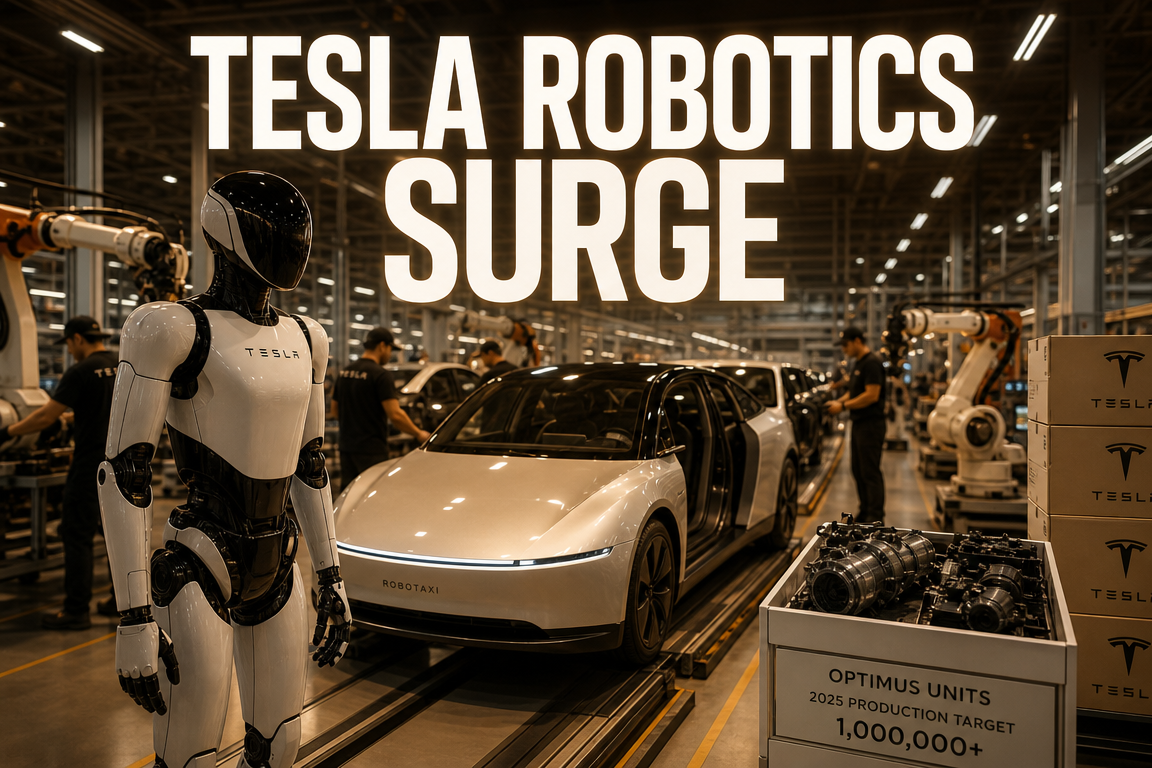
At the same time, reports from the China supply chain indicate that Optimus component production targets may rise to capacity for 1,000 units per week by September and 2,000 to 2,500 units per week by year-end, helping explain why Wall Street is reassessing Tesla.
This is also relevant from a global macro perspective, as the theme connects Tesla stock, autonomous driving, artificial intelligence, the semiconductor rally, and expectations for lower interest rates.
1. Market backdrop: semiconductor strength and risk-on sentiment lifted Tesla
In the source report, Tesla closed at $406.55.
That represented a gain of 3.17% from the previous session.
SpaceX-related pricing was also cited at around $152.16, up about 2.6%.
The broader market was led by semiconductors.
Micron announced plans to increase its investment in the United States from $200 billion to $250 billion, supporting buying across the semiconductor sector.
News that the New York facility is progressing faster than expected also helped drive the Nasdaq up 1.3%.
Tesla’s gains reflected both company-specific developments and broader support from the semiconductor rally and improved risk appetite.
2. Federal Reserve policy review and lower-rate expectations are also shaping sentiment
There were also important developments from the Federal Reserve.
The Fed said it would conduct a full review of its monetary policy framework and announced leaders for five task forces.
The review reportedly includes communication methods, balance sheet operations, and inflation assessment criteria.
While policy rates are not changing immediately, the market appears to be linking the review to possible easing later this year.
For equity markets, such policy direction matters.
For growth stocks like Tesla, lower-rate expectations can reduce discount-rate pressure on future cash flows and support valuation.
3. Middle East risk and oil volatility remain active variables
Geopolitical risk in the Middle East remains a major market factor.
Following reports of additional U.S. strikes on Iran, oil prices surged and then partially retraced, highlighting elevated volatility.
The market remains split between expectations of further escalation and the view that the conflict will remain limited.
A renewed oil spike would increase inflation pressure and could weaken expectations for rate cuts.
As a result, Middle East developments remain important to track when assessing Tesla and Nasdaq performance.
4. Volkswagen lineup reduction signals restructuring pressure in legacy automaking
Volkswagen is also preparing a major restructuring decision.
The company reportedly plans to cut its full model lineup by roughly half.
Volkswagen currently operates nearly 150 models, so the reduction would be substantial.
However, no final decision was reached on the proposed elimination of 100,000 jobs or the closure of German plants.
This matters because it reflects the cost pressure facing legacy automakers during the EV transition.
Tesla has long followed a strategy of maintaining a relatively simple model range to improve production efficiency, and Volkswagen now appears to be moving in a similar direction.
5. UBS raises Tesla price target from $364 to $442
The most important development in this report is the UBS research note.
UBS increased its Tesla price target from $364 to $442.
That represents an increase of about 21%.
Price-target increases of this magnitude are uncommon and usually follow strong earnings surprises, robust new-car demand, or clear margin improvement.
In this case, however, the key point is that the higher target was not driven by vehicle sales.
UBS appears to have materially increased the value attributed to Tesla’s robotics AI assets, including Optimus, FSD, and Dojo, rather than changing its view of the core automotive business.
That said, the firm kept its rating at Neutral.
In other words, UBS is not yet calling Tesla a clear Buy, but it is changing the framework used to value the company.
6. What Wall Street means by robotics AI
Wall Street increasingly describes Tesla as a robotics AI company.
In simple terms, this means AI that does not remain confined to a screen, but instead operates through a physical machine that performs labor in the real world.
Optimus, Tesla’s humanoid robot, is the most visible example.
Another is FSD, which enables vehicles to operate autonomously on public roads.
Dojo is the AI computing infrastructure designed to train these systems.
Tesla’s advantage is that these three elements are connected within one ecosystem.
Vehicle data, FSD training, robot control, and Dojo computing are all linked.
If this structure matures, Tesla could be revalued not only as an EV manufacturer, but also as an AI infrastructure and robotics platform company.
7. Why Wall Street’s view is changing: concrete specs and production plans are now emerging
Tesla has discussed Optimus and robotaxi ambitions for years.
Previously, the market largely treated those plans as long-dated vision statements.
The tone has changed because more concrete hardware specifications and supply-chain production targets are now emerging.
Wall Street responds to numbers, not narratives.
And the numbers now being cited are closer to “produce this many units by this date” than “we may build this someday.”
That is the key factor changing Tesla’s valuation.
8. Dual GPS spotted in Cybercab: a sign of robotaxi production readiness
Additional information has also emerged regarding Tesla’s Cybercab.
According to some Tesla-focused media reports, the vehicle appears to include dual GPS.
Dual GPS means using two GPS receivers rather than one.
This can help reduce positioning errors and improve vehicle orientation accuracy.
For a conventional vehicle driven by a human, small GPS errors are less critical.
For a fully driverless robotaxi, however, precision is more important.
The vehicle must more accurately understand lane position, stop lines, pedestrian locations, and turning direction.
While current FSD systems in Model 3 and Model Y are already advanced, Cybercab is designed from the outset for unmanned operation.
Dual GPS therefore suggests that Tesla is preparing dedicated hardware for robotaxi use.
9. Cybercab specifications: 6.1 miles/kWh, 48V, 4680, and steer-by-wire
Material related to Tesla’s 2025 Impact Report also disclosed several Cybercab technologies.
Cybercab’s efficiency was reported at 6.1 miles per kWh.
That is a very strong figure by current EV standards.
Energy efficiency is especially important in robotaxi operations.
A vehicle operating all day must keep operating costs low to support profitability.
Cybercab is also expected to use a 48V low-voltage electrical architecture.
A 48V system can reduce wiring weight and power loss while improving manufacturing efficiency.
The vehicle is also expected to use 4680 battery cells.
4680 cells remain a core Tesla technology designed to reduce cost and support structural battery-pack designs.
Steer-by-wire, previously applied in Cybertruck, is also expected to be included.
Steer-by-wire replaces the mechanical connection between the steering wheel and the wheels with electronic control.
It reduces parts complexity and improves precision, making it well suited to autonomous vehicles.
10. What the disclosure of Cybercab component details implies
In the auto industry, detailed component information often begins to surface six to twelve months before mass production.
In that context, the Cybercab disclosures suggest the project may be moving beyond the concept stage and toward production planning.
The launch timing remains unconfirmed.
Still, the appearance of specific details such as dual GPS, 48V architecture, 4680 batteries, and steer-by-wire indicates a more advanced design phase.
11. Optimus production targets from the China supply chain
The biggest attention-grabber in this report was Optimus.
Chinese outlet LatePost reported that Tesla has given suppliers in China specific production targets for Optimus components.
According to the report, Tesla requested enough manufacturing capacity to supply parts for 1,000 units per week by September.
By year-end, the target reportedly rises to 2,000 to 2,500 units per week.
At that rate, annualized capacity would be roughly 100,000 units.
Optimus is currently being produced at small scale at Tesla’s Fremont facility, with total output reportedly still around 100 units.
If the report is accurate, that would imply a tenfold increase within months and more than a twentyfold increase by year-end.
That would mark a move from demonstration to early production.
12. Why the Optimus supply-chain report matters
Until now, most expectations around Optimus have been driven by Elon Musk’s public comments.
This report is different because it points to concrete volume targets being communicated to suppliers that must actually produce the parts.
In robotics, the hardest part is not building a polished prototype, but manufacturing consistently at scale.
Hands, joints, actuators, sensors, batteries, control boards, and exterior parts all require stable supply.
As a result, supply-chain targets are an important sign that Tesla is moving Optimus toward a real product cycle.
13. However, there is still no official confirmation
Even so, the report should not be treated as confirmed fact.
There has been no official confirmation from Tesla or its suppliers.
The report also comes from a Chinese media outlet, which warrants caution.
Since its introduction, Optimus has seen several revisions in expectations for timing and production scale.
From an investment perspective, the appropriate view is that the direction appears plausible, but the pace still requires verification.
The key checkpoint is September.
Investors will need to see whether a weekly 1,000-unit component supply chain is actually established and whether production follows.
14. Tesla management comments and supply-chain targets appear broadly aligned
The report is somewhat credible because the numbers do not conflict materially with prior Tesla guidance.
Tesla Vice President Grace Tao previously said Optimus production targets were 50,000 to 100,000 units in 2026 and 500,000 to 1 million units in 2027.
The reported year-end supply-chain goal of 2,000 to 2,500 units per week translates to about 100,000 units annually.
That is broadly consistent with the 2026 target range.
In other words, the report is not obviously detached from Tesla’s internal roadmap.
15. What would be required for UBS’s $442 target to be realized
For UBS’s $442 target to be credible, expectations alone will not be enough.
First, Tesla will need to demonstrate actual progress in Optimus production.
Evidence that the company can reach around 1,000 units per week by September would be important.
Second, Cybercab’s production timeline must become clearer.
Given the specificity of the component disclosures, investors will be watching for an actual manufacturing schedule.
Third, FSD performance improvement must be accompanied by regulatory approval.
Even if the technology works, monetization can be delayed if driverless service is not permitted on public roads.
Fourth, Tesla must show that Dojo or its AI training infrastructure can operate efficiently.
In AI competition, training and inference costs matter as much as data access.
16. The key point overlooked by many reports: Tesla’s valuation framework is changing
The most important issue is not UBS’s price target adjustment itself.
The real point is that Tesla’s valuation framework is changing.
Historically, Wall Street valued Tesla using a standard automaker model.
That meant vehicle deliveries, average selling price, auto margins, and battery cost trends.
Now, some analysts are valuing Tesla differently.
They are looking at how many Optimus units can be produced, how quickly FSD can move toward driverless operation, how much Dojo can reduce AI training costs, and how much Cybercab can lower operating expenses.
This is not just a target-price adjustment. It is a change in industry classification.
Wall Street is beginning to price Tesla as a potential robotics AI platform company, not only as an automaker.
17. Key checkpoints for Tesla investors
First, investors should monitor actual Optimus production.
Reaching around 1,000 units per week by September would be a critical milestone.
Second, Cybercab’s production schedule is important.
Now that the hardware specs are becoming more detailed, timing will matter.
Third, FSD regulatory approval remains a major factor.
Autonomous driving is both a technical and regulatory issue.
Fourth, the stability of Tesla’s automotive business still matters.
Even if UBS is assigning more value to robotics AI, most of Tesla’s current cash flow still comes from cars.
Fifth, investors should track interest rates and the semiconductor cycle.
As Tesla is increasingly viewed both as a growth stock and as an AI infrastructure-related name, it is likely to remain sensitive to easing expectations and capital spending trends.
18. Conclusion: 2025 is shaping up as the year Tesla is judged as either an automaker or an AI robotics company
The UBS note and the Optimus supply-chain report point in the same direction.
Tesla can no longer be evaluated solely on EV deliveries.
Cybercab is showing the hardware foundation for a robotaxi business.
Optimus is indicating potential humanoid robot mass production.
FSD remains the core software layer for autonomous monetization.
Dojo is the AI infrastructure that supports all of these systems.
As a result, Tesla’s next major stock move will likely depend less on vehicle sales alone and more on how quickly these four pillars translate into real products and revenue.
Wall Street is not fully convinced yet, but it has clearly begun to recalculate Tesla.
And at the center of that recalculation is not the EV business, but Optimus and robotics AI.
< Summary >
Tesla closed at $406.55 in the source report, up 3.17%.
Semiconductor strength, a Nasdaq rally, and lower-rate expectations supported risk assets.
UBS raised its Tesla price target from $364 to $442, an increase of about 21%.
The main basis for the higher target was not car sales, but the value of Optimus, FSD, and Dojo as robotics AI assets.
Cybercab is reported to include dual GPS, a 48V architecture, 4680 batteries, and steer-by-wire, reinforcing the robotaxi narrative.
In China’s supply chain, reports suggest Optimus component targets could rise to 1,000 units per week by September and 2,000 to 2,500 units per week by year-end.
Although not officially confirmed, the market is increasingly reassessing Tesla as an AI robotics platform rather than a traditional automaker.
[Related Articles…]
Tesla AI Strategy and the Future of Autonomous Driving
How Robotics Is Reshaping the Global Economic Outlook
*Source: [ 오늘의 테슬라 뉴스 ]
– 옵티머스 두 달 만에 생산 10배? 월가가 이걸 믿는 이유 $406.55 주주는?
● AI, Chips, Surge, ETF, Shock
KOSPI and KOSDAQ Rally on Reaccelerating AI Infrastructure Investment, Semiconductor Supply Dynamics, and Leverage ETF Regulatory Expectations
Today’s market strength cannot be explained simply by saying that Samsung Electronics rose.
The advance reflected a combination of AI infrastructure investment expansion, improving semiconductor supply-demand conditions, SK hynix ADR-related event resolution, potential leverage ETF regulation, and broad-based rotation across KOSPI and KOSDAQ.
Notably, the rally was not limited to large-cap stocks. Previously weak mid- and small-cap names, including KOSDAQ-listed shares, also participated.
This suggests that investors are starting to view the move as a possible shift in the market’s liquidity structure rather than a short-lived thematic rebound.
Below is a news-style summary of the three main reasons behind the strength in both KOSPI and KOSDAQ today.
1. Meta’s expanded AI infrastructure investment signal counters concerns over an AI capex slowdown
The first driver was Meta’s large-scale computing infrastructure plan.
The original text referred to Meta building 14GB of computing capacity by next year, which is more reasonably interpreted as an expansion of AI computing infrastructure rather than storage capacity.
Recently, markets have been concerned that major tech companies may be reducing AI infrastructure spending.
Investors have questioned whether spending on AI servers, GPUs, HBM, data centers, power systems, and cooling infrastructure has already peaked.
Meta’s renewed investment stance was therefore interpreted as follows:
“AI infrastructure investment is not over.”
“The big tech AI capex cycle remains intact.”
“Semiconductor demand may last longer than expected.”
As a result, the first sector to respond in Korea was semiconductors.
Rising AI server and data center investment supports renewed expectations for memory semiconductors, NAND, HBM, SSDs, and server DRAM.
Accordingly, sentiment improved not only for Samsung Electronics and SK hynix, but also for semiconductor equipment, materials, and component stocks.
2. Meta, Samsung Electronics, and SanDisk supply agreement news supported Samsung Electronics
The second key catalyst was the report that Meta had entered long-term supply agreements with Samsung Electronics, SanDisk, and other major semiconductor and storage companies.
The significance of this development is straightforward.
As AI data centers expand, demand increases not only for GPUs but also for memory and storage infrastructure.
In other words, stronger AI investment creates opportunities for diversified semiconductor companies such as Samsung Electronics.
Until now, the market had focused more heavily on SK hynix due to its HBM competitiveness.
By contrast, Samsung Electronics had faced concerns that it was lagging in HBM and that its earnings recovery would be slower.
The supply agreement expectations therefore led to a rapid improvement in sentiment toward Samsung Electronics.
This is the main reason Samsung Electronics was able to lift the KOSPI index so strongly today.
Given its large weighting in the Korean market, a strong move in Samsung Electronics often improves overall KOSPI sentiment.
If foreign buying also accompanies the move, the short-term outlook for KOSPI can improve materially.
Importantly, today’s rebound was driven not by a simple technical bounce, but by earnings expectations linked to AI infrastructure investment.
3. Concerns over “excess computing capacity” are fading, prompting a semiconductor valuation re-rating
Some global media outlets recently raised concerns that AI computing infrastructure may be excessive.
In practical terms, the argument was that big tech may have purchased too many AI servers and that demand could slow from here.
Such coverage weighed on the semiconductor sector.
If AI investment slows, the impact extends beyond GPUs to HBM, DRAM, NAND, server components, and related equipment.
However, Meta’s investment signal prompted markets to reassess those concerns.
Investors are beginning to ask:
“Was the excess-capacity argument premature?”
“Are big tech companies instead entering a new phase of data center competition?”
“Could earnings estimates for Korean semiconductor companies rise again?”
In this sense, the news is not just a short-term positive catalyst. It is a factor that could trigger a re-rating of semiconductor valuations.
That is why the move extended beyond Samsung Electronics to KOSDAQ semiconductor equipment, materials, and inspection-related stocks.
4. SK hynix ADR pricing finalized, reducing uncertainty
The third important development was related to SK hynix ADRs.
The original text stated that the ADR offering price was set at $149 per share and that roughly KRW 40 trillion in funding would be raised.
These figures and the structure should be verified against official disclosures, but the market takeaway was clear:
“A major SK hynix event was absorbed without disruption.”
Large financing events are often viewed as a risk in equity markets.
New issuance, ADRs, and sizable fundraising efforts can raise dilution concerns and create supply pressure.
However, when the offering price is set smoothly and the market absorbs the event without major disruption, it is often treated as a reduction in uncertainty.
That said, one reason SK hynix did not rally as strongly as Samsung Electronics today is that the market had already priced in much of the ADR-related expectation.
In other words, the event was positive, but it was closer to “a major event being resolved smoothly” than to a fresh surprise.
By contrast, Samsung Electronics had relatively lower expectations, so the Meta-related supply contract news had a stronger impact on its share price.
5. Potential leverage ETF regulation may redirect flows toward individual stocks
One of the more interesting issues in today’s market was the discussion around leverage ETF regulation.
Political circles have also raised the possibility of tighter rules or additional safeguards for leverage ETFs.
Regulation is usually seen as a negative for markets.
However, this case deserves a different interpretation.
When too much capital flows into leverage ETFs, money that could have gone into individual stocks becomes concentrated in index-linked products.
This is especially relevant when short-term capital is heavily concentrated in 2x leverage, inverse, and ultra-inverse products.
Such flows can increase volatility while distorting stock-specific liquidity.
If leverage ETF regulation becomes stricter, or if investment conditions become less favorable, some of that capital could rotate back into individual stocks, standard ETFs, growth names, and mid- to small-cap shares.
This appears to be one reason KOSDAQ and individual stocks strengthened today.
In short, capital that had been concentrated in index leverage products may now have an incentive to move back into the broader equity market.
This is an important liquidity-related point rather than a simple one-stock catalyst.
6. The key feature of today’s session was market breadth, not just large-cap strength
The most important feature of today’s KOSPI and KOSDAQ rally was the breadth of the advance.
If only Samsung Electronics and SK hynix had rallied, the move could be viewed as a simple index rebound.
However, as noted in the original text, the market had a “nearly everything rose” tone.
This means that the breadth of the market expanded.
Broader market breadth indicates that buying is spreading across sectors and names rather than remaining concentrated in a few leaders.
That kind of environment tends to improve sentiment quickly.
It also provides a better experience for retail investors.
Rather than seeing only the index rise while individual holdings remain unchanged, investors saw participation across KOSDAQ and mid-cap names as well.
In particular, continued rotation into previously neglected growth stocks, AI-related names, semiconductor materials and equipment, some battery stocks, robotics, and power infrastructure names should be monitored.
7. Today’s market can be grouped as follows
① Large-cap semiconductor group led by Samsung Electronics
Meta’s AI infrastructure expansion and long-term supply contract expectations improved sentiment toward Samsung Electronics.
Samsung Electronics played a key role in lifting the KOSPI index.
② SK hynix and HBM-related group
The smooth resolution of the ADR event was positive.
However, because expectations had already been reflected in the share price, the stock moved less aggressively than Samsung Electronics.
③ KOSDAQ semiconductor equipment and component group
AI infrastructure investment expansion is also positive for equipment, materials, components, inspection, and packaging companies.
If rotation continues after large-cap strength, KOSDAQ semiconductor stocks may attract additional attention.
④ Potential beneficiaries of leverage ETF regulation
If capital concentrated in leverage ETFs begins to unwind, it may flow into individual stocks.
In that case, mid-cap growth names and high-turnover stocks could benefit.
⑤ Broad market sentiment recovery group
When both KOSPI and KOSDAQ rise together, investors typically interpret it as a recovery in risk appetite.
This trend should be assessed alongside the won-dollar exchange rate, foreign flows, and the U.S. Nasdaq trend.
8. The most important point missed by many headlines and videos
The core message of today’s session is not simply that “Meta invested” or “Samsung Electronics rose.”
The more important issue is that the AI investment cycle is again reshaping market liquidity and sector rotation.
First, big tech AI capex is translating directly into earnings expectations for Korean semiconductor companies.
Second, the relative leadership between Samsung Electronics and SK hynix may shift in the short term.
While the market had treated SK hynix as the main AI semiconductor leader, Samsung Electronics can quickly alter the KOSPI narrative when supply contract expectations increase.
Third, leverage ETF regulation may not be merely restrictive. It could also help restore flows into individual stocks.
This point is often overlooked.
If leverage ETF inflows decline, it does not necessarily mean the market weakens. It may instead encourage more balanced capital allocation across stocks.
Fourth, the rise in market breadth matters.
A market in which mid- and small-cap stocks rise alongside large caps is generally stronger than one driven only by index heavyweights.
That kind of environment encourages investors to increase equity exposure rather than hold cash.
9. Key variables to monitor going forward
① Meta and other big tech AI investment plans
Investment plans from Microsoft, Amazon, Google, and Oracle are also important.
If big tech continues to raise AI infrastructure spending, earnings expectations for Korean semiconductor firms can improve further.
② Samsung Electronics’ actual orders and earnings contribution
Supply contract expectations can move stock prices, but earnings ultimately matter.
Further upside depends on visible improvement in server memory, NAND, HBM, and foundry utilization.
③ Foreign flows after the SK hynix ADR event
Investors should monitor how foreign investors adjust positions in SK hynix and Samsung Electronics after the ADR event.
Even if semiconductor spending continues, relative performance between the two names may continue to diverge.
④ The scope of leverage ETF regulation
The degree of regulation will matter.
Limited administrative guidance would likely have a modest effect, while stricter rules could materially change short-term fund flows.
⑤ Recovery in KOSDAQ trading value
For KOSDAQ to sustain a recovery, trading value must improve, not just prices over one or two sessions.
If trading value rises while advancing issues remain broad, it would support the case for a genuine rotation phase.
10. Investor interpretation of today’s session
Today’s sharp rise in both KOSPI and KOSDAQ carries implications beyond a short-term rebound.
Sentiment toward semiconductors improved after signs that AI infrastructure investment is still active.
Samsung Electronics led the market, while SK hynix absorbed the ADR event without disruption.
At the same time, the possibility of leverage ETF regulation contributed to expectations of better stock-specific liquidity.
As a result, the market broadened from large caps into mid- and small-cap names.
However, several points still need confirmation.
Investors will need to see whether Meta’s investment plans translate into actual orders, how quickly Samsung Electronics’ earnings improve, and whether foreign inflows continue.
Whether today’s move becomes a one-day event or the beginning of a broader uptrend will depend on the durability of AI infrastructure investment, the pace of semiconductor earnings recovery, and the improvement in market liquidity.
< Summary >
Today’s rally in KOSPI and KOSDAQ was driven by three main factors.
First, Meta’s expanded AI infrastructure investment signal eased concerns about an AI spending slowdown.
Second, expectations around long-term supply agreements involving Meta, Samsung Electronics, and SanDisk improved sentiment toward Samsung Electronics and semiconductor stocks.
Third, the SK hynix ADR event was absorbed smoothly, while potential leverage ETF regulation raised expectations that capital could rotate into individual stocks.
The main takeaway is that the rally was not limited to large caps. KOSDAQ and mid-cap names also participated.
Going forward, investors should watch the persistence of big tech AI spending, Samsung Electronics’ earnings improvement, foreign flows, and KOSDAQ trading value recovery.
[Related Articles…]
AI Infrastructure Investment and Global Semiconductor Market Outlook
Semiconductor Cycle and KOSPI Outlook: Key Analysis
*Source: [ 내일은 투자왕 – 김단테 ]
– 코스피 코스닥 다같이 떡상한 3가지 이유