● AI Automation Power Shift Fuels Productivity Surge
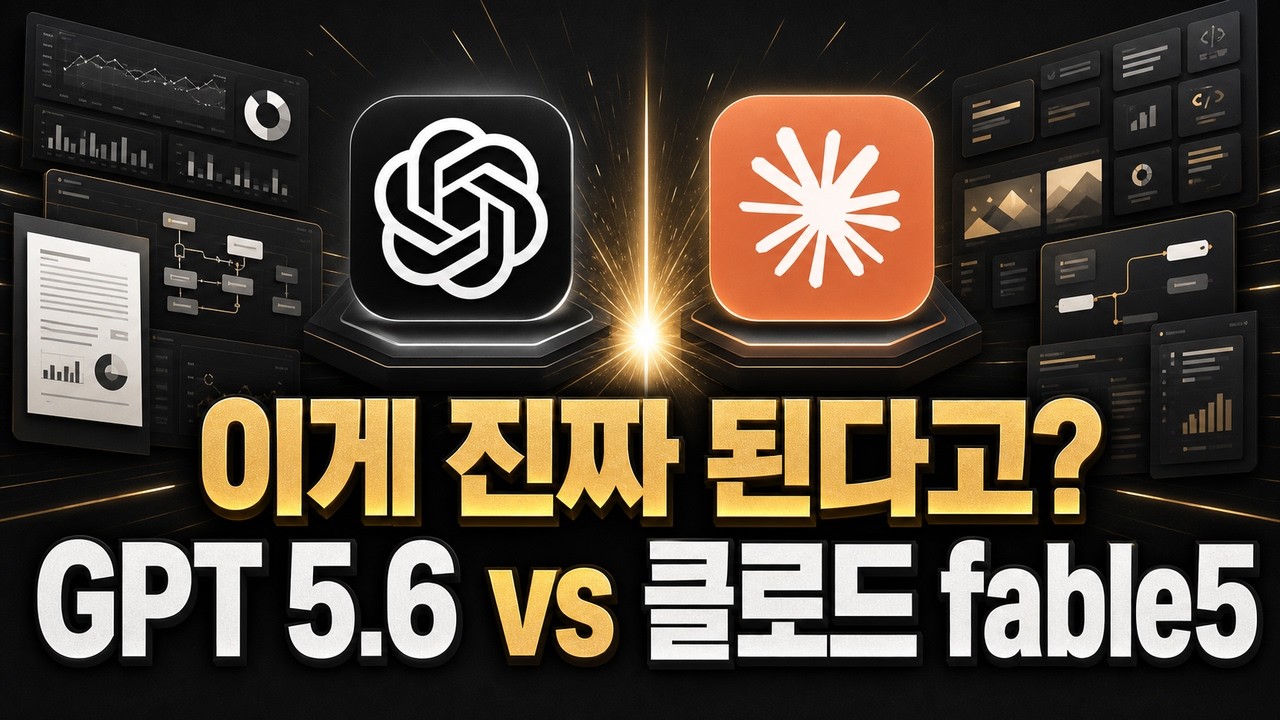
GPT 5.6 SOL Launch and the Claude Fable 5 Showdown: The Real Battleground of AI Work Automation
The real important point in this comparison is not “who is smarter,” but how far workplace workflows will change going forward.
Based on the original text, GPT 5.6 SOL introduced a Work, Sites, and subagent-based execution structure, while Claude Fable 5 demonstrated Cowork, Live Artifacts, and fast-output-centered work automation capabilities.
In particular, this test is significant because it was not a simple chatbot comparison, but a real-world AI agent showdown that directly built a YouTube live dashboard and verified API integration, deployment, sharing, and domain connection possibilities.
In short, Claude Fable 5 was stronger at producing fast outputs, while GPT 5.6 SOL was more impressive in terms of serviceization and stable deployment potential.
This is also a meaningful shift from the perspective of AI trends, work automation, digital transformation, productivity innovation, and global economic outlook.
1. The core news in this update: GPT 5.6 has moved from “chat AI” to “workplace AI”
The core point of GPT 5.6 SOL is not simply improved model performance.
The essence of this change is that ChatGPT has begun to move beyond the chat window and function more like an operating system that actually gets work done.
-
Introduction of the Work feature
Separate from the existing chat-centered screen, a dedicated space for carrying out work has been created.
The original text explains that GPT 5.6 was not yet applied to the chat area, but 5.6 SOL could be selected in the Work area.
-
Expanded model selection options
It was introduced as a structure where, in addition to GPT 5.6 SOL, options such as Terra and Luna could be selected.
The inference level could also be adjusted from medium, high, very high, to maximum ultra.
-
Ultra mode uses many tokens but produces the most careful results
Ultra settings can increase costs and usage burden, but for complex tasks or high-stakes projects, more stable judgments can be expected.
This trend is important from the perspective of businesses as well.
That is because AI is moving beyond a tool that simply provides answers and into a stage where it designs and executes real work processes.
2. Claude Fable 5’s counterattack: Cowork is strong at fast execution
On the Claude side, Fable 5 usage was reset, and the usage period was also extended to July 12.
The original text viewed this extension not as a one-time event, but as a sign that Claude Fable 5 could continue expanding going forward.
-
Cowork’s expansion to the web
The Cowork feature previously used in the Claude desktop app was described as moving into a web environment.
-
Live Artifact-based outputs
Claude showed strength in quickly generating web apps or HTML-formatted outputs.
-
Execution-oriented AI that uses any means necessary
During testing, Claude first attempted Zapier integration, then tried to pull data from a YouTube analytics site, and finally shifted direction by requesting an API key.
Simply put, Claude Fable 5 is closer to an “AI that quickly makes and shows a result first.”
It can be a powerful option for work where speed matters, such as meeting materials, report drafts, quick research, and internal dashboards.
3. The practical test task: building a YouTube live dashboard
The test task in this comparison was quite realistic.
It was not just about solving a coding problem, but about creating a dashboard that could pull real YouTube channel data and show it in real time.
The requirements were as follows.
-
Pull YouTube channel data in real time.
-
Show core metrics such as subscribers, views, watch time, and estimated revenue.
-
Provide not only basic data but also improvement points and recommended strategies.
-
Create it in a dashboard format that marketing staff could use immediately.
-
Include automatic refresh and download functions if possible.
This is the kind of task that occurs very often in real corporate settings.
Marketing teams make dashboards, update data, organize reports, and rewrite improvement plans.
If this process can be reduced through AI work automation, it could change not just productivity, but the speed of digital transformation across the organization.
4. GPT 5.6 SOL’s approach: careful and strong in serviceization
GPT 5.6 SOL approached the task with an API integration-centered method from the start.
Rather than scraping data temporarily by browsing external analytics sites like Claude, it tried to use official APIs and authentication flows.
-
OAuth-based access
GPT 5.6 created an OAuth-style login structure to access YouTube data.
This is a more secure approach than entering an API key directly into the chat window.
-
Design preview suggestions
At the beginning, it proposed several design drafts and let the user choose the preferred format.
The original text says that among three designs, option 2 was selected, and the process then moved toward a full analytics dashboard direction.
-
Linked to deployment through the Sites feature
The biggest differentiator of GPT 5.6 is that it does not just provide results as code or HTML files, but can turn them into a site and deploy them.
In particular, the Sites feature is a major change.
That is because it was introduced as a structure that includes sharing settings, link access permissions, domain connection, environment variables, and secret value management.
This means it is no longer just an “AI that makes frontend screens,” but is evolving in a way that allows non-developers to create micro-sites and operate them like real services.
5. Claude Fable 5’s approach: strong at fast, practical HTML dashboards
Claude Fable 5 tried several methods during the process of securing data.
At first, it attempted Zapier integration, and later tried to collect data by moving around YouTube analytics websites.
But when data acquisition did not go easily, it asked the user for a YouTube API key and then quickly completed the result.
-
Direct API key input method
As soon as the user provided the API key, Claude created a dashboard that pulled YouTube data.
However, directly entering API keys into the chat window can be risky from a security standpoint.
-
HTML file download available
The output Claude created could be downloaded as an HTML file and saved to a local folder.
It worked by reloading the data every time the page was refreshed.
-
Automatic refresh and filter functions
It included filters by content type such as date, long-form, and Shorts, as well as an automatic refresh function.
-
Schedule creation and skill conversion
In Claude Cowork, it was possible to pin the output, turn it into a schedule, convert it into a skill, or add it to a project.
Claude’s output was closer to an internal work tool that could be used quickly.
For users with some development knowledge or familiarity with API key management, it was a highly usable form for immediate work application.
6. Comparison of token usage and work time
Based on the original text, both models were used in testing for about one hour.
Claude finished the task first, and GPT 5.6 took about 20 minutes longer than Claude to complete.
| Category | GPT 5.6 SOL Ultra | Claude Fable 5 X-High |
|---|---|---|
| Work speed | Relatively slow | Faster |
| Usage | About 8% used | About 5% used |
| Approach | OAuth, security, service deployment centered | API key, fast output, practicality centered |
| Output form | Deployable site | Real-time HTML dashboard |
| Strengths | Stability, sharing, domain connection, scalability | Speed, immediacy, implementing the desired output |
Looking only at usage, the difference is not huge, but the felt difference was clear.
Claude showed results quickly, while GPT 5.6 took more time to think and produced a structurally safer output.
7. Output quality comparison: the winner depends on the work purpose
In this showdown, it is hard to say one side completely won.
That is because the two models had quite different characteristics.
-
If you need fast task completion, Claude Fable 5
For work where speed matters, such as report drafts, meeting material organization, quick data visualization, and HTML dashboards for internal sharing, Claude fits better.
-
For long-term projects and service deployment, GPT 5.6 SOL
If you need to share externally, require security, or need to consider domain connection and deployment, GPT 5.6 is more attractive.
-
For security-sensitive and high-responsibility tasks, GPT 5.6 has the advantage
Directly pasting API keys into the chat window is fast, but it can be risky.
The way GPT 5.6 detects secrets and moves them to a secret area is an important point in corporate environments.
From a workplace perspective, it can be summarized like this.
If you need to make something today, Claude is convenient.
If you need to share it with teammates later and keep operating it, GPT 5.6 is better.
8. Why the Sites feature matters: a bigger field than GPTs may open up
The part that deserves the most attention in this original text is the GPT 5.6 Sites feature.
This feature is not just about creating web pages.
Once sharing settings, domain connection, environment variables, and secret management are included, the story changes completely.
-
You can instantly create a personal portfolio site.
-
You can quickly deploy a landing page for a marketing campaign.
-
You can build a mini dashboard connected to YouTube, e-commerce, or CRM data.
-
Non-developers can directly run micro-services for internal work.
-
By connecting a domain, it can be used like a service shown to real customers.
Previously, doing this kind of work required some knowledge of Vercel, Netlify, Supabase, GitHub, and OAuth setup.
For non-developers, maintenance was the biggest barrier.
But if generation, editing, deployment, sharing, and management all happen within ChatGPT, it becomes a structure that directly competes with no-code web builders like Lovable.
This can affect not only the AI industry, but also the SaaS market, no-code market, and digital marketing market.
9. The core point that is not often said in other news: AI competition is shifting from “model performance” to “work control”
Most comparisons focus on whether GPT is smarter, whether Claude writes better, or who has the higher coding score.
But the truly important change is different.
AI companies are now trying to take control of users’ work operations.
In the past, we asked AI questions and received answers.
Now, we open a work space for AI and connect email, Notion, Slack, Google Drive, and YouTube APIs.
Then the AI builds the work pipeline, schedules repetitive tasks, deploys outputs, and if needed, even creates a site.
This change is very big for corporate productivity innovation.
-
One employee can operate multiple AI agents.
-
Planning, analysis, reporting, deployment, and automation are connected into one flow.
-
The work gap between employees who use AI well and those who do not may widen further.
-
For companies, redesigning actual workflows becomes more important than simple training.
-
AX, or AI transformation, becomes a reconstruction of how work is done rather than just adopting tools.
Ultimately, the future AI trend is likely to shift from “Which model should we subscribe to?” to “On top of which AI space should we place our company’s work?”
10. Selection criteria that employees and companies can apply right away
If you divide the criteria by work purpose, it becomes much clearer.
| Work situation | Recommended AI | Reason |
|---|---|---|
| Quick report writing | Claude Fable 5 | Fast speed and immediate production of the desired output |
| Meeting agenda organization | Claude Fable 5 | Strong at generating structured drafts in a short time |
| Creating a webpage for external sharing | GPT 5.6 SOL | Strong potential for site deployment, sharing settings, and domain connection |
| Security-sensitive data work | GPT 5.6 SOL | More stable OAuth and secret management flow |
| Marketing dashboard automation | Both are possible | Claude is suitable for fast internal use, GPT for operational services |
| Long-term project management | GPT 5.6 SOL | Good scalability based on subagents and work spaces |
Personally, it makes sense to see Claude as better for fast practical work, and GPT 5.6 as better for organization-level automation and deployment.
11. What it means from an economic perspective: AI has begun to actually change productivity indicators
This change is not just a technical update.
From the perspective of the global economic outlook, AI is entering a stage where it directly affects labor productivity, software costs, and corporate operating methods.
Until now, companies have had to subscribe to separate SaaS tools, bring in developers, outsource tasks, and connect internal systems to automate work.
But if AI agents handle connectors, schedules, data integration, and site deployment within the work space, the cost structure can change.
-
Marketing teams can create campaign analysis pages without separate dashboard tools.
-
Sales teams can automatically generate customer-specific action plans based on CRM data.
-
Administrative teams can automate recurring reports through scheduled execution.
-
Startups can quickly validate MVP-level micro-services without developers.
-
Large enterprises can improve organizational efficiency through AI-native work transformation.
This trend is also likely to affect AI-related investment, SaaS market restructuring, cloud infrastructure demand, and the competition structure of enterprise software.
12. Action plan that practitioners should check right now
-
Step 1: First organize your repetitive tasks
You should list the reports, data collection, meeting notes, email writing, and content analysis tasks you repeat every week.
-
Step 2: Check whether data connections are possible
You need to see whether the services you use often, such as YouTube, Google Analytics, Notion, Slack, Gmail, and CRM, can connect with AI.
-
Step 3: Experiment with fast outputs using Claude
Internal HTML dashboards, quick research, and meeting draft materials are worth testing with the Claude Fable 5 approach.
-
Step 4: Review work that needs sharing and deployment with GPT 5.6 Sites
If you need external link sharing, domain connection, or team-level operation, the Sites feature of GPT 5.6 SOL may be more suitable.
-
Step 5: Be sure to establish API key and security policies
It is convenient to paste API keys directly into AI, but it is risky.
For companies, OAuth, secret management, and access control policies should be organized first.
13. Final verdict: the surprising winner is GPT 5.6 SOL, but the daily tool may be Claude
In this one-on-one showdown, both outputs were fully usable if you look only at the results.
But when looking at the direction as well, GPT 5.6 SOL showed the bigger change.
Claude Fable 5 is strong at getting work done quickly right now.
GPT 5.6 SOL is strong at expanding work outputs into real services or operational tools.
In other words, Claude is closer to a “fast execution partner,” while GPT 5.6 is closer to an “operational AI that builds work systems.”
For employees, rather than choosing only one, the more realistic strategy is to use them according to the type of work.
Use Claude for quick summaries and drafts, and GPT 5.6 for careful projects and deployment-ready outputs.
For companies, the picture is even clearer.
The key to AI adoption going forward is not model subscriptions, but how to redesign the company’s workflow around AI.
< Summary >
GPT 5.6 SOL showed an expanded form through Work and Sites, extending into workspaces, website creation, deployment, sharing, and domain connection.
Claude Fable 5 was strong at creating fast and practical outputs based on Cowork and Live Artifacts.
In the YouTube live dashboard test, Claude finished faster, while GPT 5.6 produced a more careful and service-ready result.
Claude is advantageous for fast reports and internal automation, while GPT 5.6 is more suitable for long-term projects where security and deployment matter.
The most important change is that AI competition is moving beyond model performance into work control, automation pipelines, and micro-service deployment.
[Related Articles…]
*Source: [ AI 겸임교수 이종범 ]
– 챗GPT 5.6 SOL 출시, 클로드 페이블5와 업무 자동화 1:1 대결.. 승자는 의외였습니다