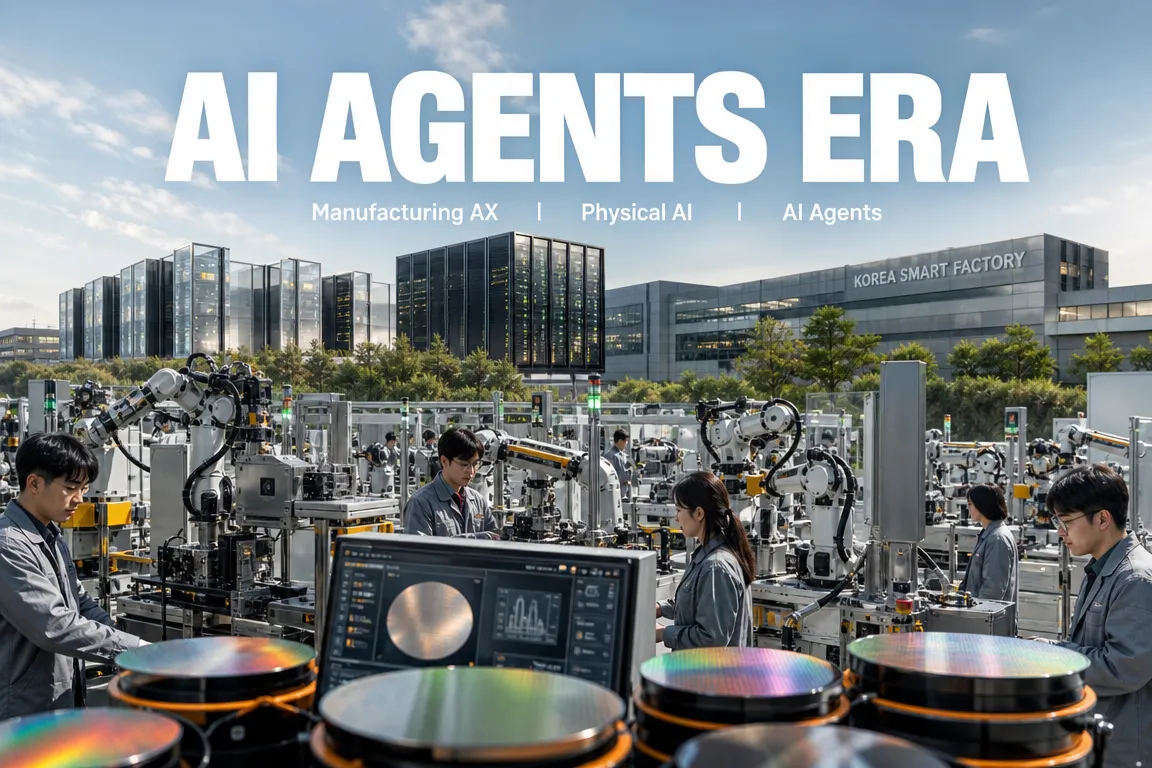
● AI-Driven, Manufacturing Boom, 2026, Game-Changer
AI Has Not Really Begun Yet: Why the Real Cycle Starts in 2026 and Where Korea’s Manufacturing Opportunity Lies
The key point is not simply that AI is improving.
Generative AI has already entered daily use, but the stage where meaningful capital begins to flow is only now emerging: AI agents, manufacturing AX, physical AI, AI semiconductors, and data center infrastructure.
For Korea, the more important issue is not who builds the best AI model, but how manufacturing operations, semiconductor processes, and global data center demand can be industrialized.
Much of the market discussion focuses on an AI bubble and Nvidia’s share price, but the more important factors are AI investment payback timing, data assetization in manufacturing, and enterprise survival under AI agents.
1. What “AI Has Not Really Begun Yet” Actually Means
The core message is clear.
Current AI remains at an early stage of the broader industry cycle.
Generative AI systems such as ChatGPT, Gemini, and Claude are already embedded in daily work, learning, and content production, but the industry as a whole has not yet entered its full-scale phase.
- Phase 1: Conversational and generative AI handled text, image, video, and code generation.
- Phase 2: AI agents move toward planning, decision-making, and tool-based execution.
- Phase 3: Physical AI connects to robotics, autonomous driving, factory automation, and smart manufacturing.
- Phase 4: Manufacturing AX and industrial AI reshape productivity, yield, and cost structures.
In practical terms, generative AI has been an answer engine.
The next stage is AI that executes tasks directly.
That transition has the potential to alter economic forecasts and industrial structure materially.
2. Generative AI Is the Appetizer; AI Agents Are the Main Course
Over the past three years, generative AI has advanced rapidly.
It is already capable of producing text, images, video, design, and code at a level that can be difficult to distinguish from human output.
However, its limitation has been clear: it can generate information, but humans still had to execute the work.
AI agents change that structure.
When a user assigns a goal such as “design this product,” “optimize this semiconductor process,” or “run this marketing campaign,” the AI can create a plan, call the required tools, and produce results.
- Planning: Builds step-by-step plans to achieve a goal.
- Memory: Retains prior tasks and execution history.
- Tool Use: Uses software, hardware, factory equipment, robots, and autonomous systems.
- Execution: Performs work without requiring manual instructions at every step.
- Learning: Improves based on execution outcomes.
The significance is that competitive advantage may shift from headcount to the ability to direct AI agents effectively.
Future organizations may operate with 100 AI agents instead of 100 employees.
Individual capability may also be judged less by volume of work and more by the ability to orchestrate AI agents.
3. The AI Bubble Debate: A Question of Investment Payback, Not Technology Failure
The most important issue in the AI bubble debate is not whether AI is real.
As with the dot-com bubble, the internet itself was not fake.
The issue was that investment in infrastructure outpaced the speed of revenue generation.
AI faces a similar risk.
Large amounts of capital are being deployed into AI semiconductors, data centers, power grids, cooling systems, and cloud infrastructure.
The key question is how quickly those investments convert into revenue and earnings.
- Technology: Utilization remains low, with substantial room for growth.
- Investment scale: GPU and data center infrastructure spending is rising sharply.
- Risk factor: Market volatility may increase if monetization lags infrastructure investment.
- Core assessment: An AI bubble would likely reflect a mismatch in ROI timing, not a failure of the underlying technology.
This does not imply that the AI industry will collapse.
It suggests that corrections may emerge in areas where investment has advanced too far ahead of monetization.
From a macroeconomic perspective, the issue is highly sensitive to capital costs, interest rates, power infrastructure, and global supply chain risk.
4. AI Adoption Remains Low: Personal Use and Enterprise Deployment Are Not the Same
Many people may ask whether AI can still be considered early-stage if they already use ChatGPT every day.
However, personal usage and enterprise adoption are fundamentally different.
The source material notes that AI adoption in the United States is still only around 20% on an industry basis.
In manufacturing, AI transformation remains at an early stage.
- Personal use: Rapid adoption in document writing, search, learning, and coding support.
- Services: Ongoing deployment in finance, retail, logistics, consulting, and education.
- Manufacturing: Early-stage integration into process optimization, quality control, and factory data systems.
- Shift from B2C to B2B: AI firms are increasingly focused on enterprise solutions rather than consumer products.
This does not mean the AI market is over.
It means the enterprise AI market is only now beginning to scale.
From an investment perspective, enterprise AI, manufacturing AI, data centers, and AI semiconductor companies may matter more than consumer-facing chatbots.
5. Manufacturing AX and MAX: Korea’s Most Relevant Opportunity
Manufacturing AX refers to applying AI transformation to manufacturing.
The term MAX, or Manufacturing AX, is also used.
This is a particularly relevant market for Korea.
Korea has a strong industrial base in semiconductors, automobiles, shipbuilding, batteries, displays, steel, chemicals, electronics, and machinery.
Although the United States and China remain ahead in AI models, Korea has an opportunity in industrial AI linked to manufacturing operations.
- Strength 1: Korea has already advanced through years of digital transformation in manufacturing.
- Strength 2: Large volumes of manufacturing data are generated through ERP, MES, and PLC systems.
- Strength 3: Korea has global competitiveness across 12 major manufacturing industries.
- Strength 4: Both government and private sector investment in manufacturing AX is increasing.
The main problem is that data volume has not yet translated into data assets.
6. The Core Problem in Korea’s Manufacturing Data: Data Exists, But Context Does Not
Manufacturing sites generate large amounts of data.
However, the key issue is that manufacturing data often lacks context.
Language data contains meaning and relationships between words and sentences.
Image data also contains context through objects, backgrounds, positions, and patterns.
By contrast, manufacturing data is often stored as simple numeric values.
- The timing of data capture is sometimes unclear.
- It is not always linked to the product being produced.
- Labeling for defective and non-defective output may be incomplete.
- Data is often not connected to workers, equipment, or process conditions.
- Much of the data is stored once and never reused.
As a result, the central task in manufacturing AX is not simply purchasing AI models.
It is converting manufacturing data into a reusable asset.
Only then can AI support process optimization, defect prediction, yield improvement, and predictive maintenance.
7. AI Agents May Determine the Survival of Semiconductor Companies
The role of AI agents is likely to become even more important in semiconductors.
Semiconductor design and manufacturing involve hundreds or thousands of process steps and highly complex variables.
Human optimization alone has clear limits.
AI agents can support design, simulation, verification, process optimization, and yield improvement simultaneously.
This trend is increasingly relevant to EDA firms such as Synopsys, Cadence, and Ansys, as well as global companies including Samsung Electronics, SK Hynix, Nvidia, and Apple.
- Chip design: AI can optimize complex architectures and power efficiency.
- Process management: Large-scale process data can be analyzed to reduce defects.
- Yield improvement: Output consistency can be improved and productivity raised.
- Cost reduction: Repetition and trial-and-error can be reduced, shortening development cycles.
The source material suggests that over the next 10 years, survival may depend on whether semiconductor design firms, fabless companies, and design houses secure AI agents.
The AI semiconductor market is moving beyond GPU competition toward a broader transformation in how chips are designed and manufactured.
8. Surging Data Center Demand: Korea’s K-AI Highway Could Become an Export Model
As AI expands, demand for data centers is rising sharply.
The source notes that the number of data centers worldwide is still below 2,000, yet approximately 25 are being added each day.
The most important opportunity may lie in emerging markets rather than advanced economies.
The United States already holds a substantial share of global data centers, and China is expanding rapidly.
By contrast, many developing countries still have limited AI infrastructure.
To participate in the AI economy, these markets will need data centers, power grids, cloud systems, and network infrastructure.
- Opportunity for Korean firms: Export integrated data center design, construction, and operations models.
- Construction and infrastructure: Firms such as Samsung C&T, Hyundai Engineering & Construction, and EPC companies can enter the AI infrastructure market.
- IT services: Companies such as LG CNS can leverage experience in smart factories and cloud operations.
- Power infrastructure: AI data centers require power grids, cooling systems, and energy efficiency technologies.
As Korea previously exported shipbuilding, plant engineering, smart city, and smart farm solutions, it may now develop an export model around data centers and AI infrastructure.
That is the strategic meaning of the K-AI Highway concept.
9. Physical AI: Still Less Visible, but Potentially the Largest Market
Physical AI refers to AI extending beyond digital interfaces into the physical world.
This includes robotics, autonomous vehicles, drones, smart factories, humanoids, and automated logistics centers.
AI agents are advancing quickly in digital environments.
However, the difficulty rises sharply once AI enters the physical world.
The real world is less predictable and requires safety controls, sensor data, robot control, and real-time decision-making.
- Digital AI: Focused on documents, search, coding, and workflow automation.
- Industrial AI: Applied to manufacturing processes, equipment operations, and quality control.
- Physical AI: Enables machines and robots to make decisions and move in the physical world.
This is one reason Nvidia emphasizes the physical AI market.
As AI expands into the real world, demand may increase for GPUs, AI semiconductors, simulation platforms, robot operating systems, and industrial data centers.
10. Can Korea Capture a Third-Place Opportunity Behind the U.S. and China?
The source argues that Korea may have moved from a secondary position to a clearer third-place contender due to recent government investment and private sector effort.
The United States and China remain the leaders in AI models, cloud infrastructure, and semiconductor ecosystems.
However, Korea has differentiating strengths in manufacturing depth, industrial data, and semiconductor production.
- United States: Strong in AI models, cloud, big tech, and AI chip design.
- China: Strong in large-scale data, manufacturing ecosystems, and state-led investment.
- Korea: Strong in advanced manufacturing, semiconductor production, industrial data, and implementation capability.
To move from third place to a leading position, Korea would need coordinated action from suppliers, demand-side industries, and policy makers.
The priority is not simply developing AI models, but building an industrial AI ecosystem that solves real manufacturing problems.
11. The Most Important Point Often Missed in Other Coverage
Much of the coverage focuses on the AI bubble, Nvidia’s share price, and big tech investment competition.
However, the more important themes are different.
- First, the nature of AI competition is shifting from model competition to execution competition.
- The key question is no longer who built the smarter chatbot, but who connected AI to real work and production systems.
- Second, contextualizing manufacturing data is a major bottleneck for Korea’s AI industry.
- Data volume alone is not enough.
- AI requires linkage between time, location, equipment, and product context.
- Third, an AI bubble is more likely to emerge from financial structure than from technology failure.
- AI demand is real, but corrections may occur if data center and semiconductor investment outpaces monetization.
- Fourth, Korea’s opportunity lies more in manufacturing AX and physical AI than in consumer-facing generative AI services.
- It is more realistic for Korea to compete through industrial transformation than by replicating the U.S. big tech model.
- Fifth, future corporate competitiveness may depend on the ability to manage AI agent organizations rather than human organizations alone.
- Role allocation and integration across agents may become more important than traditional department structures.
12. Key Investment Checkpoints
In AI investing, the relevant question is not whether a company is “AI-related.”
The more important issue is where it sits in the AI value chain and whether monetization is realistic.
- AI semiconductors: Monitor demand for GPUs, HBM, memory, packaging, and power semiconductors.
- Data centers: Servers, cooling, power equipment, network devices, and construction infrastructure matter.
- Manufacturing AX: Smart factories, process data platforms, and industrial AI software are key.
- AI agents: Enterprise workflow automation, semiconductor design automation, and development automation solutions are important.
- Physical AI: Robotics, autonomous driving, sensors, simulation, and industrial automation are connected markets.
In the near term, however, overinvestment in AI infrastructure, interest rates, power shortages, and regulatory issues may create volatility.
A distinction should be made between long-term growth potential and short-term valuation pressure.
< Summary >
AI is not finished; it is only entering its main phase.
The next stage after generative AI is AI agents that can plan and execute tasks independently.
The core issue in the AI bubble debate is not technology failure, but the mismatch between infrastructure investment and payback speed.
Korea’s strongest opportunity is not in AI model competition, but in manufacturing AX, semiconductor processes, physical AI, and data center infrastructure.
Manufacturing data remains underutilized because it lacks context, and the companies that solve this problem are likely to lead the industrial AI market.
Future corporate competitiveness may depend less on workforce size and more on how effectively AI agents are deployed and managed.
[Related Articles…]
- AI Agents and the Next Phase of Global Economic Transformation
- AI Semiconductors and Data Center Investment Trends
*Source: [ 경제 읽어주는 남자(김광석TV) ]
– [모아보기] AI는 아직 시작도 안 됐다…AI에이전트·제조AX·피지컬 AI, 그리고 한국의 기회 | 김대식x김정호x김광석x윤병동x유응준