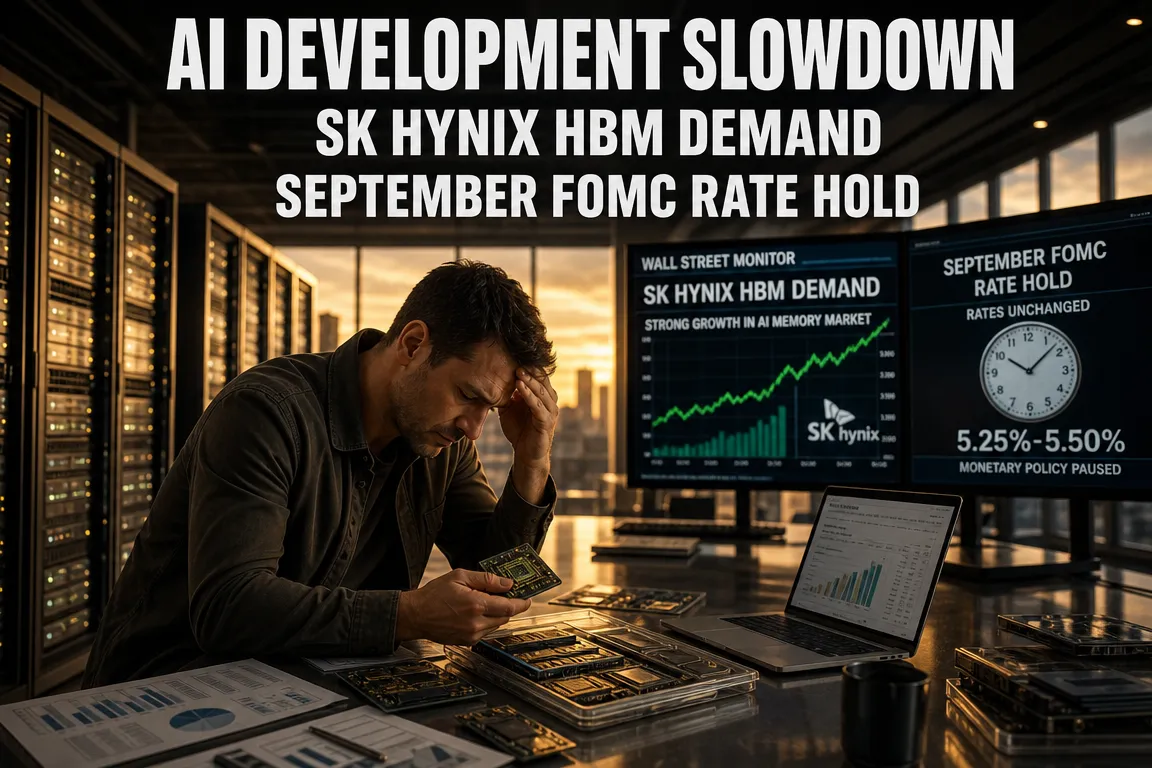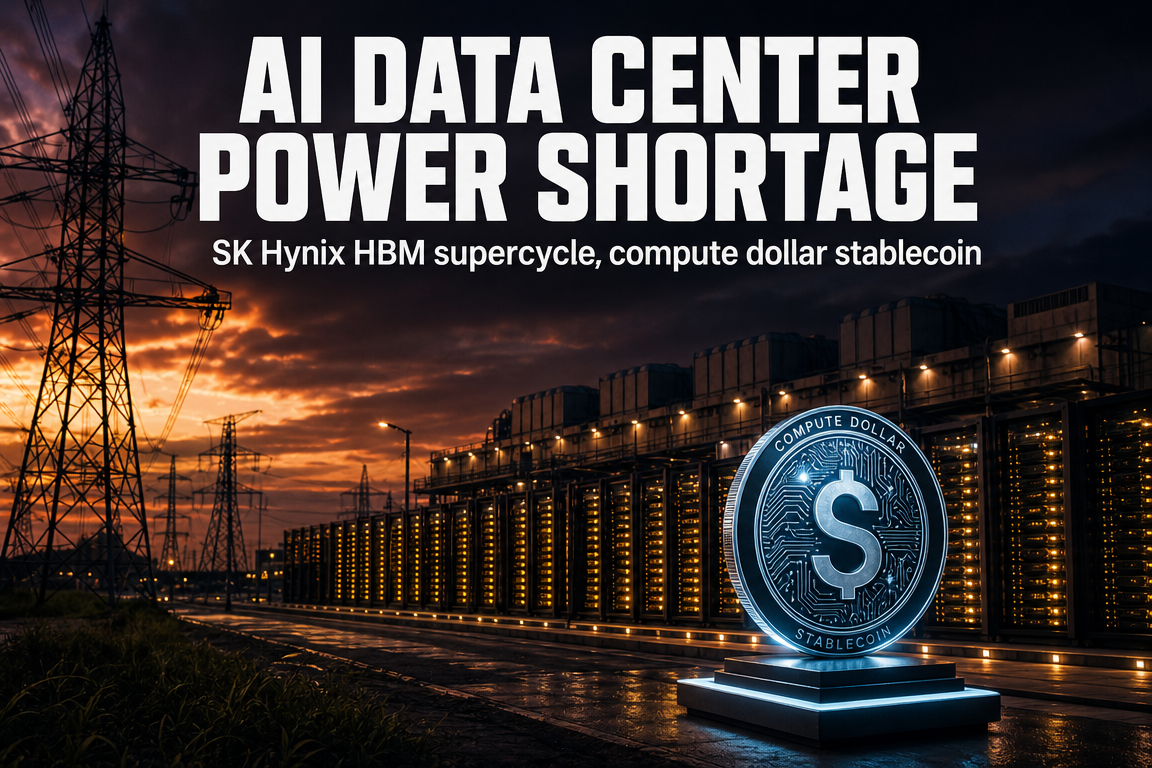
● AI Power Crisis, Korea Chip Surge
Why the Power Shortage Is Reshaping AI Leadership: Renewed Attention on Korean Semiconductor and Energy Companies
The key issue is no longer simply that AI is growing.
AI infrastructure is hitting bottlenecks in power supply, energy systems, and semiconductor supply chains.
The main themes in this cycle are SK hynix’s potential Nasdaq ADR listing, the HBM-driven semiconductor supercycle, data center power constraints, a stablecoin-based compute-dollar strategy, and the revaluation of Korea’s energy value chain.
In practical terms, the outlook is shifting from who builds the best AI model to who controls the physical infrastructure that enables AI.
1. SK hynix’s Potential Nasdaq ADR Listing: More Than a Listing, a Global Revaluation Event
Market attention has increased as SK hynix is reportedly considering trading in the U.S. market through an ADR structure.
An ADR is a certificate that allows U.S. investors to trade shares of a foreign-listed company more easily.
While this is not the same as a direct U.S. listing, it can improve global investor access and support a valuation re-rating.
SK hynix holds a strong position in the HBM market.
As demand for high-bandwidth memory rises with AI servers, GPUs, and data center expansion, SK hynix is increasingly viewed not only as a memory semiconductor company but as a core supplier to AI infrastructure.
This could lead to a re-rating not only relative to Micron and Samsung Electronics, but also of the broader Korean semiconductor sector.
However, the development is not without downside risks.
If a strong Korean company becomes easily tradable in the U.S. market, foreign investors may have less incentive to buy Korean-listed shares directly.
For the Korean equity market, this could weaken the structural advantage of having premier assets listed domestically.
Another key variable is whether new shares are issued.
If the ADR is based only on existing shares, the market impact may be limited.
If it includes new issuance, dilution concerns could emerge for current shareholders.
Accordingly, shareholder return policy, treasury share cancellations, and dividend expansion will remain important factors for SK hynix’s share performance.
2. Hidden Variables in ADR Trading: Exchange Rates, Taxes, and Fees Can Move the Stock
The impact of a SK hynix ADR will depend on three main variables.
The first is the exchange rate.
Whether it is more advantageous to buy the stock in won or in dollars will vary with currency movements.
The second is taxation.
The tax structure differs between Korean and U.S. markets, so investors need to calculate after-tax returns carefully.
The third is trading costs.
Brokerage commissions, currency conversion costs, and depositary fees can make the decision more complex than simply preferring U.S. access.
Global investors will ultimately compare exchange rates, taxes, and fees when deciding where to buy SK hynix shares.
3. SK hynix’s Capital Raising Signals Strength in the Semiconductor Supercycle
SK hynix’s efforts to expand global funding are tied to large-scale capex requirements.
This suggests that AI semiconductor demand is entering a structural growth phase rather than a short-lived trend.
Markets continue to debate whether the AI cycle is peaking or whether the semiconductor supercycle is ending.
However, capital raising for capacity expansion by a leading semiconductor company should be interpreted as a counter-signal.
Internally, the company appears to view demand as still strengthening.
HBM is a critical component for relieving bottlenecks in AI servers.
As Nvidia GPUs, data centers, and cloud AI services expand, HBM demand should rise in parallel.
SK hynix and Samsung Electronics should therefore be viewed not simply as memory manufacturers, but as suppliers of the physical foundation of AI value creation.
4. The Real Core of the AI Value Chain: Infrastructure Comes Before the Model
Consumers typically think first of AI services such as ChatGPT.
But for an AI service to function, it requires an AI model, and beneath that, AI infrastructure.
Without infrastructure, neither the model nor the service can operate.
This is where Korea’s strengths become more visible.
When semiconductor, data center, telecom network, energy, battery, and power equipment capabilities are considered together, Korea occupies a distinctive position in the AI infrastructure value chain.
In particular, the SK Group can be viewed as a full-stack AI infrastructure cluster, given its presence across semiconductors, telecom, energy, batteries, and AI services.
Samsung Electronics also has broad capabilities across semiconductors, foundry, network equipment, devices, and AI-related applications.
Global AI competition is increasingly likely to become a contest not just over software, but over companies that control hardware, power, and networks together.
5. AI, Robotics, Energy, Space, and Stablecoins Do Not Move Independently
The most important point from this discussion is that AI, robotics, energy, space, and crypto are not separate growth themes.
These five areas function as interconnected gears.
As AI advances, more data centers are required.
As data centers expand, power demand rises sharply.
As AI moves beyond screens into the physical world, demand for physical AI and robotics increases.
As robotics expands, demand rises again for sensors, semiconductors, batteries, networks, and electricity.
When land and power become constrained, space data centers, satellite communications, and space-based research facilities may emerge as alternatives.
In parallel, the question of how to pay for AI usage connects stablecoins with dollar dominance.
AI is therefore not just a technology trend, but a major economic issue tied to energy security, resource dominance, monetary power, and national strategy.
6. The Next U.S. Dominance Strategy: From Petro-Dollar to Compute-Dollar
Historically, U.S. dollar dominance was closely tied to oil.
The global need to buy oil created global demand for dollars.
This is commonly referred to as the petro-dollar structure.
However, energy transition and geopolitical change have weakened the role of the petro-dollar.
In this environment, the next strategic target for the U.S. may be AI computing power.
As AI becomes essential to productivity for companies, individuals, and governments, compute may become a necessity.
If the U.S. encourages AI usage fees to be paid through dollar-based stablecoins, dollar dominance could be extended in a new form.
Stablecoins matter because issuers often hold U.S. Treasuries as reserve assets.
As stablecoin usage grows, demand for U.S. Treasuries may rise as well.
In other words, if AI payment rails become anchored in dollar stablecoins, the U.S. can help defend both monetary dominance and Treasury demand.
7. China’s Resource Dominance: Rare Earths and Greater Use of the Yuan
If the U.S. seeks to link AI with the dollar, China is responding through rare earths and other critical minerals.
Rare earths are essential for electric vehicles, batteries, semiconductor equipment, robotics, defense, and renewable energy systems.
China holds substantial influence not only in mining, but also in refining and processing.
Its share in rare earth refining and permanent magnets is especially high, making global manufacturing difficult to decouple from Chinese supply chains.
China can use export licensing for rare earths to request details such as end use, quantity, timing, and payment terms.
This may also support wider use of the yuan in settlement.
Just as the U.S. may seek to anchor AI usage fees in dollar stablecoins, China may use critical resource supply chains to expand yuan influence.
8. Korea’s Position: A Key Manufacturing Economy Balancing the U.S. and China
Korea is in a highly complex position.
It has core manufacturing capabilities in semiconductors, batteries, power equipment, automobiles, displays, and robotics, but remains dependent on China for many raw materials and rare earths.
At the same time, cooperation with the U.S. is essential in AI infrastructure, advanced semiconductors, financial networks, and security.
Korean companies supplying the U.S. AI infrastructure market may need to reduce reliance on Chinese components and materials.
However, excluding China entirely is difficult given cost and supply stability considerations.
This is one of the most important strategic challenges for the Korean economy.
In short, Korea must sell semiconductors, batteries, and power equipment to the U.S.
But it still needs Chinese raw materials and rare earths to produce those goods.
As a result, Korean companies face a structure in which they cannot rely exclusively on either side in the U.S.-China rivalry.
9. The Power Shortage Has Already Begun: Data Centers Have Become the Bottleneck in AI Competition
The largest bottleneck in AI competition is power.
Data centers consume large amounts of electricity.
As AI models grow larger and training and inference demand increases, electricity usage rises rapidly.
Earlier estimates suggested that data center power shortages would become severe around 2027.
However, the pace of data center deployment and AI service expansion has accelerated faster than expected, bringing the shortage forward.
In the Seoul metropolitan area, additional data center and semiconductor cluster locations are already limited.
Even outside the capital region, some projects are being delayed due to insufficient power supply.
No matter how large AI investment becomes, servers cannot run without electricity.
10. Why Korean Energy Companies Are Gaining Attention: They Cover Nuclear, SMR, Batteries, and Power Grids
Korea is drawing attention in global AI infrastructure expansion for a clear reason.
It has multiple options to help address power shortages.
First is nuclear power.
Although nuclear energy once faced strong resistance, the surge in AI data center electricity demand is driving renewed interest in Europe and the U.S.
Nuclear power’s strategic value is rising again because stable baseload generation is essential.
Second is SMR.
Small modular reactors can be deployed more flexibly than large reactors, and interest is increasing for use in data centers and industrial complexes.
Global investors, including Bill Gates, have shown interest in SMRs for similar reasons.
Third is batteries.
Renewable energy output is intermittent, so energy storage systems are essential.
Batteries are a core component of solar, wind, and data center power stabilization.
As Western concern over Chinese batteries increases, Korean battery companies may gain strategic value.
Fourth is transmission and power equipment.
Transformers, substations, and grid equipment are essential for data center expansion.
While Chinese products once had cost advantages, geopolitical tensions have made Western countries more cautious about Chinese infrastructure equipment, creating opportunities for Korean firms.
Fifth is refining and energy trading.
Korea is not an oil-producing country, but it has strong refining capacity and energy supply chain management capabilities.
Some petroleum products refined in Korea are exported to certain U.S. regions.
Korea therefore has capabilities across multiple segments of the energy value chain, including power, nuclear, batteries, grid equipment, and refining.
11. A Key Point Often Missed Elsewhere: In the AI Era, the Winners May Be the Countries That Sell Electricity
Most coverage focuses on AI models, GPUs, and semiconductor stocks.
But the more important reality is that AI is ultimately an electricity-consuming industry.
As AI services expand, companies need more GPUs, more servers, and larger data centers.
The final constraint is power.
Even the best semiconductors are useless without electricity.
The real investment approach is therefore to look beyond AI software and assess the entire AI infrastructure stack.
That includes semiconductors, HBM, power equipment, nuclear power, SMRs, batteries, data centers, telecom networks, and stablecoin payment rails.
This broader framework is a key point that is less emphasized in many media sources.
12. Physical AI and Robotics: Technology May Offset Population Decline
AI is no longer limited to a screen-based assistant.
It is expanding into physical AI that operates in the real world.
When robots are deployed in factories, logistics, hospitals, elder care, and services, AI becomes labor input in the real economy.
From this perspective, population decline and low birth rates should be viewed differently.
In the past, the main production factors were labor, capital, land, and technology.
But as AI and robotics advance, technology can substitute for labor, computing power can attract capital, and space infrastructure can create a new concept of land.
For example, if humanoid robots such as Tesla’s Optimus are mass-produced and deployed in industrial settings, effective labor capacity in the U.S. could grow faster than population statistics suggest.
As robots assume production and service roles, the agents generating GDP expand beyond humans to machines.
13. Space Data Centers and Satellite Networks: When Land and Power Are Limited, the Sector Moves to Space
If there is insufficient land for data centers and terrestrial power grids become constrained, space infrastructure may become an alternative.
Space data centers, satellite communications networks, and space-based research facilities remain early-stage, but the direction is clear.
As satellite networks such as SpaceX’s Starlink expand rapidly, network access may improve across the globe.
This would also directly support AI service expansion.
Space may also become important for biotech research.
Protein-based experiments are affected by gravity, which can make results less stable on Earth.
Near-zero-gravity and vacuum-like environments may enable more precise research and could connect with AI-driven biotech development.
14. Response Strategies for Individuals and Companies: The Pace of Change Is Faster Than Before
The most concerning feature of the AI era is the speed of change.
In the internet era, technological shifts moved over multi-year cycles such as Windows 95, Windows 98, and Windows XP.
The smartphone era also took time to reshape ecosystems.
This time is different.
AI is directly involved in building the next version of AI.
While people sleep, AI writes code, analyzes data, and repeats experiments.
As a result, the pace of innovation is much faster than in previous cycles.
Individuals should quickly assess how AI may reshape their jobs.
Companies should evaluate whether their business model can remain viable not just in years, but in months.
Investors should focus on structural industrial change rather than simple thematic trading.
15. Real Estate Market: Gains in Stocks May Translate Into Higher Housing Demand
The latter part of the discussion also addressed the real estate market from a practical perspective.
The key point is that stock market gains and higher bonuses may flow into demand for better housing in Seoul.
Many employees in semiconductors, securities, and large corporations have seen cash compensation rise through stock appreciation and performance bonuses.
When combined with company loans, preferential borrowing, and existing assets, this can create demand for higher-end housing.
If this demand develops at the scale of hundreds of thousands of households, it could create substantial buying pressure in the Seoul property market.
A modest adjustment in property taxes is unlikely to materially alter that trend.
Importantly, it should not be assumed that money earned in equities moving into real estate is abnormal.
For many households, housing is the largest decision affecting quality of life, education, commuting, and wealth preservation.
In particular, younger investors often use housing decisions that involve most of their net worth, future income, and leverage, making real estate a natural investment consideration.
16. Investing in the YouTube Era: Listen to Context, Not Just Thumbnails
Economic learning through YouTube has become common, but the major risk is losing context.
If an expert says that the market remains on an upward trend but volatility may rise and cash should be partially maintained, some viewers may misinterpret that as a recommendation to sell all stocks and move entirely to cash.
Making investment decisions based only on thumbnails is highly risky.
Economic outlooks always depend on conditions and assumptions.
Investors need to understand the full context, including exchange rates, interest rates, policy, earnings, and capital flows.
It is also risky to interpret housing or equity views through political bias.
Classifying someone as conservative because they expect rising home prices, or progressive because they expect declines, is not helpful for economic analysis.
Investment decisions should be based on data, policy, supply-demand conditions, capital flows, and industrial structure, not political preference.
In the end, the proper approach to investing in the YouTube era is straightforward.
First, listen to the full context, not just the thumbnail.
Second, understand conditional statements precisely.
Third, do not be misled by surface-level statistics.
Fourth, do not filter information through personal bias.
Fifth, take notes and study carefully as if attending a class, because the capital at risk is your own.
17. Core Investment View: Focus on AI Infrastructure Bottlenecks Rather Than the Bubble Debate
The debate over an AI bubble may continue in the market.
However, the more important question is not whether AI demand is weakening, but whether AI infrastructure supply can keep up.
Is there enough HBM?
Is there land to build data centers?
Can the power grid withstand the load?
Are nuclear and SMR options returning to prominence?
Are batteries and power equipment entering a structural growth phase?
Is the payment layer for AI usage shifting toward dollar stablecoins?
Answers to these questions will make future investment strategy clearer.
More important than short-term stock moves is identifying where AI infrastructure bottlenecks emerge and which companies solve them.
< Summary >
AI competition is shifting from models to infrastructure.
SK hynix’s potential ADR listing could support a global revaluation, but new issuance, exchange rates, taxes, and fees must also be considered.
HBM and data center demand suggest that the semiconductor supercycle may not be over.
AI, robotics, energy, space, and stablecoins are converging into one broad technology-power structure.
The U.S. may strengthen a compute-dollar strategy by linking AI usage fees to dollar stablecoins.
China is reinforcing resource dominance through rare earths and critical minerals.
Korea may be re-rated as a core AI infrastructure country because of its capabilities in semiconductors, batteries, nuclear power, SMRs, and grid equipment.
Data center power shortages are already becoming real, and power availability is the main bottleneck for AI growth.
Individuals and companies need to adjust jobs, business models, and investment strategy faster to match AI’s pace of change.
In using YouTube for investment research, context, conditions, and data matter more than thumbnails.
[Related Articles…]
- AI Data Center Power Constraints and the Opportunity for Korean Energy Companies
- The Stablecoin Race and the Future of Dollar Dominance
*Source: [ 경제 읽어주는 남자(김광석TV) ]
– [풀버전] 전력대란이 온다. 한국 기업이 주목받는 이유 | 경읽남과 토론합시다 | 박정호 교수