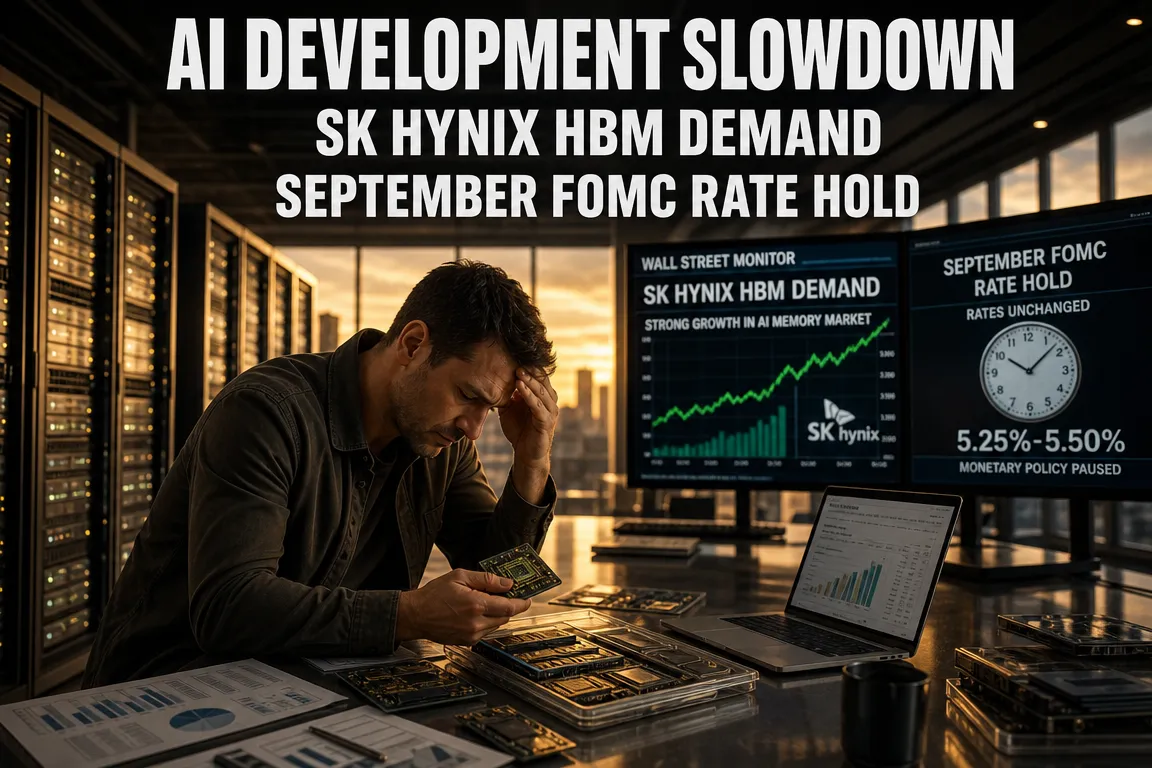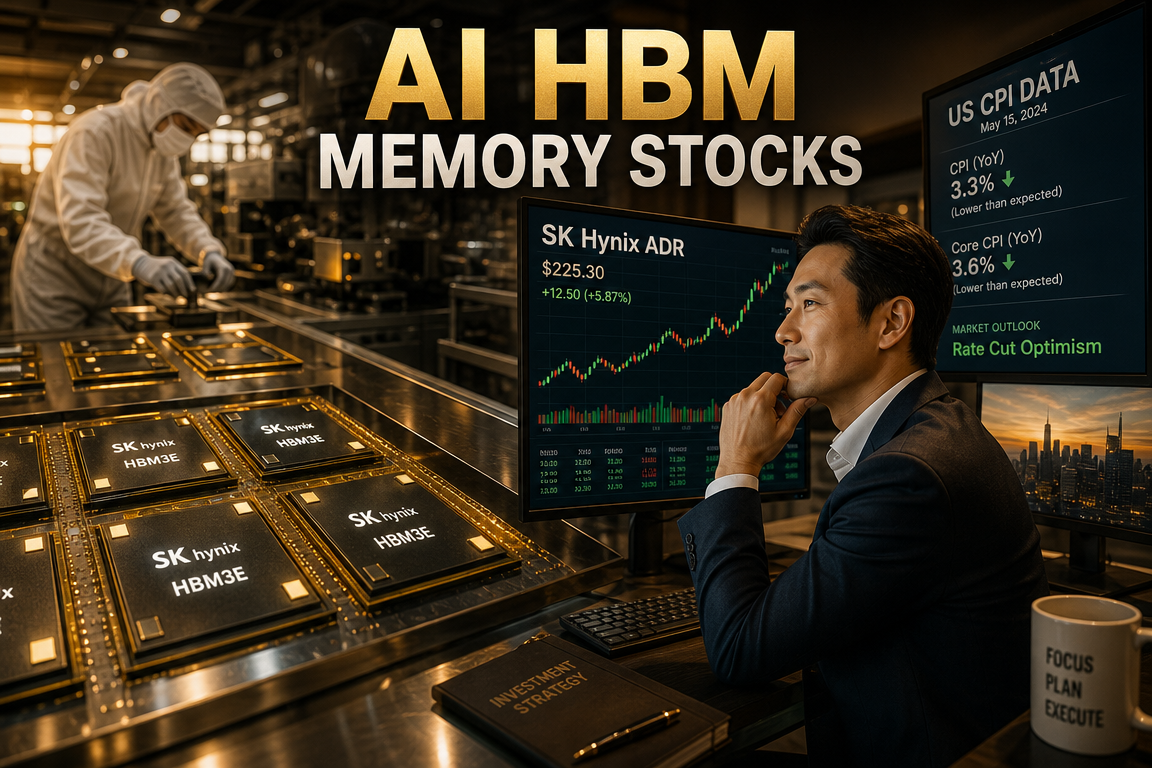
● SK Hynix ADR Soars 20 on AI Memory Boom and Fed Cut Hopes
SK hynix ADR surged 20%, driven by simultaneous strength in AI memory demand and expectations of lower U.S. rates
This rally in the SK hynix ADR should not be viewed as a one-day rebound.
Multiple catalysts converged at once, including softer U.S. consumer inflation, growing expectations of rate cuts, IBM’s earnings call pointing to ongoing AI infrastructure investment, the launch of a leveraged ETF tied to the SK hynix ADR, and aggressive target price upgrades from foreign brokerages.
The market’s key focus was IBM management’s remark that companies are directing spending away from software and toward memory and storage.
This suggests that demand for AI servers, HBM, high-performance DRAM, and data center investment remains strong.
As a result, this development is not only relevant to SK hynix, but also to the broader semiconductor sector, the KOSPI outlook, and the global AI investment cycle.
1. Event summary: SK hynix ADR rose by about 20% in U.S. trading
The SK hynix ADR, listed in the U.S., rose by as much as about 20% intraday.
ADR stands for American Depositary Receipt, a security that allows U.S. investors to trade shares of overseas companies more easily in the U.S. market.
In practical terms, it is not identical to the SK hynix common shares listed on the Korean KOSPI, but it is a primary channel for U.S. investors to gain exposure to SK hynix.
Accordingly, a sharp move in the SK hynix ADR can influence the next session in Korea, including SK hynix common shares, Samsung Electronics, semiconductor equipment stocks, and materials names.
The original report also noted a strong rise in KOSPI night futures.
This can be interpreted as a sign that sentiment toward semiconductors improved significantly in the U.S. market.
2. First driver: softer U.S. CPI changed the overall market tone
The first catalyst was the U.S. Consumer Price Index, or CPI.
According to the source material, CPI came in below market expectations, improving investor sentiment.
When inflation eases, markets tend to expect the Federal Reserve will have less need to keep rates elevated for longer.
This increases expectations for rate cuts and creates a more favorable environment for growth and technology stocks.
Semiconductors are considered a classic growth sector.
In particular, companies such as SK hynix, which are directly exposed to AI memory and HBM demand, are more likely to be re-rated when rate pressure eases.
The reason the Nasdaq did not rise especially sharply, while the SK hynix ADR reacted much more strongly, lies in this dynamic.
In other words, the macro backdrop improved across the market, and AI semiconductors attracted the strongest capital flows within that environment.
3. Second driver: IBM’s remarks highlighted the true strength of the memory cycle
The most important point in this move came from IBM.
IBM is a major IT company providing enterprise servers, software, and cloud solutions.
According to the source, IBM shares fell sharply after earnings.
However, IBM management made an important comment during the conference call.
The company said that customers are reducing spending on IBM systems and software and redirecting that budget toward memory and storage.
This is highly significant.
Enterprise IT spending is typically allocated across servers, software, cloud, security, storage, and related categories.
If customers are prioritizing memory and storage within limited budgets, it suggests that AI infrastructure spending remains resilient.
AI model training and inference require not only high-performance GPUs, but also HBM, DRAM, NAND, SSDs, and server memory.
GPU hardware alone does not complete an AI data center.
GPUs require high-bandwidth memory, and large-scale storage infrastructure is also needed to retain and retrieve massive datasets.
IBM’s remarks can be interpreted as indicating that the bottleneck in AI investment is shifting from software to hardware infrastructure.
This was the strongest fundamental driver behind the rally in the SK hynix ADR.
4. Third driver: the launch of a leveraged ETF amplified demand
The original report also noted that a leveraged ETF linked to the SK hynix ADR was launched on the same day.
Leveraged ETFs are designed to track the underlying asset at two times or more of its daily movement.
For example, when the SK hynix ADR rises, a leveraged ETF can reflect a larger percentage gain.
The launch of such a product tends to increase short-term investor attention.
In the U.S. market, leveraged ETFs tied to popular themes often attract capital quickly from retail investors and short-term traders.
As Korean investors have concentrated on themes such as secondary batteries, semiconductors, and AI, U.S. investors also appear to be responding to the narrative that SK hynix is a core HBM supplier.
In other words, a fundamental story was reinforced by a supply-and-demand event, resulting in a larger move.
In such cases, the stock may trade ahead of actual earnings improvement in the near term.
That means the backdrop is positive, but short-term volatility may also increase.
5. Fourth driver: a strong buy call from a foreign brokerage further boosted sentiment
The source referred to a strong buy recommendation from CLSA, a foreign brokerage firm, on SK hynix.
It also cited target price, operating profit, and shareholder return figures.
However, due to limitations in the voice transcription, some numbers may differ from the actual report and should be verified.
In the video, the brokerage reportedly set an aggressive target price, viewed second-quarter operating profit strongly, and said there were no structural concerns.
It also mentioned the possibility that 2027 could be a historically severe year for memory supply shortages.
The key point is not simply that earnings are strong.
The foreign brokerage appears to view SK hynix’s earnings cycle as grounded not in a temporary rebound, but in structural supply tightness and expanding AI memory demand.
This was reinforced by the possibility of higher shareholder returns, including dividends and share buybacks.
Semiconductor companies have historically been viewed as cyclical businesses that generate strong profits in upcycles and experience sharp declines in downturns.
However, with high-value-added products such as HBM, which have higher barriers to entry, investors are increasingly expecting a better quality of earnings than in the past.
6. The market’s real focus: memory semiconductors are being re-rated from a cyclical industry to an AI infrastructure industry
The SK hynix ADR rally should not be explained only by lower CPI or easier rate expectations.
The broader shift is in how the market values memory semiconductors.
Historically, the memory industry was seen as a classic cyclical business: supply increases led to price declines, and falling prices quickly hurt profits.
That is why it was often said that a company could be good without being a good stock.
In the AI era, however, the picture is changing.
HBM is more technically demanding than standard DRAM, and customer qualification is stricter.
As supply relationships with Nvidia, AMD, and large cloud and data center operators become more important, bargaining power has improved relative to commodity memory products.
SK hynix has been widely regarded as a strong player in the HBM market.
As a result, the market is now re-pricing SK hynix not merely as a memory manufacturer, but as a core supplier within the AI infrastructure supply chain.
That is the essence of this rally.
7. A key detail that can be overlooked: IBM’s weakness was interpreted as a positive for SK hynix
The most important aspect of this event was that IBM shares fell while the SK hynix ADR surged at the same time.
Normally, weak earnings from a major IT company could be negative for the broader technology sector.
This time, however, the market interpreted the result differently.
IBM’s explanation for weaker performance included a shift in customer spending priorities, and the market took this as a sign that enterprises are allocating more budget to AI infrastructure and memory.
In other words, what was a negative for IBM was viewed as a positive for SK hynix.
This suggests that the AI investment cycle is being reallocated internally.
The market is not rewarding all IT companies equally; it is directing capital toward the companies that solve AI infrastructure bottlenecks.
The focus is shifting from software to semiconductors, from servers to HBM, and from general IT spending to data center investment.
From this perspective, the SK hynix ADR rally can be viewed not as a temporary trading event, but as part of a broader market process of identifying the winners in the AI supply chain.
8. Implications for KOSPI and Samsung Electronics
A strong move in the SK hynix ADR in the U.S. market is likely to influence the Korean market in the next session.
SK hynix and Samsung Electronics account for a significant weight in the KOSPI.
When both names move sharply, the overall index is also affected.
The source also noted a rise in KOSPI night futures.
This indicates that improved semiconductor sentiment in the U.S. can carry over into the Korean market.
Samsung Electronics may also move in line with SK hynix because it is a major memory semiconductor company.
That said, the magnitude of the reaction may differ between the two companies.
At present, the market is placing greater emphasis on HBM competitiveness and visibility into AI memory orders.
Therefore, the market is likely to differentiate among companies based on HBM supply capability, customer relationships, yield, investment plans, and shareholder return policies.
9. Key checkpoints for investors
First, monitor the trajectory of U.S. CPI.
If CPI continues to moderate, expectations for rate cuts may remain intact and support growth stocks.
Conversely, a rebound in inflation could increase valuation pressure on semiconductor stocks.
Second, monitor whether HBM shortages translate into actual earnings.
The market has already priced in a significant portion of the AI memory demand story.
The next step is confirmation through revenue, operating profit, and margin expansion.
Third, track capex plans from major cloud and AI companies.
If data center investment plans from Microsoft, Google, Amazon, Meta, Nvidia, and others weaken, the HBM demand outlook could also soften.
Conversely, continued expansion in AI capital expenditure would be supportive for SK hynix and Samsung Electronics.
Fourth, assess the sustainability of leveraged ETF flows.
The launch of a leveraged ETF can lift a stock in the short term.
However, such flows can reverse quickly.
Accordingly, volatility management becomes important after a sharp move.
Fifth, monitor foreign investor flows.
Foreign investors account for a large share of trading in Korean semiconductor stocks.
It is important to see whether buying in the ADR market translates into buying in the Korean listed shares.
10. Why this rally should not be interpreted too optimistically
The SK hynix ADR rally is clearly a positive development.
However, markets always price in expectations ahead of fundamentals.
In particular, a move of around 20% can also indicate short-term overheating.
Strong AI memory demand and continued stock price gains are not the same thing.
Investors should separate the two.
One issue is the industry direction.
AI data center expansion, rising HBM demand, and the possibility of memory shortages remain constructive in the medium to long term.
The other is the stock’s current valuation level.
Even high-quality companies can face short-term corrections after very sharp gains.
Accordingly, the key takeaway is not that investors should chase the move immediately, but that they should understand why the market has begun re-rating SK hynix.
11. One-sentence summary of the SK hynix ADR rally
This rally reflects lower U.S. inflation and easing rate pressure, confirmation of AI memory demand strength through IBM’s remarks, and simultaneous support from leveraged ETF flows and foreign brokerage upgrades.
The most important point is that memory semiconductors are being re-rated from a traditional cyclical industry to a core AI infrastructure industry.
Accordingly, this event should be viewed not only as a short-term move in SK hynix, but also as a signal with potential implications for the global semiconductor market and the KOSPI outlook.
< Summary >
The SK hynix ADR rose by about 20% in U.S. trading.
Key drivers included softer U.S. CPI, expectations for rate cuts, IBM’s remarks on memory-related spending, the launch of a leveraged ETF linked to SK hynix, and a strong buy recommendation from a foreign brokerage.
The most important point was IBM’s comment that customers are spending more on memory and storage rather than software.
This is being interpreted as a sign that demand for AI servers and HBM remains firm.
The rally is linked not to a simple thematic move, but to the broader re-rating of memory semiconductors as a core AI infrastructure industry.
However, given the scale of the move, volatility may increase, so investors should continue to monitor CPI, HBM earnings, big tech AI capex, and foreign investor flows.
[Related Articles…]
- AI Semiconductor Supercycle and the Global Memory Market Outlook
- How U.S. Rate-Cut Expectations Affect the KOSPI and Technology Stocks
*Source: [ 내일은 투자왕 – 김단테 ]
– 하이닉스 ADR이 대폭등의 진짜 이유
● AI, Not Peaking Yet
AI Peak-Out Concerns Remain Premature: What SK Hynix, Micron, and Meta Reveal About the True Core of the AI Semiconductor Cycle
The key point of this article is not simply that AI semiconductors remain strong.
This report explains why markets are volatile, why memory chip companies are describing a cycle unlike previous ones, why Meta’s remarks on AI infrastructure were initially treated as negative but later as positive, and which overheating signals investors should not overlook.
In particular, it examines the background behind the shared view from SK Hynix and Micron management that a memory downturn like the past may not return.
U.S. equities, AI semiconductors, memory chips, big tech earnings, and Nasdaq ETF flows all need to be viewed together to understand the current market more clearly.
1. Current Market Conditions: U.S. Equities Have Been Range-Bound for a Month, and AI Infrastructure Stocks Remain Highly Volatile
U.S. equities have been moving sideways without a clear trend.
The market has been characterized by sharp day-to-day swings.
AI infrastructure-related stocks such as Meta, Micron, SK Hynix, SanDisk, Broadcom, Dell, and Nvidia have dominated investor attention.
By contrast, stocks not directly linked to AI infrastructure have remained comparatively weak.
The repeated pattern of rally, pullback, and renewed consolidation has made the market especially difficult for retail investors.
- U.S. equities have remained in a range-bound phase for roughly one month.
- AI infrastructure stocks have continued to experience high volatility as positive and negative catalysts alternate.
- Memory semiconductors and big tech investment plans remain the main drivers of overall market sentiment.
- Volatility is likely to remain elevated until the late-July earnings season.
2. SK Hynix’s Core Message: AI Memory Demand Differs Fundamentally from PC and Smartphone Demand
SK Hynix emphasized that AI memory demand is structurally different from past cycles.
Historically, memory semiconductor demand was concentrated in PCs and smartphones.
Those markets are ultimately limited by the number of users.
However, the AI agent era changes that structure.
One person may use hundreds or thousands of AI agents.
This means the basis of memory demand shifts from the number of people to the volume of AI workloads.
3. Even a 2x Production Increase May Not Be Enough: Customers Are Requesting 5x to 6x Expansion
SK Hynix plans to roughly double memory production over the next five years.
That would normally be considered an aggressive plan for a semiconductor company.
However, customer response appears to be that even that level may not be sufficient.
Some customers are reportedly requesting supply expansion of 5x to 6x.
This matters because it suggests not a short-term order spike, but potentially long-term AI infrastructure demand.
- SK Hynix aims to double production over five years.
- Major customers are reportedly asking for 5x to 6x supply expansion.
- AI data centers, AI agents, and cloud infrastructure are driving memory demand higher.
- This may reflect structural demand growth rather than a short-term inventory cycle.
4. The Real Message Is Not That Semiconductor Cycles Disappear, but That Extreme Downturns May Ease
One point requires clarification.
SK Hynix is not saying that semiconductor cycles will disappear.
Semiconductors will remain highly sensitive to supply and demand.
If supply expands too quickly or demand slows unexpectedly, price corrections can still occur.
The point is that the industry may no longer experience the same extreme boom-bust pattern that once led to losses or survival risks.
With AI-related demand expanding structurally, the cycle’s lower bound may be higher than in the past.
5. The Most Important Point: Memory Prices Can Rise Too Much and Still Harm the Market
One of the most important remarks is that excessively high memory prices can also become a problem.
Investors often view memory price increases as an unqualified positive.
In the short term, higher memory prices support earnings at companies such as SK Hynix, Samsung Electronics, and Micron.
However, if prices rise too far, hyperscalers may reduce AI infrastructure spending or seek alternative suppliers.
Reports that companies such as Apple are engaging with Chinese memory chip makers fit this context.
For memory companies, expanding supply in a controlled way and growing the overall market may be more important than simply pushing prices higher.
- Memory price increases are positive for near-term earnings.
- Excessive price gains can weaken AI investment by major customers.
- Hyperscalers may look for alternative supply chains if shortages intensify.
- Long-term growth depends on balancing supply expansion with demand growth.
6. The Key Factor for Semiconductor Plant Location Is Power, Not Subsidies
SK Hynix said power supply is the most important factor when deciding future investment locations.
Whether the company builds in the United States or Korea is no longer a zero-sum decision based only on geography.
AI semiconductor production and data center operations require large amounts of electricity.
Over time, the main bottlenecks may be power, grid capacity, and cooling infrastructure rather than tools or technology.
7. AI Usage Costs Could Fall to One-Tenth Within Three Years
Another important forecast concerns AI token costs.
AI token costs refer broadly to the cost of using AI services.
Today, access to high-performance AI services can cost tens of thousands of won per month, or substantially more.
However, AI usage costs could fall to roughly one-tenth of current levels within three years.
If that happens, AI may become a basic subscription service, comparable to streaming or premium digital media.
Lower AI costs would likely increase usage, which in turn would support data center and memory semiconductor demand.
8. AI Bubble Debate: Stocks May Be Overheated, but the Technology Is Real
The response to the AI bubble debate was balanced.
Equity markets can still become overheated.
Stock prices may price in future expectations too aggressively and later correct.
However, the underlying AI technology is real.
As with the internet bubble, stock prices can collapse while the industry continues to expand for years afterward.
AI should therefore be viewed as a genuine long-term industry even if related stocks become excessive in the short term.
9. Micron Delivered a Similar Message: A Severe Memory Downturn May Not Recur
Micron’s CEO delivered a message similar to SK Hynix’s.
Micron said it would increase investment by more than 20% to 30% above prior plans.
It is also accelerating large-scale U.S. fab construction.
Reports suggest the company’s investment plan, previously estimated at around $200 billion, could expand to more than $250 billion.
If completed as planned, about 40% of Micron’s total memory production could be based in the United States by 2035.
- Micron is emerging as a key company in the revival of U.S. memory semiconductor production.
- For the U.S. government, Micron could become the memory counterpart to Intel in system semiconductors.
- Micron does not rule out supply shortages extending beyond 2027 and possibly into 2028.
10. Data Centers Account for 50% of Memory Demand: The Next Drivers Are Automotive and Robotics
Micron also noted that data centers currently account for about 50% of memory demand.
Even with strong demand from data centers, autonomous vehicles and robotics could further expand demand.
Micron’s CEO described autonomous vehicles as “data centers on wheels.”
That phrase is informal, but the implication is significant.
Autonomous vehicles combine cameras, sensors, compute units, storage, and connectivity systems.
If humanoid robots also scale, memory demand could rise sharply beyond the data center market.
11. Why Automakers Are Entering Long-Term Memory Supply Agreements
In the past, automakers tended to buy semiconductors as needed.
But with electrification, autonomy, infotainment, and vehicle software expansion, semiconductor content per vehicle is rising rapidly.
Micron has signed long-term supply agreements with U.S. automakers such as GM and Ford.
These contracts may last not only three years but in some cases five to ten years.
This suggests the memory semiconductor industry is moving toward a more stable long-term contract structure.
12. Meta’s AI Update: The Interpretation That It Is Renting Out Excess Compute May Be Incorrect
Recent market commentary suggested Meta may rent out AI computing resources externally, raising concerns that AI demand was weakening.
Meta has directly rejected that interpretation.
The company said it is not renting out excess capacity because of weak demand, but because external rental terms are attractive.
In other words, demand is not soft; rather, compute assets are commanding a premium.
Meta is also showing interest in a model similar to SpaceX renting AI compute capacity to companies such as Google and Anthropic.
13. Reuters Reported Meta’s Long-Term Supply Partner List
Reuters reported on an internal Meta document that drew market attention.
The document indicated that Meta is building a long-term AI infrastructure supply chain with key partners.
- Samsung Electronics was mentioned as a key partner in memory.
- SanDisk was cited in storage and memory-related areas.
- Sumitomo Electric was mentioned for fiber-optic and network infrastructure.
- Broadcom was identified as a core partner in AI chip design.
- TSMC was cited as the manufacturing partner.
The significance of this is that Meta appears to be securing long-term AI infrastructure supply rather than reducing investment.
14. Broadcom and Apple: Contract Extension to 2031 and Rising AI Custom-Chip Expectations
Broadcom drew attention on expectations of a long-term relationship with Apple.
Broadcom has supplied wireless and Bluetooth chips for Apple products.
Apple has historically accounted for a meaningful share of Broadcom’s revenue.
There had been concern that Apple might eventually reduce its dependence on Broadcom by increasing in-house chip development.
However, reports that the collaboration may continue through 2031 helped ease those concerns.
Apple’s move toward in-house AI chip development also reinforced Broadcom’s position as a beneficiary of custom AI semiconductors.
15. Expansion of Custom AI Chips Benefits TSMC, Samsung Electronics, Intel, and Equipment Suppliers
Nearly all major tech companies are now developing in-house AI chips.
Google, Amazon, Microsoft, Meta, and Apple are all strengthening their custom-chip strategies.
The most direct beneficiary of this trend is TSMC, the leading foundry.
However, given the scale of demand, some benefits may also extend to Samsung Electronics and Intel.
Rising memory investment by SK Hynix and Micron could also support semiconductor equipment companies.
The AI infrastructure cycle is not limited to Nvidia; it extends across memory, foundry, equipment, power, cooling, and networking.
16. Nvidia and Dell: The AI Infrastructure Theme Remains Linked to Policy and Politics
Nvidia has faced concerns related to China exports and the production schedule for next-generation AI chips.
However, comments suggesting limited China shipments may continue and that production remains on schedule helped the stock recover.
Dell also attracted attention as AI server demand intersected with political remarks.
Comments from former President Trump mentioning Dell and urging support for its computers also drew market interest.
This shows that AI infrastructure has become linked not only to technology but also to U.S. industrial policy, reshoring, and election dynamics.
17. IPO Activity Is Both a Positive Signal and a Warning Sign of Overheating
The planned listing of ChangXin Memory Technologies, the leading memory company in China, is also noteworthy.
Although the IPO would be domestic, it is expected to be large and would highlight strong capital spending in China’s memory sector.
Chinese robotics company Unitree is also being discussed as a potential July listing candidate.
The wave of AI and robotics IPOs reflects strong investor enthusiasm.
At the same time, it can also be interpreted as a sign that the theme may be getting too crowded.
Even strong industries are not always attractive at current valuations.
Investors should therefore distinguish between long-term sector growth and short-term price risk.
18. Anthropic’s Potential IPO: A Possible Closing Phase for the AI Cycle
In the second half of the year, a possible IPO by Anthropic is also being discussed in the market.
If a leading AI company such as Anthropic were to go public, AI sentiment could accelerate again.
However, such a listing could also be viewed as a late-stage event in the current cycle.
As in the dot-com era, excellent technology and strong companies can exist even when market pricing runs far ahead of fundamentals.
Investors should therefore separate the future of AI as an industry from the valuation of AI-related equities.
19. Late-July Big Tech Earnings Will Be the Most Important Catalyst
Over the near term, market direction is likely to be driven more by AI investment plans than by macro variables such as rates, inflation, or oil.
Consumer price data, Federal Reserve commentary, and rate expectations still matter.
However, the center of the current market is the AI infrastructure cycle.
The key issue is whether Alphabet, Microsoft, Meta, and Amazon maintain, increase, or trim AI spending guidance in earnings reports.
Until the late-July earnings season, the market is likely to remain sensitive to both positive and negative headlines.
- Financial stocks such as JPMorgan and Goldman Sachs may help confirm broader market tone.
- In semiconductors, earnings from ASML, TSMC, and Intel will be important.
- For big tech, AI capex guidance from Alphabet, Microsoft, and Meta will be the main focus.
- For AI infrastructure stocks, forward guidance and order visibility may matter more than reported earnings.
20. Why ETF Strategies Are Regaining Attention in a Volatile Market
Individual AI semiconductor stocks may offer strong returns, but volatility is also high.
For investors who cannot tolerate daily swings, ETFs offer a more diversified approach.
Those seeking exposure to AI semiconductors can look at semiconductor ETFs.
Those focusing on memory chips can consider related sector exposure.
For broader exposure, Nasdaq or S&P 500 ETFs may be more practical.
For long-term accumulation, low-cost ETFs remain important.
21. BlackRock’s Nasdaq-100 ETF Launch and Fee Competition
BlackRock recently launched a new ETF tracking the Nasdaq-100, bringing renewed attention to fee competition.
Invesco’s QQQ and QQQM have long been the main Nasdaq ETF products.
A new low-cost ETF expands the options for long-term investors.
For active traders, QQQ may remain attractive because of its liquidity and tight spreads.
For long-term accumulation, investors should compare expense ratios, tracking error, and trading volume.
The same applies to S&P 500 ETFs such as SPY, VOO, IVV, and SPLG.
22. The Real Core Issue Often Missed in Other Coverage
The first core issue is that rising memory prices are not unambiguously positive.
If prices rise too sharply, AI infrastructure spending by major customers may slow and alternative supply chains may be explored.
The second core issue is that the competitive factor in semiconductor fab location is shifting from subsidies to power supply.
Since both AI data centers and fabs require large amounts of electricity, grid capacity is becoming a strategic asset.
The third core issue is that Meta’s compute-rental discussion may reflect financialization of compute resources rather than weak demand.
When compute becomes scarce, GPU and data center capacity can function as income-generating assets.
The fourth core issue is that memory semiconductors are partially shifting from a short-cycle cyclical industry toward a longer-term infrastructure contract model.
Long-term agreements with automakers are evidence of this structural change.
The fifth core issue is that IPO waves should be viewed both as a growth signal and as a potential overheating signal.
The expected listings of ChangXin Memory, Unitree, and possibly Anthropic may reinforce enthusiasm, but they may also indicate that sentiment is becoming too aggressive.
[Related Articles…]
- AI Semiconductor Cycle and Global Supply Chain Outlook
- Nasdaq ETF and Long-Term U.S. Equity Investment Strategy
*Source: [ 소수몽키 ]
– AI 피크아웃 걱정은 이르다? 반도체 거물들의 발언 적중할까